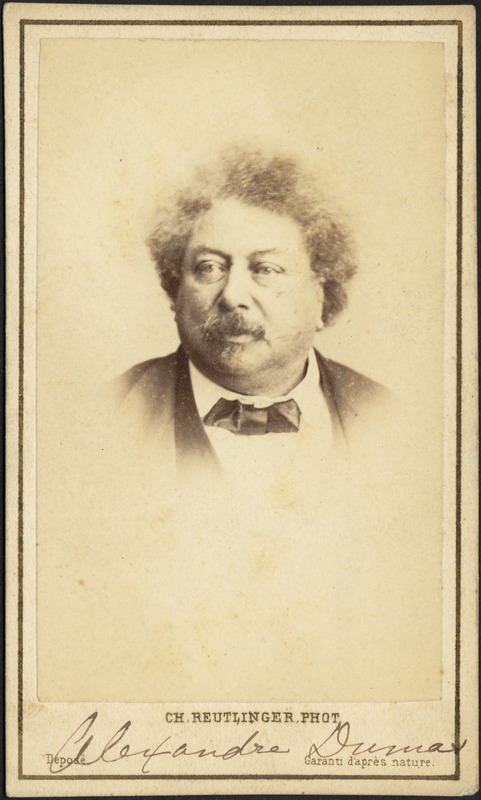
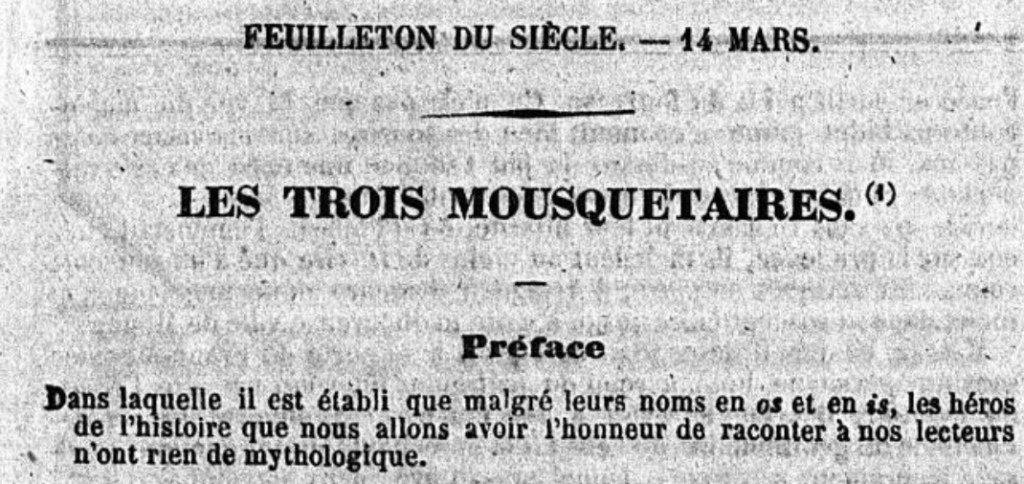

Alexandre Dumas, c. 1859–1870. Carte de Visite Collection, Boston Public Library/ Le Siecle- original publications (1844 & 1847)
Written by Alexandre Dumas in collaboration with Auguste Maquet, whose story and strained collaboration with Dumas deserves its own post, the d’ Artagnan romances remain the main inspiration for all versions of the Musketeer story, including the BBC version. They include:
1. Les Trois Mousquetaires, 1844 (The Three Musketeers)
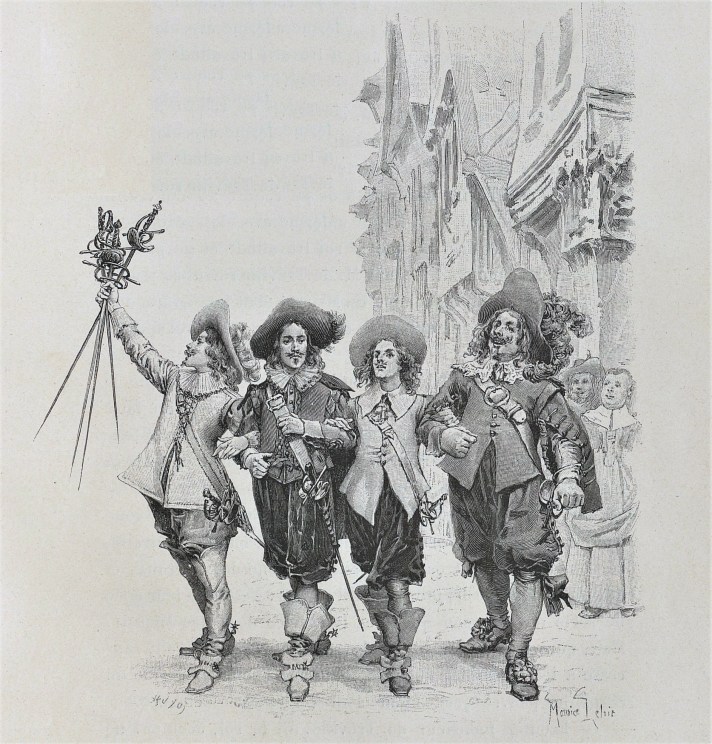
The Three Musketeers by Alexandre Dumas (illustration of the Calmann-Lévy ed., Paris, 1894).
Dumas’ story takes place between 1625-1628. Interestingly the BBC version, on which our story is based, begins in 1630, in effect, moving the entire BBC story ahead of Dumas’ timeline. This means that such well-known storylines as “the Queen’s diamonds”, the siege the fall of La Rochelle (Oct. 1628), and the assassination of the Duke of Buckingham (Nov. 1628) are not included in the BBC series. Nevertheless, the BBC writers scatter clever hints connecting the BBC series to these unused or dropped but well-known plot lines. For example, there are references to the siege of La Rochelle in “A Marriage of Convenience” (Season 2) and in Season 3 there is a “hunt for the Queen’s Diamonds”, although in the BBC series it is a different Queen. We love Dumas, and we believe such creative license with his story works beautifully!
Having disengaged their timeline from Dumas, the writers of the BBC series are free to rewrite the characters, whose arcs, in Dumas, are linked to those evens: characters such as Constance, her husband M. Bonacieux, and Milady de Winter. The “Aramis twist” in the BBC story of Louis XIV also releases writers from many arcs in Dumas. The change furthermore, affects the ages and the aging of characters: Richelieu dies earlier, Louis XIV is born earlier, etc.
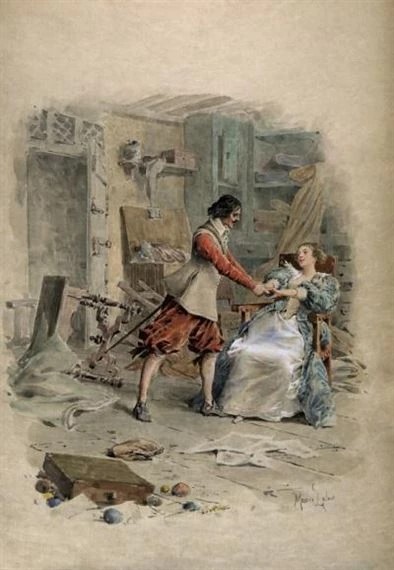
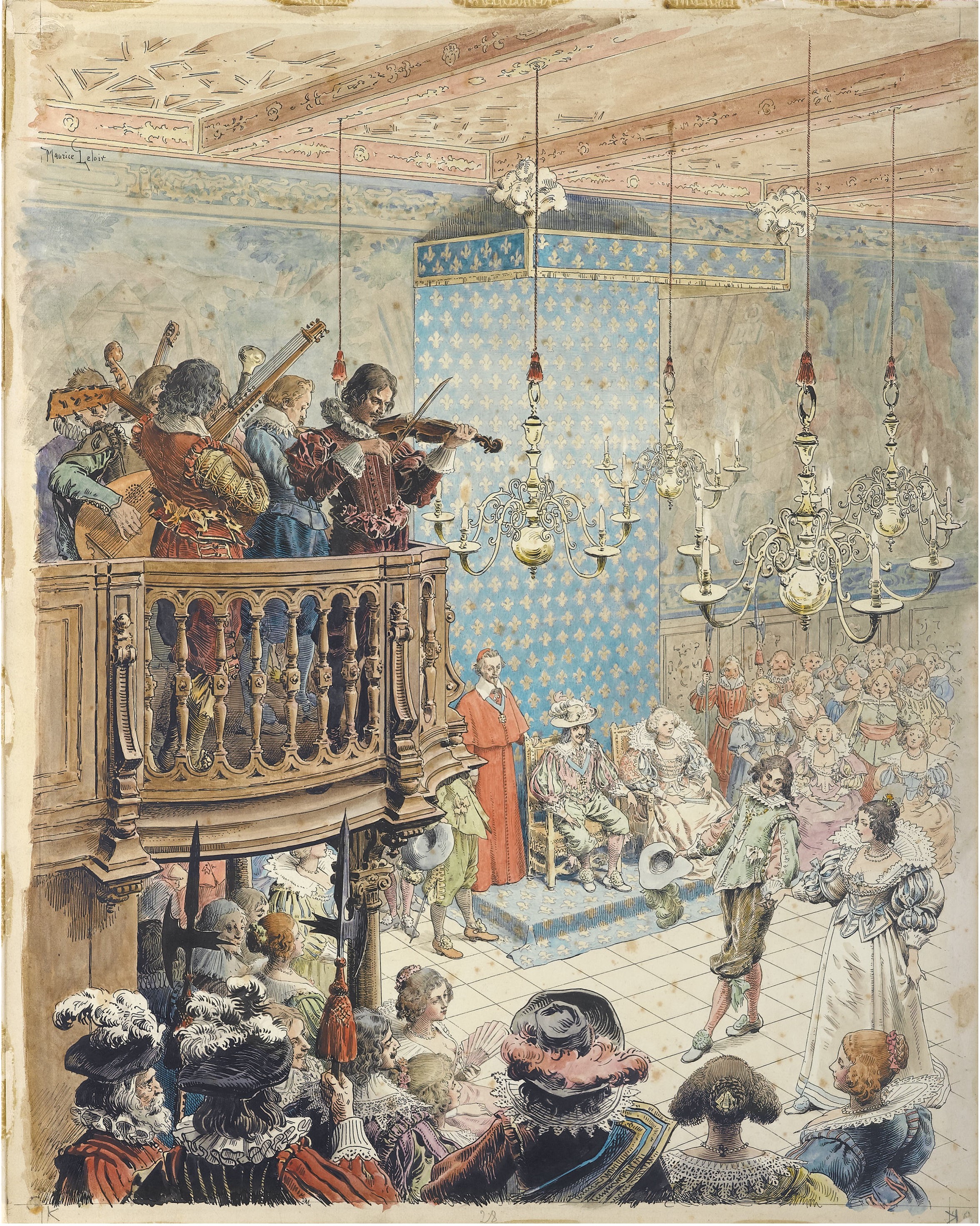
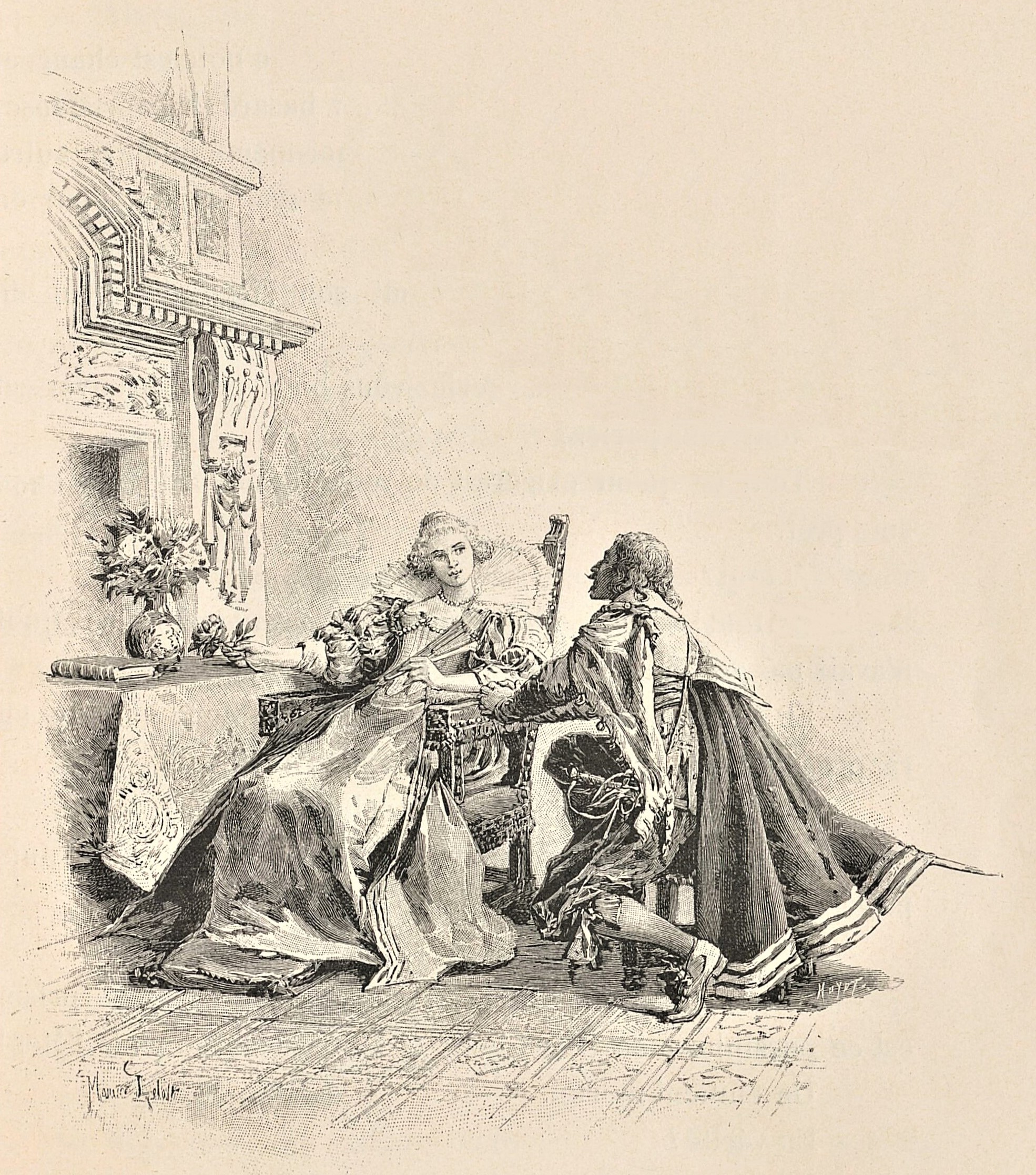
d’ Artagnan meets Constance/ The ball at the palace (the Queen’s diamonds)/ d’ Artagnan visits Milady de Winter. Illustrations by de Maurice Leloir, 1901, Publication.
None of this matters much if our starting point is Dumas because he also used history creatively: many of his historical characters are older than their historical counterparts (for example: Louis XIV and Louise de la Valliere, in Twenty Years After). Just like the BBC writers who creatively use Dumas, Dumas creatively used a much older story: a 17th century romance.
Dumas published his Three Musketeers in the periodical Le Siècle between March and July 1844. He claims that his book is the retelling of a memoir, which he uncovered in the bibliothèque nationale, written by none other than the Comte de la Fère (aka his ‘Athos’!). The fact is, that Dumas’ Three Musketeers is based on a romance, a fictionalized memoir of the life of Charles de Batz de Castlemore d’ Artagnan (later Comte d’ Artagnan), written by Gatien de Courtilz de Sandras (1644-1712), a contemporary of d’ Artagnan. We will write about the Courtliz de Sandras romances in a separate post, because those romances have a fascinating history themselves.
There is, however, an anecdote about Dumas and the Courtliz de Sandras romances, that, we think, perfectly encapsulates Dumas: it turns out that he borrowed a copy of Volume I of Courtliz de Sandras’ ‘Memoirs of M. d’ Artagnan’ from the public library of Marseille and never returned it!
2. Vingt ans après, 1845 (Twenty Years After)
The sequel to the Three Musketeers was serialized by Dumas between January and August 1845. It takes place during the French Civil war known as “The Fronde” but extends the narrative beyond the shores of France, as “the Four” get involved in the English Civil War (Oliver Cromwell against King Charles I).
Following the BBC altered timeline, we found ourselves “Twelve” (not twenty) “Years After”. Our first story “Twelve Years After” opens in 1648, during the Fronde, and we continue the action for a number of years. This last installment, “Between Two Kings”, places us in 1654.
However, given the BBC changes in the timeline as well as Dumas’ creatively “condensing” of history and aging historical characters, we are not able to keep all our characters exactly historical. “Our” Louis XIV and his brother Philippe (the duc d’ Anjou, later: Monsieur) are older than their historical counterparts. “Our” Louis marries Maria Theresa of Spain not in 1660 but in 1654. Other characters are older in our story too, just as they are in Dumas: e.g., Louise de la Valliere, the Comte de Guiche, and the Comte de Wardes (the younger).
We have kept our narrative away from the English Civil War, which occupies a significant part of Dumas’ “Twenty Years After”. Still, echoes of that civil war resonate in our story, at the French court, and one of our storylines takes our readers to Ireland, where people suffered greatly by the violence. Our version of the story takes our readers not to England but all over France and to many other places: Amsterdam and the Netherlands, Ireland, Spain, Morocco, Tunis, Venice, Florence, Constantinople, Çeşme, and Iași, to name a few.
We have connected our story with some of Dumas’ storylines about the Fronde, especially those storylines at the beginning of his “Twenty Years After” and have kept the character “Raoul”. In Dumas, Raoul is Athos’ son with Madame de Chevreuse. We have kept Raoul as Athos’ son, but changed everything else about him, including the identity of his mother.
Raoul is a main character in our story, but besides his name and being Athos’ son, he has little in common with Dumas’ “Raoul”, who was, in part, written as a commentary on “Young Werther” (Die Leiden des jungen Werthers, 1774) an epistolary novel by Goethe that was popular and influential during Dumas’ time. In our contemporary eyes, so distant from Dumas’ cultural milieu, however, his commentary and the kind of youth that Werther (and “Raoul”) represented are no longer relevant. To write “our Raoul” we used historical accounts about young men living in Venice and in the court of Louis XIV. We have invested Raoul with 17th century aristocratic values and ideas about friendship, loyalty to a monarch, love, and ambition. Jonathan Dewald’s books have been invaluable in sketching out Raoul, as well as other original (younger) characters of our story, e.g. Jean Philippe de Rohan-Rochefort. For those interested to explore pertinent topics we suggest: Jonathan Dewald’s, 1995, Aristocratic Experience and the Origins of Modern Culture: France 1570-1715 (1995); and, Jonathan Dewald’s, 2015, Status, Power, and Identity in Early Modern France: The Rohan Family 1550-1715.

Raoul de Bragelonne, in dumas’ twenty years after. Illustration by Eugene damblans
We have kept several characters from Dumas’ “Twenty Years After”. Some, like Lord de Winter (the younger) we rewrote significantly, and others we kept without too many changes even though we changed their arcs. For example the character Friquet.
There are characters in Dumas that we have not included in our story. Our Musketeers have servants but none of those are Dumas’ famous “alternative Four” as the four servants (Grimaud, Mousqueton/Mouston, Bazin, and Planchet) are sometimes known. The reason is that the BBC series did not include these characters and then, of course, they used the name “Grimaud” for a different character altogether (oh the confusion!) Still-and this is our “bow” to Dumas-we have tried to “reference” some of these famous servants. “Our Aramis” has a loyal friend who is also priest and is named Bazin in whose house Aramis and Queen Anne meet secretly. Then, there is that Frondeur baker named “Planchet” in our “Twelve Years After” in whose bakery/ secret meeting place for the Fronde, Athos reunites with Madame de Chevreuse! In Dumas’ “Twenty Years After”, Planchet is a Frondeur and indeed, owns a bakery. The character “Olivain” is also derived from Dumas. Olivain is Raoul’s servant. However, we have expanded Olivain’s arc significantly, just as we have changed Raoul’s.
Most prominent among the Dumas characters that we are not using in our story, is George Francis Mordaunt, the son of Milady and the main adversary of “the Four” in “Twenty Years After”. Because the BBC version of Milady is different, her arc is inevitably different too. Mordaunt is a magnificent and nuanced villain, but his arc makes sense only within the Dumas universe.
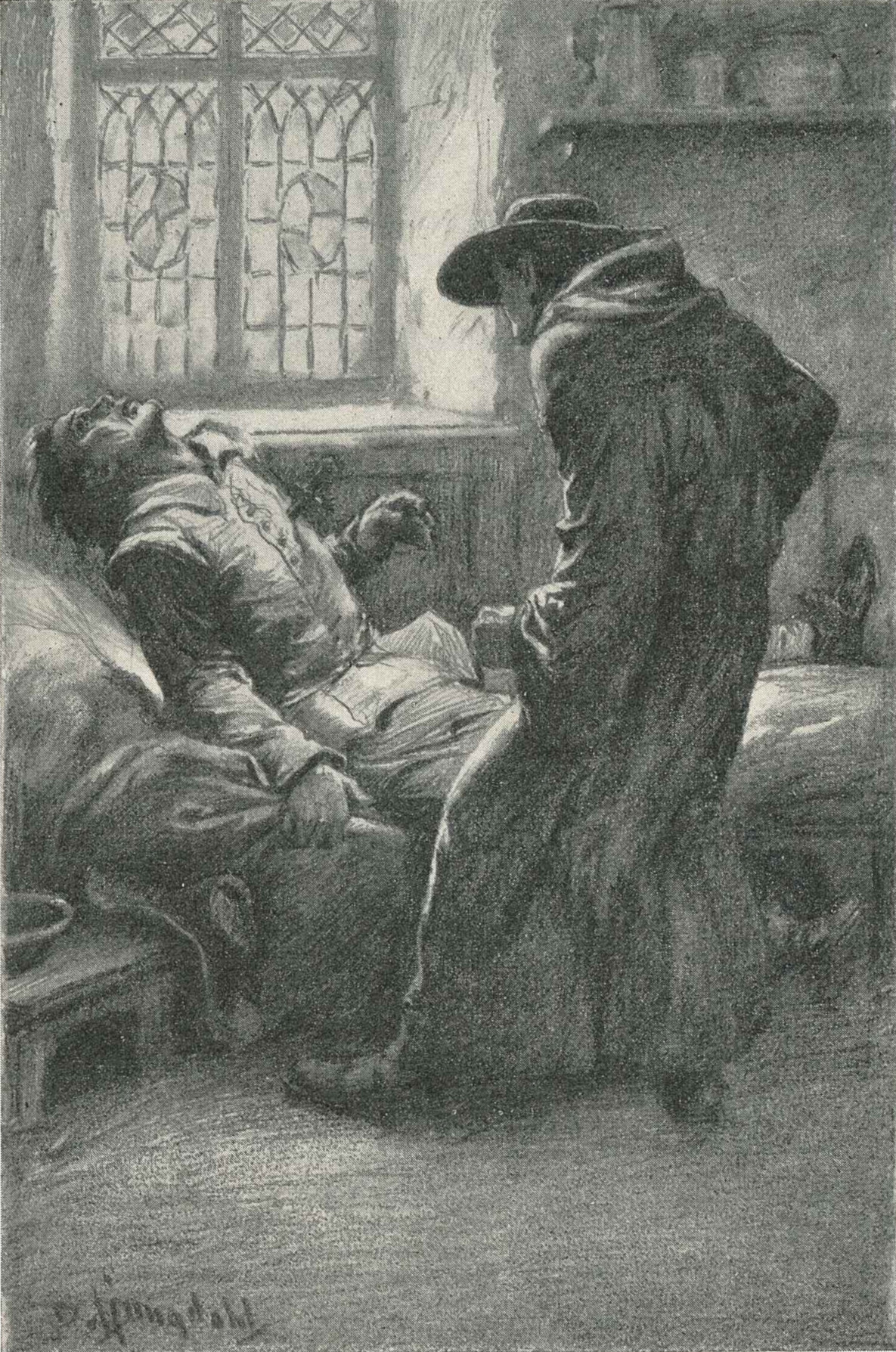
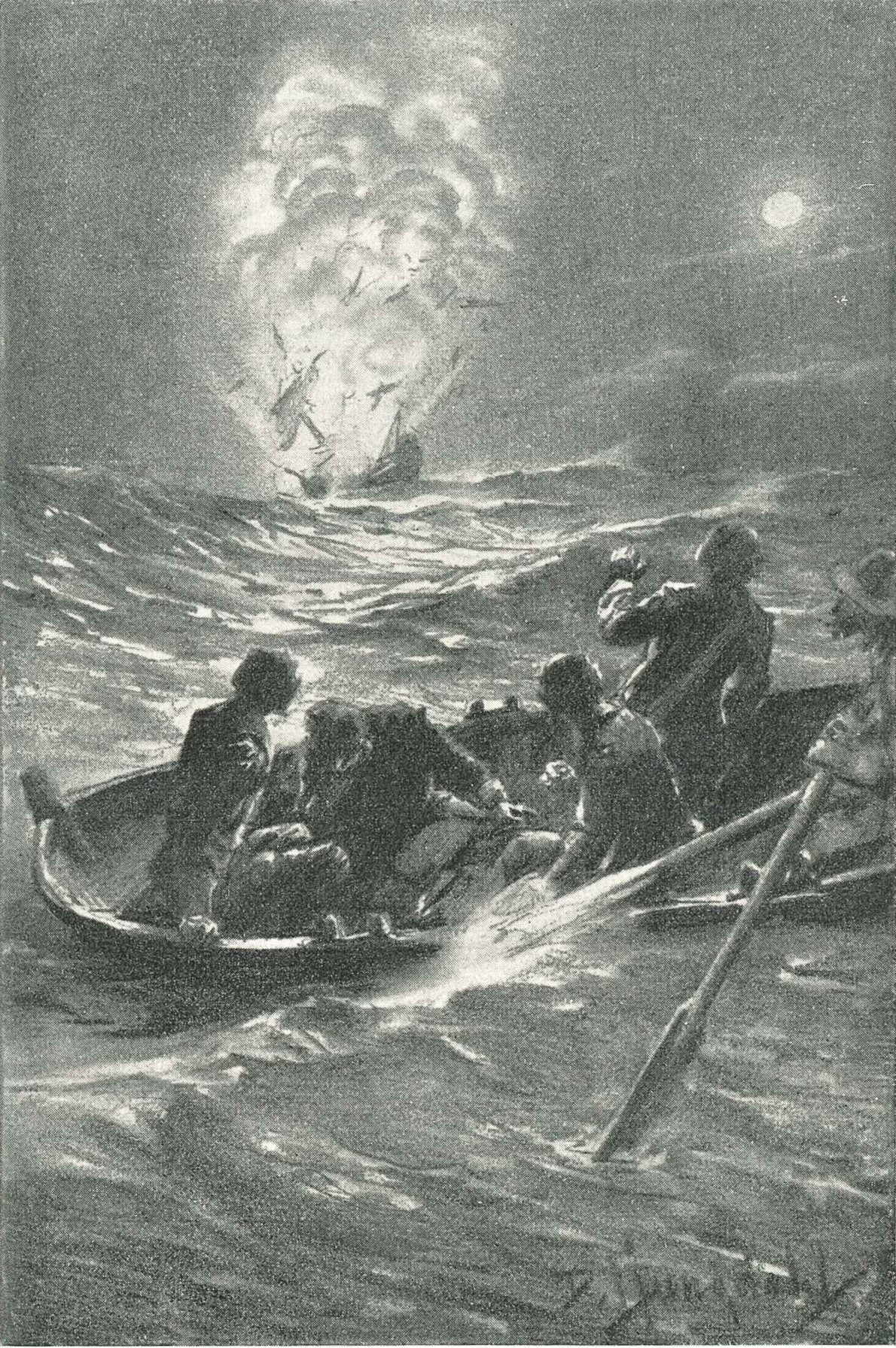
mordaunt killing the executioner of lille/the explosion of the felucca l’eclair and the deth of mordaunt. illustrations by David Ljungdahl, 1925.
Historical characters that Dumas uses, for example Louis XIV, Cardinal Mazarin, Prince Condé, the Comte de Wardes (father and son), the duc de Beaufort, the duchess de Chevreuse, or M. de Guiche, and other members of court and Parisian society (e.g. Scarron, Madame de Rambouillet, etc.) we use as well. We write them based on available biographies but also based on primary sources, when available, such as correspondence, memoirs, geneaologies, etc., but ultimately they are fictionalized.
We have added historical characters as main characters in our story that are not included in Dumas. One of them, Gaston d’ Orléans, the younger brother of Louis XIII and uncle of Louis XIV, appears in Season 3 of the BBC series. In the series, however, he is assassinated by Milady de Winter who is under orders from Queen Anne. The storyline did not make too much sense to us, and not only because the historical Gaston was never assassinated. It is not possible to write a story that takes place during the Fronde- even the most fictionalized version of it-without him, or without his eldest daughter, Marie Louise d’Orléans, Duchess of Montpensier or La Grande Mademoiselle, who is featured in our story, as she must.
Also featured prominently in our story and aged significantly is Cardinal Richelieu’s niece, Marie-Madeleine de Vignerot-de Combalet, the duchess d’ Aiguillon. The duchess is not included in any of Dumas’ Musketeer novels and is never mentioned in the BBC series. However, the duchess d’ Aiguillon was a woman who wielded significant power, especially through her many connections to the church, all the way to the Vatican and the Pope. You can read about her in our “Histories & People”.
3. Le Vicomte de Bragelonne ou Dix ans plus tard, (The Vicomte de Bragelonne or Ten Years Later)
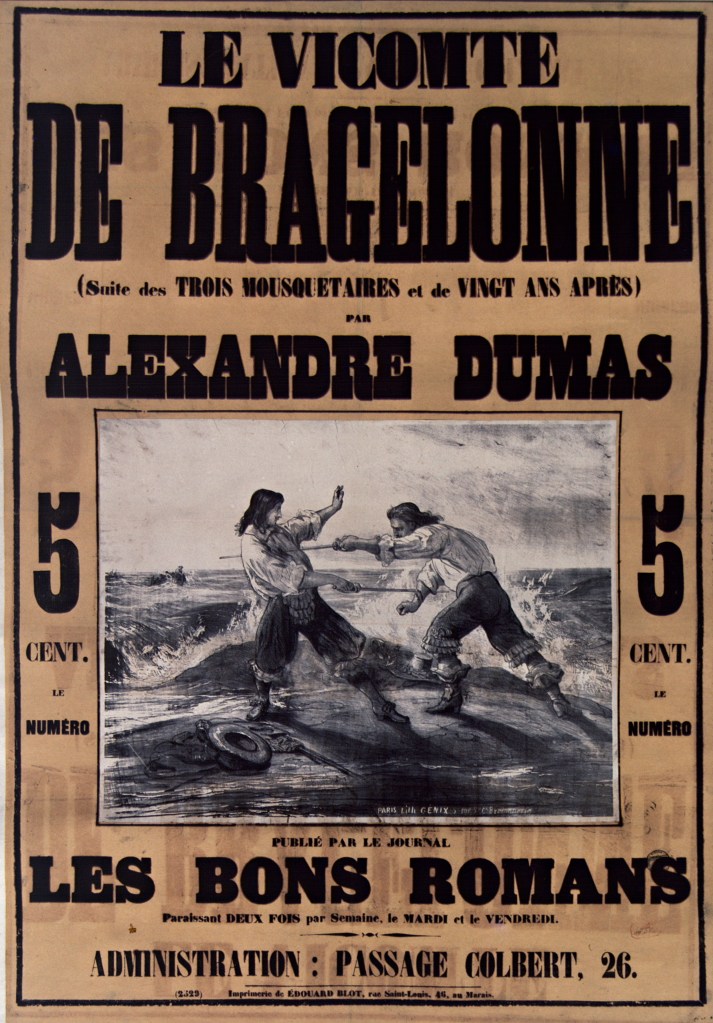
poster from the periodical Les Bons romans.Pencil lithograph, printed at the printer Génix. text from the Édouard Blot printing house, 1861 (cf. Anne-Marie Sauvage, “Posters for the novels of Alexandre Dumas”, Revue de la Bibliothèque nationale de France, No. 11, p. 71).
The Vicomte de Bragelonne first appeared in serial form between 1847 and 1850. This sizable, 268 chapter story, is divided up differently in English translations: three, four, or even six books.
In three volumed English editions the books are:
The Vicomte de Bragelonne (or Between Two Kings)
Louise de la Vallière
The Man in the Iron Mask.
In four-volume editions Ten Years Later becomes the second volume.
Dumas’ story is set in the 1660s and covers the early reign of Louis XIV.
Chapters 1-98 include the Restoration of Charles II, the death of Mazarin, the arrival of Henrietta of England to France as the wife of Monsieur (Philippe duc d’ Orléans, the younger brother of Louis XIV) and the romantic rivalry for Henrietta’s heart among the duke of Buckingham (son of the duke of Buckingham in the Three Musketeers), the Comte de Guiche (Raoul’s friend), and the Comte de Wardes (son of the Comte de Wardes in the Three Musketeers). This part of the novel, furthermore, introduces the rivalry between Jean-Baptiste Colbert, Louis’ finance minister and Nicolas Fouquet, his Superintendent of finances.
Chapters 99-180 focus on romantic liaisons in Louis’ court, especially as Raoul’s childhood sweetheart Louise de la Valliere finds herself in love with the King while she is chosen by Henrietta and the King as a decoy to cover their escapades. The love affair that ensues between Louise and the King affects many at court, especially Raoul who finds himself exiled in England, and Athos who finds himself almost arrested.
Chapters 181-269 (The Man in the Iron Mask) turn to a conspiracy between Aramis and the duchess de Chevreuse, his former mistress, to replace Louis XIV with his twin brother Philippe (this is not the duc d’ Orleans) who had been kept imprisoned by their father since childhood. The story ends with the death of Raoul, who is killed (or allows himself to be killed) in N. Africa where he fights as a mercenary, despairing the loss of Louise la Valliere, while in France, Louise is supplanted in Louis’ heart by Madame de Montespan. Athos, Porthos, and d’ Artagnan die in the end. Aramis is the only one of “the Four” who remains alive. After the conspiracy to replace Louis fails, Aramis (who is a general in the Jesuit order) flees to Spain. There he becomes the duc d’ Almeida and later returns to France redeemed, as the Spanish ambassador. D’ Artagnan is killed at Maastricht the very moment he receives the letter that makes him a Marshal of France. His final words are: “Athos, Porthos, au revoir! Aramis, adieu forever!”
So this is how we came up with the title “Between Two Kings” for the fourth part of our story! It is a title Dumas chose too, although our “Two Kings” and Dumas’ two kings are not the same.

 Twelve Years After
One thought on “The d’ Artagnan Romances & “Between Two Kings””