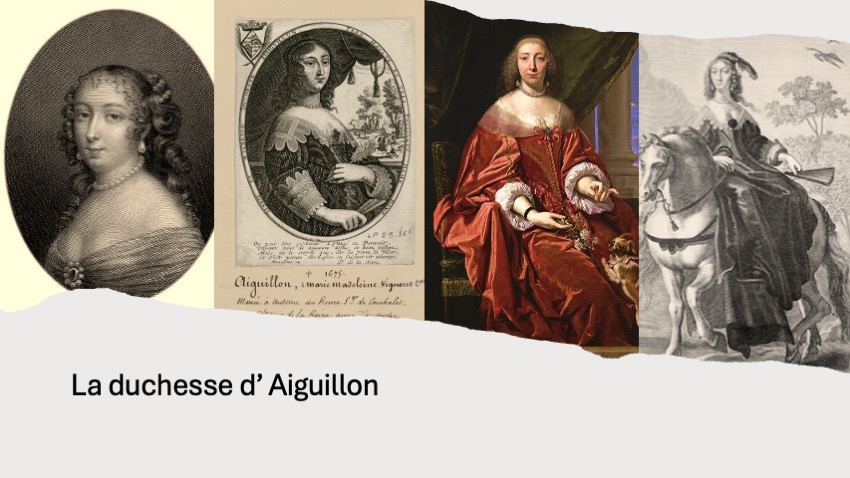
Marie de Vignerot was the daughter of René de Vignerot, Seigneur de Pontcourlay, and Françoise de Plessis, the elder sister to Armand-Jean du Plessis. Marie’s father was in the court of Henri the IV as Gentleman of the Chamber and Captain of the Guard. Her mother Francois was a devout woman and instilled in her children a sense of deep piety, prayer, charity, and family loyalty. This devotion to religious matters, the need for the practice of charity, as well as the idea of family loyalty, influenced Marie for the rest of her life.
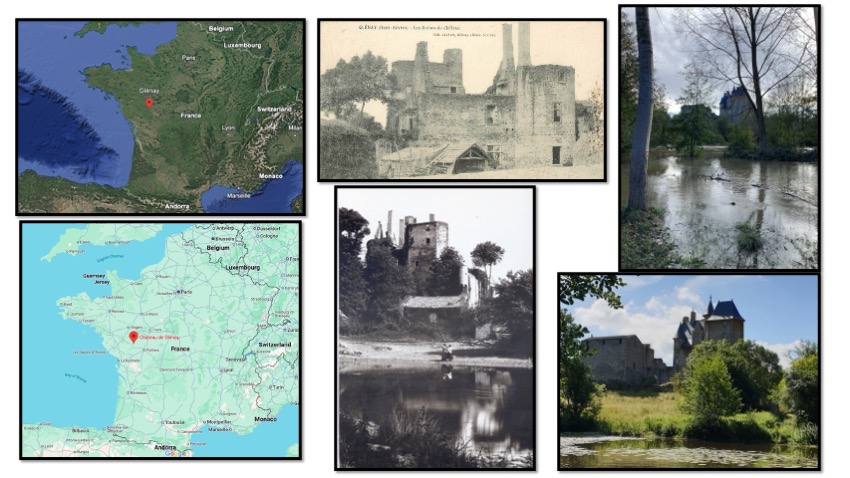
chateau de glenay, then and now
Marie and her younger brother Francois grew up in the country, but this idyllic life was shattered with the untimely death of their mother at the age of 37. Since their father was often away with military duties, Marie and Francois were taken from Glenay to the Chateau de Richelieu, the Plessis de Richelieu family home under the care of her maternal grandmother Mme de Richelieu (Suzanne de la Porte). Marie was 11 years old.
Marie’s maternal grandmother was a formidable woman who educated the young Marie in a manner exceptional for the time. Her grandmother continued to reinforce in young Marie the sense of obedience and family but also noticed Marie’s gift for languages and music. Marie learned to speak and sing in Italian and Spanish as well as French and the ecclesiastical Latin of the time. Her uncle Armand arranged for her to be tutored in literature by the same man who tutored him. Marie had a lifelong passion for reading, poetry, drama and became an important patron to authors and artists throughout her life. She also supported the work of women working in unconventional roles of mathematics and natural sciences.
As an aristocratic woman of her time, Marie was intended to marry according to her family’s wishes and help the men in her family rise to prominence and produce heirs. When Marie turned 18, her uncle brought his favorite niece, a young girl raised in the country to Paris to marry Antoine de Beauvoir du Roure, marquis de Combalet, a nobleman military officer. It was a political alliance arranged by her uncle to serve his ambitions. Antoine was away for most of their two years of marriage. Antoine was killed and Marie de Combalet, as she was then known, was a widow. She had no wish to marry a second time, nor even remain “in the world”. Marie joined the Carmelite Order in Paris, where she spent more than two years with the Carmelites, finished her novitiate, and was ready to take vows, until her uncle intervened. Uncle Armand had another purpose for his favorite niece. He refused her request to take vows, took her from the convent and had her appointed as a Lady-in-Waiting to Queen Marie de Medici, mother and Regent of Louis XIII.
So began Marie’s life as an agent in service to her uncle. From this beginning, Marie de Combalet rose to play an indispensable role in the rise to power of her uncle Armand-Jean du Plessis. At the time of his death, Cardinal Richelieu, contrary to customs of the time, ignored his male heirs and left his entire fortune to Marie. Wealthy and educated, Marie de Combalet as the unconventional and independent Duchesse d’ Aiguillon, would be influential in shaping the political, religious and cultural life of her country. Her reach would extend to shaping events in Europe, Africa, Asia and the New World.
Marie faced a great deal of malicious gossip when Cardinal Richelieu ordered her to leave the convent and come to live with him to manage his household and created her Duchess d’Aiguillon in her own right. She helped nieces and nephews, children of friends with obtaining important positions or arranging advantageous marriages. Her role in his household and her influence with Richelieu made her a target for his enemies. Rumors and malicious stories were whispered that many of these children were in fact Marie’s children, fathered by Richelieu.
We have used this part of Marie’s story in the creation of our own story. We have also used certain characteristics of Marie, such as Lucien’s affinity for languages, singing and the keen intelligence of both Lucien and Athos.

 Twelve Years After
One thought on “Marie Madeleine de Vignerot”