Rosie and Renee Practice the Art of Papercutting
The oldest examples of paper cuts come from 8th century China, although it is possible that the Chinese have been creating designs and cutting paper since paper was invented there in the 2nd century but the examples lost, due to paper’s delicate nature. The art was practiced by wealthy families who could afford the expensive paper; often brides prepared them as part of their dowry. As paper became more affordable, jianzhi grew into a folk art, mastered by the general population. Many cultures have developed art based around paper cutting, each with its own unique look, serving some religious, ritual or mystic purpose. Nature was a common theme designs of suns, birds, flowers, or animals.
In the 16th century, “Scissor Cutting” was a traditional folk art in Switzerland and Germany. In this tradition, the paper is cut while folded, creating symmetry, which was an important design element. Germanic design tends to be more surreal, while Swiss cuttings are characterized by intricate borders and themes depicting landscapes and local traditions. The Pennsylvania Germans brought this art form to America in the 1700s and used the cut work to decorate birth, baptismal, and marriage certificates.


title page & frontispiece: hannah whoolley (1670) the queen-like closet or rich cabinet
As young girls in the 17th century, Rosie and Renee would be taught needlework skills, to paint with watercolors and papercutting. The cutting out of prints in the 17th century was an art form usually undertaken by girls or women and a skill that they could use to showcase their taste and dexterity. In the 1980’s evidence of papercutting was found at Sutton House in England. Originally built for one of Henry VIII’s statesmen, Sutton House has been used for a variety of purposes over the years, becoming a school in the 17th century. During this time, it’s thought that paper shapes cut out by schoolgirls slipped through gaps in the floorboards, remaining undiscovered for centuries.
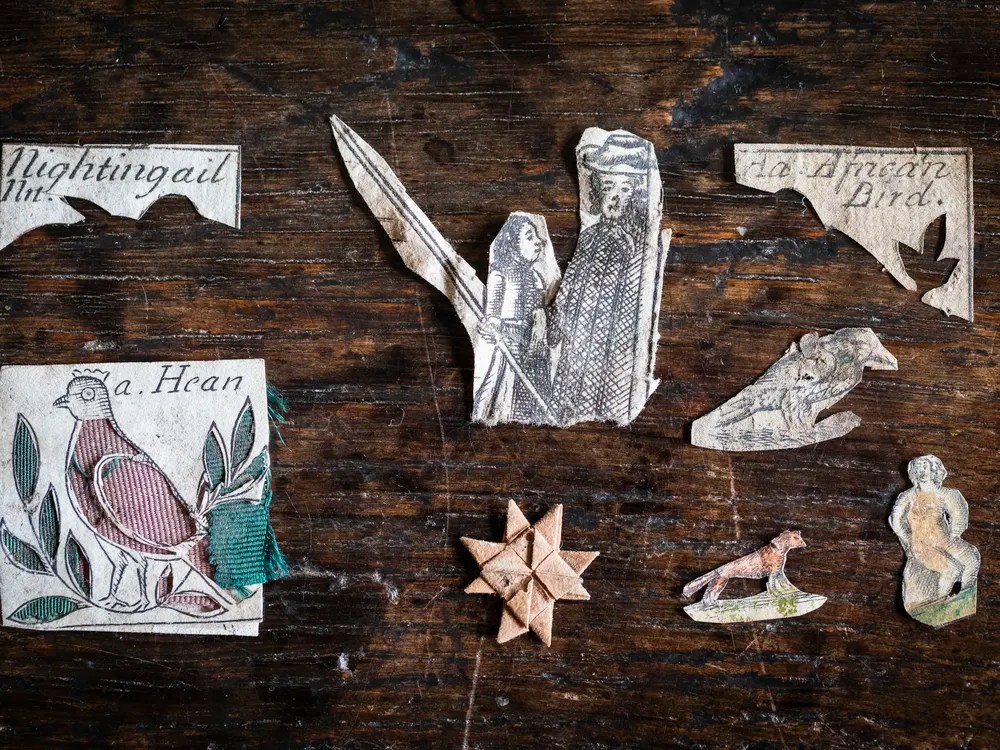
The 17th-century paper cut-outs found at Sutton House, U.K. Photo courtesy of National Trust Images – James Dobson
Paper cutting for decoration was a subject in books on household management in the 17th century, such as the 1668 A Guide to Ladies and 1674 A Supplement to the Queen-Like Closet , written by Hannah Woolley, where she described the skills which “I shall be willing to impart to them who are desirous to learn”. It is believed that Hannah Woolley may have taught at Sutton House, and so it is possible the paper cut-outs found under the floorboards were carried out by pre-teen and teenage girls under her tutelage almost 400 years ago.
Sources:
For Sutton House
National Trust
Smithsonian Magazine

 Twelve Years After