“Madame is in her salon…” the footman at the door barely has time to speak. M. de Rohan is already running up the stairs two at a time, hat in hand. He flings open the door of Marie Cessette’s private salon, where she sits at her writing desk finishing her daily correspondence. She springs to her feet.
“He is gone!” M. de Rohan exclaims before Marie Cessette manages to utter a word. “Henri Bernard is gone!”
She gasps. “How?…When?”
He throws his hands in the air, despondent. “Sometime in the night… I don’t know… No one knows.”
“What does that mean?”
“Marie Cessette, it is as if he never existed.”
“I still don’t understand.”
“There is no Henri Bernard in the Bastille and never was. The man does not exist.”
“Good God what have they done to him? Could he be…”
“Anything is possible, but I don’t think so.” She urges him to continue with her eyes. “Every prisoner is registered when they enter the prison. Yes, even in the Bastille. More or less…”
“More or less?”
“Bear with me, I beg you” he sounds somewhat vexed. “If there is an order for arrest, that order is registered when a prisoner enters the Bastille. If there is an order for release the same thing should happen and the release should be registered.”
“But there was never an order for Henri’s arrest was there?” He shakes his head. “So he was never there in the first place…and now they’ve killed him!” she clasps her hands in despair.
“No, wait! This is what I am trying to explain. There is a second ledger. An unofficial one. It belongs to the Head Turnkey. He is known as Maître Clous although his real name is… it doesn’t matter what his real name is, what matters is that he keeps his own record of every prisoner, including those arrested without an official order, and those meant to be forgotten. Because he has to know those he must feed, and those he must remove from the oubliettes and the dungeons when the interrogators and the rats are done with them.” She shudders and he reaches for her hand. “I apologize,” he says softly. “I forget you are not Layla.”
“I am fine!” she declares peevishly. “You were saying?”
“I sent M. Morant to the Bastille. After what Raoul said, I thought we should remain vigilant.”
She frowns. “M. Morant!”
“Don’t worry. Layla and I have known him since he was an orphan at Bicêtre. One of the brave children who barely escaped from the clutches of Benito de Soto and his thugs.” She shudders again. Some of those men almost killed her in the service of the Comte de Wardes. “M. Morant is one of my most trusted men, discreet and loyal to the core,” M. de Rohan continues. “He is also cunning- his hard childhood has taught him that he must be smart to survive–and thorough, and knows his way around the Bastille. So, he never bothered with the official record of prisoners. He went directly to Maître Clous.”
“Who–let me guess–has never heard of Henri Bernard,” Marie Cessette says and M. Rohan nods. “Good God, they have killed him!”
“I don’t think so. Here is why: As I explained, M. Morant is as meticulous as he is resourceful. Maître Clous has a very ambitious son named Hubert–currently working as the turnkey’s assistant–who thinks his father is an obstinate old man who has outlived his position and hopes to succeed him, but understands that he needs more than experience and his father’s name to do it. Hubert needs the good word of people of some influence and has come to perceive M. Morant as one such person. So, M. Morant did not bother with old Maître Clous, once he denied the existence of a prisoner named Henri Bernard, and went to his son. Hubert, eager as he is to ensure M. Morant’s good word, remembered a man named Henri Bernard clearly. M. Bernard’s red hair is after all memorable. Hubert remembered other details. That the man was kept in one of the more decent cells. That he was visited by Captain Marchal daily and most recently by Captain Marchal with a man from court, whom some of the guards recognized as the Spymaster of France.”
“Raoul!”
“Exactly. So there is no doubt at all, that the man Hubert describes is indeed Henri Bernard. Then, he recounted an even more interesting story. It turns out that this prisoner caused a great deal of ruckus in the middle of the night, demanding to see Captain Marchal then and there. Maître Clous was alerted, and sent the only man he trusted…”
“His son. Hubert.”
He nods. “When Captain Marchal left the prisoner’s cell he was in a state.”
“In a state?”
“In a state. The Captain returned later that morning–that would be yesterday morning–with some peculiar orders. Hubert was sent out immediately to procure a fine meal and good wine from a nearby tavern, and carry hot water and clean clothes to a certain cell, for a certain prisoner.” He notices Marie Cessette’s expression: “No, it was not his last meal. That’s only how it’s done in books.”
She clicks her tongue, annoyed. “I am not cloistered, you know. I am a General’s daughter. I grew up among officers and Musketeers.”
“I apologize.”
“Henri spoke then.”
“Just as Raoul expected. They can no longer touch Henri Bernard, it is a crime and a sin, but they can make him disappear. Which brings me to the conclusion of this peculiar story. At around midnight, Hubert was stirred from his bed, his father banging on his door. He found himself in the midst of great commotion. The inner courtyard was teaming with Musketeers bringing in prisoners from the Conciergerie. He was told that after the events leading to the escape of the duc d’ Herblay, the prison is being inspected, and parts of it are being rebuilt, so prisoners had to be moved to the Bastille.”
“In the middle of the night?”
He raises a meaningful brow. “Even Maître Clous thought it peculiar and unlike his son, he never questions anything.”
“And?”
M. de Rohan shrugs. “And Henri Bernard disappeared after that. He does not exist. Hubert swears that the pages where he saw the name registered in his father’s ledger are torn–missing”
“How subtle.”
“Well, it is Fabien after all.” He runs a hand through his hair. “We have nothing.”
Marie Cessette paces the salon for a few moments, then turns, hands on her hips, determined: “We do not surrender without a fight. Is this not another Musketeer motto M. de Rohan?”
“Yes, but…”
“Well we have to fight with what we’ve got.” She measures him from head to toe and he returns a perplexed look. “You must change.”
“Pardon?”
“In two hours, I am expected at the house of the Duchess de Chevreuse. It is M. Carret’s exhibition of winter fashions, which always takes place at Madame de Rambouillet’s. I take it as a sign of the times that the Duchess de Chevreuse has intercepted that tradition. In two hours, you and I must be there.”
He gasps. “Me?”
“Layla declined the invitation claiming she is indisposed. But then, Layla is known to be discriminating in her choice of engagements and unlike most people she is expected to be discriminating- even eccentric. And no one really expects Layla to appear at Chevreuse’s house after what happened with the Comte de Wardes, although I am sure many would be thrilled to witness such an event.”
“Well there you have it. Layla declined and I was not invited.”
A small, sly smile crosses her lips. “A moot point. You will be escorting me.”
“This is absurd! Do you expect me to show up at Chevreuse’s house… Chevreuse who plotted with de Wardes… who almost had Layla killed…”
“Chevreuse is your cousin.”
“That is not my doing. And shouldn’t Raoul be escorting you?”
“He is never available for this sort of thing. Besides…” M. de Rohan is returning a terrified gaze. “Besides–and judging from your expression, I can see that you anticipate what I am about to say: husbands rarely escort their wives to this sort of thing and wives rarely care to show up with their husbands.”
He gasps. “You expect me to escort you to Chevreuse’s house to start gossip… give food to rumors?”
“Gossip and rumors will be there no matter what we do, M. de Rohan. I suggest we use them in our arsenal. It is not unlike Raoul’s costume. A sleight of hand. Make them gossip about us while we ferret out the information we need. There is a strange sort of intimacy among those who share a sense of being complicit. So we will be complicit. Everyone who is anyone will be at Chevreuse’s. M. Marchal is Chevreuse’s lover and is supposed to be betrothed to her companion, that … Sylvine Mercier. I doubt M. Marchal will be there, although he is invited, but others will certainly be there with their lovers, every one of them a notorious gossip. And M. Loret will be there too of course, reporting on the new fashions and more for La Gazette. We will offer them gossip, M. de Rohan, you and I, and in turn we will unearth the information we need. It is a different sort of battle and we must fight it.”
He frowns. “I prefer blades and pistols.”
“It will have to be cravats, brocades, and witty banter, M. de Rohan, or poor Henri is lost forever.” She clicks her tongue impatiently. “We do not have all day. You must either choose one of Raoul’s outfits or we must send to your house…”
“I prefer my own outfits, thank you!”
“I thought so.” She smiles a satisfied smile as she hurries to open the door. “M. Idoine!” she calls the stewart who appears at the threshold. “Please send a footman immediately to the house of the Baron Rohan-Rochefort at the Marais to bring…”
“Tell my valet, I must have the new outfit with everything else necessary. He knows exactly what I mean.”
The stewart bows deeply. “His Grace needs to be ready in two hours, M. Idoine so your man must hurry. Please have one of the guest rooms ready for His Grace, and order a bath for him.” The stewart bows a second time and hurries to give the right orders to footmen and servants.
“A bath?” M. de Rohan is frowning again.
“We must be immaculate, M. de Rohan. Let them gossip about that too. The more they gossip, the better it is for our purpose. Besides, you have been out riding all morning.”
⚜️⚜️⚜️⚜️
Marie Cessette slides the carriage curtain only just so, and clicks her tongue impatiently as she peeks out on the road. “We are not moving!” She lets the curtain slide and sits back crossing her arms over her chest, frowning.
Across from her M. de Rohan raises an amused brow. “Are we not supposed to be fashionably late?”
“Do not tease me, Monsieur. You know very well that there is fashionably late, and then there is late.”
He feigns a resigned sigh. “We must provide food for gossip, is it not so? On that note: I suggest you start calling me Jean. After all, I call you Marie Cessette.”
She nods. “You also know very well that there is gossip and then there is gossip. We need the first kind.” She draws in a deep, exasperated breath and levels a mischievous gaze. “For a man who purports to care so little about the trivialities of fashion, you devoted quite some time to it this morning, or we would not be late.”
“We should be immaculate, or so you urged me.” He sits back and crosses his arms over his chest. It is his turn to sound peeved. “Is this criticism?”
She shrugs, a faint, teasing smile at the corner of her lips. “A mere observation. Ah! We are moving!” she adds, as the carriage makes a small jolt and begins to move first slowly, then at a good pace.
M. de Rohan bites the corner or his lip, his frowning eyes scanning Marie Cessette’s face for a while. “Has Layla complained?”
“Layla!” Marie Cessette sounds amused. “What reasonable woman would ever complain about such a rare quality in a husband? At first she was surprised– she knew you only as her lieutenant, and the barracks, the Garrison, and the battlefield are not where a man can exhibit his understated yet exquisite taste. Then the duc d’ Anjou first, and King Louis soon after, became obsessed with the style of your cravats…”
He gasps. “My cravats!” He narrows his eyes contemplating the implications of her words, and then, as if he finally makes a connection, he adds vexedly: “Did you bring up my cravats to Layla?”
Marie Cessette giggles, playfully. “You underestimate my friend, dear Jean!” The carriage has crossed under a magnificent porte-cochère into the cour d’ honneur of the Hôtel de Chevreuse, and jolts to a stop. “Finally, we have arrived!” She motions to move toward the carriage door, but stops: “Your exquisite taste and incomparable charm, dear Jean, are our two most valuable weapons in this battle. Remember we must make the gentlemen envious, the ladies swoon, and everyone gossip!”
The footmen have opened the carriage door and lowered the steps. “I do not make the ladies swoon!” M. de Rohan mutters under his breath as he follows her out of the carriage.
Marie Cessette slants him an impish and disbelieving gaze. “Let’s just give them plenty to gossip about then,” she whispers, offering him her arm.
They enter the crowded hall of Madame de Chevreuse’s elegant mansion amidst a flurry of astonished gasps, fluttering fans, and whispering voices. Marie Cessette presses M. de Rohan’s hand and he reciprocates. The battle has begun.
⚜️⚜️⚜️⚜️
“Cousin!” Madame de Chevreuse clasps her hands with excitement as she welcomes them. “I never imagined…” She turns to Marie Cessette, pretending to be at a loss for words. “How did you accomplish such an impossible feat, dearest Marquise? My cousin, the Baron, has never before graced our gatherings.”
“The Baron is always busy, in the service of our Queen,” Marie Cessette observes sternly.
“Of course, yes…” Chevreuse is taken aback it seems, but it is only momentary. She leans closer and says in a conspiratorial tone. “But today, your services are not needed, we hear, cousin. Her Majesty has been feeling unwell and will remain in seclusion with her ladies, while the physician has been to see her several times–they say that we may see a dauphin before the end of next year!” M. de Rohan assumes an inscrutable expression. “Dear cousin, you are the very model of discretion!” Chevreuse observes playfully. “Perhaps the Baroness, who declined her invitation due to an unexpected indisposition, will soon surprise us with equally happy news?” M. de Rohan frowns, despite himself, at the mention of Layla. He feels Marie Cessette pressing his hand: faux pas, she is signaling.
“You cannot monopolize them, dear Duchess!” M. de Guiche interrupts them, and, for once, M. de Rohan is grateful for Raoul’s rather intrusive friend. Marie Cessette on the other hand appears to be unaffected. She is much better equipped for this sort of battle, M. de Rohan realizes. Madame de Chevreuse clicks her tongue seemingly annoyed by M. de Guiche, but at that very moment the King’s brother, the duc d’ Anjou, enters with his favorite, the Chevalier de Lorraine, so she makes a curtsy and hurries to welcome her new guests.
“Le Petit Monsieur is here. Your timing is as impeccable as your appearance is breathtaking,” M. de Guiche admires. He slides between M. de Rohan and Marie Cessette. “Forgive my familiarity, dear Baron,” he says, “but all eyes are on the two of you and as a good friend of the Marquise and her husband I find it is my duty to misdirect.”
M. de Rohan scans the crowded hall. “I’d say it is too late, M. le Comte.”
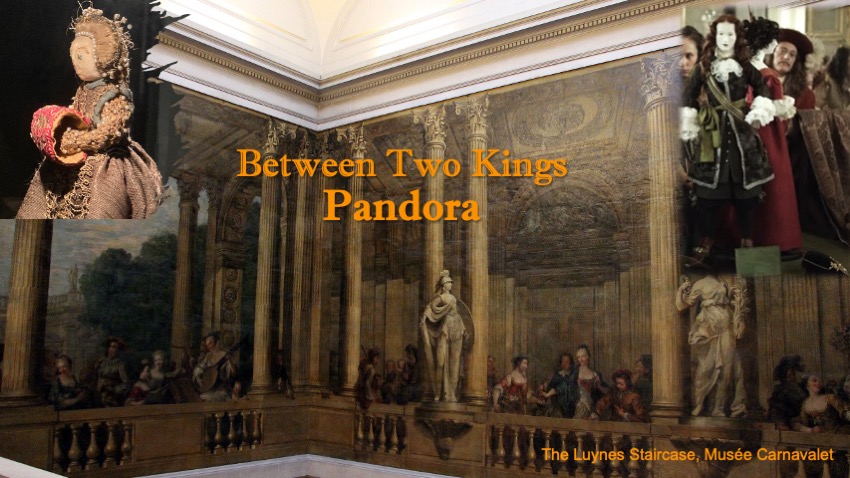
M. de Guiche raises a brow indicating he agrees, and he guides them further inside. Although it is a gray winter day, the gold-plated candelabras and the opulent crystal chandeliers create a dazzling display of lights that are reflected on the marble floors and in the large mirrors which have been lined along one of the walls, across the windows. The mirrors are meant to allow guests to admire themselves as they walk around the hall, sampling an array of exquisite fabrics, lace, feathers, furs, hair ornaments, hats, gloves, jewels, and shoes that are exhibited on large tables in the middle of the hall. Everything is arranged in the most alluring combinations of color and texture, around a series of beautiful porcelain dolls, those the French call poupées de mode and the English call Pandoras. Each doll is fully dressed in a complete, miniature outfit for a lady or gentleman using a specific combination of colors, fabrics, and accessories, every detail carefully crafted as if this is the real costume. The other side of the hall is furnished with tables decorated with candied fruit and flowers, and sculptures of animals made of sugar. There, guests can enjoy the finest assortment of dishes, savory and sweet. Wine and champagne flow freely, and, somewhere hidden from view, a small group of musicians adds soft, discreet melodies, to the fragrant air.
“You two are already the talk of Paris, and Loret is here,” M. de Guiche cautions, pointing with his eyes to one corner of the room, where M. Loret seems to be in deep conversation with M. Fouquet. “Nicolas has taken it upon himself to become the sole patron of La Gazette,” M. de Guiche explains, “which means that the talk of Paris is whatever you would like it to be.” M. de Rohan frowns, and this time he does not care if it is noticed. Implicit in M. de Guiche’s words is an exchange that M. de Rohan is not willing to make.
“What is the talk of Paris, then?” Marie Cessette interjects, and M. de Rohan marvels at her mastery in the art of evasion. In this battle, she leads and he must follow.
“There are those who credit the Baron for redressing his wife’s expected snub against the duchess. Others see his presence here today as a way of healing one of the many family rifts,” he slants his eyes toward Madame de Montbazon who is inspecting an ermine muff at one of the tables. She is the second wife of Madame de Chevreuse’s father who wants nothing to do with his daughter, and she is also a lover of the duc de Beaufort who is escorting her today. “Then, there are those who see much more than a cousin escorting a cousin’s wife to M. Carret’s exhibition,” M. de Guiche continues. “Finally, they say, the Baron shows himself for the man of quality that he is. A man in love with his wife is only good for merchants and protestants. And what better distraction from the banality of marital bliss than the elegant wife of a friend— a cousin? And the Marquise is known to be adventurous in ways the Baroness is not. There are many such eager tongues, I fear…”
“In what way eager?” M. de Rohan begins, ready to take offense, but pauses. The duc d’ Anjou, the King’s brother, has approached them, followed by the always scowling Chevalier de Lorraine who sees everyone as a potential rival.
Marie Cessette curtsies and the two gentlemen bow to the young duc, who greets them with a smile. “Baron, it is a happy day! You have finally succumbed to our corrupt ways!” the excited young prince exclaims. He kisses Marie Cessette’s hand. “Madame, all of Paris and…” he points to the Chevalier with his eyes, “almost all at court, are grateful for your successful intervention!”
Marie Cessette feigns an embarrassed little giggle and lowers her eyes: “I cannot take such credit. Perhaps it is M. Carret we must congratulate, Monseigneur. ”
“It seems to me,” the duc teases, “that our dear Baron has little need of M. Carret’s sartorial recommendations. Unlike some…” He tilts his head toward the door where Paul Scarron has just arrived on his special chair–for he is unable to walk–pushed by a servant, with Francoise d’ Aubigne, his young wife. They join in conversation with M. Mancini, the Cardinal’s nephew. “Scarron considers a clean shirt the height of fashion,” the young duc scoffs.
“So much beauty to be wasted on an old scarecrow,” M. de Guiche observes, “but then, our beautiful Indian is as clever as she is God-fearing and virtuous. She will make him a faithful wife.”
“Boring!” the Chevalier sneers. M. de Guiche turns a meaningful look toward M. de Rohan. A virtuous and faithful wife, no matter how clever, is as banal as a virtuous and faithful husband, he is signaling, and both are frowned upon at court, where the King proclaims love for his young, pregnant wife while silently removing his lover La Valliere so that he may rekindle his affair with Mazarin’s married niece.
“Look! Mancini!” the Chevalier growls. “The Italian is everywhere these days.”
The young duc says nothing. It is rumored that the duc d’ Anjou first found love in the arms of Philippe Mancini, the Cardinal’s nephew, and with the approval of his mother, Queen Anne, who’d do anything to discourage her younger son from his military pursuits, as was his inclination. It was a passionate affair, and the young prince was heartbroken when it ended. He still harbors feelings for the Cardinal’s nephew, which is why he has been opposing Mancini’s promotion to the Musketeers, let alone the possibility that he could be their Captain.
“M. Mancini is an old friend of M. Scarron, is it not true?” Marie Cessette ventures.
“And the virtuous beautiful Indian is also M. Mancini’s friend now, through her husband” the Chevalier adds, his tone bitter. He keeps his eyes fixed on the young duc, who appears to be distracted at the sight of his first love.
It is the Duchess de Chevreuse who saves them from the awkward moment. She approaches again, all fake smiles and artfulness. “Monseigneur,” she curtsies, “I must steal my cousin, the Baron.” She wraps an unusually friendly arm around M. de Rohan’s elbow. “Will you indulge us, cousin? You are a rare sight in our midst and the ladies present will not rest until they meet you.” She leads him away, winking mischievously to the duc d’ Anjou who reciprocates.
“I must see the velvets!” the Chevalier is repeating peevishly. It is not that the duc d’ Anjou has refused him anything, but the duc is still distracted by M. Mancini, and the Chevalier has a jealous nature. “I must see the velvets!” He demands kicking his feet like a spoiled child. “I want to go now! Now!”
The duc rolls his eyes. “Forgive me,” he says sternly. “We must see the velvets it seems.”
“The spoiled brat is always jealous,” M. de Guiche whispers to Marie Cessette as soon as the duc and his companion are at a safe distance. M. de Guiche vies for the attentions of the King’s brother as much as any other ambitious man at court, and the duc d’ Anjou is as generous as he is inconstant. “It all started the moment d’ Anjou saw M. Mancini…” Guiche stops and gasps. “M. Mancini!” he exclaims just as the Cardinal’s nephew has approached them in the company of the duc de Beaufort.
The gentlemen bow: “Madame de Normanville. M. de Guiche.”
Marie Cessette and her companion greet the newcomers with equal courtesy.
“Do you find the selection to your liking, Messieurs?” M. de Guiche sounds affable although he dislikes the Cardinal’s nephew–like the Chevalier de Lorraine, he too sees Mancini as a foreigner and an interloper–but he likes the duc de Beaufort and despite the politics. Everyone likes the duc de Beaufort, he is that sort of man. Since the duc returned to Paris from his exile in Venice, and after a few failed riots in his name and the death of the Comte de Wardes, he has publicly, and on many occasions, signaled his loyalty first to the Queen Mother and later to King Louis and has even sought public rapprochement with the Cardinal, whom everyone knows that he detests. His friendship with the Cardinal’s nephew is yet another such public exhibition. Whether the King, the Queen Mother, or the Cardinal are persuaded is another question, but unlike Prince Condè who is still negotiating his return, the Grande Mademoiselle who remains exiled at Saint-Fargeau, and M. Gondi who is imprisoned at Vincennes, the duc de Beaufort is the only major player of the Fronde who finds himself fully restored.
“Ah yes!” the duc de Beaufort extols. “M. Carret has surpassed his last collection. His choices for the winter season are incompatible!”
“Sans pareil” M. Mancini hurries to interject. The duc de Beaufort is known for his constant malapropisms, and no one is certain if they are the result of his nonchalance, a way to show his contempt for the educated middling classes having received little education himself–which is common for men of his class–or if he does it on purpose to entertain himself.
“Indeed! Incomparable!” M. de Guiche chimes in.
The duc de Beaufort leans closer to Marie Cessette. “Everyone is always eager to affirm my words as you see,” he remarks in a mischievous tone and then adds: “I suspect, dear Marquise, that unlike the rest of us who thirst for any semblance of good taste especially in the dreary winter season, to you and to the Baron de Rohan-Rochefort the display before us must seem a mere trifle. Look at poor Chevreuse, she is trying so very hard to return to favor, and I understand Madame de Rambouillet acquiesced out of charity.” Although once an ally of the duchess de Chevreuse against the duc d’ Herblay, and on the same political side –if Chevreuse can ever be constant with any political side–the duc de Beaufort is not a great admirer of the duchess. After all, his lover, Madame de Montbazon, is married to Chevreuse’s father who detests his own daughter as much as his beautiful wife detests her older stepdaughter. On Chevreuse’s side, the feeling is mutual.
“Paris is in dire need of the unstudied elegance the Marquise and the Baron afforded us today,” M. Mancini exclaims, his tone annoyingly obsequious.
“And how do you find M. Carret’s display, Monsieur?” Marie Cessette does not fall prey to M. Mancini’s flattery.
“A welcoming distraction from overwhelming duties,” the duc de Beaufort interjects. “M. Mancini is too modest and reticent a man, and will not admit it, but he finds himself overwhelmed with duties that should never have been his.”
The Cardinal’s nephew is neither modest nor reticent, so he must have been listing his grievances to anyone who will stop to listen. Marie Cessette feigns a concerned tone. “Oh no! How so?”
“Ah Madame! Such a tedious story and so inappropriate in these surroundings,” M. Mancini pretends to be reluctant.
“Not among friends,” Marie Cessette insists.
“Well, then…” he draws in a deep determined breath. “Besides joining the Musketeers …I am sure you know first-hand, Madame, what immense obligations that entails, having been the daughter of such a celebrated Musketeer as your honorable father.” He does not mention Captain d’ Artagnan, or any other, Marie Cessette notices. She smiles encouragingly. Something tells her she should hear this.
“Oh, do I not know, Monsieur! A Musketeer’s life is demanding and dangerous!”
“And to have to be subjected to more than any of the lieutenants–nay, more than the Captain, M. Marchal even!”
She mocks an astounded gasp. “Preposterous!”
“Indeed! You see, I am fortunate in my uncle and the trust he places in my abilities,” M. Mancini says.
“A trust that is very well placed,” Marie Cessette goads him. He smiles a flattered smile.
“But unfortunate too, for I find myself inclined to reciprocate. Although truly, whom can he trust more than family?”
“Whom indeed, Monsieur! His Eminence is fortunate in the loyalty of his family,” M. de Guiche says.
“I told M. Mancini this very thing!” the duc de Beaufort agrees.
“But Vincennes? How can this be my concern?” M. Mancini insists, vexedly.
“Don’t even remind me of that dismal, infernal place,” the duc de Beaufort sounds disgusted. “I was there for five years. Five!”
“A dismal place indeed,” M. de Guiche asserts with a slight quiver in his voice. “It disturbs me to ride past it.”
“Well, I am supposed to make that dismal, infernal place…comfortable for a prince! And in a matter of days!” He leans closer to Marie Cessette. “My poor uncle has assumed the governorship as you know after the death of M. de Chavigny. He, of course, cannot be everywhere at the same time, so he assigned this task to me…On top of everything else!”
“Another Prince at Vincennes,” the duc de Beaufort slants a meaningful look toward Marie Cessette. “And we can guess who that is!”
Marie Cessette knows that there are times when a lady must not make an exhibition of her intelligence. This is one such time, she decides. “We can, Monseigneur?”
“Naturally!” the duc de Beaufort says. “Who else but Prince Condé? And they are preparing the old quarters of the governor for him! Can you imagine! I was kept five years in the same dismal side where they keep Gondi now, as if we are equals. But… oh no! Condé is too good for that… too precious to treat like the rest of us, so he is staying at the governor’s apartment, even if his infractions have been incomparable!”
“And to have it all prepared in two days time!” M. Mancini bemoans. “My poor uncle was at his wits end. I share the sentiment. An enormous task!”
Marie Cessette finds the role of the well-meaning but politically naive lady increasingly more fitting to the occasion. “But if they were to confine M. le Prince at Vincennes, no matter how luxurious the confinement,” the duc de Beaufort clicks his tongue dismissively, “well… could that not be cause for new rioting?” Marie Cessette continues feigning the same bemused tone. “It has been the same with you, Monseigneur! Your confinement at Vincennes raised a great deal of anger in the Parlement and among the people.”
“Unlike poor Gondi,” M. de Guiche sneers. “But Gondi is an ambitious priest, not the Prince of Les Halles.”
The duc de Beaufort acknowledges the compliment with a condescending nod. “Lesson learned, Madame. They will not make the same mistakes again. Is this not so, M. Mancini?”
“We are supposed to be preparing these apartments for some man called Dauger,” M. Mancini clicks his tongue dismissively. “Such an imposition if it is not M. le Prince! Who the hell is… Dauger anyway, that my uncle or I must sacrifice our precious time for his accommodation?”
“It can only be M. le Prince,” the duc de Beaufort assures them knowingly.
Or it is the legitimate king of France, Marie Cessette thinks. Carefully, with her eyes she seeks M. de Rohan and finds him standing not too far, and no longer in the company of Madame de Chevreuse who is seemingly talking about laced sleeves with Madame de Rambouillet and Madame de Longueville, but surrounded by a bevy of curious and talkative ladies. Their eyes meet for a fleeting moment, and Marie Cessette can see, just as M. de Rohan can see, that they are winning this battle.
⚜️⚜️⚜️⚜️
“Such a mutiny Chevreuse has achieved here today!” Madame de Montbazon is saying. “I never imagined that Rambouillet would have conceded so readily. M. Carret was her discovery. I wonder what Chevreuse promised in exchange. They seem quite at ease with each other. ”
“The Marquise de Rambouillet is above this sort of thing,” Mademoiselle de Scudèry replies peevishly.
“Of course, you’d say that, Scudèry. Rambouillet is your friend. But no one is above this sort of thing,” Madame de Montbazon insists, and fixing her eyes on M. de Rohan adds: “Is this not the sad truth dear Baron? A man’s perspective on the matter is invaluable. There are very few among our sex who are truly unimpeachable. In fact, looking around I can’t see a single one.”
M. de Rohan recognizes the well-laid trap. “It is not for me to judge, Madame.”
“Speak for yourself Montbazon,” Madame de la Vigne says. “The Baron is all discretion and made an honorable gesture today, toward his cousin, Chevreuse.”
“Commendable and Christian,” Francoise d’ Aubigne, Scarron’s young wife, observes approvingly.
Montbazon rolls her eyes. “Chevreuse will never appreciate your generosity my dear Baron, I hope you know this.”
“The Baroness, she is…well?” Mademoiselle de Scudèry interjects assuming an air of innocence. “She has joined us on a few happy occasions at Madame de Normanville’s salon…”
M. de Rohan is aware of several pairs of curious eyes fixed on him at the strategically interjected question about Layla, including the seemingly lowered eyes of the virtuous Françoise d’ Aubigne. He makes his tone as flat as possible. “She is well, Madame.”
Madame de la Suze leans closer to him and whispers reassuringly but loud enough to be heard by the rest in the company. “No one expected the Baroness to be here! Not even Chevreuse is that ambitious.” And then adds, in a mischievous tone: “Was Madame d’ Artagnan invited, I wonder? Chevreuse should reciprocate after all and the soiree at the new house of the …Comtesse…was not half as bad as everyone expected.”
It is not that M. de Rohan is unaccustomed to gossip–he has lived at court and in society long enough–but the viciousness always strikes him. What he told Marie Cessette is true: he’d rather fight with blades and pistols than face this kind of cruelty.
“I will tell you who was invited and is not here,” Montbazon sneers. “Sourface!”
“No!” the women gasp in chorus.
“She was invited and never even condescended to answer!” Montbazon insists. “I know it on good authority.”
“Sourface would kill to find herself here. She begged several of us to intervene for an invitation to Rambouillet’s last year,” Mademoiselle de Scudèry says. “She and that vile son of hers…”
“Well she snubbed both Chevreuse and Longueville at Madame d’ Artagnan’s soiree the other night,” Madame de la Suze says. “Perhaps she thinks herself too important now that she married what’s his name…”
“I tell you she has disappeared from the face of the earth,” Madame de Montbazon insists. “She has disappeared from court too, and that is as unusual for Sourface as it is for her vile son.”
“Perhaps that creature knows more about it,” Madame de la Vigne tilts her head toward Sylvine Mercier who is standing all by herself next to one of the tables with the candied fruit and flowers, secretly stuffing her mouth with sweets when she thinks no one is looking. “Was she not Renard’s lover before being engaged to Captain Marchal?”
“She still is Renard’s lover, don’t let appearances fool you. She is his accomplice too. And I can’t see her ever marrying Fabien Marchal–he’s not the marrying kind, is it not so, my dear Baron?” Madame de Montbazon counters. “Is he not your friend?”
“M. Marchal is an honorable man,” M. de Rohan evades.
Madame de Montbazon raises an incredulous brow. “If he is an honorable man and cares for his reputation, then he should never marry that. Can you imagine that Renard would easily let go of what he can learn about all of us from my stepdaughter through that creature or that the creature will relinquish what she can earn from him? I hear he pays her generously for her services and she has very expensive tastes for a maid, because that’s what she is: a maid. Oh good God! Don’t look at her, she’ll take it as an invitation to join us! Oh God, she is smiling!”
“We must show kindness, especially to the less deserving,” Françoise d’ Aubigne admonishes.
“Oh for God’s sake, Françoise,” Mademoiselle de Scudèry protests. “Why don’t you go and keep her company? Her brain is empty, you can fill it with your Christian aphorisms. Good God! I think you are right, Montbazon! She is coming this way! Baron, you must save us!”
“Mesdames!” Sylvine Mercier draws a fine curtsy as she greets the company. M. de Rohan bows and the ladies reciprocate, all affable smiles, their artfulness astounding. But then again, M. de Rohan thinks, such is society. He knows little about Sylvine Mercier and what he knows is not worth any praise, but he knows a great deal more about Thomas de Renard, her lover, and the duchess de Chevreuse, her mistress, and even more about Fabien, who is supposed to marry her, and a part of him sympathizes with this young woman, who seems surrounded by vile beasts and is denounced by vicious tongues.
“It is quite a display today!” Sylvine ventures.
“An expensive display,” Madame de la Suze sneers.
“I am sure the duc will lavish you with gifts today, dearest Montbazon,” Madame de la Vigne says, conspicuously turning her back to Sylvine.
“Is it not what lovers are for? They must prove their worth, unlike husbands.” Madame de Montbazon replies. “And are we not all here with our lovers for good reason…well…except dear Françoise, but we do not hold it against her–she is newly wed and the exception that confirms the rule!”
Sylvine Mercier lowers her eyes. She is here with no one. “M. de Rernard does not seem to be here,” Madame de Montbazon observes. “He is a coming man–of some means…”
The girl keeps her eyes lowered, and M. de Rohan feels truly sorry for her–no one deserves to be treated with such cruelty.
“And M. Marchal is not here…” Madame le la Suze begins.
“M. Marchal is always on duty in the morning,” M. de Rohan interjects sternly and the girl raises her eyes with a look of astonishment, gratitude, and relief.
“Yes indeed, Your Grace,” Sylvine hurries to agree with him in her gratitude for his intervention. “He’s been gone since last night in fact. Urgent duty, he said.”
M. de Rohan wonders if it is worth a try: “Yes, I understand they are moving prisoners from the Conciergerie to the Bastille.”
She looks baffled for a moment. “No, not at all! It is something about Vincennes.” She giggles timidly. “I overheard him speaking to one of his men…Something about taking a prisoner to Vincennes before moving him further from Paris.”
⚜️⚜️⚜️⚜️
They walk side by side to their carriage followed by footmen carrying reams of fabric and boxes. “You were very selective in your choices for yourself. It was noticed. But in your gifts to me you spared no expense. It was noticed too,” Marie Cessette teases. “I thank you of course!”
M. de Rohan makes a small bow and mocks a pretentious tone. “A man of quality knows how to be noticed especially when in the company of a lady of exquisite taste. At the same time, a paragon of fashion like myself, Madame, cannot appear to be impressed by the likes of M. Carret.” He winks, and she giggles. “But I have enough for a costume for that infernal soiree that Raoul is planning.”
“Dear me. All it took was one morning and you are entirely converted,” she teases him back as she climbs into the carriage. He enters right after her and the footman closes the door.
“Vincennes,” he says as soon as they sit and the carriage begins to move.
She nods. “And the name they use for him is Dauger.”
“And there is more,” he adds.
⚜️⚜️⚜️⚜️
By the time they have returned to Saint-Germain–the Normanville house–it is late afternoon. Neither pays attention to what the house stewart is telling them, so engrossed are they in the details of their morning encounters which they are imparting to each other. M. de Rohan opens the door of the salon for Marie Cessette to enter.
“Well, look at that. And we were supposed to be the ones in disguise.”
“Layla!” M. de Rohan dashes ahead to embrace his wife and they share a long passionate kiss. Marie Cessette, on the other hand, smiles affectionately as Raoul presses her hands in his.
“You are back,” Marie Cessette exclaims with relief, “was it dangerous to enter Paris?”
Raoul shakes his head. “Lucien took care that it was not.” He points to his wife and M. de Rohan with his eyes. “There seems to be a story here. Something to do with the gathering at Chevreuse’s, I presume?”
M. de Rohan nods. “Henri Bernard was taken from the Bastille and has disappeared. But we must hear your story first.”
⚜️⚜️⚜️⚜️
“Cousins!” M. de Rohan gasps. He stands at one side of the fireplace. Raoul stands at the other.
“It changes nothing,” Raoul says quietly. “We are still cousins, only in a different manner.”
Layla stands from where she was sitting, next to Marie Cessette across the fireplace and walks next to her husband. She wraps her arm around his and leans her head on his shoulder. “Now you are married to his cousin.”
Marie Cessette says nothing. Her eyes are fixed on her hands, which she keeps folded on her lap. To Raoul, his wife’s silence speaks more clearly than any words. She is pondering about the past, about the decision which marked both their lives. Would this truth have made any difference? He has been asking himself the same. Marie Cessette raises her eyes: “How are your fathers taking it?”
“Bravely. As you might expect,” Raoul says.
“With small strides. As they must,” Layla adds.
“Glénay is the safest place. Your grandmother’s plan is wise” M. de Rohan observes, “although the journey is long and there are children involved.” He turns to Layla. “And your sister… Perhaps we should find a way to join them–help…”
“I thought the same, but my father and my mother discouraged me. We are needed here much more than on the road with them. They have a small army to protect them.”
“And two enemies, threatening them,” Marie Cessette says. “Marchal on one side. Rochefort on the other.”
“Let us begin with Marchal,” Raoul says. “What happened with Henri? What happened at Chevreuse’s?” He smiles. “Besides the fashionable attire.”
M. de Rohan and Marie Cessette recount every detail of the story from the beginning. From discovering that Henri Bernard disappeared, to M. Morant’s inquiries at the Bastille, to their plan to stir up gossip at Chevreuse’s, to every little piece of information they managed to ferret out.
“I fear there will be unsavory gossip in the pamphlets and in La Gazette,” M. de Rohan fixes an apologetic look toward his wife first and then toward Raoul.
“Who cares!” Layla scoffs.
“I do!” Layla raises a concerned brow and kisses his hand. “I do!” M. de Rohan insists, turning to Raoul.
“If it bothers you that much,” Raoul says, “I will make it disappear. The truth is, Jean, in the game we four must play now, some level of notoriety works to our advantage. An impeccable reputation does not blend well with society or at court. It makes one stand out and we must be invisible.” M. de Rohan frowns.
“It is what I tried to explain,” Marie Cessette says.
“Henri Bernard is at Vincennes, then…” Raoul muses. “They will not keep him there long.”
“That is what Sylvine Mercier overheard,” M. de Rohan says. “They will keep him there only until the time comes to move him further from Paris.”
Raoul clicks his tongue. “I will post Timothèe and his men around the château at Vincennes. We must know the moment they move or we will lose him for good.” He draws in a deep breath. “I believe the ship meant for Henri has been sighted. I will confirm as soon as I return to my office, but something tells me the Belladona is moving in place. We have very little time either way.”
“Can we snatch him from inside the prison?” Marie Cessette fixes a meaningful look toward her husband. It has happened before, with Beauford and our parents, she is signaling.
“Mazarin is no Chavingy. Don’t let the Cardinal’s smooth Italian charm fool you. Whatever M. Mancini, his nephew, is, Mazarin must not underestimated. There has already been one escape from Vincennes. They will be ready. But on the road… In the winter…There we have a good chance.”
“Who is Dauger, I wonder?” Layla muses.
“Someone dead,” M. de Rohan says. “They will keep changing the names, removing any trail, and any proof that Henri Bernard exists. An oubliette–comfortable, even luxurious, but an oubliette nevertheless. Henri Bernard will be erased from memory.”
“Dreadful,” Marie Cessette gasps. She draws in a deep breath. “But we will not succumb–not without a fight.”
“Good!” Layla says. “And then there was all the rest…about the Renards: Sourface and her son.”
“Another mysterious disappearance. What do you think, Raoul?” M. de Rohan says.
Raoul rubs his chin. “I am not sure. It sounds suspicious, but Catherine de Renard detests Chevreuse–on the other hand, she and her son, in particular, would not have missed such an opportunity…” Raoul clicks his tongue vexedly. “Let’s see if Renard shows up at Zola’s. He was bartering all kinds of vile gossip for an invitation, which we procured for him…”
“I don’t like this Raoul,” Layla says. “Catherine de Renard is married to…”
“Yes, I know,” Raoul interjects, tersely.
“Rochefort’s man!” Layla insists. “Our family is…”
“I know!” he interrupts her. And then more gently: “I know…” he repeats. “Let us deal with the first issue at hand, shall we? Henri…” He stops and signals them all to be silent, because someone is knocking on the door. “Come in!”
The footman bows as he enters. “A visitor, Your Grace,” he announces and withdraws, closing the door, just as M. de Beaumont hurries inside, hat in hand. “Good, you are all here,” M. de Beaumont says.
“Timothèe! This is unexpected but fortunate. I was about to send word that we need men around Vincennes.” Raoul says.
“We can do that,” M. de Beaumont replies. “And we can talk about it. But before there is urgent news.”
Marie Cessette springs to her feet. “Is something wrong?”
M. Beaumont nods. “M. Bennart was trying to find you,” he tells Raoul. “He found me instead. Captain Marchal returned to the Garrison a few hours ago–from where M. Bennart was unwilling to reveal. It seems he was with the Captain, and so was M. Rochois, M. Guet, and M. Falaize.”
M. de Rohan and Raoul exchange meaningful looks. “The old guard,” M. de Rohan says.
“Exactly, M. de Rohan,” M. de Beaumont says–he has noticed the exchange. “But what concerned M. Bennart, and what should concern you, is another matter. As soon as the Captain returned he summoned an entirely different group of men: Bernoul, Chenart…”
“His own recruits,” Raoul says.
“Indeed. Three men only. And they rode off again. Immediately.”
“Rode off… where?” Layla interjects, her voice trembling slightly.
“Obviously, the Captain said nothing to his men. He left M. Rochois in charge as usual. But M. Vallans was in charge of the guard at the Porte Saint-Martin and he alerted M. Bennart that…”
“Good God! To Royaumont!” Marie Cessette gasps.
M. de Beaumont nods. “I thought you should know immediately.”
“We must send them a warning.” M. de Rohan urges. “If Fabien left…what an hour ago? Two?” M. de Beaumont nods again. “He will be there by morning. Perhaps even earlier.”
“Pigeon post! Father Massey is at Royaumont.” Layla says.
“We can try…” Raoul sounds unconvinced. “We need to make sure the warning reaches them. We need a second way to send a message, besides pigeon post.”
“I can ride…” M. de Rohan begins.
“None of us can ride anywhere,” Raoul counters. “Not without betraying everything. It took Layla and me hours and a great deal of Lucien’s planning just to get into Paris and come here. We are being watched and any mistake on our part could be our last mistake. You don’t need me to tell you this.”
“Who then?” Layla despairs. “Who can ride to Royaumont unnoticed, but also fast enough to overtake Fabien and his men? We need someone willing to fight too…”
Raoul paces the room for a few moments. “I know!” he exclaims. “Sang dieu, of course. Olivain!”
“Of course!” M. de Rohan agrees. “He is a lieutenant. They ride in and out of Paris all day long with orders and know all signs and countersigns.”
“He needs an order,” Raoul says, “and it cannot come from me.”
“I will take care of that,” M. de Rohan says. He seizes his hat and gloves and motions to the door but pauses to kiss Layla again. “I must ride to the Palais Royal immediately. We have no time to lose. Olivain must be on his way to Royaumont within the hour. I will leave it to you to explain to M. de Beaumont what must be done at Vincennes.” He shakes his head. “This is quite a war we fight!”

 Twelve Years After
2 thoughts on “Chapter Fifteen-Pandora, by Mordaunt”