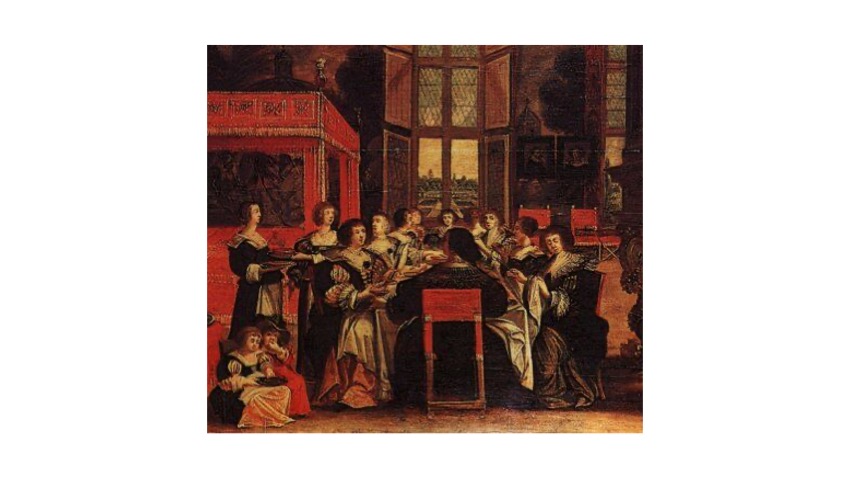
Réunion de dames, Abraham Bosse, 17th century
The kind of gathering called “salon” first appeared in Italy in the 16th century, but developed in France throughout the 17th and 18th centuries. Alongside fostering political and social alliances and exchanges, the purpose of such gatherings of “equal minds” adhered to Horatio’s definition of the purpose of poetry: aut delectare aut podesse (either to please or to educate). The term “salon” appeared in France for the first time in 1664. Before that, in the period of our story, for instance, they were named after the room in which they were taking place (e.g. cabinet, réduit, ruelle, and alcôve).
If we were to be historically accurate in their depiction (which we are not every time), before the end of the 17th century, these gatherings were frequently held in the bedroom, which was treated as a more private form of drawing room: the hostess would be reclining on her bed, receiving close friends who would sit on chairs or stools drawn around her. The term ruelle means “lane” designating the space between a bed and the wall of a bedroom.
These were also known as gatherings of “les précieuses“, a term used often in pamphlets and gazettes but meant to be disparaging. Moliére ridiculed the practice and the women involved in his 1659 comedy “Les Précieuses Ridicules.”
In our third book, “Behind the Mask”, we describe such a “ruelle” or salon at Marie Cessette’s house, attended by Layla and the Grande Mademoiselle among other well-known women authors, poets, philosophers, artists, playwrights, and political activists of the time and allude to the disparaging name “Les Précieuses.”
The most renowned salon in Paris was that of Madame de Rambouillet. The guests gathered at the Hôtel de Rambouillet, not far from the Louvre, on the west side of the rue Saint-Thomas-du-Louvre, just north of Marie de Rohan’s Hôtel de Chevreuse.
The hostess, Catherine de Vivonne, marquise de Rambouillet (b. in Rome, 1588 – 2 December 1665), known as Madame de Rambouillet, received her visitors in the chambre bleue, a salon painted in blue and with blue heavy brocade wall hangings. The marquise, who found the intrigues and coarseness of court life not to her taste, started organizing these gatherings in 1620 and continued until her death.
The gatherings in the chambre bleue at the Hôtel de Rambouillet, waned in 1645 but returned in 1648, during the Fronde and despite the death of Vincent Voiture l’âme du rond (“the soul of the circle”). They were most sought after in 1652 (time of the death of the marquis de Rambouillet). The chambre bleue was frequented by everyone who was anyone: the habitués were aristocrats, intellectuals, and artists. In the spring and summer, the marquis and marquise de Rambouillet would entertain their guests in the château de Rambouillet at Yvelines.
We have described different salons in our story, besides that of Marie Cessette. In “Twelve Years After” we describe the salon at the house of Paul Scarron as well as two such gatherings at the Hôtel de Rambouillet, one of which is not unlike the gathering at Chevreuse’s mansion in chapter 13, centered around an exhibition of fashions by the fictional “M. Carret”. We have, furthermore, described gatherings for (very bold) poetry readings at Chevreuse’s house that could be seen as another kind of salon.

 Twelve Years After
2 thoughts on “Gatherings of Equal Minds: Ruelle, Salon, and the Chambre Bleue of Madame de Rambouillet ”