The Dolls
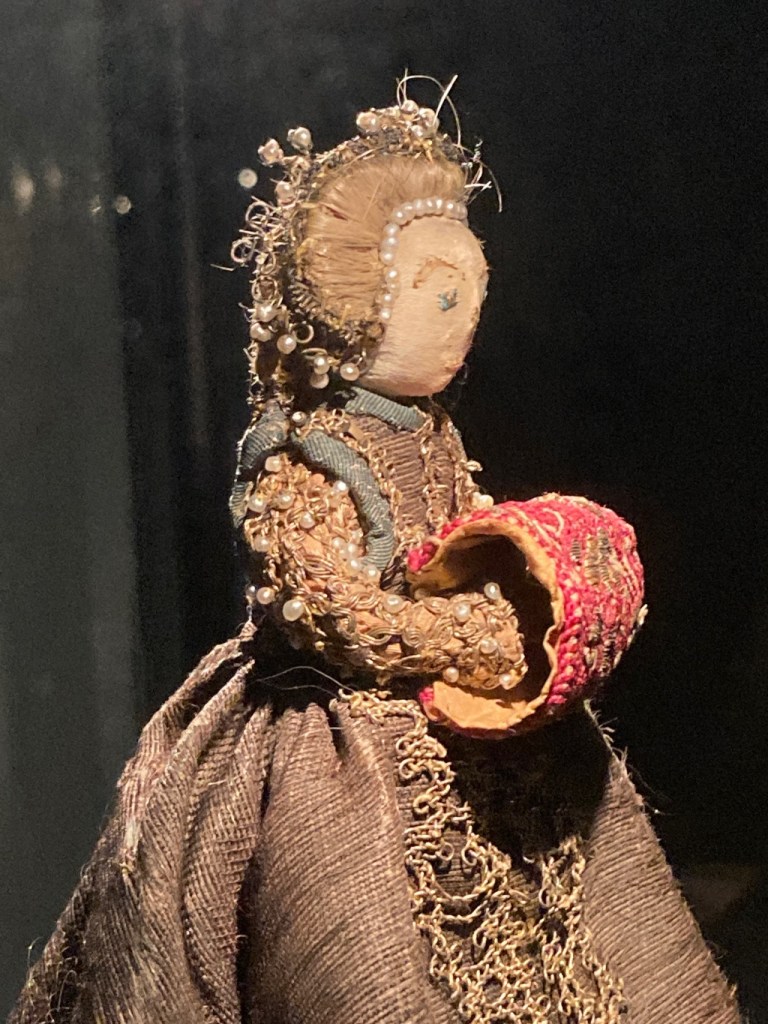
One of the oldest fashion dolls is displayed in the Livrustkammaren (Royal Armory Museum) in Stockholm. She has clothes made of silk which are embroidered with gold and silver thread. Her wig is made from real human hair and is styled in an elaborate coiffure. The high quality of the doll’s clothes and the skill present in the creation of the doll itself is proof of the elite status of these objects.
From the 14th to 18th century, dolls known as Pandoras or poupées de mode, were miniature dolls dressed in the fashions du jour, not unlike models, and sent across Europe to share new fashion trends. These dolls were not intended as children’s toys, rather they were important economic and cultural items.
As early as the 14th century, there are records of the royal families of France sending dolls to other European courts to promote French fashion and strengthen diplomatic relationships. The Italian Marie de Medici, lover of all things fashionable, received fashion dolls by the French king Henry IV before their marriage so she could learn how the French dressed. The use of these dolls in royal and aristocratic circles marked them as something exclusive, and helped establish France as a center of fashion.
By the 17th century, these dolls had become part of the fashion trade. The 18th century saw the peak of their popularity; it was during this time that they became known as “Pandora” dolls, although the origins of this name are unknown. French dressmakers sent Pandoras with their designs to England, Germany, Italy and Spain.
What lies behind a name?
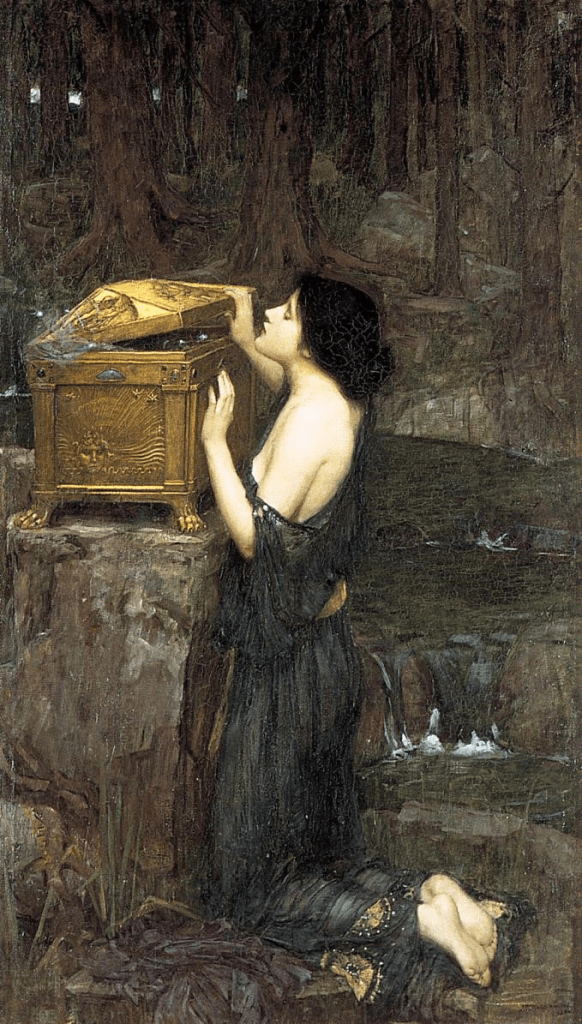
Pandora by John William Waterhouse, 1896
In Greek mythology, Pandora was the first woman. According to Hesiod’s Theogony, after Prometheus stole fire from heaven bestowing it upon mortals, Zeus determined to counteract such a blessing, ordered Hephaestus to create a woman out of earth upon whom the gods would bestow their gifts. In Hesiod’s Works and Days Pandora had a jar containing every misery and evil. Zeus sent her to Epimitheus who made her his wife, ignoring the warning of his brother Promitheus. She then opened the jar from which evils flew out over the earth. Hope remained inside, the lid having been closed before Hope could escape. In the 16th century Pandora’s “jar” became a “box” when Erasmus either mistranslated the Greek “pithos” (jar) to “pyxis” (box) or confused this jar with the box from the story of Cupid and Psyche.
There are many interpretations of the myth of Pandora, whose name can be taken to mean either “all-gifted” or “all-giving”. She also rises from the earth, which is the “giver of all things.”
In the late 15th-16th century there was an association of Pandora with Eve, that is also worth noting. Bishop Jean Olivier’s Latin poem Pandora drew on the Classical account as well as the Biblical to demonstrate that woman is the means of drawing men to sin. Originally appearing in 1541 and republished thereafter, it was soon followed by two separate French translations in 1542 and 1548. There was also the 5-act tragedy by the Protestant theologian Leonhard Culmann (1498-1568) titled Ein schön weltlich Spiel von der schönen Pandora (1544), similarly drawing on Hesiod in order to teach conventional Christian morality.
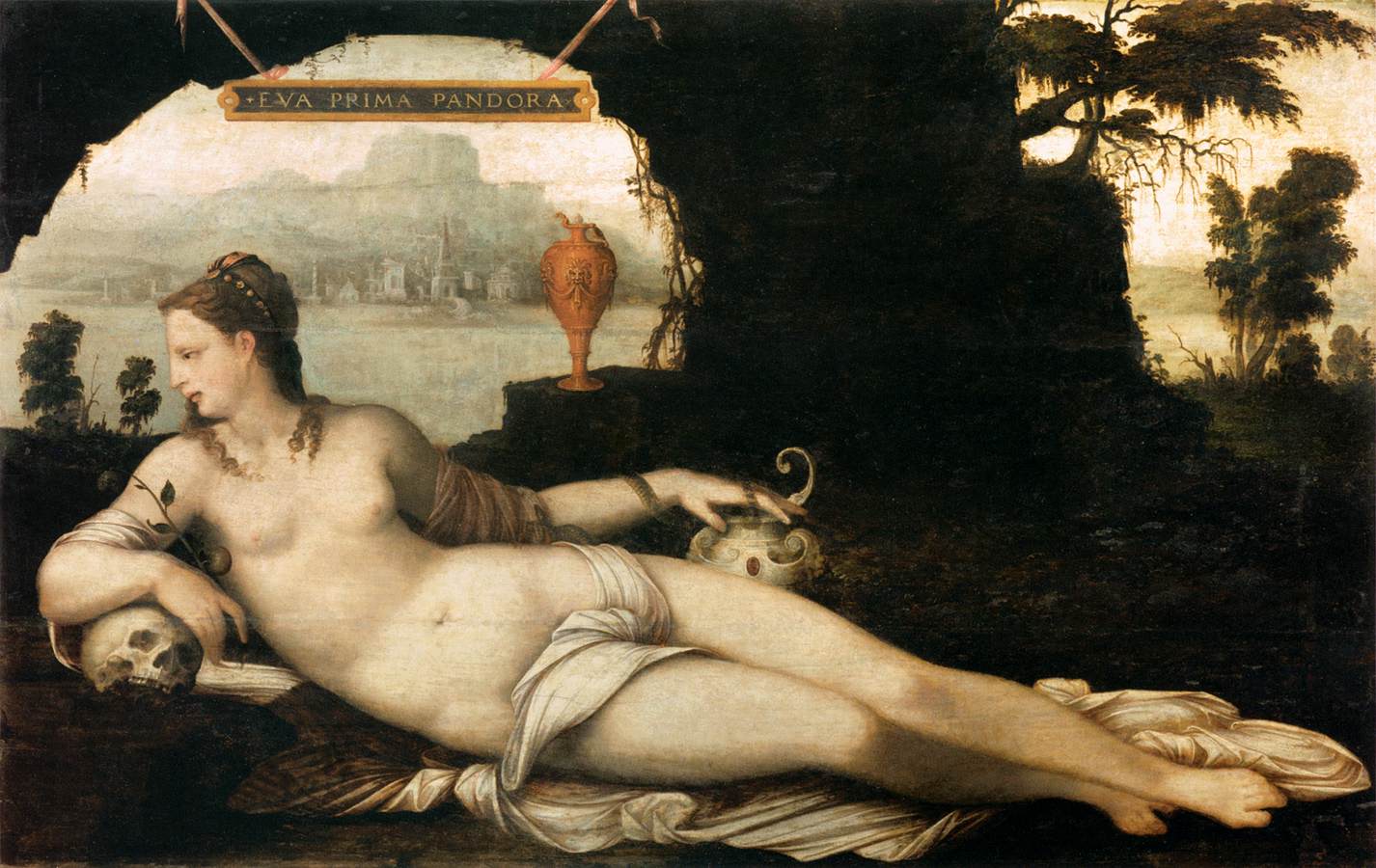
The equation of Pandora and Eve can also be seen in visual arts, for example the 1550 allegorical painting by the French painter Jean Cousin the Elder “Eva Prima Pandora” (Eve, the first Pandora).
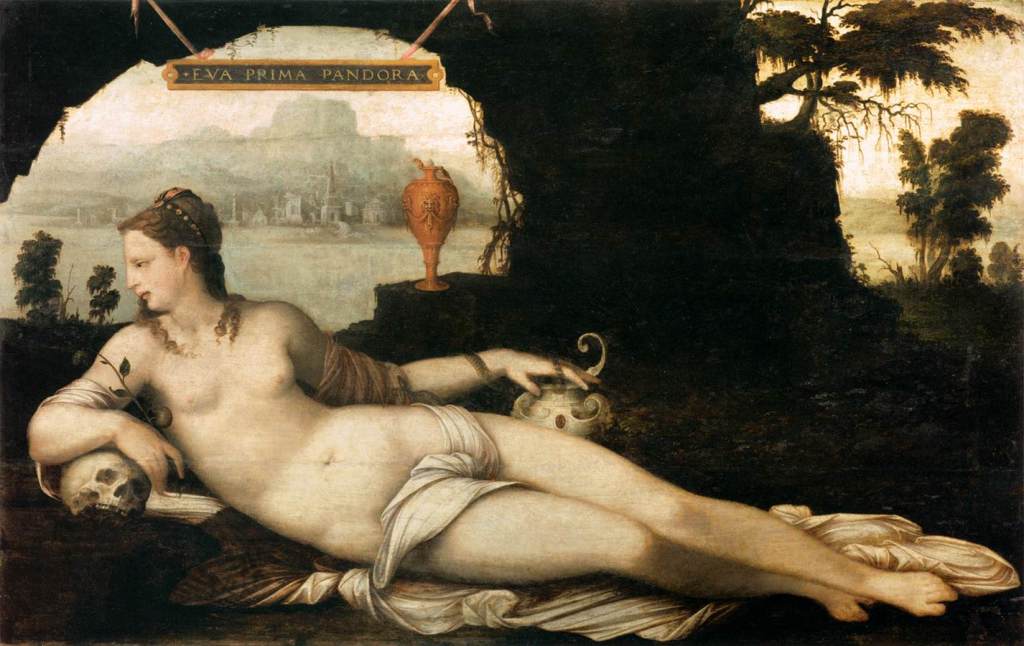
Jean Cousin, painting on panel, Eva Prima Pandora (Eve the first Pandora), 1550
In his emblem book, Emblemas morales (1589), Juan de Horozco gives a motive for Pandora’s action. Accompanying an illustration of her opening the lid of an urn from which demons and angels emerge is a commentary that condemns “female curiosity and the desire to learn by which the very first woman was deceived”.
In the 17th c. the desire to learn was equated with the female demand to share the male prerogative of education, and that kind of infraction (or sin) was associated with vanity.
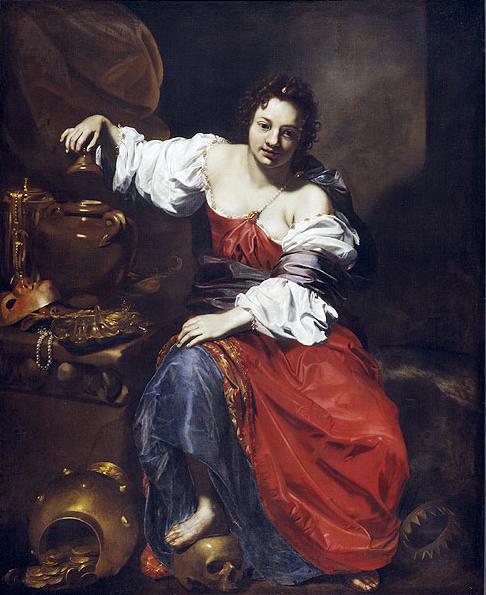
Allegory of Vanity—Pandora, Nicolas Régnier, c. 1626
In Nicolas Régnier’s painting “The Allegory of Vanity” (1626), subtitled “Pandora”, curiosity about the contents of the urn is compared to other attributes of vanity surrounding “Pandora” such as fine clothes, jewellery, a pot of gold coins. Pietro Paolini’s lively Pandora (ca 1632) seems more aware of the effect that her pearls and fashionable headgear is making than of the evils escaping from the jar she holds. There is a social message carried by these paintings where learning and knowledge for women is associated with expensive adornment of the body. It seems, therefore, that in the 17th c., in particular, “Pandora” implies a (patriarchal) warning and admonishment against the curiosity of women, and their thirst for learning, and there is an association with vanity and expensive (but empty?) trinkets for the body (vs. the soul). All these 17th c. associations felt relevant to the themes in Chapter 13 and the added peculiarity of fashion dolls named “Pandoras” made the name fitting as the chapter’s title.

 Twelve Years After
_-_Eva_Prima_Pandora_-_WGA05537.jpg)
2 thoughts on “Pandora(s) or Why we picked that title for Chapter 13”