Hôtel de Chevreuse, (later Hôtel d’Épernon, then Hôtel de Longueville) vs. Hôtel de Chevreuse (later Hôtel de Luynes).
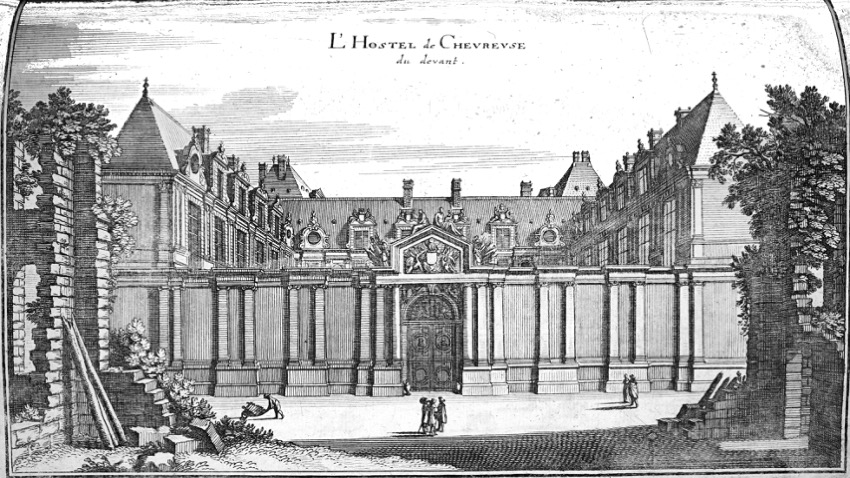
Street front of the Hôtel de Chevreuse (later Hôtel d’Épernon, and later Hôtel de Longueville) before 1655, engraved after Jean Marot and published in Topographia Galliae.
This is great example of how aristocrats owned several mansions in Paris. In our fictional world too, Lucien and Rochefort for example own several mansions at different parts of the city. This was not uncommon.
Chevreuse owned two mansions, one close to the Louvre–proximity to the Louvre was a sign of power—and a second one on the Rive Gauche of the Seine, at an area that was considered very fashionable in the 17th century.
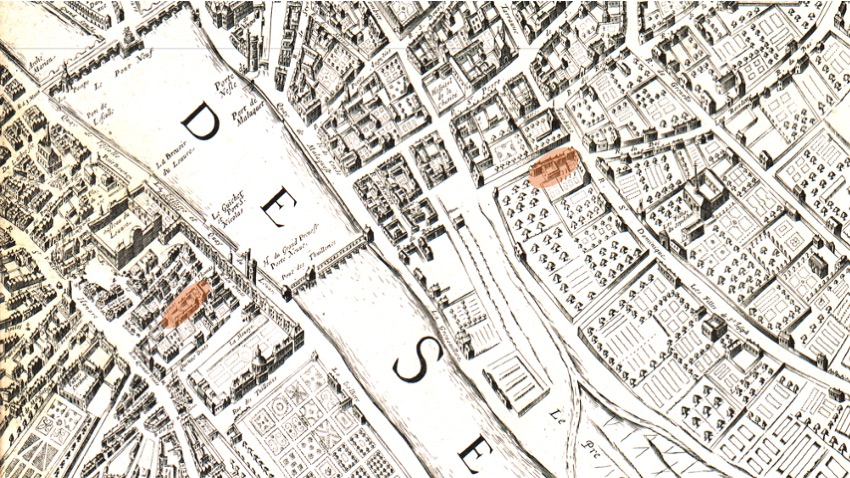
Map of Paris: Plan de la ville, cité, université, isles, et fauxbourgs de Paris. Paris en 1654. Facsimilé du plan de Jean Boisseau, showing the location of the two mansions owned by chevreuse.
We are using the mansion near the Louvre because the house at St. Germain was built in 1660 and we are in 1652.
In Twenty Years After, Dumas describes the mansion in St. Germain although the story takes place in 1648. He describes the route that Athos and Raoul follow from the inn with the sign of the “Green Fox” at the Rue du Vieux Colombier to Chevreuse’s house “with the arms of the Luynes”:
“It was three in the afternoon–the suitable hour for making visits. The travellers went by the Rue de Grenelle, took the Rue des Rosiers, entered into the Rue St. Dominique, and stopped before a magnificent mansion facing the Jacobins over which were the arms of the Luyens.” (Twenty Years After, Transl. David Coward, Chapter XXII, p. 192. Oxford University Press)
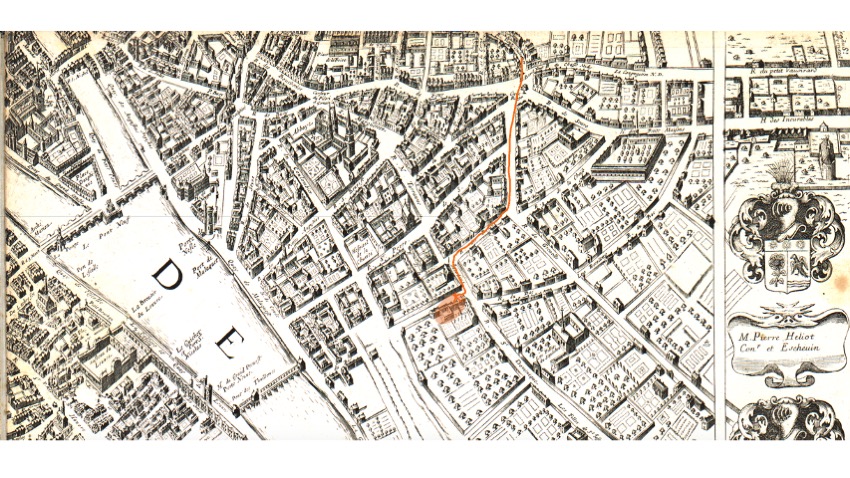
the route described by dumas in twenty years after
For our story we consult several maps for Paris, but the best map for the period is the “Plan de la ville, cité, université, isles, et fauxbourgs de Paris. Paris en 1654. Facsimilé du plan de Jean Boisseau.” In the images from that map you can see the route Dumas describes and the location of the Hôtel de Luynes as well as the location of the Hôtel de Chevreuse near the Louvre.
Hôtel de Chevreuse (near the Louvre)
The one we use in our story.
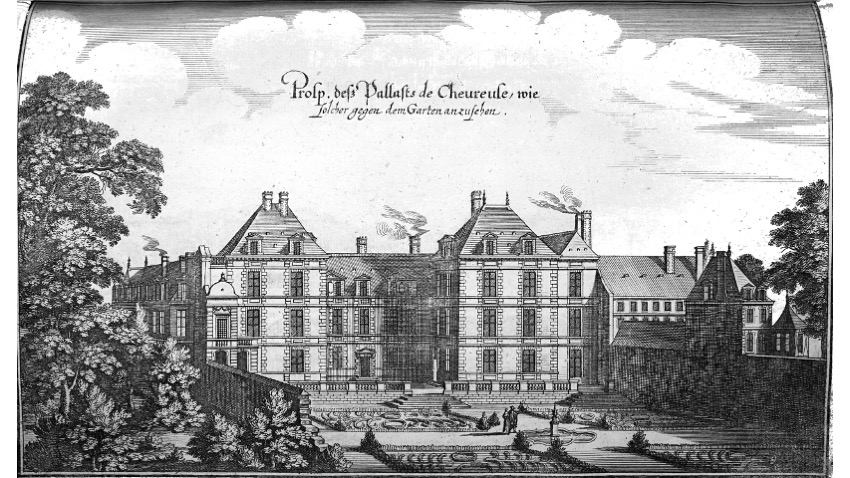
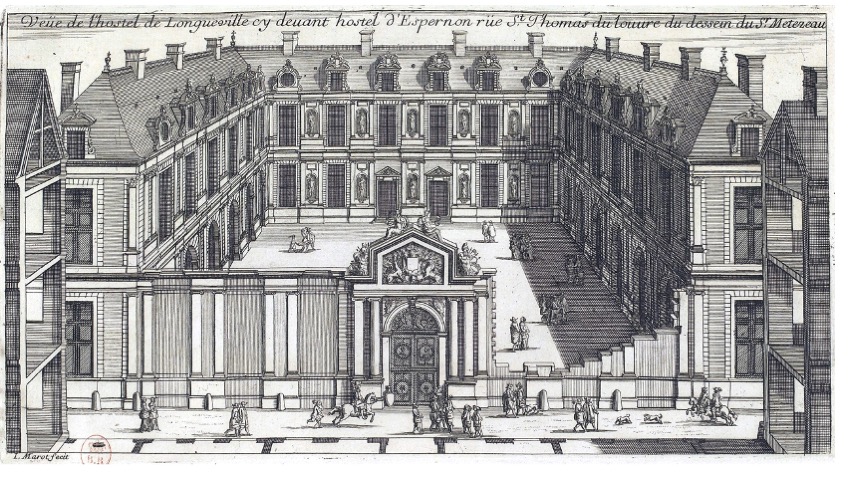
Garden façade of the Hôtel de Chevreuse before 1655, engraved after Jean Marot and published in Topographia Galliae and Street front of the Hôtel de Longueville, as engraved by Jean Marot c. 1670
The Hôtel de Chevreuse (later Hôtel d’Épernon, then Hôtel de Longueville) was a mansion or townhouse (hôtel particulier), built in 1622. It was destroyed in 1834. It was located across the river, on the west side of the Rue Saint-Thomas-du-Louvre on a site now part of the Cour Napoléon on the west side of the Louvre.
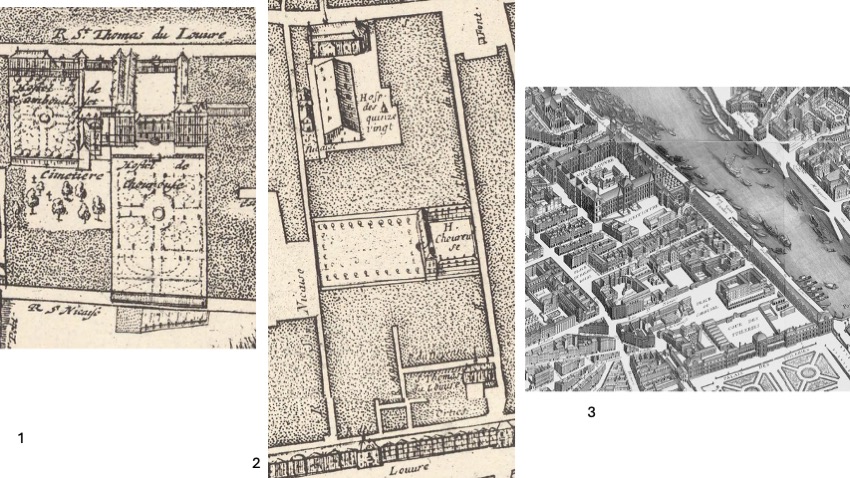
1. the Hôtel de Chevreuse on the 1652 Gomboust map of Paris (east at the top); 2. the Hôtel Chevreuse on the 1672 Jouvin-de-Rochefort map of Paris (north at the top; 3. the Hôtel de Longueville on the 1739 Turgot map of Paris (southeast at the top)
An earlier hôtel on the site was sold in 1620 for 175,000 livres to her first husband, the duc de Luynes, who the following year united it with an adjacent house to the west for 8,000 écus. After de Luynes died in December 1621, the property passed to his widow, Marie (later Chevreuse). The old hôtel was demolished and the Hôtel de Chevreuse was built in 1622–1623 to the designs of the architect Clément Métezeau for Marie de Rohan’s new husband, Claude of Lorraine, duc de Chevreuse, who had purchased the property from her just before their marriage on 21 April 1622. They hosted the duke of Buckingham in May 1625, who came to escort Queen Henrietta Maria to England. After the Duke’s death in 1657, Chevreuse sold the house for 400,000 livres to the duc de Candale, who bought it in the name of his father Bernard de Nogaret, duc d’Épernon.
The duc d’ Épernon died on 25 July 1661, and on 30 July 1662, Marie-Claire de Bauffrement, widow of Gaston de Foix, Comte de Fleix, relinquished it to Louis XIV for 488,722 livres, 8 sous, 9 deniers. On 13 August, Louis gave it to duc Henri II de Longueville, in exchange for the hôtel the latter had in the Rue des Poulies. The duc de Longueville died the following year, and his daughter, Marie d’Orléans de Longueville, having inherited all of his estates following the deaths of her brothers, gave it to her cousin, Louis-Henri de Bourbon-Soissons (known under the name of Prince of Neufchâtel), who died in 1703. On 30 July 1710, his daughter, Louise de Bourbon, brought it as part of her dowry to Charles Philippe d’Albert, duc de Luynes, to whose family the property thus returned.
The hôtel is depicted on the 1652 Gomboust map of Paris with an entrance screen and a central porte cochère on the rue Saint-Thomas-du Louvre, a cour d’honneur with two lateral wings and a corps de logis between the entrance court and a large garden, which runs all the way to the rue Saint-Niçaise on the west. It is also shown in a somewhat different configuration on the Turgot map of Paris, published in 1739.
The street and garden façades of the hôtel were engraved by Jean Marot. The two engravings were re-engraved and published in 1655 in volume one of Martin Zeiller’s Topographia Galliae. A view of the street front from a higher perspective with a cutout of the entrance screen was engraved by Marot c. 1670.
Hôtel de Luynes
The one Dumas uses in Twenty Years After.
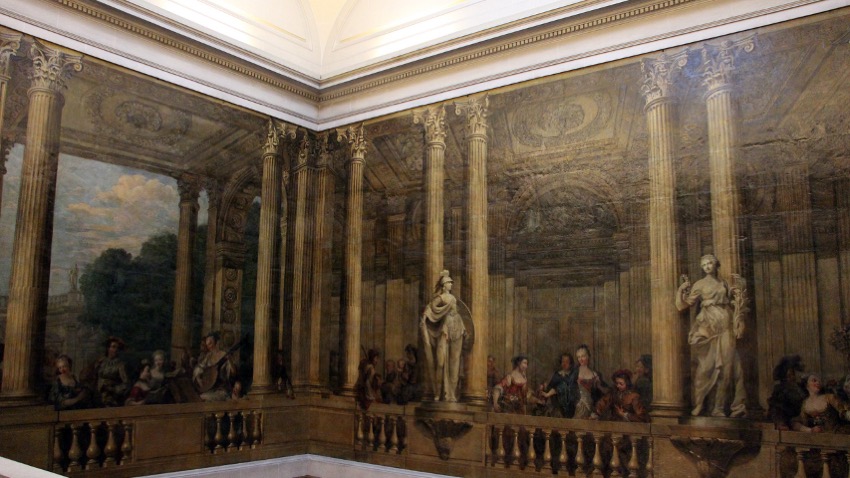
The Luynes Staircase, Musée Carnavalet
The former Hôtel de Chevreuse (later known as the Hôtel de Luynes) was located at 33 Rue Saint-Dominique (on a site that now includes part of the Boulevard Saint-Germain), just south of the Église Saint-Thomas-d’Aquin.
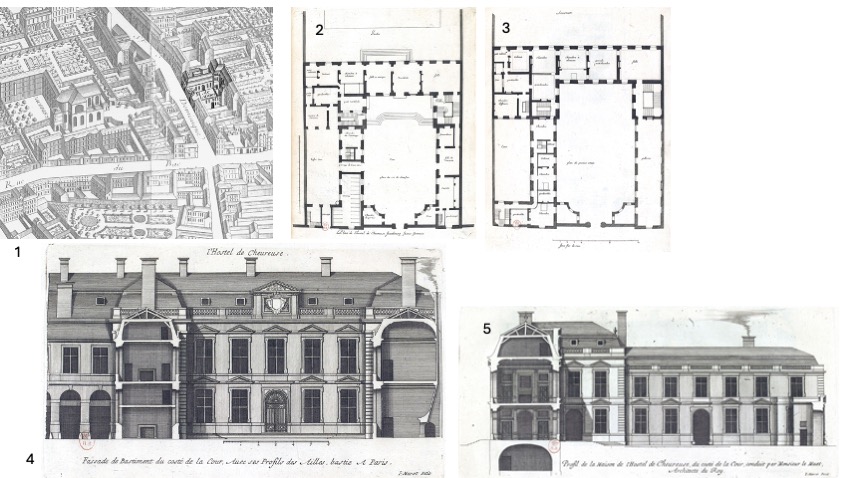
1. The Hôtel de Chevreuse (“H. de Luines”) on the 1739 Turgot map of Paris; 2. Plan of the ground floor; 3. Plan of the main floor; 4. Court facade of the corps de logis; 5. Transverse section of the corps de logis and elevation of the court facade of the west wing.
The Hôtel de Chevreuse was constructed in 1660 for Chevreuse, by the architect Pierre Le Muet, whose designs were engraved by Jean Marot and published in the Grand Marot in 1686. Le Muet’s hôtel was in the traditional French style, including the court and the garden. The hôtel was partly destroyed in 1868, for the construction of the Boulevard Saint-Germain. The remaining sections were demolished in 1900 to make way for the Rue de Luynes and the Boulevard Raspail.

 Twelve Years After
2 thoughts on “Which Hôtel de Chevreuse?”