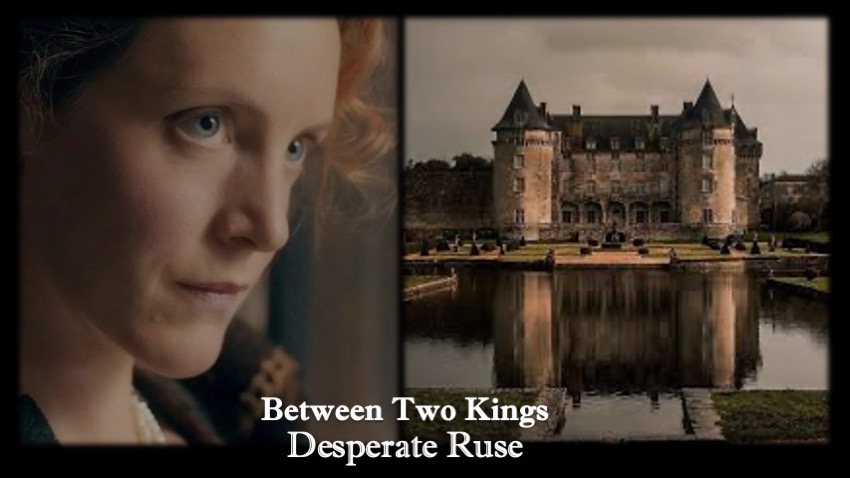
When she was younger, Catherine de Renard sought her mother in the faces of lay sisters and nuns knowing well her mother chose God over her daughter. Many years later, Catherine no longer remembers her mother’s face, only being abandoned when she was eleven.
The lay sister from the Benedictines of Abbaye aux Dames in Saintes could be any age past middle age. When the woman first arrived with Harry, Catherine wondered if her mother was still alive. It was a momentary lapse from more pressing concerns. The woman should have never been here.
In her well-laid out plans, Catherine did not anticipate this drawback—the Venetian whore, like a cursed cat, has many lives. This is what Catherine always believed and still does. Catherine is certain the whore is pretending again–it’s what she does best—hoping to force their plan to a standstill until she devises an escape for herself. Catherine will have none of it. This time the murderous whore will get the punishment she deserves. Catherine is determined to have her on her feet and on the scaffold, facing the noose in July. On the same day, at the same hour the whore hanged for Thomas’ murder once before but cheated death, like the cursed cat she is. Only this time, she will not escape.
This time, the execution will take place at Saintonge. Not at the godforsaken estate in the north, near Aisne, where the family sought shelter, those miserable lands that Athos–the impostor and coward–gave back to tenants that were never his; that sordid place where Catherine was forced to marry Renard, a vile brute, to survive when Athos left her to fend for herself. The murderous whore will be executed just as she deserves, at the ancestral home that was the rightful inheritance of Thomas de la Fére.
Catherine blames the whore for everything. Athos she blames less. He is a weak man, slave to his vices and the whore is his worst vice. Besides, Athos is a nobody. A destitute orphan the Marquis de Mouys picked from the streets or from some orphanage or from God knows where and decided to treat better than his own flesh and blood, making Athos his heir; investing Athos with the only title left after the discomfiture instead of passing the title to Thomas. Or perhaps, as Thomas was convinced, Athos is the Marquis’ bastard, whom he inflicted on his wife and family, as a matter of principle. The Marquis was too generous–his generosity, just like his skewed principles, a fatal flaw. Catherine is determined to restore the balance that long eluded the family of the Marquis—later just Comte de la Fére— a family left without true living heirs besides herself, through Thomas de la Fére, and her son, whose vile father Catherine chooses to forget. Athos–Catherine will not touch him. She cares not about some orphan of dubious stock. Athos–whoever he is– is his own worst enemy. Was he not almost destroyed once before?
Catherine will have her revenge and claim what is rightfully hers. She has tried for years, suffered for years too, but now things are different. Now she has a wealthy husband with powerful friends and an even more powerful patron. She remains at court while the Queen Mother is banished, and owes her position to her son, to Thomas, who knows how to deal in secrets, who has influential friends, and has grown closer to the King than the whore’s son will ever be, especially since Athos’ public display at the Louvre in the name of the whore. It was upon witnessing Athos’ disgrace that Catherine became convinced she was finally going to reap her revenge and everything owed to her. The estate at Saintonge has been in the hands of the Queen Mother who harbors–it seems–some sense of loyalty toward Athos even though he is a notorious Frondeur. But the Queen Mother remains banished from court and Athos has disgraced himself before the King, threatening the King to his face.
Catherine knows a good opportunity, and this is as good a moment as it can ever be. She will avenge Thomas de la Fére’s murder. She will get rid of the whore. The whore’s son plays with fire that is destined to consume him and almost has–his days are numbered, of this Catherine has no doubt after Athos’ disgrace. Then, there is the little daughter, the spitting image of her mother, the lucky brat who managed to escape once before. This time, Catherine has in mind to leave the daughter last. Motherless, without a brother, the father dishonored and wrecked, what defenses does a child of four have? Even Madame d’ Artagnan, the wife of a man who is supposedly Athos’ best friend, is eager to distance herself–nay, to betray. After all, it was Madame d’ Artagnan’s perfect timing and revelations that made Catherine’s revenge so easy. Who will stand for an orphaned four-year old, the daughter of a Venetian murderous whore and a bastard who has betrayed his King more than once? Who came to Athos’ defense at the Louvre? None of his so-called friends certainly–all of them equally disgraced–but the duc du Plessis, or rather Lucien Grimaud, another bastard son and as vile as they come despite the veneer of his title and his mother’s respectability—was Marie d’ Aiguillon not Richelieu’s niece and his mistress? Let the whore’s lucky little brat rot in the streets. Maybe Lucien Grimaud will pity the child and hire her for one of his brothels, to entertain his thugs and brutes, so she can follow in her mother’s footsteps.
Catherine’s revenge this time, begins with the whore, and the whore is mocking her. They have no choice but to trust this Sister Therese-Humbeline. Harry says that he offered to pay the woman on the way from Saintes but the woman adamantly refused. His promise to the Abbess to cover the expenses for a new roof for the refectory suffices, the Sister claimed.
Thomas listens, clicking his tongue impatiently. “What if the old cow blabs? Old cows like her often do, vows or no vows, and she has not taken any vows. I say that we…”
Henry de Winter springs to his feet from where he sits on an old bench by the fire rubbing his hands vigorously having had to ride with Sister Therese-Humbeline in a snow storm. He seizes Thomas from the collar and shoves him against the wall. It is a large room although sparsely furnished. When the Marquis’ family resided in this grand estate—descendants of the dukes of Lorraine, of the Bourbons, the Gonzagas, the Guemenes, and the Montmorencies, an ancient noble line that lost everything over a matter of principle—this room must have been used as the Marquis’ study.
“You say nothing!” Henry growls. “Have you not done enough damage again? It’s because of you that the old cow must be here!”
“Mother,” Thomas pleads, and Catherine is compelled to take a step forward as if to intervene–she must—after all she does everything for her son, for Thomas.
“Stay back!” de Winter barks at her, and she complies. He keeps Thomas pinned against the wall.
“It was Comminges. Comminges roughed her up. Comminges threw her in the oubliette,” Thomas manages between painful gasps.
“Comminges!” de Winter sneers. “What does he have to do with anything? This was your plan from beginning to end, just like your other ridiculous plan with the Ogre for the child. I had to clean the mess you made then, and now I am forced to do it again, putting my neck out for you, wasting my good money to repair some crumbling refectory!”
Thomas fights him off. “It did not hurt you last time, did it? You got rid of Martinez and the whore’s son with one stroke…”
De Winter lunges against his stepson again, but this time Catherine moves between them. “Enough! We are all on the same side. We want revenge. We want the whore and her spawn to disappear from the face of the earth. We want what is rightfully ours! This estate. The lands. The title.” She turns to her husband. “Thomas is right…”
“You dare!” de Winter seethes.
“He is right!” she defies him. “What happened with the brat did not exactly harm your purpose in the end. If you must blame anyone for wasting good money now, blame the whore. She plays us–nothing is wrong with her at all.” She turns to her son. “Harry is also right,” she admonishes her son. “You can be impetuous and the whore is devious and cunning. You gave her an opportunity in that oubliette and she is taking it…” She pauses at the sound of someone knocking. The two men step away from each other, assuming dignified postures. Thomas straightens his collar.
“Enter!” de Winter orders. “Ah, Sister.”
The woman makes an almost imperceptible bow. When she speaks, she fixes her eyes to some undetermined distance, as if she doesn’t care about their faces, and her tone is matter-of-fact. “Cleaned her up as you asked. She is gravely ill.”
“Nonsense!” Thomas exclaims. De Winter slants him a seething look.
Catherine is determined that neither her son’s innate impetuousness nor her husband’s justifiable wrath, will expose any part of her plan to this woman, who should never have been here. She intervenes, therefore, assuming a quiet tone. “Your patient is not to be trusted. She knows how to manipulate the credulity and generosity of good Christian people.”
“She is gravely ill,” the woman insists in the same matter-of-fact tone. “Chopped off her hair. Sometimes it helps with the fever.” She shrugs. “She should be taken to the Abbaye— there’s better care for the sick than this place—but in this weather, she will not survive even that short journey. I will do what I can for her here, but she is not long for this world. You should have brought Père Emanuel along to administer last rites. She will not live long enough to have the baby.”
Catherine gasps despite herself. Next to her, de Winter swears—something about the Virgin Mary—and the woman fixes a disapproving pair of eyes, for the first time acknowledging any of them.
“Baby? Are you sure, old woman?” Thomas motions threateningly toward Sister Therese-Humbeline.
“We are concerned about the poor wretch as good Christian people must be.” Catherine interrupts Thomas, feigning a sanctimonious tone. “Sister, we rely on your assistance and discretion.”
“I answer to God and the Holy Mother. I serve those who are sick and in need. I am no judge of sins, not even my own,” the Sister replies sternly. Catherine has no recourse but to feign humility and acceptance as the Sister explains: “The sick woman upstairs is with child. I would know. I have been a midwife all my life.” She shakes her head. “She is not showing, not yet, and she can’t keep anything down. I doubt she’ll live long enough to show. If God is merciful, He’ll take the baby and the mother together soon.”
“If God is merciful, the bitch will…” Thomas growls under his breath but Catherine slants him a sharp look and he stops mid-sentence.
“We must trust God’s mercy,” Catherine hurries to mask her son’s resentment. She notices that the Sister lingers as if she waits for instructions. “We leave the poor wretch to your care, good Sister. You know best what must be done.” She attempts an awkward smile. “In this terrible weather, I fear we must suffer this place until we can move the poor soul just as you advise.” She is compelled to explain their presence here and it annoys Catherine that she must do this, as much as it annoys her to feign compassion for the murderous whore and another brat. The Sister does not appear to care for explanations one way or another. She motions to the door. “I will return to her then. I suppose I can use the kitchen? If you plan to stay here, you will need a few hands. The place is large and has been empty for decades. You can hire good people from the village…”
“We have what we need,” de Winter begins rather harshly but eases his tone. “Thank you, Sister.”
“The old cow is right. We can’t stay in this godforsaken place!” Thomas says the moment they are alone again. “We are trespassing. The estate still belongs to the crown.”
“You should have thought that before bringing her here!” de Winter replies. “But you did not think it through this far, did you? Just like every other time.”
“Mother wanted to bring her here…” Thomas begins to protest.
Catherine has been pacing the room since the Sister left, wringing her hands, thinking. “Enough the two of you!” she exclaims. “Enough! She will be executed here no matter what she contrives. She was to be kept here—not as we found her—kept… To be hanged at the right time, so that she knows this is revenge. My revenge. Our revenge.” An angry chuckle escapes her lips. “It’s all her doing!”
“No executioner will hang a pregnant woman!” de Winter counters.
“They will, if they are paid.” Catherine levels a meaningful look. “Enough coin and even the most God-fearing executioner will turn a blind eye. That is my experience.”
“You have attempted this before!” de Winter sounds in awe.
“Twice before. The first time, she was with child too and the bitch escaped. The second time, her deplorable husband intervened. Not this time. I tell you; this is another contrivance of hers.”
“In the meantime, we are stuck here with her!” Thomas growls.
“Only until the roads open,” Catherine says. “Nothing has changed about our plan. We leave her here until the day of her execution. No one will ever look for her here,” she chuckles dismissively. “Not that anyone is looking for her.”
“And the old cow?” Thomas insists.
“I can take care of the old cow,” de Winter says. He sounds appeased. “We will have some of Comminges’ men guard the bitch, as planned.” He lashes out against Thomas once more. “Only we don’t keep her in an oubliette, you fool! From now on, I will give orders.”
Thomas is about to answer when the door flings open, a burst of cold air, dust and dirt filling the room. “We have a serious problem,” Comminges announces as he hurries inside. He is followed by his two henchmen, Godier and Muldarc.
“What else can possibly go wrong?” de Winter scoffs.
“We are not alone,” Comminges says. He signals to Godier. “Tell them what you know.”
“This comes from our outpost at Tours,” Godier begins. “We have a few men there, as you ordered. Enough to make sure we keep track of Grimaud’s supply train to La Rochelle. It’s where his ship is anchored.” De Winter nods. “Well… Our men at Tours did not expect to see Grimaud himself.”
De Winter gasps. “What?”
“Sang Dieu! The fiend!” Thomas de Renard can hardly think of Lucien Grimaud without fretting for his life, although he makes an effort not to sound as terrified as he is.
“Not just him,” Godier continues. “An entire caravan, children, wife…wives…”
Catherine narrows her eyes perplexed. “Wives?”
“From the description,” Godier says, “and it sounds unbelievable… but…well, our men are certain that he was with Captain d’ Artagnan, Captain de la Fére, and General du Vallon.” Catherine gasps.
“And when these three are together, d’ Herblay is never too far,” Muldarc adds.
“What in hell’s name are you talking about? How is this possible?” de Winter snarls. “Grimaud and these four are sworn enemies.”
“Our men are certain about what they saw,” Godier insists.
“There’s more,” Comminges says. “This…caravan… It is surrounded by an army of mercenaries. Germans and Sicilians. I attest to that. I saw their scouts, not too far from here. I know the German—Martin, I think his name is. He has a twin brother. The Sicilian is called Gasparo. He is loyal to the Venetian.”
“S’blood!” de Winter swears. Thomas steps back as if confronted by Lucien Grimaud in person.
“What does this mean?” Catherine clasps her hands, fretting.
“Where are they now?” de Winter demands.
“We were not expecting…” Comminges sounds apologetic. “My men are spread out, thin. Our job was to follow Grimaud’s supply train to La Rochelle, not fight against an army.”
“Where are they now?” de Winter presses.
“I had only four men stationed at Tours,” Comminges explains. “Two had to stay behind…Grimaud’s supply train…” de Winter frowns.
“The caravan split,” Godier interjects. “Our men followed part of the caravan to the Abbey at Fontervraud. Gimaud was with them.” He sighs. “The rest… our men lost them once they crossed the river. Our men are certain that they moved south…the direction of this estate.”
Thomas swears under his breath. “What does this mean?” Catherine insists.
“It means we don’t have enough men to defend ourselves here and this place is indefensible. Even if we could fight, the land belongs to the crown. We are trespassing-it’s treason.” Comminges growls.
“They can’t possibly know we are here!” Catherine counters. “How can they know? Who’d think to come to his place? It’s been deserted for decades.”
“We are talking about Lucien Grimaud, mother! He is the devil incarnate.” Thomas protests.
“Nonsense. He is another criminal, who passes himself off as nobility.” She turns to all the men in the room. “Think! If they are here to save the whore, why bring their children and their wives?”
“They are bringing a mercenary army, Madame!” Comminges corrects her.
“To protect their children and their wives…” Catherine points a finger toward Comminges,“…from you, most likely.” The men around her, gape, perplexed. “Think!” she insists. “Athos and his friends are disgraced. D’ Herblay, if he is with them as your men believe him to be, has escaped from the Conciergerie where he was to be executed. He is a man on the run. They all are. They are not coming here. They are escaping from Paris. From the King…From Captain Marchal…And from you!” She turns to her husband. “I don’t care what it is you do, Harry. I don’t care who you work for, but I do know this: Lucien Grimaud is your adversary…And this makes him our adversary too.”
“Madame has a point,” Muldarc ventures.
“Where could they be headed if not here?” Thomas interjects.
“It does not matter to us,” Catherine replies. “They are not looking for the whore.”
“On the contrary, Madame. My men fought against Grimaud and Athos looking for the Venetian not far from Bragelonne. And it matters a lot where they are headed.” Comminges counters. “Let’s say it’s La Rochelle where Grimaud’s ship is anchored, or somewhere nearby—the man owns houses everywhere. That mercenary army is far too close for my taste.”
“And people talk,” Godier adds.
“The people at the Abbaye… the old cow…” Thomas enumerates.
“We must leave this place, immediately. Take the Venetian and leave. Join our men who wait at Nantes and on the road to Lorient,” Comminges urges de Winter.
Catherine crosses her arms over her chest. “Out of the question!”
Comminges turns a scowling glare toward de Winter—rein in your wife, he is signaling. “Enough!” de Winter exclaims. He draws in a frustrated breath. “We can’t leave here,” he raises a hand to silence Comminges’ objection. “We can’t have them breathing down our neck either, you are right. We must therefore direct them elsewhere.”
“A ruse!” Thomas exclaims.
“I am listening,” Comminges agrees.
“Grimaud has men at La Rochelle, is it not so?”
Comminges nods. “The Aigle and her crew. He has other agents in La Rochelle too.”
“No, no…The crew suffices.” De Winter rubs his chin. “Who do we have in La Rochelle, Comminges?”
“Ballesdens.”
“Tell him to find someone expendable in his own ranks. Pay that man well from my coffer. Tell Ballesdens the man must sound disgruntled. He wasn’t paid enough to secretly transport a woman from near Blois… a beautiful woman…green eyes… Should be enough.”
“If the man falls into Grimaud’s hands, you realize, Grimaud will discover the ruse,” Thomas objects. “He has ways to squeeze the truth…”
De Winter ignores Thomas. “Instruct Ballesdens to make sure the man does not fall into Grimaud’s hands alive.”
Comminges nods. “And where is the Venetian supposed to be?”
“Far from here…” de Winter muses. “Somewhere believable… Somewhere hard to get to in the winter.”
“Many years ago, when I was a cadet for the Red Guard under Richelieu,” Comminges says, “we were ordered to storm an abbey. Remote and favored by the Queen in those days. Probably because it was remote. The four were inside—we discovered later—cadets are never told much before a fight. The Venetian was supposed to be on our side. Whether she was, in fact, on our side, I don’t know. First time I ever laid eyes on her. She rode into our camp with a gang of Irish mercenaries. They stormed the Abbey for us in the end. Their leader was called Gallagher.”
“Where was that?”
“The Carmelites near Bourbon-les-eaux.”
“This is far from here and hard to get to as it is, almost impossible this time of the year,” de Winter says. “Good choice. That’s where we will send them. That should slow them down significantly.”
“You cannot remain here,” Comminges observes. “We can keep the Venetian here- guard her until you do away with her, but you cannot stay here. The place is deserted. Someone will notice.”
“Poachers,” de Winter shrugs. “I am sure poachers and vagabonds find shelter in this ruin during the winter. It’s a good cover for us and for you. Throw coin around to keep mouths shut and people happy. Are people eager to talk, you think?”
“I doubt it–no one likes the Austrian around here, and she owns this estate. The villages should thrive from it but she keeps it shut down, the lands unused, the house deserted. Still the crown demands taxes. And many around here harbor resentment and grievances from the wars of religion. There are secret Huguenots everywhere in these parts still,” Comminges reasons.
“It is to our advantage,” Catherine remarks.
“Nevertheless, Comminges is right, we cannot remain here long,” de Winter cautions her. “Only until roads are safe from the storms and from the mercenary army that has taken over these parts. We must distract them away from here and then we move to Sainte, until the time comes for the Venetian to be executed.”
“Muldarc, ride to Nantes and bring reinforcements. We need men,” Comminges orders. “Godier, you ride to La Rochelle and make arrangements with Ballesdens.” Both men turn on their heels and motion to the door.
“We need help here, if we are to stay even for a few days,” de Winter says.
“Ballesdens’ wife can cook, I am sure. He has a son and a daughter. They are all very much… indebted to the Florentine banker, I understand.” Comminges fixes a meaningful look toward de Winter who returns a sly grin.
“Do I need to know what this means?” Catherine interjects. There’s disgust in her voice.
“Better not, Madame,” Comminges sounds amused. “But Ballesden’s family will serve you while you remain here, and they will keep their mouth shut and not see anything they are not supposed to see.”
De Winter grabs his hat and gloves from the bench where he had left them. “Let us see what we can do about this place until reinforcements arrive,” he tells Commiges. “You too,” he growls at Thomas, “if you imagine yourself master of this place, you should prepare to fight for it.”
⚜️⚜️⚜️⚜️

 Twelve Years After