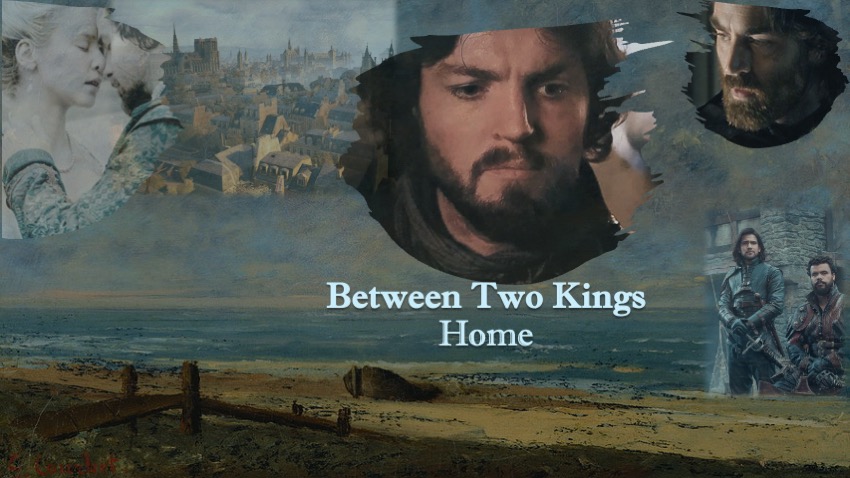
“My love,
I no longer fear writing these words.
My most precious love,
There is no suffering worse than being separated from you, but what you have suffered I cannot fathom; what you may be suffering still.
Louis–it is his pride that drives him, my love, and you know his pride well, for we instilled it in him, you and I–Louis sends the missive, which arrives with this letter. He asks that you return, that you join him at his royal council–his advisor, his protector, and his friend as you have always been.
As for me, even though I will endure any distance between us to keep you safe, the mere glimpse of your beloved face will be all the happiness I could hope for.
Your loving wife
A–”
Aramis reads the letter one last time and tucks it carefully into his doublet. Spread on the desk before him is a royal missive, with Louis’ signature and seal.
His Grace the duc d’ Herblay, Our most beloved friend and loyal advisor is invited to court, to serve in His Majesty’s council as befits a man of his rank, ability, and talent.
Louis R
Aramis crosses his hands behind his back, assuming a formal tone. “And how did you find us here, Monsieur?”
Even from a distance and from the ramparts, Aramis recognized the young officer who arrived with the correspondence because of his uniform as one of M. de Rohan’s regiment. This was the only reason the young officer was allowed through the gates of Glénay without one of the sharpshooters stationed along the walls taking aim at him, despite the fact that he rode up to the gate carrying a white banner. D’ Artagnan also remembered the officer’s name, M. Morant, and added that M. Morant was one of the orphans from Bicêtre, one of the orphans who survived the battle on the infernal slave ship that Lucien boarded at Marseille. The boy used to be called Gobelin, d’ Artagnan remembered too, and M. de Rohan took him under his wing together with Layla. That last part, Lucien has confirmed.
There is no trace of the emaciated orphan from Bicêtre in the strong and handsome young officer who stands before Aramis, shoulders straight, full of purpose as officers tend to be. M. Morant must be as remarkable a young man as his commander, M. de Rohan, Aramis thinks. “I was given specific instructions for this mission by M. de Rohan, Your Grace,” M. Morant explains.
“And you are certain that you were not followed?” Aramis scrutinizes.
“We were followed, Your Grace,” the young officer says. “M. de Rohan anticipated it in his plan. I left Paris with three fellow officers, all delivering royal correspondence and all selected by M. de Rohan. We were all given the same orders, but my instructions were different.”
Aramis raises an impressed brow. “And where are your comrades now?”
“Rennes, La Rochelle, and Bordeaux, Your Grace. It is the regular route for the royal correspondence this month.”
“And you will join them again?”
“Yes, Your Grace. At Tours. My instructions are that should Your Grace decide to return with me, you must ride up to Tours in disguise. M. de Rohan suggests something ecclesiastical. We must avoid raising suspicions about this estate. Once we reach Tours, no such precautions will be necessary.”
“M. de Rohan does not expect that we will be followed once we reach Tours?”
“M. de Rohan says that once we reach Tours, we could be arriving from anywhere.”
“M. de Rohan is a very clever man. Ah, Ignazio,” Aramis exclaims just as the young monk enters the room carrying a tray with wine. He is not dressed in his monk’s habit, unlike Father Massey, Father Francois, and Brother Aloysius. Unless they are at chapel, Brother Ignazio prefers to be dressed as a valet and is not averse to carrying a sword or pistol; he has a natural talent with both it seems, the sword in particular, although he is averse to killing. “I will be leaving for Paris early tomorrow morning, with M. Morant. I am traveling as Brother Joseph, at least until Tours.”
“I shall prepare everything for our departure immediately, Your Grace.” Igazio sets the tray on a table and hurries to the door.
“You do not have to return with me,” Aramis says gently.
“I go where you go, Your Grace,” Iganzio replies. He bows and closes the door behind him.
⚜️⚜️⚜️⚜️
The missive passes from hand to hand but no one dares to voice their misgivings. How can anyone tell a father that his son’s promises are hollow or that his son’s word is not to be trusted? Still, upon reading it, brows are raised in disbelief, d’ Artagnan clicks his tongue disapprovingly, Porthos shakes his head, and a faint, dismissive chuckle escapes Lucien’s lips. Raoul makes an effort to remain impassive. Does he believe the missive is true? Yes, and he knows and trusts M. Morant and Jean would not have sent one of his most trusted men without good reason. But is Louis to be trusted? Perhaps for the moment, but with Louis, moments are brief. In the end, it is his father who speaks.
“Perhaps you should rethink your decision, Aramis.”
“No, Athos.” Aramis sounds adamant. “We must put an end to this impasse.”
“Arresting you again, that is one way of ending it,” d’ Artagnan says.
“I am coming with you,” Porthos declares.
“No absolutely not, Porthos.” Aramis says.
“We need men here,” Lucien says quietly. “We are looking for Alessandra. Other enemies surround us also.” He carefully avoids naming Rochefort, the Company of the Orient, and the Belladonna sailing where it should not be sailing, Raoul notices. “We cannot divide our forces, and even though we did not lose many men at Saintonge, we have many injured. Every man counts, Porthos.”
“Lucien is right,” Aramis insists. “Besides, once at court, and with Anne at my side, we can intercede…” He fixes an inquisitive look at Athos. “You don’t agree.”
Athos returns a wisp of a smile. “Do you need my approval?”
“Yes. Yes, I do,” Aramis affirms with resolve and Raoul is reminded once more that among the Musketeers, a Captain remains, no matter how many years have passed. Captain d’ Artagnan was his own Captain, but his father commanded the Musketeers before that. “You don’t agree!” The Duc d’ Herblay sounds disappointed.
Raoul marvels at his father’s subtlety; “Your expectations may be premature. For example, I am aware that I have offended His Majesty, which could be irreparable. But my friend, I will never stop you. I cannot.”
⚜️⚜️⚜️⚜️
“I disagree! If you must return, you cannot return alone!” Porthos lingers in the room, while the rest are leaving: first Lucien, prompted by Afonso, who has signaled through the half-open door that there is urgent business, and then Raoul who hurries to seek out M. Morant.
“I will not be alone, my friend,” Aramis rests a gentle hand on Porthos’ shoulder. “Ignazio comes with me and M. Morant is trustworthy or M. de Rohan would not have sent him. In Paris there is Anne and M. de Rohan and Layla and…”
“None of us will be there with you!” Porthos sounds angry. “Glénay is too far should anything happen.”
D’ Artagnan raises an impish brow. “Should anything happen to our reckless friend and Glénay is too far for us to intervene, then there was not much we could have done in the first place. Otherwise, we will come to your rescue, Aramis.” He shrugs as if it is the simplest thing in the world.
“This is not a joke!” Porthos protests.
“No, this is serious,” Athos agrees, gravely. “But Aramis must return, just as we must remain.”
“It defies reason!” Porthos pushes. .
Athos has fixed a probing gaze on Aramis. “I daresay reason has little to do with it.”
“Funny. Aramis said the same thing about you, the other day,” d’ Artagnan tells Athos.
“Did he?” A faint, vexed chuckle escapes Athos’ lips. “Did you?” Aramis shrugs apologetically.
D’ Artagnan wraps his arms around Athos’ and Aramis’ shoulders. “Aramis was right. Just as you are right. I was wrong on both counts, and now, my dear Porthos, I fear you are wrong as well. You see, even though I find myself as far from home as I could possibly be– you too Porthos, for neither of us hails from these parts, which are too noble for a farmer’s son, like myself—we are in many respects at home. Think about it, Porthos. Everyone who matters to us is here, and safe.” Porthos nods. “As for you two,” d’ Artagnan mocks a stern tone turning to Aramis and Athos, “you two are more alike than you would like us to believe!”
“That’s not true,” Aramis feigns an aloof tone. “I have always been and intend to remain the charming one.”
Athos shakes his head. “Aramis, let us be serious for a moment. I must confess something important. It is important that you all hear this even if you suspect it. Lucien knows. There was no other way to…”
“I assumed that Lucien knows,” Aramis interrupts him. “I have thought about it a lot–this secret of mine that has threatened and destroyed so many lives. I should have been the one confessing. Lucien has every right to know–he has sacrificed too much. His children and his wife have suffered. He offers us safety. And then, he is your brother Athos. To me that alone is enough.” He slants a teasing glance toward d’ Artagnan. “Let the Gascon be jealous. It is the prerogative of younger brothers.”
“Mordieu, Aramis!” d’ Artagnan grunts. “Now you will make me insist that I return with you to Paris just to annoy you.”
⚜️⚜️⚜️⚜️
The officer, M. Morant, springs to his feet from where he is seated at the large kitchen table enjoying a sumptuous meal and wine. “Your Grace, M. de Normanville!”
Raoul weaves his way past a small army of maids and servants hurrying about as dinner is being prepared and nods politely to the Cook. “I disturb your dinner, M. Morant. Please sit.”
“Not at all, Your Grace.” The officer sits and pours a glass of wine for Raoul who sits on the bench next to him.
“How is M. de Rohan?”
“Very busy. We must be one regiment fit for two Queens, M. de Rohan says.”
Raoul chuckles. “Your regiment and your commander are a tribute to France. I understand you carried other letters for him. For the family.” The young officer nods. “Then I will not impose on you if I ask you to deliver some letters for me, M. Morant.”
“Of course not, Your Grace. In fact, the Lieutenant gave explicit orders about such correspondence.”
“M. Morant I am not…here. I have never been …here. And you have not seen me.”
“I fully understand, Your Grace.” He moves closer to Raoul and whispers. “M. de Rohan said so.”
How well Raoul recognizes his best friend in the elegance and secrecy with which he has handled the matter! “What else did M. de Rohan say?”
“He said to tell you that your pigeon posts have been arriving. He said to tell you that things are in place, what things he did not clarify.”
Raoul nods. He pulls two letters out of his doublet. “I ask that you deliver these in M. de Rohan’s hands. If at any moment you find yourself in peril, I ask that you destroy them.”
“Goes without saying, Your Grace.”
“And tell, M. de Rohan: Spain.”
⚜️⚜️⚜️⚜️
Athos flings his gloves on the desk.
“I was coming to find you but I see that you have heard.” Lucien is standing at the open door of the library.
“I just spoke with Gasparo.”
Lucien enters, closing the door behind him. “I just spoke with Jasper who was with Gasparo. He said the nun could barely walk, they had to carry her to the carriage–they used Catherine’s carriage because the woman was too sick. By the time they got to Saintes, to the Abbey, she was on the floor of that carriage…”
Athos clicks his tongue, angrily. “Apoplexy.”
“She is not dead. She may still rally.” Lucien sounds unconvinced.
Athos slants him an equally unconvinced glance. “It leaves Bellesdens. I understand that you will ride to La Rochelle early tomorrow morning. I will be joining you.”
No! No, you will not. This is all we have. We cannot make a mistake.”
Athos manages to hold back his anger, although his voice trembles slightly: “And me joining you in search of Bellesdens…that is a mistake!”
“Where I must look for Bellesdens you cannot come. And don’t give me the usual about coming in disguise and whatnot… No matter what you do you…You reek of…of Musketeer. Sang dieu, there are moments when I wonder if it is brushing off on me!”
Athos gasps, his anger getting the best of him. “You suggest I don’t look for Alessandra!”
“I suggest that you let me follow this, the only trail left to us, my way, because no matter what you do, you will stand out like a sore thumb in that world where Bellesdens has vanished. Let me do this my way, with my people.” He draws a deep breath, calculating. “Well…some of your people may come in handy. A couple of Sicilians no one has ever seen before can be useful. But not you! Not yet. I will send word when it’s time.”
“And what am I supposed to do in the meantime?” He points an angry finger toward the door. “My daughter cries for her mother.”
Lucien glares at him aghast. “You did not tell her the truth!”
“Of course not. I lied to my five-year old daughter. Badly. It was a terrible lie and I am a terrible liar. How did you put it? I reek of Musketeer!” He sinks in a settee.
Lucien sits next to him. “You do reek of Musketeer and I have no doubt that you are a terrible liar. But lying to one’s five year old daughter about anything is an entirely different affair and not for the faint of heart.”
“She asked so many difficult questions. I had no answers. I had nothing.”
“They see right through you, and they are brutally honest.”
“What am I supposed to do while you follow the only path left?”
“Talk to our mother.” Athos chuckles angrily. “No, I am serious,” Lucien insists. “What would you do if you were in your Garrison, and still a… good-old noble Musketeer?”
Athos shrugs. “Drink. And before you ask, no, it would not help at all. It would just make me oblivious. Then I’d gamble and lose all my money and seek a duel with Red Guards most likely–our father’s men–no irony there at all.”
Lucien leans back, crossing his arms over his chest, legs stretched out. “When Layla was injured–you remember–I had just discovered that she was my daughter. There was no hope we were told, it was just a matter of time. That night I…I walked into the chapel at La Croix. Smashed everything that could be smashed.” He turns his head and sees that Athos is listening intently. Lucien chuckles. “Did it help, you will ask. No, not at all. But our mother was there. That helped.”
“Our mother?”
Lucien shrugs. “Well, I didn’t know she was my mother then. Surprising how such things can affect you where it matters and when you least expect it.” He sits up in the settee. “She wants to see us. Talk to us, she says.”
Athos narrows his eyes for a moment as if realizing something. “Are you angry, Lucien?”
“Angry does not begin to describe it. Aren’t you? Not with her… No…But… I don’t know… I am not like you, am I? I don’t waste my time studying the portraits of my ancestors hanging in that infernal gallery and pondering about my lineage; about who I am. I know who I am. Besides, what’s the point? I don’t remember this house or anything else. I don’t care to ask about anything and she expects questions.”
“You are not coming then,” Athos says quietly. “And you must leave for La Rochelle early tomorrow?”
“Yes, very early. And there are preparations to be made, so I cannot join you and her now.”
“This is a terrible lie, Lucien.” Athos stands and walks to the door.
“If Mére insists–which she will not– tell her that I am not in an introspective mood,” Lucien says peevishly, once again leaning back in the settee with arms crossed over his chest and stretching out his legs.
⚜️⚜️⚜️⚜️
Athos finds the duchess d’ Aiguillon not in her study, or at chapel, or at the family salon, but outside, in the garden. The sun has not yet set, and the crisp afternoon air carries with it a hint of warmth and the scents of early spring. The duchess is strolling along a path lined with cherry trees, their first blossoms about to bloom. Guilia is walking behind the duchess with Father Massey and ahead of the party Athos can see Bianca and Alexandre holding hands and prancing together–Athos knows his daughter’s sweet chatter and is relieved to hear it.
He greets Father Massey and Giulia, who linger further back, allowing him privacy with his mother. “I did not expect to find you out here,” Athos says.
“I worry about the little one,” the duchess says. “I understand you and Raoul spoke to her…”
Athos keeps his eyes fixed on his daughter. “It did not go well.”
The duchess smiles kindly, but there is concern in her voice. “She is very young. They say children forget…”
“They don’t!” His tone is uncharacteristically abrupt, he realizes. He realizes too that Lucien was right about being angry. “Forgive me,” he says, reining in his anger.
She attempts another, fleeting smile, accepting his apology, but he can see that she understands; such must be the nature of motherhood. “We thought to distract her a little. She has not been eating too,” the duchess continues. “The weather is pleasant even at this hour and Alexandre is always so eager with her–and he is her favorite.” They walk a few silent paces and she breaks the silence: “I had this idea… The weather has turned and…and tomorrow there will be many partings and farewells. I understand Raoul will be leaving us too.”
There is a question in the duchess’ words, which Athos cannot fully answer. What he knows is what Raoul announced: that he will be leaving in the morning too and with Madame Bernard, their destination unknown. Of course, it is not difficult to piece some things together. Their destination is wherever Olivain has gone with Thomas de Renard. This is somehow connected to the fate of Henri Bernard, his mother, and that ship off the coast at the bay of Biscay which bothers Lucien. This is also, somehow, connected to Alessandra. “I will send you news about Mother,” Raoul assured him. It sounded as if Raoul had a clear path already planned and Athos decided not to interfere because he trusts Raoul whose position is delicate while Alessandra’s life hangs in the balance.
No one asked where Raoul is going or where he will take Madame Bernard. In fact, it was surprising how casually everyone reacted to this news–everyone except Bianca who clung to her brother for sometime. She neither wept nor spoke, only latched her arms around her brother’s neck refusing to let go, and that to Athos was more alarming than whatever his son’s plan is. If Alessandra were here, she’d be incensed by his detachment. He can even hear their argument in his head: how can you not be concerned about him she’d push and Athos would push back that he trusts their son’s judgement. He wishes she could be here so they could argue. That glimmer in her eyes when she is vexed, when he knows she will interfere no matter what he says–he misses that.
“I had this idea…” the duchess ventures again, “…to avoid farewells, for the little one.” Athos agrees. He would rather that Petite is spared any more heartbreak. “There is a place I would like you to see. A place that is very dear to me. It is not far, less than a day’s drive by carriage. If we start early tomorrow, we may even get there by this time. We can spend the night. Return the next day. There is a house…I will send word.” He is perplexed, and something else that he cannot fully grasp. Instinct or perhaps that inextricable bond that connects a son to his mother, the bond Lucien spoke of, tells him that he must agree. That he must go. “I was hoping Lucien could join us, but finding Alessandra comes first and he must be at La Rochelle for that.” She reaches for his hand. “I am sure you want to join him in La Rochelle, but you are needed here–the little one has suffered too much already.”
⚜️⚜️⚜️⚜️
Riding on Balignan, Athos is first to crest the low hill. He is followed by the carriage with his mother, Bianca, Giulia, and Collette, Bianca’s maid–Olivain’s sister. Something urges him to press his horse ahead. A sense of familiarity but not because he recognizes the obscure country road or any landmark, but something else which is compelling, beckoning, and impossible to determine. Something in the air, he thinks; the scent of lavender mingled with wild flowers and the saltiness of the sea.
The next moment, Athos knows the place, right where the country road forks to meet a descending, narrow trail. He jumps from the saddle. He knows the verdant gentle slope before him and recognizes the small flower that now lays dormant so that in a month a cloud of delicate blue blossoms will glisten with the morning breeze: the forget-me-not. Alessandra was here, and so was he.
He ventures further down the path with yearning and trepidation, his mind–or is it his heart?–overwhelmed by those images he once thought were only dreams. One more step–he knows this place well–and it opens before him, where the slope meets the sand, and the sea yields to a long curving shoreline.
It is not imbued in blinding light as in his dreams, or in a haze of golden hue as in the paintings. It shimmers in the midday sun, the colors vivid: the pale blue of the cloudless sky, the gray and dark blue of the rippled sea. Outlines are clear and defined: a rocky promontory on one side, a low hill on the other, with a pretty cottage nested on the crest. And everywhere there is life. No more the serenity of the painted world or the stillness of dreams: above him screeching sea-birds wheel, hunting their prey, and all around him is the murmur of the rolling waves and the whispering of salty wind. Right in front of him as Athos takes his first step into this familiar landscape is the old wooden pier, where in his dreams, Francesca waits. To the left there was the carcass of an overturned boat but there is nothing now, only an empty beach and the low rollers of the tide lapping against the sand.
He turns to the sound of women shouting and laughing behind him.
“Mademoiselle!”
“Birichina!”
“Bia! You naughty little rabbit!”
Petite has darted out of the carriage it seems, and she is fearlessly sliding down the sandy slope to the beach, while poor Collette, Giulia, and his mother, skirts lifted, are making a valiant but awkward effort to catch her, helping each other down the slope without tumbling. Athos intercepts his daughter, scooping her in his arms and lifting her high in the air. She claps her hands, with excitement: “Papa! Papa! It’s the sea! It’s like Venice! We will see Maman! We are home! We are home!”

 Twelve Years After