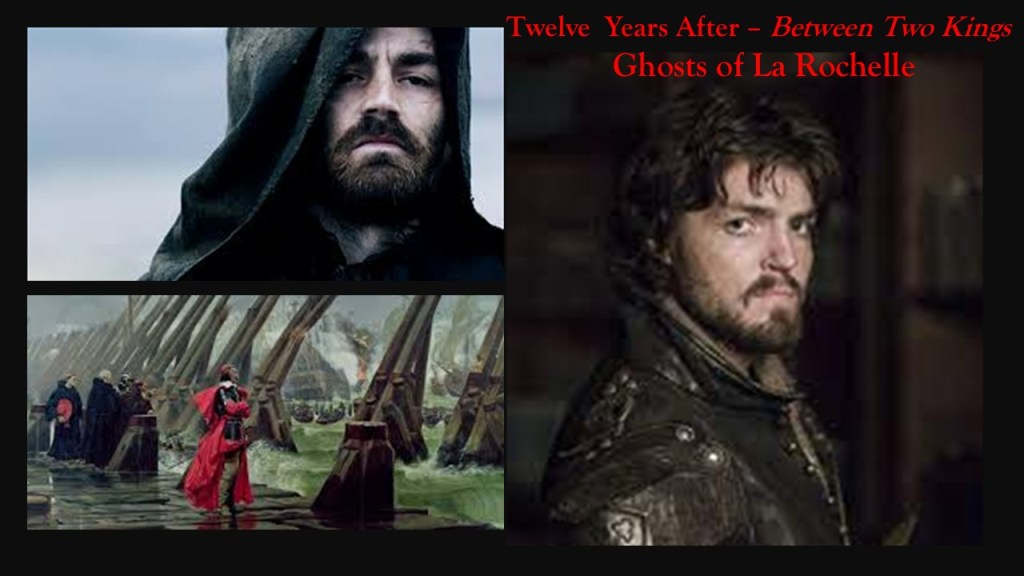
At the thin border between night and dawn, bird song is tentative, the full chorus to a new day wait for light. Marie de Combalet lays quietly in her bed, dark behind bed drapes closed against a chilly morning. The intermittent singing notes tell her the hour is late enough for Lucien to be already on his way to La Rochelle. Beyond the draped bed she hears the maid’s quiet voice admitting the footman, the soft thump of cut logs dropping into the box, a crackling of wood as he stirs the flame to life, soft rustling of her maid’s skirts, the sound of water pouring into a basin. Hot water is waiting for her. She sits up and swings her feet to the floor feeling for her mules and her heavy wrap at the foot of the bed. Marie moves with practiced efficiency through her daily rising routine, hot water, dressing, her warmest cloak settled over her shoulders. She opens the door of her chamber and stops short.
Lucien is pacing in the hallway, his heavy winter cloak draped to the floor, his hat held in his hand. He stops and faces her, noting her surprise. He makes a conciliatory shrug, ‘I thought to accompany you to Lauds.’
The walk to the de Vignerot family chapel is on a well-used path through the gardens to an open grassy area. The chapel is a single story, small unassuming stone building with narrow stained glass windows. It is set under tall chestnut trees, their spreading bare limbs stark against the weathered stone building. Spring is not far away, when these majestic trees come to life with new green leaves and soon after, a lavish blooming of pink flowers. Richelieu had the trees planted as a gift and after his death, she had not the heart to cut the trees down. Why should the tree suffer for his cruelty or her complicity. While she admires their beauty, the trees stand as a solemn reminder of her failures, as if she could forget and is compelled to pray for her sins and omissions.
Father Massey is at the chapel’s thick and plain door to greet them and two women from the village who attend regularly before their workdays begin. Lucien guides her to her customary bench and Father Massey begins the introductory prayer.
‘Deus, in adiutorium meum intende…’
Marie closes her eyes, silently her lips move with familiar prayers and intercessions and listens to the readings. Perhaps because Lucien is there, Father Massey concludes the brief service with an old hymn, nodding to Lucien to join him.
Through these days of penitence,
and through thy Passion tide
Yea, evermore in life and death,
Lord with us abide
For us he prayed for us he taught
For us daily works he wrought
by words and signs and action
Thus still seeking not himself but us
She closes her eyes as Lucien’s deep resonant voice weaves around her. His presence is commanding and filled with his vitality. The words he sings moves her deeply, she must grip tightly on her reserve to stop the tears the pool in her eyes. … I am not worthy … guide me on the path of motherhood…
Outside the chapel, a groom stands next to Lucien’s great black stallion. Father Massey hands a thick packet of correspondence to Lucien concerning the trade with colonies in New France and Marie’s missionary work. Father Massey then walks a few paces away to give them a last moment of privacy.
‘I am grateful for your presence this morning,’ Marie smiles up at her tall son. ‘I fear you are too penitent for your outburst yesterday.’ Her son ducks his head, ‘I regret my intemperate words. You do not deserve my ill behavior or any degree of my anger.’ She hears not only regret but a tremor of fear that she might withdraw from him, withhold her love.
She lays her hand against his cheek, ‘nothing could alter my love for you or my good opinion. I insist you banish that thought now.’ She seeks to lighten the mood and mocks an impish smile, ‘but prayer never hurts anyone does it?’
He cannot help his smile of relief and unexpectedly he embraces her firmly, a quick kiss to her cheek. ‘I shall remember your wise words,’ he mocks a serious tone. Then he is on his horse, sweeping his hat to her and turning the big stallion. The path is soon empty.
⚜️⚜️⚜️⚜️
The inner port at La Rochelle bristles with masts of ships moored to a dock or waiting their turn to have their cargo unloaded and their holds refilled with cargo and return to the sea. Their destinations are far flung – to ports in the Mediterranean or across the Atlantic to the North American ports of English and French colonies. Other ships, engaged in the slave trade sail south along the west coast of Africa, then across the Atlantic to the West Indies and South America, then north to the colonies and then returning to La Rochelle. At every port, captains empty and refill their holds with goods for trade. Outside the harbor more ships wait their turn to be piloted to the docks. La Rochelle is among the busiest and most important ports on the west coast of Europe.
Lucien walks the docks, stepping around the bawling stevedores ordering men shifting cargo from a ship or a long boat to waiting wagons and carts, working the ropes at the base of a treadwheel crane lifting cargo from deep in a ship’s hold. Wheeling screaming gulls compete with aggressive ravens and cormorants diving for food scraps among the flotsam washing up against the pilings. He breathes in the perfume of his trade, a distinct and pungent atmosphere created from a blend of the natural smells of the sea and the unpleasant odors of commerce. The sea air dominates, the fresh salty tang of the ocean, combining with the scents of fish and decaying seaweed, waste and debris clinging to pilings under the dock. Ships add the tang of tar, wet wood and musty canvas, a sour scent of unwashed sweating men. Added is the smell from cooking fires over heated braziers, smoke rising as vendors with small carts pile cooked meat or fish on a thick slice of bread and a small tankard of ale for a dock worker. It is an intoxicating blend of industry, ambition and waste.
He stops to watch two of his ships berthed next to each other being unloaded. There are two more in outer harbor, where many ships wait, drifting close enough to each other to trade a flask of wine or catch a tossed biscuit. Captains stand at the rails talking across the gap, smoking their pipes, and trading gossip and news of other ships, captains and seamen.
He walks the length of one arm of the dock that embraces the port on two sides. The St Nicholas tower that guards the entrance to the inner port looms large and forbidding. Directly across is the Chain Tower housing the winch controlling the massive iron chain that allows boats in and out of the port. He turns around to look at the busy dock teeming with dock workers, merchants, ship owners, clerks, customs officials, notaries and messenger boys. He remembers a time when the port was empty of ships, no sound except for the slap of small waves against the pilings. There were no ships, the treadmill cranes stood still, the dock deserted except for sea gulls and ravens staring out at the empty harbor.
During the siege of La Rochelle and its rebellious Huguenots, Richelieu had looked at the impenetrable walls surrounding the populous port city and decided to not to waste his army on an assault. Instead of picking up guns, Richelieu had his soldiers pick up shovels and ring the stubborn Huguenot heretics with seven miles of trenches. Forts were built to support the soldiers in the trenches effectively ending any landward opportunity to resupply La Rochelle. At the narrowest point in the port, Richelieu built a seawall on a foundation of sunken ships and installed artillery on the top of the wall closing off resupply to the city by sea. Richelieu had a stranglehold on La Rochelle. Only a few small ships managed to slip through the cordon. Lucien knew this firsthand.
The English Duke of Buckingham, Villiers, paid Benito to run the blockade and bring guns and supplies into La Rochelle. Benito had in his crew a native son of the Ile de Ré and the Ile d’Oléron, a man known on ship as the Huguenot. A seasoned smuggler, the Huguenot knew a few secret routes from both the Ile de Ré and the Ile d’Oléron to the city. The work was exceedingly dangerous, but they had success using the habitual fog for cover, wading through the salt marshes that surrounded the city or steering small boats or rafts from hidden coves. On one of their last trips, Lucien remembers the stench of rotting dead bodies as they wriggled through a crumbling section of the city wall. They held kerchiefs to their nose and mouth as they walked quickly toward the town center. The streets were eerily empty, the quiet unsettling. A few people slumped against buildings, unfocused eyes unnaturally large in gaunt hollow cheeked faces, not yet dead and hands outstretched beseeching them for help. There were no animals, the citizens of La Rochelle ate their horses, their dogs and cats, and rats when they could catch them, chewed on boiled leather and ate leaves and plants. The silence was pierced by wailing as starvation silenced its victims and death took children, husband, wives, sisters and brothers. He remembers bodies piled up against buildings, only a few rats that scattered as they came close.
They managed a few more trips before they were discovered. They barely escaped under a barrage of gunfire, he took a bullet in his back, dragged by Benito out of range of the soldiers’ guns. While the Huguenot tipped a flask of brandy into his mouth, ‘it’s a good time to get drunk laddie,’ Loup and Fou held him down and Ver dug the bullet out of his back. Years later, when he and Sophia first lay together, she traced the scar of that bullet asking him where he got it. He claimed not to remember.
Lucien walks back along the dock, wondering where his brother was while he was climbing over broken stone walls into a city where over twenty thousand people were starving to death. Of course, their deaths were considered a fault of their own making for being heretics and not true believers. He wonders if Athos thinks about true believers, Richelieu and the legacy their father has left to his sons. It is good that Athos is not here. He might have questions that Lucien did not care to answer.
He leaves the port area, walking to the Rue du Temple. His business office is located on the second floor in one of many tall office buildings that line the street. As he enters, his man of business, M Smal is leaning over the desk of an associate, M Diniz, the two men reviewing pages of a contract. Both men look up and smile and tug their doublets straight.
‘Your Grace!’ M Niels Smal has a thick Dutch accent and a broad face to match his shoulders and chest. He was the third son of a magistrate, well-educated but with no interest in the law or the clergy and took his education and ambitions to sea. He served as a purser on Lucien’s ship the Adele and had a reputation as a shrewd negotiator, and keeping excellent records and books. M Smal knew the business of shipyards, merchants, and trade.
‘Very good to see you, M. I have your correspondence collected,’ M Smal holds a page of the contract in one hand, pointing to a box on the table with the other. ‘All that?’ Lucien marveled at the size of the box needed to hold his correspondence. He hands a clerk a similar box of correspondence that will be sorted and sent by ship to their destinations in missions from New France to the Mediterranean as far as Constantinople.
‘M de Vry in Paris sends letters daily,’ M Smal replies, ‘to me as well. We anticipate a very busy spring. We have several ships in drydock for repairs. All will be ready to sail.’ He does not ask his master how he is in La Rochelle. Lucien Grimaud has a habit of showing up when he wishes.
‘Good,’ Lucien settles into a comfortable chair, ‘I want to see the list of ships and repairs first and then the contracts. Shall we dine together later?’ Paul de Vry would have reviewed any contract in minute detail and M Smal would also study the document before implementing it. Still, Lucien likes to read them too.
‘It would be my pleasure Your Grace,’ M Smal replies with enthusiasm. Dinners with M Grimaud are always entertaining, filled with the exchange of stories of past adventures at sea, plenty of wine and discussion of business.
‘Good, but until then I am starving. Kindly send for food and a boy to take a message for me,’ he adds, and picks up the list of ships. A messenger boy arrives, Lucien scrawls a message and hands it to the boy,
‘Do you know the tavern Salty Boar in Laleu?’ Lucien names a small village just outside the city walls. The boy nods, tucking the message into an inside pocket. ‘Good,’ Lucien says, ‘ask the man there for a man named Loup. The message is for him, and you will wait for his reply.’ He drops several coins in the boy’s hand. M Loup will give you the same upon delivery.’
Lucien is finishing the last page of ship repairs when the boy returns with a reply. Lucien hands the pages back to M Smal. ‘You have it well in hand M Smal.’ He notices the boy eyeing the tray of unfinished bread and cheese and pushes the plate to him. ‘Take it with you.’ The boy’s eyes light up, he refrains from grabbing the food, wrapping the bread and cheese in the small linen napkin Lucien hands to him, ‘thank you M.’ Lucien watches the boy tuck the linen in a pocket. Lucien wonders if the boy shares the food he gets with another. He had done that when he was a boy, alone in the forest or in the court of miracles. Every child who worked in the Paris streets turned out their pockets delivering what they stole or begged for the day. In return they were handed bread, a little cheese, maybe an apple. In those days he shared food with Flea. He doubts Athos ever needed to share food.
He walks quickly along cobbled streets to a narrow gate where the guard waves him through. Ver and Bulle are waiting for him outside the Salty Boar. ‘Fancy place Captain,’ Ver seems to be complaining.
‘Not enough grit on the floor for you Ver? The air can be breathed?’ Lucien asks, ‘or the wine is not sour enough.’
‘All of it,’ Bulle grumbles, agreeing with Ver’s assessment, ‘and no whores.’
‘Tragic,’ Lucien says, ‘where are the others?’ Bulle knows to whom he refers, ‘they are in a house not far, Crotte and Poilu are there.’
Lucien levels a look at Bulle, ‘they understand my orders.’
‘Yes Captain, I made sure of that.’
Loup is waiting for him at a table in a small alcove. With him is a visibly agitated man. He shifts constantly in his chair, eyes darting in all directions, smoothing the thin strands of hair on his head repeatedly. He is a man filled with dismay and anticipatory of something dreadful about to happen to him. He may be right.
‘M Ballesdens,’ Lucien says sitting at a chair that faces the room. ‘How kind of you to meet me.’
‘I thought if I just came…I know you are…’ He jerks fearfully at the elbow jab from Loup in his ribs. ‘He is Monsieur to you,’ Loup growls.
‘Yes! Yes…of course. I know Monsieur,’ Ballesdens is careful to emphasize the form of address, ‘that M was looking for me. Remembering the last time…I know I am late … uh.. well, I … I thought I should just come.’ Ballesdens flashes a quick smile, adding, ‘I will tell you Monsieur everything.’
‘Everything?’ Lucien raises his brow, ‘you know everything?’
‘Well .. I meant… I am nobody!’ Ballesdens cries desperately, ‘my…my wife…my wife saw… I have a son, a daughter …’ Ballesdens stammers wildly, ‘a man came and took a woman,’ he blurts out, his fear ungovernable. ‘Pardon M! There is more I swear to it! But I am nobody.’
Lucien blows out a slow breath and leans back in the chair … Athos was right …
Lucien drums his fingers on the table, leveling a long considering look at Bellesdens. How he handles this man is important, he must find the right degree of fear, where desperation seeks a ray of hope. It is another reason why Athos could not be here. He would not like the pressure Lucien is prepared to bring. Ballesdens is slumped in the chair, his head hangs down in defeat, as though he expects the sword at any moment and has no will to fight it. Lucien signals for another tankard.
‘Start at the beginning.’

 Twelve Years After