‘What ship is that!’ Odysseus shouts up to Crotte, high overhead above the lookout. Crotte looks down, not at Odysseus, but at a head poking tentatively through the lubber’s hole. ‘That’s it pup! Keep coming,’ he encourages the sailor climbing tentatively through the hole and into the lookout. The ‘pup’ grips the sides, his legs trembling with the effort and squeezing his eyes shut against the sun’s glare. He cranes his neck up to Crotte, sitting with legs wrapped around the crosstrees, wondering if he is expected to go higher.
‘Stay there,’ Crotte orders, his eye still to the glass and the pup breathes a sigh of relief.
‘Crotte!’
‘Three ships, no flags.’
‘No flags,’ Odysseus mutters mulling over the possible reasons for it. They spotted the ships to the west, moving steadily north, turning east as though to investigate the two ships cruising the shore. But whatever they saw did not interest them and soon the three ships were back on a northerly course.
He looks up again. Crotte is sliding down the backstays, the ‘pup’ climbing down at a sedate pace. He grimaces. At least the boy is willing. He did not hesitate when ordered to go aloft with Crotte. He came with the crew when they returned from a night in Vigo – drinking, gambling, and counting their remaining coins for a visit to a whorehouse. He is an affable fellow, and eager. The crew usually handed lubbers a blistering hard time but for some curious reason less so with this young man. Perhaps it was boredom. During this interminable watch duty over the Belladona, getting him shipshape had given the crew something to do.
‘Well, who were they?’ Odysseus demands as Crotte lands lightly on the deck. The young seaman follows him, hand over hand as his palms are not yet toughened enough to slide. He staggers slightly as he lands on the deck, legs braced apart and lowering his head to clear the wave of dizziness. The ship rises and falls under his feet rocking in the waves. He swallows hard to stop the rising of his stomach – again.
‘Spanish!’ Crotte declares and claps the shoulder of the young man on the shoulder. ‘Now tell me that wasn’t fun.’ Crotte beams, showing more gaps than teeth and thumps the shoulder of the greenish sailor, ‘what’s your name again pup?’
‘Blais,’ the youngster gulps in air, stumbling under Crotte’s heavy hand. ‘From Galicia,’ he adds although he was not asked.
‘Well, I figured that out for myself pup, seeing as how we picked you up in Vigo!’
‘Spanish,’ Odysseus returns to the more pressing matter of identification. ‘No flag.’
‘I do not need a flag to know a Spanish ship,’ Crotte replies amiably. ‘Spanish, all three. I seen one before – we fought her in the Cantabrian, did some serious damage, but she wasn’t sunk.’
‘There was only one enemy ship that survived the Cantabrian,’ Odysseus muses. But he has no reason to doubt Crotte. On land Crotte is hopeless, a poor gambler and easily entangled in the worst schemes. He could hardly be trusted to remember his name. But at sea, his mind and his memory were as tight as the rigging, his judgement sharp, quick and decisive. If Crotte said the three ships that appeared and disappeared in the distance were Spanish – then that’s what they were.
‘Where were they headed?’ Odysseus wonders to himself, scanning the sea again with his glass. But the ships are gone. He pauses his glass on the lone ship, the Belladona, still cruising to their lee. ‘She could be on a tow line she is so consistent on her bearing,’ he mutters to himself.
‘Probably St Malo,’ Crotte answers.
‘That’s a French port, a haven for French corsairs,’ Odysseus exclaims. ‘Why would three Spanish navy ships go into a French port?
‘Maybe to find their flags,’ Crotte laughs uproariously at his joke, ‘more than French corsairs in St Malo. In his day Benito ruled at St Malo and, but all manner of flags are there.’ Crotte looks in the direction the Spanish ships had vanished.
‘A right seaman givin’ the orders. You seen their little creep east to have a look at us? Smooth and easy like a hot knife through sailcloth.’ Crotte grins again. ‘What say you sailmaster? Shall Mr Fleury open his gunports, and we chase after those picaroon Spanish? Catch ourselves a prize? St Malo is a wonderful place for us rowdy seadogs and our captain has many friends in St Malo.’ He winks at the young man Blais, ‘there’s a lady there who knows her way around a man waiting for a nice young puceau such as yourself to wet your…’
‘Our orders say no,’ Odysseus interrupts Crotte’s lascivious description in a mild tone. ‘Fou had a bird yesterday. Loup and Ver are bringing the Cap’n back with them. How would that go if we were not here?’
Crotte grunts and claps a hand again on the young Galician Blais. ‘No love lessons for you pup, except knot tying and swabbing.’
⚜️⚜️⚜️⚜️
The westerlies are hard and relentless. A weak winter sun beats down, providing the only warmth from icy ocean water breaking over the bow soaking them at every tack. Lucien, Ver and Loup take turns at the wheel and haul sail as they race north, sheets taut hugging the coastline as close as they dare. They work together, coming about in practiced efficiency, sails luffing for the barest moment before filling again and then they off, whooping and hollering at their speed, angle and a biscuit toss from the rocks that reach out to smash the ship to pieces.
‘Cap’n,’ Ver is at the wheel shouting above the wind, ‘this wind is fierce!’
‘I reckon a rigged pinnace in this wind needs at least six to ten men.’ Lucien’s voice carries from where he and Loup are gripping onto the rope, feet braced and leaning back precariously over the side as ballast.
‘Oh good,’ Loup growls, ‘I thought for a moment we were undermanned.’
They laugh uproariously, three men wet and cold in a swift moving pinnace in an immense ocean against a monstrous wind and an unforgiving coastline.
‘When was the last time we used these guns?’ Lucien aims a kick at the cannon in the bow. On the deck below are three more cannons each port and starboard.
‘M Fleury takes the pinnace out with a couple hands now and then.’
‘So not all the time?’
‘More or less,’ Loup clarifies in his own way and Lucien laughs. ‘I regret to say I understand you Loup.’
They pass small fishing villages, built in sheltered coves, with long stretches of sandy beaches. Fishermen work on their boats or nets, their children wave and holler, racing with them along the sand. They pull into one such cove, drop sails and anchor close to the beach. Lucien tosses a long line to a young boy running out from the beach to tie the ship to a short dock. They trudge through the sand to a path leading to a village perched on the low headland overlooking the cove. At a small tavern they purchase dried fish, bread and cheese and sit outside on rough stools around an upended barrel serving as a table. They chat with fishermen and wash their meal down with cold spring water collected from a trickling stream down the cliffside. The sun dries their hair and clothes, stiff from salt water. All three are watching the fluffy fair-weather clouds on the horizon begin to billow upward, darkening to a bluish black, lighting flashes followed by the low rumble of thunder. The sea is kicking up gray green waves, choppy and white caped. They can feel the temperature is dropping.
‘I do not think we enough men for this,’ Lucien comments, ‘I suggest we fix the anchor and see if there is a room for us tonight.’
⚜️⚜️⚜️⚜️
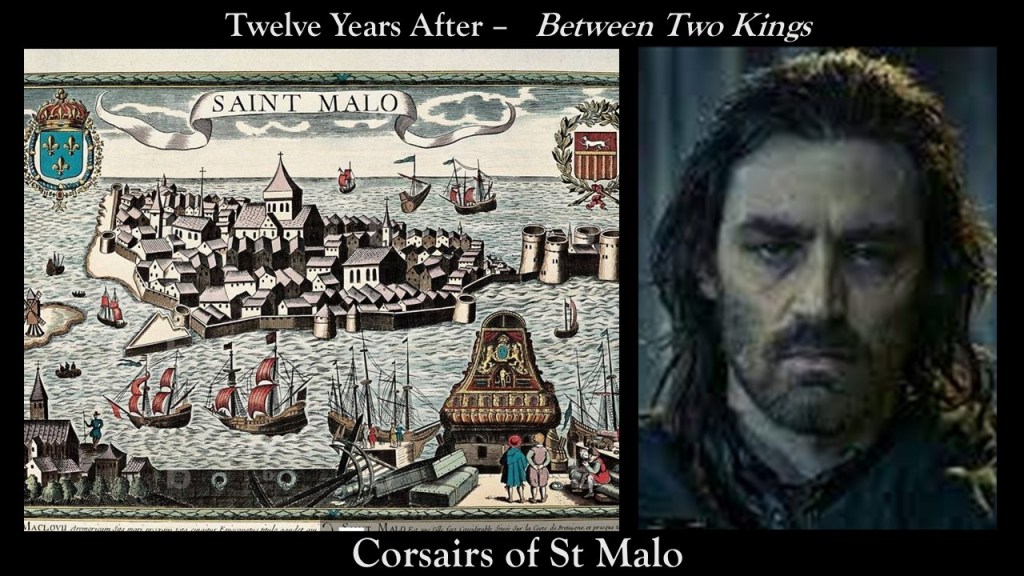
A storm is brewing on the distant horizon, but on the French coastal city of St Malo, the sun beats down on the old granite walls. The spire of the St Malo Cathedral, built in Gothic style, dark and grand, complete with arches, flying buttresses, ribbed vaults, and large stained-glass windows, reaches into the sky. The fortified city faces the open sea, the channel and the ferocity of the westerlies. Scouring waves wash up the wide sandy beaches to the base of the walls. The easy access to the open sea makes St Malo a center of seafaring and a haven for corsairs targeting merchant ships passing through the channel and the ocean. Ships fill the harbor, their sails furled, and flags stowed. Small row boats scurry back and forth between ships and the quay, carrying goods to waiting shop merchants and vendors for the open markets. Men wearing head scarves, rings in pierced ears and noses, eyes heavily rimmed in kohl and with fierce expressions lean on the rails of their ships watching the bustle of commerce on the quay. Those off ship roam the streets between taverns and whore houses wearing loose pants and shirts, sleeves rolled up to display brawny arms covered with tattoos and banded with bronze or gold bracelets. Shirtless men on the docks load and unloading their long boats, muscled chests and backs covered with tattooed symbols and images of animals. They stare at strangers with open suspicion, a hand hovering not far from a dagger in a belt.
Five men walk the quay outside the walls, mounting the tall stone steps to an arched gate to the unpaved street. Three tall confident bearing men carry a weathered navy coat with scarlet facings, the coat worn by Spanish naval officers, over their arms. In contrast, the two other men wear the remnants of military dress, a faded doublet, the long waist length coleto, patched breeches and tattered shirts. Their shoes have holes stuffed with paper, some tied with string to keep the shoe separating from the sole. Between them they have enough coin for drinks and a meal. They enter through a low door into a dark tavern, windows too grimy to permit sunlight. The grit on the floor crunches under their feet, the fire sputters uselessly, but the wine is generously poured and the cooking smells from the kitchen give them hope. They sit at a table away from the general crowd, the serving girl brings wine and bread, promises of fish stew to be ready soon. The five men secretively survey the room for anyone paying too much attention to them. But the crowd is raucous, concerned with the usual banter between men who tell and retell embellished pirate stories of battle and plunder, common to those who make their living stealing on the high seas. Mixed in are accusations of cheating at cards or dice and skirmishes over a woman. The languages are as varied as the men in the room, French, Portuguese, Irish, English, Spanish, Dutch, Swedish and a few others they cannot identify. No one is paying particular attention, but this is a French city port, and they must be cautious. Their enemy has many friends here.
‘Por nuestros hermanos caídos,’ Pedro Lous de Guevaro Mogano, captain of the Sagrio, currently at anchor in the Saint Malo harbor, salutes their fallen comrades, lifts his glass and looks each man in the eye, ‘we share their loss.’
‘We vow to take vengeance for their murders,’ Captain Don de Velasco, captain of the San Isidro, also at anchor in the harbor, raises his glass and the five men drink a solemn tribute to their dead.
‘We also share poverty, Capitaines.’ Alonzo Dosma says bitterly. He was a master gunner in the Spanish navy, serving on the Madera under Captain Berreto. Alonzo Dosma sailed with Captain Berreto for many years before the conflict in the Cantabrian. He stood with his captain, both men gripping the rail as they watched the San Pedro sink beneath the waves, all hands lost, including his beloved uncle, Captain Pedro Guevaro.
‘Yes,’ Captain Mogano nods at the three men, ‘we have been mistreated. Regardless of which side we served, the political stage was not set by us.’ He looks around the table. ‘Let us tell you what we have learned.’
‘The King has decreed that the duque del Infantado and the Frenchman, the Grand Condé, are to blame for the entire conflict. The duque paid for Spanish ships to interfere with the French ship Aigle, to prevent the Infanta from reaching Pheasant Island in the Bidasoa where she was to be married to the French King. We know the duque and Condé were supported by the Company of the Orient to pay the captains and the mercenaries to fight both the French and Spanish ships loyal to our King.’
‘The captain of the Aigle is Lucien Grimaud, the so called duc du Plessis,’ snarls Diego Elcano. ‘He and his King are to blame for the murders of our family.’ Diego Elcano brings his fist down forcefully onto the table. He lost two cousins on the ill fated Donacella.
‘We did not want to fight against our own ships and men,’ Diego says carefully, ‘but we have not been paid our wages.’
In fact, no seamen were paid for their service in the Cantabrian. Did any of them understand the political nuances at the heart of the conflict? Spanish ships fought each other, their captains, deeply divided as were the men serving under them, manning the guns, the wheel, the sails, and ordered over the rails into vicious combat with each other. They watched friends and family die in the Cantabrian. When it was over, and the royal marriage concluded, it was left to ordinary seamen to bear the brunt of the entire affair. Regardless of which side they fought, none received promised pay, each side scorned, both claiming the other was responsible. The offices of the Company of the Orient were quietly closed, and no clerk or director could be found. But they have found the Aigle, belonging to the French privateer Lucien Grimaud.
Only one thing is clear to these men. The Aigle and the ship that sails in consort, the Takhar, joined with Spanish ships to bring the Spanish Infanta into Bidasoa estuary to Pheasant Island. They are responsible for the sinking of Donacella, the San Pedro and the San Carlos. The Rosario was crippled but managed to limp back into port. However, Captain Padilla was killed in the action.
‘Did you see the Aigle on your way here Captain Mogano?’ Alonzo asks eagerly, ‘I long to see her through the gun port, sight my cannon and blow her out of the water.’
‘All in good time my friend,’ Captain Mogano replies, ‘the Aigle is formidable, swift and with excellent gunnery. We will get one chance with her and her crew. More important than seeing the Aigle is that we did not see the Takhar.’
‘The rumor is that the Takhar sailed for Hispaniola weeks ago,’ Captain Don de Velasco of the San Isidro interjects. Captain de Velasco’s wife lost her father on the San Antonio.
‘There is another ship near the Wrecks, the Belladona,’ Captain Mogano replies. ‘We know that ship is out of Hispaniola. We should ask ourselves why the Ogre sends a ship to the Wrecks. Is the Ogre now working with Lucien Grimaud? We do not have good intelligence on it.’
‘That seems unlikely. You think the Belladona would support the Aigle?’ Captain de Velasco says in a speculative tone. ‘The Ogre sends the Belladona to wait for the opportunity to attack the Aigle and use the Wrecks to the Ogre’s benefit. We can use that. They would come to our side. He looks around the table, ‘there are three of us and without the guns of the Takhar, the Aigle is at a disadvantage.’
‘We capture the Aigle and take her as a prize,’ Alonzo Garrido has a hard expression and speaks forcefully, ‘we could recoup all our losses. We would be rich!’
There is a general murmuring of approval. Garrido presses his argument, ‘we capture the ship and kill the crew. No one survives against a Spainard and his sword! But we should try to capture her captain. The French King would pay a good ransom for one of his favorites.’ He looks at the third captain at the table, who has remained silent.
‘What do you say Antonio?’
Antonio Tejara is the current captain of the refitted Rosario. On land he is a quiet man with steely pale eyes that watch and miss nothing. When he speaks, the others fall silent.
‘Captain Padilla was a good captain, a loyal subject and an honorable man,’ Antonio Tejara says in a soft voice, more terrifying than if he stood on the table and shouted in his captain’s voice. The voice his men hear when gale winds threaten, or cannons belch fire and death.
‘Captain Padilla was an honorable man. He suffered a bitter death, fighting against men he valued, trusted and counted as friends. The French used us badly and for Captain Padilla’s honor, I want revenge.’
He looks around the table. ‘I have also heard as you, Garrido, that King Louis favors the duc du Plessis and recently honored him at court. Nothing will satisfy me than for this French duc to suffer the same ignominious death as did my captain.’
The men exchange nodding glances of agreement. ‘What do you propose we do to him?’ Alonzo Garrido asks.
‘A common pirate’s death. Execution by keel hauling. That is the death Lucien Grimaud deserves.’
⚜️⚜️⚜️⚜️
On the other side of the room, an intense conversation holds the attention of captains and quartermasters assembled around a table. One man, Edward Cornelly, quartermaster on the Sa Revanche, half listens, his attention drawn by a group of Spanish soldiers lifting their glasses together. He cannot hear their conversation and wonders idly what they are saluting. St Malo is home to many, but still, the Spanish make a rare appearance in this French port. He glances at his captain who has followed his gaze and is also considering the Spanish group of men. Captain de Clisson looks back at him with a questioning look. Edward Cornelly makes a noncommittal shrug and both quartermaster and captain turn back to the table.

 Twelve Years After