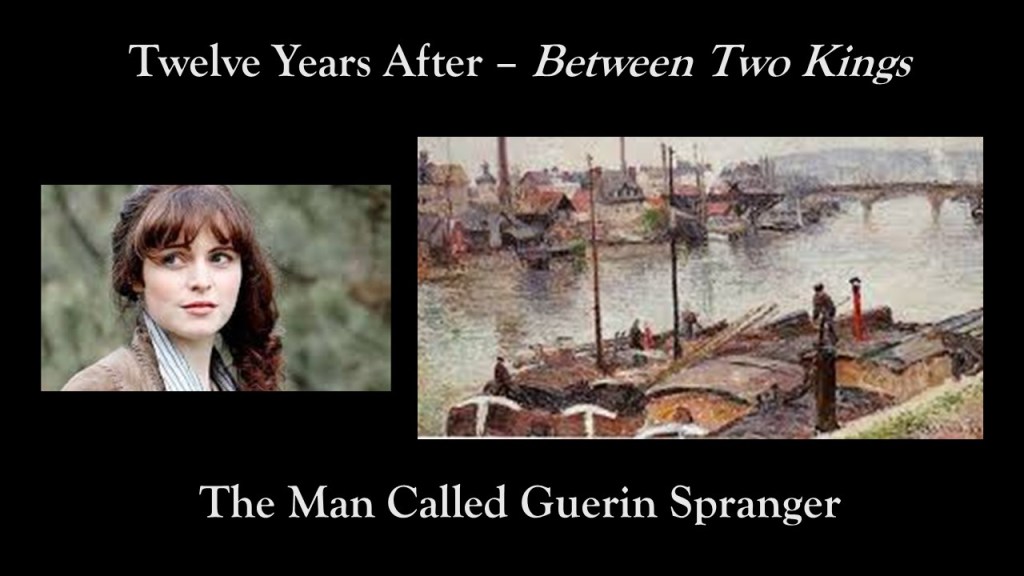
Rouen…
‘Who is this man, Guerin Spranger? Do you or Lucien know of him?’
‘And if we did?’ Captain Peter Eastman raises a questioning brow to the man beside him. Gérard Leroy is a wealthy successful merchant in Rouen, a restless man constantly seeking investment opportunities. Peter Eastman and Lucien Grimaud are known to be successful in multiple ventures and M Leroy has tried several times to join their syndicate. Lucien Grimaud keeps a tight circle of men around their activities, both on the sea and on land.
Captain Eastman and M Leroy stand on the deck of a river barge, on the Seine River. Their journey began in Le Have where Captain Eastman unloaded the cargo from the holds of the Merry Adventure, Captain Eastman’s flagship. It has been a long day’s journey to Rouen where the cargo will clear inspections and be stored in warehouses. Merchants will be on the dock, most of whom have contracts, others who will bid for certain items. The barge is on the last stage of this journey, the dock in sight. Both men are wrapped in heavy cloaks, hands kept warm in expensive fleece lined leather gloves. Captain Eastman watches the docking maneuvers with sharp observant eyes. He is an experienced captain in positioning ships in calm and rough seas, especially when attacking and boarding enemy vessels. Or, in bringing in a barge against a dock.
‘He is a Hollander,’ M Leroy explains, ‘selling land here and near La Rochelle. He claims to be an agent for a lawyer, William Kyrtle.’
‘Guerin Spranger had contracts to provide supplies with the Dutch colonies in Brazil. He made his fortune in the trade between Amsterdam and Brazil. But, the Portuguese are pressing their interests in the same region. I understand that Meneer Spranger is looking for investors for a venture to establish a colony of his own on another island in the Caribbean,’ Captain Eastman says. He does not add that Lucien had once been interested in Guerin Spanger’s trading business but one visit to Brazil convinced him that the Portuguese would ultimately win the contest and passed on the opportunity.
‘Yes, he has answered my letters with the same points,’ M Leroy replies. Eastman nods. M Leroy can be aggressive in his business, but he is not a fool.
‘Perhaps it is part of his scheme to raise the funds. What land is he selling?’
Gérard Leroy shrugs, ‘he has documents for a considerable amount of land north along the coast and more parcels near La Rochelle. I have not yet seen a map, but he is offering good prices for prime locations. You know how this goes. Desperate Catholics escaping England and frightened Huguenots escaping France – all needing to sell and buy. A land agent can hardly miss!’
‘It only works if these agents are authorized to act as a broker for the landowner,’ Eastman counsels, ‘otherwise, they are land pirates.’ He wonders if Lucien knows of these sales near La Rochelle. He makes a mental note to include it in his message to Lucien. He looks back at Leroy, ‘their barely legible documents with smudged seals will not pass the test.’
‘So, you would advise I not put my money with him,’ Leroy is pensive and then brightens. ‘I can offer a good price for your cargo instead.’
‘My cargo is already purchased,’ Eastman replies evenly, ‘invest with Spranger if you are interested in a Dutch colony in the Caribbean. Be sure to get the receipts for it. It is not necessarily a bad investment, but the map checked against the recorded boundaries will tell the tale. Take the map and walk the land. That is my recommendation and on this point I can also speak for Lucien Grimaud.’
‘I thank you for your candor,’ M Leroy say, ‘I will pursue it as you advise. My regards to the Duc du Plessis.’
Captain Eastman watches the oarsmen in the pilot boats nudge the barge into position to bring it smoothly alongside the dock, mooring ropes tossed and secured to the docking post. Simon Margus, son of his man of business, Jacques Margus, waits for the barge to be snugged up tight. The gangplank is set in place and M Leroy and a few other passengers leave the barge.
‘‘Warfies!’ Simon shouts to the group of dockworkers and with no further orders needed, they swarm from the dock to the barge to transport crates, bales and barrels into the waiting horse wagons. The customs inspector and port clerks arrive to collect dock and port fees and complete their forms. Simon Margus and customs inspector check the cargo against the manifest. Jacques Margus looks up at Eastman, still on the barge.
‘Looks to be an excellent load Captain Eastman.’
‘Scottish wool and Swedish iron, among other things,’ Captain Eastman smiles enigmatically. He is pleased with the docking, the cargo listed on the manifest and the cargo not listed on the manifest and the fortune he will have for it. Simon Margus notes the family name and crest stamped on each crate and bundle.
‘Murdoch wool,’ Simon exclaims. He is a young man, long brown hair tied back, the oldest son of Jacques Margus. His friendly ocean blue eyes and affable energetic nature belie a shrewd sense for details in completing paperwork and computational skills in settling fees and bargaining prices. He also knows what undeclared goods are hidden underneath that precious wool.
‘We can renegotiate the price with the mill,’ Simon raises his knowing brow to his father. The senior Margus nods sagely, staying a step back to allow his son full authority.
‘Eudes!’ Simon calls to a burly dock worker holding a cargo hook in one hand supervising two men handling large crates, ‘put those crates in the last wagon,’ he points to the crates stamped with the name Murdoch and the family crest. Eudes nods and signals for men to accompany him. ‘
“We will get it loaded and taken to your warehouses Captain. I will post a special guard tonight.’ Simon looks meaningfully at Eastman and walks away to talk to the wagon drivers.
Jacques Margus extends a polite hand to Peter Eastman who waves it away and jumps nimbly from the barge to the dock. ‘Simon has this well in hand,’ Eastman comments to the senior Margus. Up and down the long busy quay, barges and small ships are moored and from the shipyards farther away come the sounds of ships under repair, hammering and sawing, the clang of metal and shouts of ship’s carpenters. Behind the quay are shops catering to the business of the port, the offices of the port officials and many taverns. Across the river is the old fortress, its inhabitants secreted and quiet behind thick walls peeking through vegetation, the moat full and sluggish at high tide.
‘Allow me to buy you a glass of wine,’ Captain Eastman claps a friendly hand on the senior Margus, a man of older years, his face lined and weathered but still trim in form, graying hair tied back. He has a demeanor of vigor and sharp intelligence gleams in his deep set blue eyes under thick craggy brows.
‘With pleasure,’ Jacques Margus replies, and the two men stride along the dock to a nearby tavern with a two story inn frequented by merchants, sea captains and ship owners who need to stay close to their ships, merchandise, and warehouses. They find a table by the window where they can watch the bustle of activity, talk business and exchange gossip. Captains and merchants stop at their table to chat, and the time passes pleasantly.
‘Simon is doing well Jacques,’ Eastman comments. ‘You must be pleased with him.’
‘I am and he has given me a third grandson this past winter.’
‘Congratulations!’ Peter exclaims lifting his glass, ‘to your family’s health and prosperity.’
‘Aye,’ Jacques chuckles, leaning back in his chair and surveying Captain Eastman with an assessing but fond expression, ‘I am satisfied that my eldest son is content to succeed me with you and Lucien.’
‘Lucien has said he will miss your old stories.’
Jacques smiles, ‘your father has the better stories, and Lucien his own tales from his days with Benito on the Burla Negra. But if he likes, we can always get drunk and make up new stories.’
‘So, what are you doing on the dock today? Eastman teases, ‘missing my father?’
‘Your father was a good friend to me. One of the truly rascally pirates that plagued every ship from every nation from the colonies to Calais. The sighting of the Happy Days was a sad day for others,’ Jacques raises his glass in a silent toast and a touch of nostalgia. ‘He was not a brutal man, only interested in the business. Now your father is on his estate in Savoy, overlooking the sea, sitting in a comfortable chair watching his grandchildren play in the garden. He worked well into a pardon and a retirement with his lady and his fortune.’
‘And his head attached to his shoulders,’ Captain Eastman comments. ‘Aye!’ Jacques smiles, ‘he and I were very young when we started working together, ‘a clever man. As are you Peter.’ He slants a sly eye at Captain Eastman.
‘Did your father ever tell you who gave him his license?’ He refers to the letter of marque that allows a pirate to cross over the vague boundary from criminal to the merely shady practices of privateers. Peter shakes his head.
‘The old red fox himself,’ Margus says with a chuckle.
‘Richelieu!’ Captain Eastman exclaims.
Jacques nods, ‘an unlikely coincidence is it not? Given you sail in consort with Lucien Grimaud. The Cardinal set up the network, highly efficient, and no one saw his hand, save your father and me. We still use his warehouses for certain crates and bundles.’
‘I did not know that. He built solid warehouses,’ Eastman admits and exchanges a conspiratorial smile at what contraband that lies under the wool in the Murdoch crates. ‘Didn’t the old King make Richelieu’s niece the Governor of Le Havre?’
‘Maneuvered by Richelieu I imagine,’ Margus chuckles. She was tasked with examining all the port documents to verify that the treasury received its due revenue. She sent a report to the King. And money flowed.’
‘Did she know?’
‘No, of course not. The lady would never have countenanced it. But the Cardinal knew how to compose documents and keep ledgers. It all looked very legal.’
‘I assure you Jacques, the Duc du Plessis knows none of this,’ Eastman insists wondering if he should tell Lucien. It is not the type of information to be included in a pigeon post.
Margus shrugs, ‘why should he? All of France smuggled then and now. If Richelieu were still alive, I would not tell you this, but our time is over, it is all ancient history. You and the duc forge your own paths. It is as it should be. I am pleased that my son will continue with you and Lucien as I did with your father.’
‘And the father of the Duc du Plessis,’ Eastman adds. He sees Simon Margus walking towards him.
‘Captain Eastman, the mill managers are waiting for us.’
‘Waiting for you Simon,’ Captain Eastman claps his new business manager on the shoulder. ‘I leave the negotiations in your capable hands. I must return to Le Havre to see Obi before I sail on the tide.’
‘Where is next?’ asks Jacque Margus.
‘St Malo.’
⚜️⚜️⚜️⚜️
Agnes Bernard walks the paths through the manicured part of the garden to the rear wall, ducking through a low gate to an ungroomed path. It meanders through low shrubs and stiff grasses to a path along the bluffs overlooking the sea. The woman who serves as her maid, follows at a discreet distance and behind the maid at another discreet distance is the young Lieutenant Maillard. He, along with the Marquis de Normanville, brought her to this house and he is the only guard. But there is little danger. Local villagers nod and smile as they pass by her but otherwise pay no attention to her. Agnes walks carefully as the immediate danger comes from tripping on the path, which at times is remarkably close to the edge of the bluff. Lieutenant Maillard is a welcome presence. He does not intrude or attempt polite conversation, allowing her privacy to meditate on her own thoughts. He seems a man who is comfortable in the countryside and the bracing sea air. Maybe he reflects on his own thoughts.
She comes to a copse of oak trees, twisted and bent by the strong ocean winds and stops to look out over the ocean. It has been a long time since she has seen Henri and she is desperately worried about him. The marquis reassured her that Henri will join her, although she does not know when or what happens after they are reunited. She only has the maid and Lieutenant Maillard for company, with no other visitors since arriving at the house. It has been a long time since she has seen Henri and while she is accustomed to being in her own company, but still there are moments of intense loneliness, the empty hours filled with memories. She walks the bluffs and through scenes from the past- the village where she met Henri’s father and their brief happiness, Henri’s early years in the village, fleeing Paris and then France, finding safety in a marriage to a wealthy man who surrounded her with comforts and security, and a future for Henri. It was the Marquis de Normanville who had gently explained to her that her marriage was most likely not legal, a man hired to impersonate a priest. It was never a real marriage. How could she have been so blind to the truth? Father Duval had married her to Henri’s father and she knew the sweet intimacy of true love and marriage. She bore him a son. She had not questioned Cesar’s lack of interest in marital relations with her. Maybe she was relieved.
Bicetre ripped away the veils from her eyes. In the complete fall from a wealthy man’s pampered wife to being chained to a wall, left in squalor to die alone and forgotten by that same man, Agnes faced the truth she could never have fully realized – the horror of it, the danger to Henri. In the days following her rescue from Bicetre, she sank into a shameful despair that she had accepted too readily a wealthy man’s smooth assurances and failed to protect her son. Henri had never been safe and that was her fault. She shrank from the people around her, ashamed of the consequences of her decisions, the state in which she was found, unable to face the pity she expected. Now she wonders … where was her anger? Cesar practiced deceptions and murdered the innocent. Where was her anger?
In the safe house in Paris, under Henri’s care, her wounds healed, and in the pastoral setting at Royaumont, she grew stronger. With gentle insistence, she was drawn out of her room, accompanying the elder Duchess to prayers, helping Sophia deliver gifts during Noel to the estate families, to join the family dinners, slightly raucous affairs, lively and unorthodox as the children were seated among the adults. It was the children who made it easy. Rosie took her hand to guide her to sit between her and Renee. The boys chattered about their studies and made plans for walks in the woods with their tutors, eager for her to join them. Later, in the family salon, she sat with the others on the settees while the children played games or performed a piece on their instruments. The younger girls took up their needlework showing her their progress.
She was aware of the reasons these families had to leave their homes and flee with her, first to Royaumont and then to Glenay. The men were considerate, the women kind, and she was encouraged to use their Christian names: Sophia, Constance, and Elodie. She was welcomed into a kind and generous company, but never under scrutiny or judged. Rochefort had aimed his evil at all of them, including their children.
She glances down the path watching the maid and Lieutenant Maillard draw closer. As she waits for them to catch up, she remembers one particular morning – a chance meeting with young Samyar and his father. She asked if she might borrow a book from the library and was encouraged to do so. While perusing the shelves, young Samyar burst into the library in the middle of lively chatter with his father. ‘My apologies, Your Grace, I did not know you had returned from riding.’
‘We have just come from an adventure seeking the noblest of stags,’ the Duc du Plessis feigned a grand tone in honor of the stag. ‘Madame, you are welcome to be here.’
‘May I help you Madame,’ young Samyar asked eagerly, ‘what do you like to read? History or a novel?’ He pointed out books, pulled them from the shelves, handed them to her for inspection. Soon her arms were full of books. ‘Here is one by the priest de Sales that I read with my tutor. There are also wonderful books on nature and if you…’
‘Samyar,’ his father laid a gentle hand on his son’s shoulder and carefully relieved her of the stack placing it on the table. ‘Please allow Madame Bernard to answer one question before asking two more.’ Samyar blushed, ‘of course Madame. I do have a wonderful travel book in my room. I will just go and get it.’ He hurried from the room, leaping the stairs two at a time.
‘Oh dear,’ Agnes was apologetic, ‘I have upset your quiet morning.’
‘A quiet morning is an unknown creature in this house. My son is an avid reader, and pleased to find a kindred spirit,’ the duc replied, ‘it is no disturbance Madame.’
‘My son was also an enthusiastic reader at that age and still is,’ Agnes said with fond pride. She glanced at the duc. ‘‘Your Grace,’ she hesitated, ‘you will recall that I remembered meeting you, from years ago, when Henri was a baby and I was walking with him to the border.’
‘I do,’ he replied, leaning back against his desk.
‘I remembered your voice,’ she said. ‘I could hardly ever forget the frightful circumstances in which I heard it. You were traveling in a carriage with a lady who showed great kindness to me.’ She ducked her head realizing she may have made an error. ‘Pardon me Your Grace, I did not mean any disrespect to Her Grace…’ She thought to lower her eyes, but in a silent moment, he fixed her eyes with the intensity of his gaze.
‘There is no reason for pardon, Madame. You met Beatrice, still now among the dearest of friends from my earliest days in Paris, and long before I was married or she too for that matter. You should not have been alone on the road. No one knew that better than Beatrice.’
Agnes looked down, not knowing what to say. He kept looking at her. ‘Do you still blame yourself?’ he asked gently into the silence. He was genuinely curious, and she wondered if he meant then or every time since.
‘Not entirely,’ she answered honestly, ‘his intention to use me to work Henri into his evil plan…for that, I am angry. My part was to be naïve.’
‘And yet Rochefort failed and here you are. It is my experience Madame,’ his voice was quiet, ‘that by the time I learned what I really needed to know, the moment when it would have been useful was long gone. But the lessons were not a waste. I ask that you not judge that young mother on the road too harshly.’
The memory fades and Agnes looks out at the long horizon, drawing in a deep breath of bracing sea air. Lieutenant Maillard joins her in admiring the view of the sea. ‘A beautiful spot Madame.’ She studies his strong profile, noting the slight melancholy in his expression.
‘Lieutenant Maillard,’ she asks boldly, ‘is it a young lady that causes your pensive expression?’ He turns to her, surprised and then shakes his head with a shy smile, ‘I apologize Madame….’
‘Whatever would you apologize for M?’ Agnes says kindly, remembering the duc’s daughter, Mlle Rayya in company with Lieutenant Maillard. He ducks his head and slants a shy look at her, ‘I do think of a lady while on these walks.’
‘I am glad of it,’ she replies impulsively. He smiles again. They listen to the sounds of the sea – rolling swells of the ocean stretching endlessly into the distance, waves crashing against the shoals, white foam spraying up. Below is a pristine beach, birds crying out and swooping low for a fish. Lieutenant Maillard glances at her. ‘Are we turning back Madame or shall we walk on?’
‘I wish to return to the house,’ Agnes says, ‘I have several letters to write that I would like to entrust to your care.’
‘I am happy to be of service Madame,’ Lieutenant Maillard replies looking curious. ‘To whom shall they be delivered?’
‘After my son and I depart,’ Agnes explains, ‘I would be grateful if you would give the letters as addressed to those who remain in Glenay. I … I wish to convey my gratitude.’ She looks up at him.
The lieutenant smiles and nods, ‘as you wish Madame.’
⚜️⚜️⚜️⚜️
Le Havre
Benoit Demare, Constance’s older brother, pushes open the door of the tavern and scans the room. There is a card game at every table, and more men seated on benches and clustered in groups around the wooden pillars or leaning against the walls. The crowded room is noisy, the air thick with the smell of closely packed bodies, wine and cooked food. Serving women carry trays of food, but for wine, the men must go to the serving bar and pay before they can drink. From across the room an African man waves at him, holding up a tankard of wine. Benoit lifts his chin and walks in that direction.
‘Obi,’ Benoit Demare takes the tankard of wine and drinks deeply. The two men move to a private table and Benoit looks around. ‘No word from my brothers?’ Obi points to a windowed alcove. Malcolm, his youngest brother, is in a card game, Hubert sitting behind him reading a book. Benoit shakes his head and Obi chuckles, ‘only Hubert could read in the middle of a tavern.’
‘At least they are here on the right day,’ Benoit grunts and murmurs appreciatively at the bowl of hot fragrant stew a serving woman sets in front of him, adding a substantial chunk of fresh bread. He glances at Obi.
‘Did they have anything of interest from up north?’
‘The watchers spotted a Dutch frigate in the bay at Cran Poulet and another at Ningles. It was poorly organized, a swarm of people on the beach. But nothing in comparison to what happened farther south,’ Obi answers. Benoit frowns, ‘what happened?’
‘A skirmish between three Spanish privateers near the Wrecks,’ Obi replies.
‘The Wrecks? Is that ship still there?’
‘It was and so was the Aigle.’
Benoit stops eating and looks hard at Obi. ‘Is Lucien alright?’
‘Yes. There was a message from Captain Clisson. She was in St Malo and saw the captains. The watchers who saw most of it. Your brother, Huber has the details but has not shared them, despite being asked numerous times for the story.’
‘What does Huber know?’
‘Apparently Lucien pulled off some sort of stunt with a pinnace against one of the galleons and lived to tell the story!’
‘He would live, but he would never tell the story,’ Benoit grunts, ‘there is no man more reluctant to brag or fire his reputation than Lucien Grimaud.’
‘Huber will give you the details. Lucien is chasing one of the galleons. He sent a message from near La Rochelle – asking about the captain of the ship Belladonna. Do you know it?’
Benoit nods, frowning, ‘he knows that ship is from Hispaniola, an Ogre ship. We were not able to identify her name from the headlands. He wants to know her captain?’ Obi nods.
‘The last I knew of the Belladonna, she was in African waters, her captain a brute named Wijard. He tried the take the Wrecks once, lost a longboat and twelve men. A fool of a captain.’
‘The Belladonna took one the Spanish galleons as a prize.’
‘Whoo!’ chortled Benoit, ‘Lucien has cause to doubt it is Captain Wijard?’
‘Apparently, the captain did not kill the entire crew. Set them into a boat.’
‘That definitely does not sound like Wijard.’ Benoit shrugs, ‘no idea.’
‘Captain Eastman was here earlier,’ Obi says, ‘he delivered his cargo to Rouen. Simon Margus is stepping into his father’s position. The cargo is now in the warehouse across from the old fortress. Captain Eastman mentioned Guerin Spranger selling land parcels.’
‘Guerin Spranger selling land?’ he looks doubtful. ‘Perhaps he found another way to fund his colony venture in the Caribbean. Auguste sent me a message about a similar scheme around La Rochelle, in fact close to the village Esnandes, which overlooks the Aiguillon bay. The Duchess’ border runs close to the old Rocheford estates.’ He taps his chin thoughtfully. ‘I had not given it much thought, but now, I wonder …’
‘Send all of it to Lucien,’ Obi advises, ‘it is never good to decide what he wants to know.’ Benoit nods in agreement and looks at his brothers, ‘I better gather them up. Is there a room for us tonight? Tomorrow, we will ride to meet Auguste and Theo outside Rennes.’
‘Something amiss?’ Obi asks.
‘Our mother demands we all come home. She wants one of us to go to Glenay and see our sister. There has not been a letter or any message since they arrived there.’
‘As the eldest, will you go and deliver a stern message?’ Obi asks. Benoit reacts visibly. ‘Oh no!’ he declares forcefully. ‘We beg off from that commission, pointing to obligations to our wives and children. We always send our youngest brother Malcolm to deal with our sister. He is still unmarried and too affable to be ruffled by her sharp tongue. Besides, Malcolm adores her children, and they adore him. She cannot turn him away.’
⚜️⚜️⚜️⚜️
Glenay
‘Ahoy the gate!’
Martin leans over the rampart and scowls at the mounted man grinning up at him. ‘Malcolm Demare! Are you lost? Did you row that horse here?’ Martin gestures to the guards below. ‘Open the gate to this picaroon.’
Malcolm Demare jumps from his saddle and leads his horse into the courtyard, unfazed by Martin’s sarcasm. ‘Martin!’ he waits to embrace the scowling mercenary, descending the steps.
‘You never change Martin! You are as reliable as an oak tree … and about the same size.’
Martin cracks a smile clapping Malcolm shoulders soundly between his two strong hands and adding a good shake. ‘Why are you here? Come this way, there is food and drink in the barracks.’ Martin strides off, Malcolm falling into step next to him, surreptitiously rubbing his bruised shoulders.
‘My sister,’ Malcolm says. ‘I am on a mission from our mother who wishes to have news of her only daughter. I believe she would like me to add recriminations for lack of letters about her grandchildren, but that rarely goes well with Constance so I shall…’
He breaks off at the sound of a high pitched squeal from a child. ‘Good grief,’ Malcolm mutters turning in the direction of the distressed child, only to see a small boy, kicking up a cloud of dust, hurtling himself in his direction. Transfixed, Malcolm watches the small tornado and then cries out, ‘Alexandre!’
He catches the boy in mid stride and swings him around high in the air. ‘My favorite nephew!’
‘Am I?’ Alexandre shouts with joy, ‘I saw you from the window in our school room. We did not know you were coming Uncle.’
‘Well, I did not know myself, but here I am!’ They stand back, hands to hips and survey each other happily. Malcolm looks past Alexander to a tall slender man smiling as he hurries across the courtyard to retrieve his pupil, priestly robes billowing around him. Behind him is his sister, Constance. She is not smiling.
‘Your tutor has come to recover you,’ Malcolm says, deciding not to comment on his mother’s demeanor. ‘Now go quietly and I will see you after your lessons.’ He bows to the tutor, winks at Alexandre.
Constance gives him a severe look, and turns to her son, ‘you should not have dashed from the school room as you did, it was quite alarming for Brother Francois and Brother Aloysius. You must apologize.’ Dutifully, Alexandre apologizes to his tutor and walks docilly back toward the house turning repeatedly to look back at his uncle. Malcolm waves and smiles broadly.
‘Stop that!’ Constance snaps, ‘you show too much enthusiasm Malcolm. Why did you not send a message that you were coming. I would be better prepared.’
‘For what?’ He teases her, ‘it is only me. Huber thought all of us should come…’
‘What? All five of you?’ Constance looks aghast. He grins, ‘our mother agreed, and we …’
‘Are they on their way? All of them?’
‘Benoit had the final word and so it is just me. Why send a message?’ he shrugs, ‘you would only tell me not to come. Is your husband away?’ He looks hopeful.
‘No.’
He shrugs again and smiles at her, turning to take in the mansion and the expansive grounds. ‘Magnificent,’ he says admiringly and then looks at her. ‘I am glad to see you sister. We know it was not an easy journey to come here.’
‘I have not forgotten that we have eyes everywhere,’ she replies. ‘And ears,’ Malcolm reminds her. ‘Come on,’ Constance softens, ‘you must be hungry. I will arrange a room for you and take you to the duchess. Did you bring clothes for dinner?’
His smile holds a slight regret. He touches her cheek, a gesture of brotherly affection. ‘Mother packed everything so I will not embarrass you. But I will stay in the barracks.’
‘Malcolm! You are my brother. You should stay in the house.’
‘It is because I am your brother. If Lucien were here it might be different, but I will stay with the men in the barracks and cause you as little trouble as possible.’ He does not mention her husband, but they both know that is the trouble he wishes to avoid for her.
‘Oh Malcolm,’ she takes his arm resting her head against his shoulder as they walk toward the house, ‘I am happy to see you.’ She feels a little overwhelmed with a sudden wave of nostalgia for her home, her mother and her brothers. ‘You must tell me all the news of the family, our neighbors, the gossip – everything. Promise!’
He plants a kiss on her forehead, ‘Huber and I saw a scraggly group of pirates on the beach near Calais, and then in the village we heard of a story of a woman who fell, hit her head and no longer recognized her husband, so he…’ She giggles, playfully slapping his arm, ‘yes, everything.’
⚜️⚜️⚜️⚜️
‘You got it Rosie! Just move the ball forward to Alexandre,’ Malcolm calls. Brother Francois and Brother Aloysius hike up their robes to demonstrate. Malcolm fixes a warning eye on the older boys who are dancing from one foot to the other in anticipation of their turn, ‘take it easy lads, there are young ones here too.’ They nod, as they are good lads and eager to comply.
Constance leans back on her hands. Juliet’s eyes are wide at the commotion. Her brother is organizing a restrained game of le soule. So far, it has gone at a slow and sedate pace to accommodate the younger children. She remembers when her brothers played this game with friends in the village, a far more raucous running game ranging over fields and jumping over hedges. She ran after them, not allowed to play of course, but eager to cheer for her brothers. After the game, Benoit or Auguste would swing her up to their back and trot home through the fields, pretending to drop her into a stream or a haystack as she laughed and shrieked happily.
Malcolm is taking small, restrained kicks at the ball, made of leather and stuffed with hay. But the boy still inside the man cannot resist a few feints with Alexandre, Samy and Olivier and soon they are chasing each other across the field with Rayya, Charlotte, Rosie and Renee clapping their hands cheering. Malcolm feigns a slip and tumbles into the grass, Samy and Olivier tripping over him and then all the children are rolling the grass tossing leaves and grass at each other, laughing. The two priests slowly restore order, the children brush off their clothes and follow their tutors from the field back toward the house. Malcolm plucks Juliette from her arms and they walk behind the children.
‘Lucien will be sorry he missed this game,’ Malcolm declares.
‘I recall all of you playing on the beach,’ Constance says smiling at her memory of her brothers, Lucien and others chasing the ball, tackling and tossing each other into the sea, the whooping and hollering. She glances at her brother carrying her daughter. She has not traveled to her family home. Other than Malcolm, Alexandre and Juliette do not know their grandmother, uncles, or cousins. Constance does not miss village life. She likes living in Paris. But she does miss her family and wonders if her decisions are selfish.
‘I should have written to mother by now,’ she says abruptly. ‘But it can be hard, Malcolm, to be here. There are so many of us and we are thrown together constantly. The children get along, but there are the inevitable squabbles and then we must tip toe carefully not to blame and cause more problems. There is little peace or time to sit and write a letter. I long for the time Charles and I can return to our home. It is that fiend Rochefort who has caused all of this! I hate that man!’
‘Rochefort?’ Malcom is astonished,’ that is a name I have heard from Auguste. Rochefort, like the name of the estate. Auguste has been telling us about a land selling scheme, a lawyer selling parcels of abandoned estates. One of those estates belonged to the Rochefort family. I believe it is close to the Duchess’ lands.’
‘What?’
‘Yes, in fact, the boundary of the Rochefort estate is near the little village of Esnandes. Auguste was sure that the old Rochefort estate was being divided into parcels. Lucien will want to know of a selling scheme, given the nearness to his mother’s lands.’
‘Hmm,’ Constance murmurs, but stays silent. This is information that would interest Lucien, and Athos. She knows they believe Rochefort took Alessandra from Saintonge and is keeping her somewhere – but where? Rochefort has too many properties to search effectively. He could easily move her from one to the other. Sophia had no messages from Lucien as to when he would return.
But she could tell Athos.
She cannot forget the day Athos brought the news that Alessandra was missing, his face pale with worry. It broke her heart to see him that way. Ever since she has been plagued with a vague worry that she might have, inadvertently of course, played a hand in Alessandra misfortunes. She never liked the woman, considered her scheming, a ruthless dissembler and deserving of a severe comeuppance. Here they all are, fugitives from the King and Rochefort, trapped first in Paris, then Royaumont and now Glenay. Athos is drawn and silent, yet still he leaves his little daughter alone for long periods to search for his missing wife. Milady de Winter always manages to divert everyone’s attention to her mischief.
But her sense of guilt lingers. She wonders if Athos realizes how close they are to the old Rochefort estate, abandoned and apparently being sold off. He is still at the beach house with Bianca and the duchess but when he returns she could bring him this news and if it turned out to be important …
She cannot change her opinion of Alessandra, but she might contribute to righting her own wrong, if in fact it was wrong … she quibbles with herself. It would feel a relief and she does want to help Athos.
‘Who was it who was selling the Rochefort parcels of land?’ she asks Malcolm.
‘A man called Guerin Spranger.’

 Twelve Years After