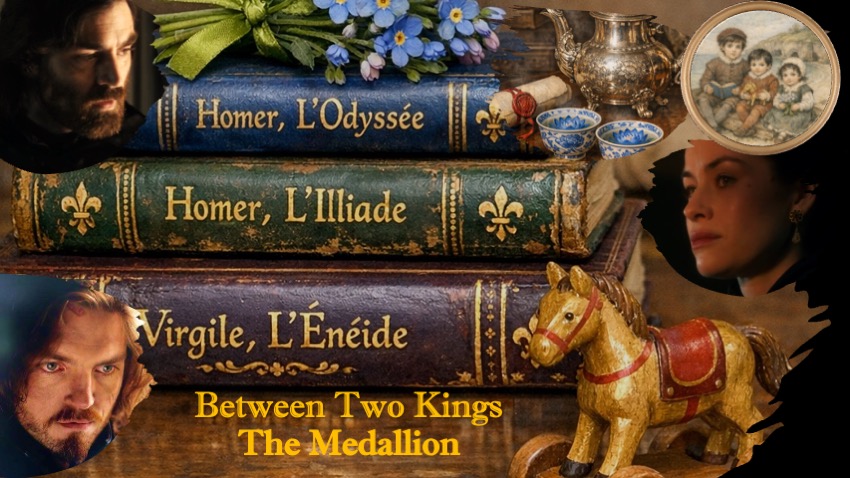
There are good moments when hope is not fleeting. Athos is not pessimistic by nature, and a life lived by the sword, on battlefields, teaches not to waste precious time in anticipation of a future that is unpredictable. Alessandra cannot be convinced that the world around her is not a dream to shield her from a reality that is full of horrors. Athos got a glimpse of what those horrors are like, but after that one night, she keeps her nightmares to herself as valiantly as she can. Athos marvels at her tenacity but wishes she trusted him enough so that he could walk with her back from the darkness.
It is a good moment when Petite or Raoul visits, and, if they are together, a better moment still. Their newborn brother, they are only allowed to see from a distance. Madame Bourgeois insists that until the baby is stronger and gains weight, she will allow no one to come close to him except his mother, his father, and his wet-nurses. The two physicians do not object to her rule, even though they do not always see eye to eye.
They do not see eye to eye when it comes to Alessandra. Dr. Prujean argues that fever, abuse, and the deprivations she endured for too long, must inevitably affect her perception, even if her eyes are healing. But Dr. Guenaud disagrees. He claims much better experience than Dr. Prujean when it comes to ailments such as Alessandra’s. Among his patients he includes Layla even though he is careful never to mention her name. But Lucien does, and Sophia too, when Athos shares these different and alarming prognoses. Lucien adds himself to Dr. Guenaud’s examples without hesitation, and, to Athos, the trust that Lucien’s confession denotes is profound. He and his younger brother have come very far in a very short time. Still there is one thing which Athos will share with no one, a rare consensus among both physicians and Madame Bourgeois: that Alessandra should not have any more children. This, Athos has decided, he will keep to himself, and when Alessandra is better–as he is convinced she will be–he will share it with her only.
“Did you bring these?” Alessandra opens her eyes after a slumber prolonged by the administration of one of Sophia’s infusions. Athos left the bouquet with the forget-me-nots on the table by her bed, and Philipote, the maid, put them in a smaller vase, next to the vase with Petite’s morning flowers.
“They were Petite’s idea.” Even though it is true, it is also true that for days, Athos has felt compelled to deliver these flowers as if it is a bargain he struck with fate. He is vexed to hear himself evading, but even more surprised to see in Alessandra’s eyes, which she has fixed on him, a glimpse of disbelief combined with amusement. This is the Alessandra he knows, the Alessandra that Dr. Prujean tells him is not returning. She draws in a deep breath and closes her eyes, but Athos counts on that fleeting moment, so he pushes: “You think this is still not real.”
“I think that you are not telling me everything,” she replies tiredly, keeping her eyes closed.
“Well, of course I am not telling you everything. You would do the same in my place. You are very ill,” Athos protests.
“Alright then. A simple question. Why are we at Glénay?”
Athos has not thought of a good answer to this question, which is not simple, even though it is not unexpected. “Because it was the closest place to be. You are very ill.”
“This seems to be your answer to my every question and it makes no sense to me, even though I am so very ill.” She sighs, resigned. “No. I don’t think this is a dream, because Raoul would not be leaving for Paris if it was.”
⚜️⚜️⚜️⚜️
“Watch the flower.” The duchess d’ Aiguillon is pouring hot water from an elegant silver teapot into Athos’ delicate chinese teacup. “Father Adam Schall von Bell sends me this rare gift from China, where, by the Grace of God, he finds himself an advisor of the Emperor Schizu, and Director of the Imperial Observatory and the Tribunal of Mathematics, and has procured permission for his Jesuit brothers to build churches and to preach, already converting thousands himself.”
Athos smiles a mischievous smile. “By the Grace of God and perhaps with a little help from a generous patroness?”
His mother clicks her tongue feigning a stern tone and wagging a warning finger. “Do not be blasphemous!” Athos mocks an obsequious bow and she smiles. “Now, watch the flower!”
He gasps, for it is truly a magnificent sight, the large lotus flower in his cup slowly unfurling its blue pedals, and yielding its secret beauty and subtle aromas to the warmth of the water. “This is exquisite,” Athos marvels, tasting the delicate infusion.
“It is God’s beauty of which we grasp a mere glimpse,” his mother says, and takes a seat at the other side of the small table set up elegantly in her private salon. She picks up her own cup, “I am glad to hear that you are hopeful for Alessandra. Dr. Guenaud certainly agrees. Dr. Prujean, on the other hand, he is…”
“Always more cautious.”
She smiles at her son’s diplomacy, for she trusts Dr. Prujean as much as her younger son and his wife, whose family physician Dr. Prujean has remained for years. “Exactly. Cautious. And the baby, I am told…”
“There is hope for him. He thrives a little more every day, every hour it seems.”
“I understand that Bonne has made an excellent impression on my grandson, even though Louise thinks Bonne unprepared for her role.” The duchess sips from her cup and sets it on the table between them. “Bonne reminds me of her grandmother, Marguerite, when we were both young.”
“I am as guilty in judging Madame Charbonneau too quickly as Madame Bourgeois is in judging her granddaughter.” His mother slants him a knowing look. “And I saw my error.”
The duchess has fixed that knowing look. “Unlike Lucien? This is why you are here, is it not?”
“Mother!”
“We may have been apart for a long while, but I am still your mother, and his.”
Athos sets his cup on the table and sits back drawing a determined breath. “Unlike me, Lucien has not been quick to judge Tatie May or anyone else. But, Mother, unlike me also, Lucien is disinclined to revisit that past, which you and I value greatly and strive to remember. I ask that you no longer belabor the point with him.”
For a moment she looks surprised and then reaches for his hands, her eyes flooding with tears, although she smiles. “You have not changed. Always protecting your brother. Gentle Sage,” she whispers and Athos narrows his eyes perplexed and perhaps a little vexed–not unlike Lucien, he realizes–but she presses his hands and insists. “That is the name my dearest friend, Bianca, Alessandra’s mother, gave you when you were a boy, and it was perfect. Bianca had a rare gift, to see immediately at the very depth of someone’s heart. It is how she painted.” She lets go of his hands. “I will embarrass you no longer. And I will no longer put pressure on Lucien. But…” her demeanor has changed, composed and businesslike. “There is another pressing matter. I am sending letters to Paris with Raoul and Marie Cessette, among them a letter to Anne and a letter to Louis.”
Athos suspects what his mother is about to say. He dreads it. “Mother, perhaps…”
“No.” Her tone is austere. Before him is the woman the Pope consults Athos realizes. His mother stands and walks to her escritoire, where she unlocks an inner drawer, removing a large rolled parchment and a seal ring. “I think you know what these are,” she says, returning to sit across from him and setting them on the table next to the elegant silver teapot and the delicate porcelain cups.
Of course, Athos knows what they are. He recognizes the seal. “I cannot…”
“You can and you must,” she interrupts him. “The title is mine to bequeath as I deem appropriate and at my discretion according to your father’s will. Whether he had anticipated this moment, I am not sure, but he always knew you were his son, unlike Lucien, whom we tried to keep hidden from him.”
“I will have nothing to do with that name!”
“That name is your name, whether you like it or not,” she says bluntly, “and this is not about your wishes.” Athos begins to object but she raises her hand. “This is about duty. I could speak to you about how this title ensures the future of your children, but you already know all this. The duty you must adhere to is your duty to your family, this family, and at this moment. Your brother carries the burden alone but now you must share it. The walls of Glénay may be fortified and your men and your brother’s men may be ready to fight, but to protect this family we must use our power.”
“Politics!”
She raises a knowing brow. “ Pére de Paul and Pére Massey would caution that politics is a human measure that degrades what is divinely given, and I agree. However, saints are rare and to be practical with human affairs when one lives in the world is also a divine gift. As we find ourselves besieged, we must afford ourselves of the gifts and blessings we have been granted or we waste God’s gifts. Everything is politics. Even the church. Especially the church. Your father understood that well. I daresay I understand it at equal measure.” Better, Athos marvels, and it strikes him that his mother is the most powerful woman he has ever known, more powerful than Alessandra’s aunt, and that his mother’s power is different from any man’s; different from Richelieu’s. Quiet, understated, and intentional. “We are told that Rochefort is reinstated,” the duchess continues, “and what this means remains unclear to me. I know the man by reputation, but I knew his father and he was odious. I surmise that Rochefort poses the same grave threat as before, only now he has Louis’ protection. We can speculate about what Rochefort has to offer, but I say it is of no importance because there is much that the King of France–not Louis, but the King of France–needs more than twenty ships over here or some convenient deal over there. Yes… I know… your brother will not fully agree with me on this matter, and I understand his reasoning. But I also know Anne. I know how she raised her son. This is not about fearing God, this is about summoning God’s power on earth, which a King, ordained by God is destined for. That power ultimately derives only from the church which has been there before Louis and will be there after he is long gone.”
Athos nods in agreement: “It is my understanding, from my days as ambassador for Venice, that Louis aspires to become the defender of Christendom.”
“He does indeed. And he will need God’s grace and wisdom to guide him in his worthy cause.”
Athos smiles at his mother’s subtlety and her incomparable political acuity. “And who else can deliver that to any earthly prince but His Holiness?”
“Anne understands the predicament well and I am certain that her son does too. Rochefort’s leverage over Louis depends on what he can offer. We claim no such leverage because we are who we are. Me, your brother, and, now, you. Louis must contend with who we are.”
“Is this what you wrote in your letter to him?”
“I do not need the King’s permission to bequeath my fortune to my heirs. Nevertheless, it is in good form to acknowledge the King’s good grace in this and all matters. Our family and his family share long-standing ties, our connections deep-rooted and cherished.”
Athos slants a scowling gaze at the rolled parchment and the ring between him and his mother. “Can I not even think about it?”
She returns a small encouraging smile. “It will be here for you tomorrow.”
⚜️⚜️⚜️⚜️
When he enters Alessandra’s chamber, Athos finds Lucien seated at his chair next to Alessandra’s bed, only he has angled the chair so that he sits with his back to the door. Athos rests his hand gently on Lucien’s shoulder and his brother turns. “Ah, you are back,” Lucien remarks. “She is sleeping, and I wanted to keep her company.” Athos pulls another chair carefully, and sits across from Lucien but close enough so that their whispered talk will not disturb her.
Lucien smiles a wry grin. “So… are you the duc de Richelieu yet or do I have to bear the burden of our monstrous legacy by myself?”
Athos opens his eyes wide with surprise. “You know?”
“Just a lucky guess,” Lucien teases.
Athos sits back crossing his arms over his chest, and in the same wry tone, says: “I have until tomorrow.”
Lucien raises an impressed brow. “More than I was given, but you are her eldest and her favorite. Did she complain about me, finding excuses not to join in reminiscing with the two of you?”
“We did not reminisce,” Athos says quietly.
Lucien frowns, his demeanor changing. “You said something to her, didn’t you?” He glares at Athos with hooded, angry eyes. “What did you tell her?”
“That people remember differently. That not everyone wants to remember.”
Lucien sits back crossing his arms over his chest mirroring Athos’ posture, still frowning: “When did you turn into an advocate for the forgotten ones?”
Lucien’s words strike Athos deeply. Stay quiet and I will return, Athos promised his little brother the day the armed men came. It was a dark place where he left his brother waiting, like a crypt, at the back of Tatie May’s house, where Athos still refuses to go. Athos never made it back for his brother. He was taken that same day, and his brother was left…forgotten… Athos pushes back the haunting memory. “When I finally decided to understand my wife,” he says gently.
The light in Lucien’s eyes has changed again, Athos notices, and his frown has softened. Lucien leans forward in his chair, toward Athos. “I have a confession,” he whispers and from inside his doublet he pulls a battered book with brittle yellowish pages that Athos recognizes even before he reads the fading title on the cover. “When our mother sent me to that infernal house at the cove that you both cherish so much, your… Tatie May… she mentioned there were some of your old books… I thought to bring you this.”
The book was not randomly chosen and Lucien will never admit it, but Athos feels he can push a little: “Did you read it?”
“No… Well…” His frown returns and it is deeper. “No. I don’t care much for the Illiad.” He sets the book into Athos’ hands.
“Thank you,” Athos says simply. “I very much cherish this book. It is Alessandra’s favorite. Petite’s too.”
“Well there’s more,” Lucien adds, pulling out a small delicate object from his doublet. “Your Tatie May, she… You left before she returned this to you as she promised, she said. I don’t know why I had to carry it for her, she could have brought it to you herself. I suspect it is another one of our mother’s little conspiracies,” Lucien grumbles. In his hand he is holding the miniature drawing that Alessandra’s mother had made, set in the simple medallion-frame where Tatie May has preserved it all these many years: three children seated on top of an overturned wrecked boat at the cove. The same boat Alessandra’s mother has painted over and over. “I admit,” Lucien is saying and he is no longer complaining nor jesting: “I decided to keep it for a while, and it was not difficult to find excuses, just as I can find excuses to avoid our mother. Don’t ask me why I kept it.”
“Alessandra’s mother made it.”
“Do you remember that day?” For the first time Lucien sounds genuinely interested to know.
“I remember a few things,” Athos replies. “I am not sure that I remember that very day.”
There is defiance in Lucien’s tone as he declares: “I remember nothing. I have looked at that child long enough to know that I don’t see myself.” He smiles wryly, turning the small medallion in his hands. “You on the other hand, I can see that child being you. And Alessandra, I see her too.” He fixes his eyes not on Athos but on the little vase with the forget-me-nots next to Alessandra’s bed. “Did you bring her the flowers?”
“The ones in the drawing?” Athos evades. “I am told that I did not. We were not allowed to leave the house and Guillaume got them for me, I am told. I do not remember.”
“That’s not what I asked,” Lucien teases leaning even closer to Athos with the medallion in his hand. He points to the drawing: “This child, the wide-eyed bookish boy I see here, he definitely gave her the flowers.”
“Lucien?”
At the sound of Alessandra’s voice, still hoarse from sleep, both men manage to draw away from each other quickly, Lucien springing to his feet and sitting at her bedside, and Athos standing up and walking to the other side of her bed.
“Good afternoon M’lady,” Lucien teases.
She draws in a deep breath and blinks at him sleepily. “They make me sleep all day,” she protests.
“They–including Sophia–are right,” Lucien mocks a stern tone.
A faint smile crosses her lips, and she narrows her eyes, as if a new idea occurs to her. “Lucien, why are we here? Why are we at Glénay?”
“Because you are very ill and it was the closest place to where we found you,” Lucien replies.
Alessandra frowns and points to Athos. “That’s what he says.”
Lucien feigns surprise, while slanting a quick alarmed look at Athos. “And you don’t believe him?”
She shakes her head. “He is a terrible liar.”
“But I never lie to you.” Lucien persists valiantly on this futile line of dissembling.
“Then what were you two whispering about?”
“This and that…The flowers Bianca brought you,” Lucien says and Athos realizes that Lucien is equally unprepared. It does not solve their immediate problem, however, that Alessandra must be kept calm and that she can know nothing which may distress her.
Athos sits at the other side of Alessandra’s bed. “He was asking me about the forget-me-nots, just as you did. Remember when you asked me who brought them?” he coaxes unsuccessfully.
She frowns and shifts her eyes from one man to the other, her expression impossible to decipher, as if she sees them both for the first time, and then, to their horror, she fixes her gaze on the medallion that Lucien forgot to shove into a pocket and still keeps in his hand. “What is that?”
“Ah, nothing. A silly trinket!” Lucien sounds as awkward as he looks.
“Alessandra, you should drink some water, you must be thirsty,” Athos attempts an even more awkward distraction.
She ignores him. “I want to see it!” she demands pointing to the medallion.
“Alessandra, you must not get upset,” Lucien protests.
“I am upset already. I am always upset these days. Give it to me!”
“You must not exert yourself over a silly trinket,” Athos reaches for her hand, alarmed by her agitation, but she pushes him back.
“If it is a silly trinket, and if you care that I do not exert myself, then let him give it to me!” she stretches out a persistent but quivering hand.
In Lucien’s eyes, Athos sees despair that matches his own, as well as the only possible way to put end to this agonizing ordeal. “Alright, alright,” Athos agrees, signaling Lucien.
Alessandra sits up on the bed, against the headboard, refusing Lucien’s and Athos’ assistance. She takes the medallion carefully in the palm of her hand as if it is some sacred relic, and Athos wonders if, somehow, she recognized it from the moment she saw it. Alessandra turns it over, and upon seeing it, she covers her mouth with her hand to muffle a loud sob that escapes her lips. Lucien swears under his breath. “Good God, Alessandra!” Athos frets.
“She made this,” Alessandra repeats, trembling. She raises her face, drawn and pale, her eyes darting between them, flooded with unshed tears. “I did not dream this, did I? It was not a dream. I was there.”
Lucien looks as baffled as Athos feels. “Come love, give it to me now, that’s enough,” Lucien coaxes, reaching for the medallion but she holds it back, close to her heart and fixes her eyes on Lucien, a choked chuckle escaping her lips. “Sweet Mischief,” she whispers, opening her arms to him. He smiles an affable but perplexed smile and embraces her, just as she opens her arms again but to Athos this time: “Gentle Sage,” she whispers and Athos knows what she means, having heard the name from his mother. Alessandra holds them both tightly in her arms in a fit of tears and laughter that is as perplexing as it is infectious.
⚜️⚜️⚜️⚜️
They sit side by side on the bench outside Alessandra’s chamber, Athos and Lucien, each man holding his head in his hands. They sit in silence, the medallion and the old book of the Iliad between them, and it is past midnight.
“Putain d’ enfer, if that was not a complete disaster, I don’t know what is,” Lucien is first to break the silence.
Athos raises his head. “I wonder if there was a way for Alessandra to learn the truth that would not have been disastrous in her condition.”
“I can think of a few. I am sure you can too.”
“How did Prujean put it? At least you two did not kill her,” Athos says.
“Now, I would not take that to heart,” Lucien objects. “Prujean is my physician and a good physician too, but he always exaggerates.”
They both sit back stretching their legs, their eyes fixed to the coffered ceiling. It is a small muffled chuckle that breaks the silence this time, and it comes from Lucien. Athos slants a curious look. “Gentle Sage,” Lucien teases, “if that is not a misnomer I don’t know what is.”
Athos shrugs, in a nonchalant manner. “Maybe it was meant as a euphemism. Whatever it was, I promise to kill you if you ever mention it to anyone, Sweet Mischief.”
They sit in silence for a while again, and again a small muffled chuckle breaks it, only this time it comes from Athos. “Don’t!” Lucien threatens, but it is too late, for they are both overcome. “It is ridiculous,” Lucien growls at the end of it. He sits up, more frustrated than relieved.
“I disagree,” Athos replies gravely sitting up also. He picks up the book that lies between them, opens it to a certain page, the scene where Achilles kills Hector, and shows it to Lucien. Not the text, but the boy’s hand that writes in the margins, practicing his letters, both in small case and in capital letters: “Xanthus, XANTHUS, XANTHUS”, and signing his name under his work with great pride: “Lucien.”
“To me there is nothing ridiculous in this,” Athos says gently. “It is a promise that I failed to keep. My promise to you. But I never forgot. Not for a single moment.” They sit in silence once more, overcome by something else, even though neither of them dares acknowledge it.
“So, what will you do?” Lucien asks in the end.
“What I must, no matter how distasteful the title,” Athos says. “It is time that I do my share to protect this family.” He turns to Lucien. “What about you?”
“I am summoned to a parlay, it seems. But before that I will see our mother.”

 Twelve Years After