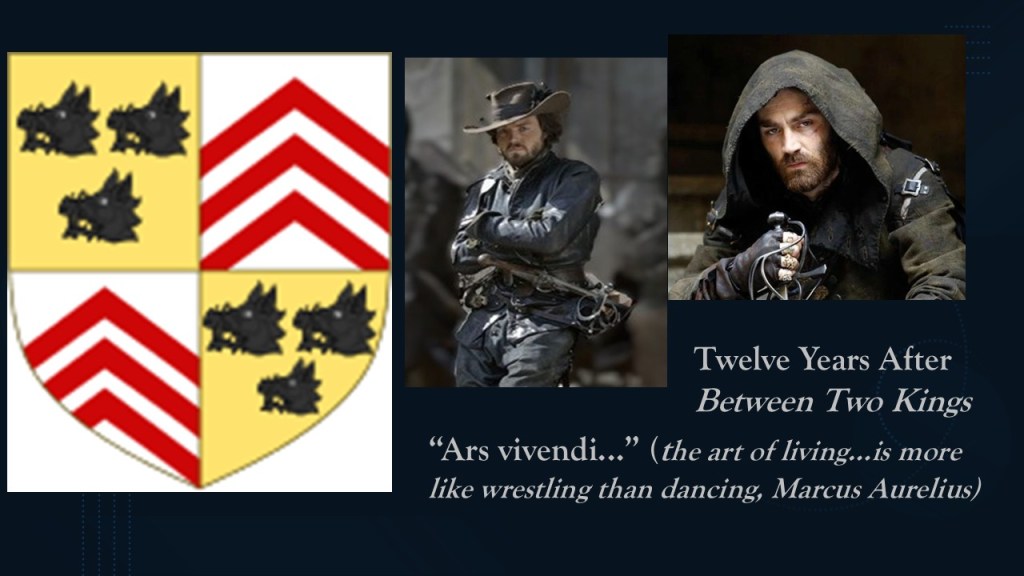
The art of living…is more like wrestling than dancing, Marcus Aurelius
“Lastly Madame, the Comte de la Fere has reviewed the wine list ….” Marie listens with distracted attention to M Mael, faithful boutellier at the Château de Glénay, as was his father before him, serving her father, René de Vignerot de Pontcourlay, and her grandfather the Seigneur du Pontcourlay. As it was with the housekeeper Mme Rolland, the stablemaster and head gardener at Glenay, Royaumont and many great estates, where the families of servants move across time with their noble occupants sharing their fortunes or misfortunes and keeping their secrets.
M Mael slows to shuffle a few papers, and Marie pauses to wait for him. They are walking through a gallery, one wall lined with family portraits, tall windows on the opposite side. A large portrait catches her attention. Marie looks up into the eyes of her father. It is like looking into Lucien’s eyes, swirls of green and brown, flecks of gold and banded with blue. Like Lucien, her father’s eyes are knowing, intelligent, his expression firm with a faint hint of amusement curving his lips. René de Vignerot du Pontcourlay had been a handsome man, his dark hair worn long brushing his broad shoulders. He has a neatly trimmed chin beard and moustache favored in his time. He faces the observer, arms crossed, a familiar stance of Athos and with the same easy muscled grace, a man of refined manners and innate charisma. He wears his formal uniform with the confidence of a soldier who knows himself in battle. Marie sees her sons, her father’s grandsons foreshadowed in him, a father she barely knew as his life was lived at the court in service first to Henry IV and then Louis XIII.
…they should have known their grandfather…
It is a forlorn thought, an empty wish for what might have been. Her father would have found a way to keep them safe at Glénay, taught them to ride and fence, saw to their education, she would not have been separated from them… father…they should have known you … they do not know our family … their family … if only you were here to tell the story. It is left to me…a poor storyteller…
Their ancestors, hers and her sons, ancestors before René de Vignerot du Pontcourlay were noble by the sword, owning lands and properties in the western provinces, but they lived modestly, valuing economy and hard work. They managed their lands with fairness to their tenants and administered the affairs of local people living in villages. What set her father, Athos and Lucien’s grandfather, apart from his forebears was being elevated to service in the royal court, a consequence of his extraordinary skill and courage in war.
It was at the Battle of Arques where, unhorsed and surrounded by the enemy, René showed true valor in hand-to-hand combat defending his king and others around him. King Henri rewarded him with positions on councils of state and privy and made him a gentleman of the King’s chambers. René excelled at his duties and was popular among courtiers. Marie smiles, as her father, like Lucien, loved to sing. He played the flute and was a gifted storyteller, spinning thrilling accounts of his travels, people he met and adventures.
Also at court was his good friend and fellow officer, Francois du Plessis de Richelieu who held high positions of responsibility and his wife, Suzanne de La Porte, a wealthy aristocrat. René became acquainted with their eldest daughter, Francoise du Plessis de Richelieu, widowed early in her first marriage. René and Francoise were soon married in the presence of the King. As a wedding present, the King appointed René, ‘his most affectionate friend,’ to the lucrative post as captain of his guard, the Seigneury of Glénay and a beautiful chateau set along a Thouaret river – the Château de Glénay. The heraldic symbols of the House of Vignerot were combined with those of the House of Plessis-Richelieu. With his marriage into the prominent noble families of du Plessis and de La Porte, René’s ascent into the upper ranks of French nobility was confirmed.
It was an advantageous marriage, but also an affectionate one. Marie and her brother, Francois, were born at Glénay, and Marie remembers those early years as idyllic. In their father’s absence, it was their mother who competently managed the estate, the finances and affairs of the chateau. Theirs was a country life, away from the politics and frenetic pace of Paris. She remembers her father as a distant figure. But, when he came home he brought with him parties, music and people. Marie looks out at the courtyard, seeing shadows from the past filling it with restless horses cavorting as dogs swirl around their legs, men laughing loud and boisterous, her father’s voice booming as he calls them to the hunt. The images fade as their life soon changed forever. Her mother, always frail, suddenly died. Stricken with grief and unable to stay and care for his children, her father took them to live with their grandmother, Suzanne de La Porte at Richelieu. Marie was barely eleven years.
“Your Grace.” Father Massey’s determined tone is accompanied by a patient sigh. No doubt he has been trying to get her attention for some time while she indulges herself…she sways, lightheaded…
“Would you care to sit Madame?” the priest asks as he steers her to a bench and tells M Mael to find a glass of water. “I am alright,” she says irritably, annoyed mostly at herself for getting lost in memories. M Mael puts a cool glass in her hand, and she sips the water, recovering her decorum and smiling into the anxious faces of the two men hovering.
“Where were we?” she says brightly and M Mael continues to describe the preparations for later in the day. His voice becomes a steady drone, and she tells herself that her servants are more than capable of managing details of a small family gathering.
Her thoughts drift away. Her sons know too little about their family. Centuries of brave and loyal men earning their nobility through military service. They do not know the women, including both grandmothers, and great-grandmothers with absent husbands. They left their wives at home to bear their infants alone, raise their children, see to their education while managing extensive estates, economizing to pay debts to set their children on steady paths. Her sons only see one man, Armand de Plessis du Richelieu, whose story they think they know, but they do not know all of it. Athos has some interest, but not Lucien. How will her sons take their place on the path that links them to their forebears?
“Father de Paul would like your attention to the costs of repairs. There are letters from the abbess at the convent in Mont – Royal.” The priest pauses, “and one from the Jesuit, Father Albanel.”
Marie looks interested and holds out her hand for that letter, “I do enjoy the accounts of his travels and experiences with the native peoples.” She smiles at Father Massey, “my Lucien would like him very much.”
“His Grace may enjoy Father Albanel’s letters,” Father Massey suggests to which Marie frowns, “and have him tempted to sail to New France and join his expeditions into the interior?” She shakes her head, tucking the letter into her pocket to read later. A noise outside draws her to the window. She gasps at what she sees.
“Who is that man attacking the Duc du Plessis?” she demands. Father Massey looks from the other window.
“That is Benoit Demare,” he says, “Madame d’Artagnan’s eldest brother. But Madame, he is not attacking His Grace, he is teaching him a Breton style of wrestling. It is a rather distinct style, the Bretons call it gouren, more of a grappling technique than striking the opponent.”
‘What…?” Marie gasps in shock to see Lucien lifted off his feet and slammed into the muddy ground. He staggers to his feet, swaying as he assumes a stance. The paddock fence is lined with men, and she can hear their voices calling encouragement and advice, then groaning as Lucien is once again thrown down.
“He does not appear to be learning very quickly,” his mother murmurs to herself, as Lucien’s feet are swept out again from under him and he falls awkwardly, but Father Massey overhears and smiles discreetly. “Not at all Your Grace. See how he lands? He tries to avoid the Lamm, the perfect fall where his shoulders touch the ground at the same time and the attacker stays on his feet. He grabs for Benoit to lose his balance. Clever of him.”
Marie slants a look at the priest, “you seem to know a great deal about this Breton wrestling.”
“Wrestling was designed to teach men to fight hand to hand in battle. It is an honorable and ancient sport Your Grace, with many different forms.” She looks doubtful, “hmm.”
‘Énemond!’ Marie’s decorum slips in shock at what she sees, “are those men placing bets?” She frowns and narrows her eyes, “is that Samyar in the center with Lucien? Good heavens, all the boys are there. Where are their fathers? What will their tutors think?”
Father Massey is a wise and practical man and does not tell the worthy lady that aside from Lucien in the center of the ring, d’ Artagnan, Porthos and the tutors are among the men clinging, limpet like, along the paddock fence, watching and contributing to the general air of a carnival. Lucien’s men, Ver, Crotte and Poilu are moving through the crowd soliciting bets and adding to the raucous, high-energy mixture of intense local Breton pride, shared violence and greed.
There is a tittering of laughter coming from the end of the corridor. Several maids are standing at the window, admiring the bared muscular bodies of the combatants, wide eyed and giggling.
Marie frowns, “M Mael, please advise Mme Rollard that her maids need to be reminded of their duties.”
⚜️⚜️⚜️⚜️
Nicholas Murdoch grips the gunwales of the long boat, his hands freezing under the constant wash of sea water over the side as wind driven waves carry the boat toward the beach. He grits his teeth and keeps his eyes on the headland to alleviate the roiling of his stomach in the heavy surf. It is a relief to hear the grinding sound of the bow against the sand and the boat lurches to a stop. The oarsmen and Murdoch jump into the shallow water and drag the boat higher up the beach. Murdoch straightens, grimacing at the cold water in his boots and looks around. The cove is wide, backed by steep cliffs, the headland hovering over a wide beach. A steady wind is blowing, the incoming tide covering the exposed rocky shoals that they had managed to avoid. Going back out toward the ship would be a different matter. He shoves that worry away and studies the cliff face looking for the trail he had struggled up the first time he came here, to deliver Captain Renacer’s letter inviting a parlay with Lucien Grimaud.
“This way M Murdoch. The rest of you stay here and watch the boat unless you fancy swimming out to the ship.” The man Captain Renacer had put in charge of this expedition is Guillon, a cantankerous Breton who knew the coastline and the area, having been raised in a local village. Guillon is well within his middle years, still lean, his muscles etched like taut wires under his leathery nut-brown skin, permanently stained from years under the sun. He pulls off his shoes and sets out in long strides through the sand toward the headlands. Nicholas, his boots sinking in the sand, struggles after him. He stops long enough to take them off and then hurries to catch up. At the base of the headland, both men put their shoes back on and start up the steep winding path. At the top, Guillon does not pause but walks at a steady pace across the scrubby flat land toward a cluster of low buildings, smoke curling into the air. Guillon stops at a small two-story inn with a long rectangular building attached. “As before, he will be in there.”
Murdoch pushes open the door. The light is dim and the air is smoky from a sputtering fire in the fireplace. The few men sitting around the room stare openly at the stranger. Two men are at the back of the room. The one he knows as Theo Demare lifts a finger. Murdoch walks in his direction, arriving at the table and stands uncertainly. The men are eating, spearing chunks of fish from a fragrant stew, dunking chunks of bread in the broth. They are Bretons and even sitting down they are clearly tall, muscled men, their eyes constantly alert, accustomed to hard work and immune to the effects of bad weather. They do not back down from a fight, often carrying a fight at provocations against honor, duty or family.
The man he knows sits back chewing and regards Murdoch, eventually waving a hand at a chair and returns his attention to the food. “Hungry?” The stew smells quite good, but Murdoch shakes his head thinking of the trip back to the ship over high waves. The man shrugs, “you have something for me?”
‘Yes, I was instructed to put it into your hands. I do not know your companion.”
Theo Demare looks amused at his suspicions, “my brother, Auguste.” He snaps his fingers for the letter and Murdoch takes it from his pocket and hands it to Demare who immediately tucks it into his doublet, picks up his hat and settles it on his head.
“I will send a signal,” he says and turns to leave, his brother scrapping back his chair to follow.
“Wait,” Nicholas Murdoch is surprised by his abrupt departure. “Is there to be parlay?”
“Yes.” The two men are walking away.
“Alright,” Nicholas looks around the tavern. “Here?”
“No,” Theo Demare scoffs and keeps walking.
“Where?”
“Île de Batz.”
“What?” Somehow Nicholas thinks he should have asked more questions, uncertain if he has done what the captain wants him to do. Surely there is more information … He repeats, “Île de Batz … where on the island? What is there?”
Theo and August Demare exchange a glance and turn around to regard Nicholas Murdoch with open disbelief, shaking their heads.
“Seaweed.”
A faint knock at the door, it opens and Rosie peeks in, “Rayya…” Rosie pushes the door wider and sees her sister lying on the bed, her back to the door. “Oh Rayya, what is it?” Rosie rushes to the other side of the bed. Rayya raises up on her elbow and draws the back of her hand over her tear streaked face. “I have not seen Olivain since he talked with father. I do not know what happened.”
‘Sit up,” Rosie commands her elder sister, pouring fresh water and handing it to her. She dips her kerchief into the basin and gentle wipes Rayya’s face. “Hold this to your eyes.”
“I have not been crying,” Rayya sniffs holding the cold wet cloth to her face and eyes.
‘No, of course not,” Rosie dips the cloth in cool water again and hands it back to Rayya.
“I just do not understand why Olivain did not come to me,” Rayya mumbles under the cloth. Rosie pulls Rayya’s hands away from her face. “Come downstairs and find out.”
“What?”
“Grandmere wants to see you – now.”
“Now?” Rayya hands the cloth back to Rosie and goes to the small table that holds her brushes and a mirror. “Oh dear,” she mutters tucking strands of her wayward curls back under the pins and smoothing the rest. From the wardrobe, Rosie chooses a pretty scarf, one that she had embroidered with bluebells, and settles it around Rayya’s shoulders. “There, that looks nice. Let us go, we cannot keep Grandmother waiting,” Rosie grabs Rayya’s hand and leads her from the room.
Outside the family salon, Rosie turns to Rayya, smoothing her hair and straightening the scarf. She leans forward and kisses her sister’s cheek, smiling, “all will be well.” She opens the door and gives Rayya gentle push. Rayya steps inside.
She is startled as the room is full of people. M Jozen is there supervising footmen passing trays of sparkling glasses filled with wine. As expected, her grandmother is seated in her large comfortable chair angled near the fireplace, Yusuf standing behind her chair. She leans over to whisper to Bianca, leaning on the arm of the chair, her brilliant green eyes bright with suppressed excitement. There are other people in the room who are unexpected. Her mother is on the settee with Suzanne and Marie Cessette. Afonso is standing behind the settee, as is her cousin, Raoul and next to him is her uncle Athos. Her eyes search for her father who is in front of the mantle talking to someone sitting in the chair facing away from her. Her father looks up and walks towards her, the person in the chair rising to walk with him … her heart lurches as it is Olivain, smiling, his eyes shining. She gasps, hand to her stomach as she realizes what is about to happen. She reaches for the back of the chair, but her father is there to embrace her in his strong arms. Olivain stands behind her father, hands fixed behind his back, his eyes never leaving hers. Her father holds her hands, his eyes gentle on hers. He speaks directly to her.
“Rayya, there are seasons for a father to travel with a child, where their heart belongs to him – I held your finger while you learned to walk, the halter when you learned to ride, a hand as we practiced the formal steps in a court dance. I had to swallow some measure of pride when your understanding of spherical trigonometry surpassed my own.” There is general laughter, Rayya giggles and shakes her head. Her father squeezes her hands and continues.
“I had to learn to let go, so you could run, ride like the wind and dance with joy. I could celebrate as you grew into a brilliant, compassionate and lovely young woman. But my dear daughter, this is the hardest season for me – to place your hand for safe keeping into another’s. No one could be worthy of you dear Rayya, except Olivain. Your mother and I give our blessing to your betrothal, and your family will celebrate with joy at your wedding.”
Her father steps back for Olivain to take her hand. He places a ring in her palm and in this crowded room, he speaks only to her in low voice thick with his emotion, “my mother gave this ring to me. It was a gift to her from her mother at the time of her betrothal to my father and it is now her gift to you. I give it to you as a symbol of our bond, my commitment and,” he swallows, “my love for you.”
They stand, looking into each other’s eyes and then Rayya moves into his arms, her head against his shoulder and then she steps back, eyes wide and blurts out, “you will truly marry me? Be mine – forever?’ As gentle laughter flickers through the room, Olivain makes a low chuckle and draws her back into his embrace, “forever my love.
“To Rayya and Olivain!” Raoul cries out and raises his glass and the toasting to the happy couple begins.

 Twelve Years After