
To gild refined gold, to paint the lily
To throw a perfume on the violet
To smooth the ice, or add another hue
Unto the rainbow, or with taper-light
To seek the beauteous eye of heaven to garnish,
Is wasteful and ridiculous excess.
(William Shakespeare, King John, Act 4- Scene 2)
It has been more than a fortnight since Layla’s encounter with Rochefort at Boulogne and the news of his reinstatement. They have not been easy days.
That same night, JeanPhilippe returned very late, long past midnight, to find Layla awake. She had sent Ignazio back to the duc d’ Herblay with a small packet of letters for Olivain to deliver to Glénay, letters for her father, her mother, her grandmother, each one of her sisters, her brother, and a letter for her uncle. She wrote nothing about meeting Rochefort to anyone, only that she knew about the dangers to them that his reinstatement posed. She asked about Glénay–a place she had never seen–and about her aunt. The latest pigeon-post her father had sent indicated that her aunt had been found alive but was gravely ill. Writing all these letters was a welcome distraction from the one thing which worried Layla the most. How to tell JeanPhilippe. She paced their chamber trying to anticipate his reaction to the news about his father, at times faltering. Perhaps she should not tell him about the encounter at Boulogne for what would that do except upset him even more? And perhaps Rochefort’s intention was just that. But to keep secrets, especially something like this, from JeanPhilippe was unthinkable.
He looked exhausted. Perhaps wait the few hours until morning she thought, but knew that she was deceiving herself. “It’s the pox at Saint-Severin. The Queen must be moved to Fontainebleau urgently, by tomorrow in fact, and it is a good decision,” JeanPhilippe said, removing his doublet and loosening his shirt. “It must be done discreetly to avoid panic in the city, and that too is a good decision. But can you tell me how we are supposed to ‘be inconspicuous’ when she insists on eight carriages packed with her shoes and clothes and five for just the two ladies, her duena, and her dwarf accompanying her? All that in addition to carriages for her two priests and her confessor, her physicians, the midwives, her musicians, and the maids. Then, she also demands that her escritoire, her private altar, and her bed from the Louvre must travel with her. Her bed! She will have the Dauphin in that bed and no other. The King will indulge her in everything, and that too is understandable, but then he orders that she must also be accompanied by three cooks whose dishes she prefers, and they are to bring with them not just their servants but–hear this!–all the kitchenware they customarily use to prepare her food at the Louvre and even… the hens whose eggs she likes most and …four goats, whose milk is the only milk she will drink. Pots and pans! Hens and goats! An hour ago, the head cook handed me a list–nay a leger– informing me, in the most condescending manner, that he needs two additional carts, because he is bringing plants, herbs, and six citrus trees to replant at Fontainebleau, since his recipes demand those specific flavors, and, somehow, the orchards, orangeries, and the herbarium at Fontainebleau are not good enough!”
At any other time, Layla would have chimed in, jesting perhaps about the absurdity of these demands, but all she could think was what she had to tell him, and how this was clearly the worst moment. Vexedly, JeanPhilippe ripped off his shirt and started washing. “How are my men supposed to make such a caravan leaving the Louvre and crossing half the city to Saint Antoine, inconspicuous? If we had time, we could trickle out the carriages and the carts from different gates. But we have one day to get her to Fontainebleau and the city doesn’t have enough gates from which we can move her train and get everything to Fontainebleau before she arrives.” He splashed water on his arms and chest, lathered his hands with soap and started washing his face. “Eighty pairs of shoes! She is bringing eighty pairs! Is she planning to wear them all as soon as she arrives?”
Layla walked next to him, picking up a linen towel and helping him rub the soap on his shoulders and his back. “You don’t need eighty pairs of shoes in one day do you?”
“I don’t have eighty pairs of shoes.”
“Thank God.” He exhaled a loud frustrated sigh, and paused as if an idea occurred to him, slanting a grin, at the same time impish and apologetic. “Do you want eighty pairs of shoes? We still have time before we leave, and we can make an impression entering Madrid in grand style with a train of carriages for your clothes. They love such excesses in Spain.” At any other time, Layla would have pretended to be teased, but she only rolled her eyes and handed him a dry towel. He frowned. ”What?” he insisted as he slipped on a clean shirt. “Something has happened!”
It would have been futile to hide any part of the day’s events from JeanPhilippe, Layla thought. Yet, in all the time pacing their room, she had not come up with a good way to say what she had to say, so she handed him the note that the duc d’ Herblay had sent. For a fleeting moment, as he read it, his blue eyes darkened but there was no other reaction.
“What does this mean?”
This, Layla had thought about, and, truth be told, her encounter with Rochefort had been enlightening in that respect. “That you are no longer a traitor’s son.”
An angry chuckle escaped his lips. “A relief,” he scoffed, turning from her and angrily tossing the note onto a table. He kept his back turned for a few moments, as if to protect her from the rage that was meant for the fiend, his father, who shadowed his life no matter whether he was reinstated or not. It pained Layla to see JeanPhillipe suffer thus, again and again. It enraged her at equal measure too, thinking about the despicable fiend, who had dared to call her daughter, and then pretended to care for their safety. “There is more isn’t there?” JeanPhilippe had turned, his eyes fixed on her, not with anger but with alarm.
“JeanPhilippe…”
“There is more!”
They sat at the edge of the bed next to each other, and Layla told him everything. Not only what happened, but what she inferred and what she suspected. He listened silently, pressing her hand, and in the end he seized her in his arms. “Thank God,” he whispered. “Thank God you are safe.”
In the aftermath, they have spoken little about Rochefort. Yağız continues to get his daily exercise at Boulogne and wherever else he pleases, only Layla and JeanPhilippe ride out together, or Layla rides out with Ciaran and one of JeanPhillipe’s men. But returning to Rochefort would be inevitable, especially once Raoul and Marie Cessette would be back in Paris.

⚜️⚜️⚜️⚜️
The return to Paris is perfectly choreographed, which is something only Raoul could have devised. He was assisted by pigeon-post along the way from Glénay, and, as soon as they reached the city walls, by the Chevalier de Beaumont, the duc d’ Herblay, and a small secret army of his men.
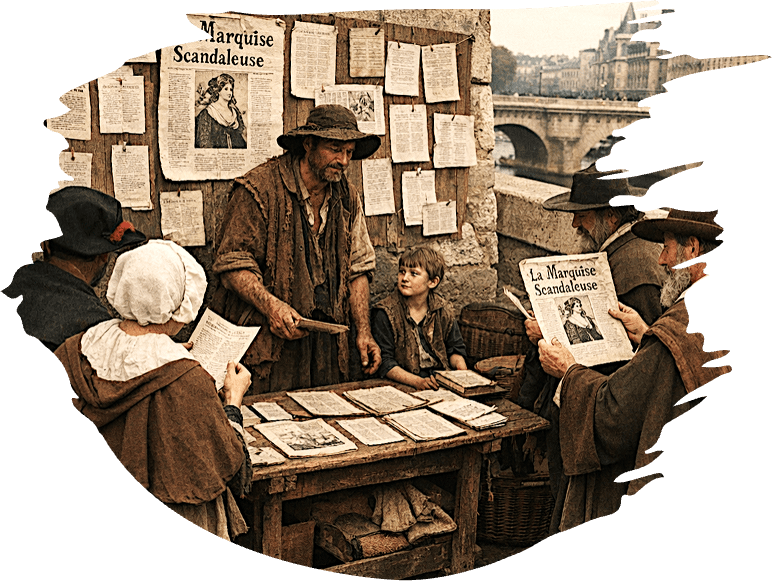
In the end, it looks as if Marie Cessette emerges from Saint Severin with Layla, having spent days helping the sick, supposedly a discreet exit for the two brave ladies, which is, however, witnessed by many, including M. Lorraine of ‘The Gazette’. By late afternoon, and faster than the pox, the news spreads to the pamphlets, and by the evening someone has already changed the lyrics of the street-song ‘The Scandalous Marquise’, and its title to ‘The Marquise Beloved by the People’.
“I deserve none of it,” Marie Cessette insists. “I have done nothing for those poor people, it is only Layla and the duc d’ Herblay who have truly risked their lives.”
“You have taken risks to protect an innocent man,” Layla objects. The dinner on that same evening at Layla and JeanPhilippe’s house is well choreographed too, because their house has been constantly watched by spies, and whether it is Marchal’s or Rochefort’s makes little difference. Guests arrive separately. Marie Cessette arrives first with Timothée, carrying a large pack of letters and packages filled with gifts from Glenay, as well as news about their aunt who gave birth prematurely to a frail baby boy still fighting for his life as does the lady. The duc d’ Herblay arrives next, and then JeanPhilippe, returning from Fontainebleau where the Queen has finally been settled with her entire train. Raoul arrives last and he is not alone.
“You two have a new brother and Marie Cessette and I have a new cousin,” he announces to Layla and to JeanPhilippe, resting his hand on Olivain’s shoulder, although Layla already knows the exciting news, having read the letters from Glénay. Olivain is welcomed with warm embraces and exultations. Then, wrapping his arm around the young man’s shoulders, the duc d’ Herblay leads him to the dinner table: “You still have time to extricate yourself from this little cabal in which you find yourself. Say the word and I will return you to your barracks,” he teases.
Olivain shakes his head, feigning a despondent tone. “I fear it is too late, your Grace, and, in some respects,” he lifts his hand to his neck, “I fear I am up to here already.”
“Just don’t let the Lieutenant of the King’s Guard know,” the Chevalier de Beaumont says, “although he probably knows how often you change your undergarments by now. True!” he protests, faced with looks of disbelief around the table, “he employs laundresses.”
“It is true,” Raoul confirms solemnly.
“His men are on the street outside,” M. de Beaumont says.
“Oh yes,” JeanPhilippe chuckles. “Layla and I know their shifts by now.”
“And he is still, a day away from Paris,” Raoul chimes in.
“It is no laughing matter,” the duc d’ Herblay remarks to Raoul. “He will be your neighbor. I heard from the most reliable source that upon his return, and as a reward for his services, he is to reside at Captain de Treville’s old house,” there are gasps of distaste all around the table. “I admit,” Aramis continues, “that this particular detail struck me worse than I expected. After our old Garrison was burned, Captain de Treville’s house at the Rue Vieux Colombier was the only remnant of my youth in Paris, and to have it despoiled in this manner gives me pause.”
Raoul shakes his head. “Then I must add insult to injury, by revealing that he–our old friend the Lieutenant of the King’s Guard–requested via pigeon post while away, and as soon as the offer of the house was made, that two wine cellars should be refurnished into something else.”
There are sounds of disgust around the table. “This man was once our friend,” Layla muses. “I trained him…How could it have eluded me, what he really is?”
“Perhaps none of us wanted to see. I know I did not,” Raoul remarks and there is something in his wistful tone that gives Layla pause, but she cannot fully understand what it is or why. Besides it is JeanPhilippe’s silence that concerns her, even though everyone treads carefully regarding the news about JeanPhilippe’s father.
But the topic of Rochefort inevitably returns, after Olivain departs with M. de Beaumont. It is the duc d’ Herblay who raises it and in a most unexpected way. “Your fathers must stay at Glénay,” he tells them, “and I can never replace them, but I am here, in their stead, and more than that,” he places his hand on JeanPhilippe’s shoulder, “I am responsible for much that has befallen you since childhood. It is true,” he insists, seeing that JeanPhilippe is about to object.
“My father’s crimes are his, and his alone.”
“He has committed none,” Aramis says coldly, and then easing his tone he adds: “the crimes he has committed, heinous crimes, odious, against innocent people, against the Queen, against your mother, against you, they are all forgiven.”
“Because the King has returned him to power?” JeanPhilippe exclaims and it is the first time in all these days that his rage takes the better of him. “No, Monsieur! My father’s crimes will never be erased, not by the King…Not by anyone!”
“Careful my son…” Aramis cautions quietly, “careful about how easily the matter provokes you. Careful what you might say in anger, no matter how justified and rightful that anger is. In a few weeks you will no longer be just the Queen’s Lieutenant. And there are many who will provoke you thus–worse even.”
“What does it mean, that Rochefort is reinstated,” Marie Cessette hurries to interject, with that subtlety particular to her, that always manages to ease tensions.
“It means that he is no longer deemed a traitor, and that all his crimes are erased. It means that his title, his fortune, and his estates in France, which, until now were in the hands of the crown, are returned to him. It means that M. de Rohan, whom the King of Spain endorses by returning to him his Spanish title—and the de Lerma family almost ruled Spain back in my days– is also endorsed by the King of France. Following his father, M. de Rohan is again the scion of an ancient French family with ties to the earliest kings of France. It also means that with this heritage, as ambassador to Spain, M. de Rohan’s stakes are higher than they have ever been. The more power one wields, the more powerful one’s enemies, after all, and Spain is mired with enemies. Your father and many members of the de Lerma family are among them.”
As she hears the rationale laid out by the duc d’ Herblay, Layla wonders if this most obvious reasoning wasn’t, in fact, Rochefort’s reasoning at all. If his purpose is different. Rochefort’s words at Boulogne were not the rantings of a madman. Every word he spoke had meaning and weight, and some of it proved to be true, some Layla thinks she can decipher, but most of it eludes her. There is a different game at play, and not unlike her old card trick, Rochefort plays it with great dexterity and with a marked deck of cards. Layla wishes she were as quick and astute as Raoul–the only man who ever discovered her card trick. All Layla knows is what her instinct tells her, and it tells her that she is missing vital clues to the puzzle that is Rochefort.
“It also means that the Company of the Orient ships sail for the King of France,” Raoul says in a nonchalant tone, and Layla realizes again that she failed to see something obvious.
“Very true,” the duc d’ Herblay agrees. “I suspected the same thing, Raoul, that Rochefort offered the ships of his syndicate and the services of his bank.” He smiles: “this, from an old Spymaster to a young one–even though the young one surpasses me in every way.”
Raoul smiles affably. “Thank you, Your Grace, but is it not the most reasonable inference?”
An angry chuckle escapes JeanPhilippe’s lips. “You mean that my father’s ships…and although it is true, forgive me, but the notion that my father runs a privateer syndicate is very hard for me to grasp… in any case, you mean that this syndicate, the Company of the Orient, and Lucien’s ships now fight on the same side?”
So many obvious connections in this game Rochefort plays, Layla thinks. “My father will never agree!” she exclaims and immediately realizes that if the King is involved, as Rochefort has made sure he is, her father will have no choice.

⚜️⚜️⚜️⚜️
The company disperses after midnight, JeanPhilippe returning to his office at the Palais Royal to finish his lengthy report regarding the Queen’s arrival at Fontainebleau, and Raoul riding to his own office at the Palais Royal, to prepare for his meeting with the King the next day.
Before leaving for his house, the duc d’ Herblay, however, has more to say to JeanPhilippe. “You will need friends in Spain,” he insists, “as many friends as you can muster, and, I have many friends, some of whom you met before. This time will be more difficult–yes, I know, it sounds improbable, given what happened when you were last in Spain. But your stakes have never been higher than they are now. You are no longer just an envoy and the Queen Mother’s Lieutenant of the Guards. You are not even just the French Ambassador.” He sighs. “I cannot join you officially, of course.”
“But unofficially?” Layla pushes.
The duc replies with an impish half-shrug. “A man can always travel to Spain to visit old friends.”
JeanPhilippe hurries to shake the duc’s hand. “I will be honored, Your Grace!”
The duc smiles. “Ignazio will be coming with me. In fact, something tells me that an enterprising Benedictine from a Spanish mission in La Florida may prove invaluable.”
⚜️⚜️⚜️⚜️
It is decided that Marie Cessette will not return home, but that she will remain with Layla for the few hours left until morning, so that the two friends, accompanied by the duc d’ Herblay will join the Queen Mother at the Louvre to an early mass for the victims of the pox and afterwards to the Cardinal’s new palace, where supplies will be gathered for those in need at the parish of Saint-Severin.
The two young women lie in bed side by side holding hands, just as they used to when they shared Layla’s room at the Louvre in the days when they were both ladies-in-waiting; the days before Marie Cessette was abducted by Benito de Soto’s thugs to be handed over to de Wardes. “It has been so very long,” Layla muses. “It feels like a lifetime ago. So much has happened in only two years.”
“It was a lifetime ago,” Marie Cessette says.
“And now we are leaving for Spain. I wish you could come.”
“You should not wish for such a thing. I am not a good companion for you or for Jean Philippe, and you cannot afford such a mistake. Any connection to me now would be a serious mistake.”
Layla sits up against the headboard, frowning. “That is nonsense!”
Marie Cessette begins to croon:
“Hear ye! Hear ye!
Good people of Paris, come near!
The story of a lady whose blue eyes shine clear!
As beautiful and sad as December’s cold light.
Wife of a great lord with a heart cold as night!
Ah! beauty, ah! beauty so precious and rare,
Blue eyes gleaming softly beneath moonlit air,
Cherished by her husband with love tender and fair
But loved like a sister, and left to despair!”
“Marie Cessette! How can you care about this sort of rubbish!” Layla protests, even though she knows it is disingenuous on her part. Layla cared very much about ‘this sort of rubbish’ when she was called Pirate Princess in the pamphlets.
Marie Cessette slants her a knowing look that signifies exactly that, and continues to sing:
“Her husband is mighty, her husband is strong,
He rules over kings and commands the great throng,
Her brow he kisses with brotherly grace,
But night brings her only his cold embrace.”
Layla gasps at the not so very concealed allusions to Raoul. She has made it a point to avoid the Pont-Neuf, and if she must cross it, not to listen to any songs. This song in particular.
“It gets worse,” Marie Cessette pushes:
“So the lady went seeking some warmth for her soul,
And found a young lover who made her feel whole,
Two pairs of blue eyes like blossoms entwined,
What sweet tender lies two lost hearts could find!
Along rides the Captain, both fierce and severe,
The King’s iron fist, with a falcon’s cold sneer,
Had the lover arrested and thrown in a cell,
To the dark grim Bastille, to the dungeons of hell.
The bolts were slammed shut, the cold chains rang clear,
Her poor blue-eyed lover just vanished in fear,
And the lady wept softly by pale candlelight,
While the moon kept her vigil through the sorrow-stained night.”
“Sang dieu! This rubbish, it is all coming from Fabien. It is vulgar enough,” Layla exclaims.
“It does not matter,” Marie Cessette says quietly. “These songs have no authors, only victims. And it gets worse still. Do you want to hear the rest?”
Layla has some idea about the rest of the song, of course, because in truth, she has heard it–it is impossible not to, no matter how much one can avoid the Pont-Neuf and pretend not to listen– but now she would like to hear the full extent of it carefully. The full extent of Fabien’s underhanded and sordid tactics.
“Now the lady’s dear friend had good noble spouse,
Most virtuous among men, and true to his vows,
A man of his word, honorable and right,
Who came to her rescue, and ended her plight.
From one consolation to another so sweet,
From tenderness gentle to tenderness deep,
His honor unvarnished, his word always true,
The lady at last found her heaven anew!”
Layla springs from the bed. “Fabien is vile!”
Marie Cessette sits up against the headboard too. “I handed him this opportunity. He took it.”
“He entrapped you, beginning at Saint-Fargeau.”
“And I let myself be entrapped. There are no excuses for his actions, he is odious, but I cannot devise excuses for my choices. As for Jean Philippe, he is guiltless.”
Layla returns to the bed, and sits close to her friend, taking her hands. “You and JeanPhilippe did what had to be done, or we would never know where Henri Bernard was taken. Enough of this! I will not have our precious time together wasted because of Fabien Marchal’s vile ambitions. He is Chevreuse’s lover, did you know that? Not just the lover of that maid, but of the mistress. And JeanPhilippe tells me that Saint-Aignan, who sees Raoul as his first and foremost political adversary, is Fabien’s new friend at court. I am no longer the naive Layla who ignored court intrigues and I cannot pretend to be oblivious, not in France, and certainly not in Spain, for the sake of JeanPhilippe most of all. Fabien is all about unbridled ambition and revenge, both with you and with my mother at Royaumont. I will never forgive him either. None of us will.” Layla eases her tone and smiles a faint smile. “Besides, that vile song has changed, and the new song I have paid great attention to.” Layla begins to sing:
“The people of Paris thus learned her true face,
A lady of worth, of courage, and grace,
No scandal, no sin, no stain, no fault
But one who stood tall against death’s grim assault.
Ah! beauty, ah! beauty so precious and rare,
Blue eyes gleaming softly beneath moonlit air,
Whose name is charity,
Whose heart remains pure,
Whose silent sincerity,
All darkness shall cure.”
Marie Cessette returns a rueful smile, pressing Layla’s hands. “It is because of you, my beloved sister, that it has changed. I have done nothing to deserve it. You placed your life at risk maintaining this ruse which has protected us. Which has protected me.”
“And the Queen Mother, and the duc d’ Herblay… And, of course, Raoul. This was his idea.”
Marie Cessette has lowered her eyes. “He has been so gallant in all this. Gallant, courageous, and patient. And all the while his mother’s life has been in grave danger and that poor little baby…Raoul did not want to leave them but he had no choice. Because of me. Because of Henri. Oh Layla, he has borne it all with such grace.”
“He loves you,” Layla fixes a meaningful gaze, but Marie Cessette returns a sorrowful smile that makes Layla’s heart sink.
“I love him also,” Marie Cessette says quietly, “but not the way you would like me to. He does not love me that way either.”
“And Henri Bernard did?” Layla pushes testily. She is surprised to see her friend return the same sorrowful smile as before.
“Henry and I loved each other well, for the time it lasted. Neither of us could ask for more. Does it shock you?”
“I don’t understand,” Layla mutters.
“My love, I am not like you,” Marie Cessette says gently.
It annoys Layla when Marie Cessette makes this claim, even though, of course, she can see the truth behind it. Still, she refuses to accept it, so she insists, peevishly: “I don’t even know what that means!”
“It means that to be loved as you are is an expectation I cannot have. People like me do not marry for love, Layla, nor should they expect such an indulgence. To make a good marriage is the best I could hope for, and, in that, I am most fortunate. But my darling, why does this vex you? You have always known this, or you and Raoul would have been long married.”
Layla draws in a deep, frustrated breath. “I don’t have to like it! I want you to be happy. I want him to be happy. I want you to be happy with each other. As happy as I am with JeanPhilippe.”
A soft chuckle escapes Marie Cessette’s lips. Tenderly she cups Layla’s face with her hands. “Oh my love, if only that could be true! If only anyone could be in love the way you and Jean Philippe are in love with each other, although you face some stark competition from your sisters in that respect. The rest of us must seek happiness where we can find it, and seize it whenever it is within our grasp. Let us not quarrel over what we cannot change. Let us not waste this last night when we can be together.”
“But, we do not leave for Spain until a month from now,” Layla protests.
“I leave for Normandy in two days,” Marie Cessette says.
“What? No! Whatever for?”
“Layla…”
“That vile song? It is already forgotten. And tomorrow you will be with Her Majesty, the Cardinal, the duc…”
Marie Cessette reaches for her hands. “It is precisely because of all this, that I must leave. It is also Her Majesty’s condition.” She smiles playfully. “Even the notorious Chevreuse had to face exile and not just once.”
“But … but Chevreuse is a schemer! She plotted with England. She planned to overthrow the King. She conspired to assassinate Richelieu and later the duc d’ Herblay! What have you done to deserve exile?”
Marie Cessette raises a knowing brow. “I have done enough. And I am no Chevreuse.” She finds herself in Layla’s arms.
“I don’t know how long we must remain in Spain. We may not see each other for years,” Layla frets. Her eyes are filled with tears. Marie Cessette’s eyes also. “Let us not say farewell,” Marie Cessette pleads. Layla pushes her back gently. “Never, a farewell for us, my love. Our hearts can never part.”

⚜️⚜️⚜️⚜️
Raoul and M. de Rohan ride side by side. It is not far to the Palais Royal but the two young men keep their horses walking at a slow pace, enjoying each other’s company in silence. Besides the occasional drunken brawl and unruly vagrants, or the medicants outside the churches, the streets at this time of night are mostly empty, except for the Vielle Rue du Temple which is lined with carriages, because the play ending at the Theatre du Marais is very popular.
Raoul tilts his head toward the stopped carriages, signaling to M. de Rohan, who returns a meaningful smile. The duchess de Chevreuse is here tonight. The Comte Saint-Aignan also. Guiche is here too, but Guiche will never miss a play at the Marais, especially if it’s popular.
“Perhaps our old friend Fabien has already returned and is here too,” M. de Rohan teases.
Raoul chuckles. “To enjoy the play or to arrest everyone?”
Past the Academie Royale, the street becomes quiet again, until a song pierces the silence. A familiar song. Someone is singing it off tune, not at the Pont-Neuf, but outside the Cemetery of St. Jean.
“The people of Paris thus learned her true face,
A lady of worth, of courage, and grace,
No scandal, no sin, no stain, no fault
But one who stood tall against death’s grim assault.
Ah! beauty, ah! beauty so precious and rare,
Blue eyes gleaming softly beneath moonlit air,
Whose name is charity,
Whose heart remains pure,
Whose silent sincerity,
All darkness shall cure.”
“At least it is the better version,” Raoul scoffs.
“Raoul you must not blame her!”
“Of course I don’t. We both know who is behind this.”
“Like Layla, I cannot believe he is the man we trusted, the man with whom we took the same vow of friendship. What decent man attacks the wife instead of the husband? He did it at Royaumont as well.”
“He has no scruples, but perhaps he finds that scruples are a luxury which a man with his ambitions cannot afford.”
Jean sounds horrified. “You justify his actions?”
“No, I am simply stating the facts. I know Fabien. He is ruthless and being ruthless is all he knows and understands.”
“And Marie Cessette?”
“She must go to Normandy.”
“Raoul! Have you thought that this could ruin her? It is almost an admission!”
“We have thought about it, Marie Cessette and I together. We have considered every contingency. It will be worse if she stays, for then she will be marked as defiant and not even the Grande Mademoiselle can be thought defiant. It is what still keeps the King’s cousin in exile at Saint-Fargeau. For Marie Cessette, of course, Normandy is excessive, but that is the point. When she returns to Paris, in–let’s say— three or four months, just as the court returns to Paris, and after she has been visited at Normanville by the Queen Mother in the course of her procession and her pilgrimage to Douai, everyone will be appalled that Marie Cessette had to endure exile when faced only with innuendo and unfounded vile gossip. By autumn no one will remember any talk of transgressions and scandals, only the unfair treatment.”
“And you?”
“You mean that I will be blamed for treating my wife with such severity? That is a battle I can never win, Jean. In their eyes before being spymaster and Richelieu’s grandson, I am Venetian. Some see us as libertines and others as vulgar prudes, and neither is true.”
“I meant being apart from her,” M. de Rohan pushes.
“I cannot be with her,” Raoul says gravely. “I must play my part as she plays hers. It is the only way to put all this behind us. I will send men with her, of course.”
“M. de Beaumont?”
Raoul shakes his head. “I plan to send Timothée to Spain with you. You will need someone as skilled as he is with the sword, but also versed in the art of forbidden delights, which is an art most cherished in the circle of Don Juan Jose. And before you refuse Timothée’s services, let me add that my own inclination as well as my orders are that you must arrive in Spain with the best that France is able to offer you, including men, messengers, safehouses, weapons, and ammunition. Wait until I see the King tomorrow and the next day, after Marie Cessette departs, let us meet at my house for dinner. It gives us an opportunity to plan your journey. You must know all our spies and agents in Spain.”
They have arrived at the Palais Royal and they both dismount handing their horses to the stableboys. They proceed through the courtyard, walking slowly, and speaking carefully, in low voices.
“I am concerned that whereas we receive such protections, you and Marie Cessette are left here surrounded by enemies.”
Raoul stops for a moment, and rests his hand on his cousin’s shoulder. “The Spanish court is mired, Jean. At least here, we have some idea about where our enemies are lurking.”
M. de Rohan stops too, and turns. “One of those enemies is my father, and he can–he will!– be both in Spain and here.” He shakes his head. “I will never stop thinking that when it comes to my father, I am responsible, for he attacks all those that are important to me.”
“No!” Raoul raises a warning finger. “Never say this. His crimes are his own. Your father will be stopped. There are ways, but you must trust me.”
M. de Rohan looks bemused for a moment, and then fixes a penetrating gaze, which Raoul tries hard to avoid. “Raoul, I am your cousin. I love you more than any man, you are also my brother in arms,” he says with affection, “but my father is a dangerous fiend, not just the raw power he wields, or thinks he wields. He can infect more than one’s mind. He can infect a man’s soul, and such infection is worse than any pox. I ask you to be careful.” He keeps his eyes fixed on Raoul, the more Raoul tries to avoid him it seems. “I cannot make you speak to me about your plans, of course I cannot, Raoul. As Spymaster of France your position is complex and delicate. But if there is something… anything that weighs heavily in your heart, remember that you have an older brother in me, and that you can trust me also.”
“I could not have asked for a better friend, cousin, or brother,” Raoul says, embracing M. de Rohan.
It will remain with M. de Rohan for a long time, the unsettling feeling, not so much that Raoul has secrets– he is after all the Spymaster of France–but that Raoul is involved in a dangerous undertaking and feels that he cannot ask for anyone’s help if he is to succeed against Rochefort.

 Twelve Years After