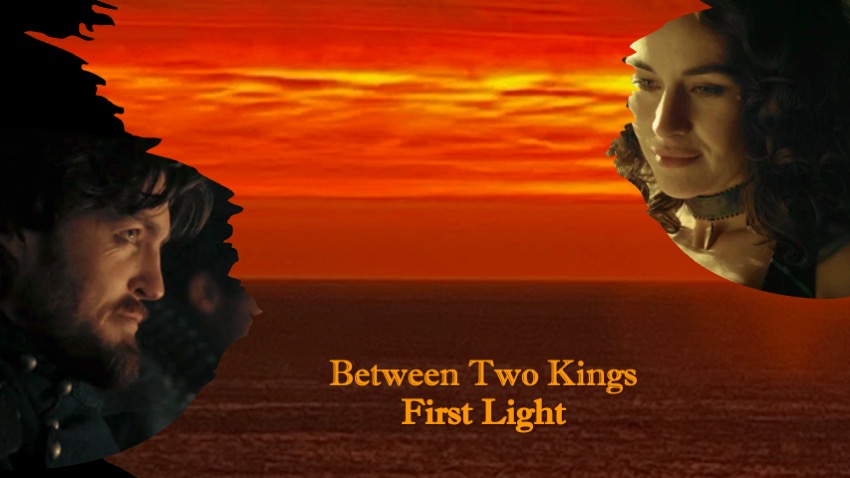
“I meant to wait for Alexandre in the carriage,” Constance says. “Madame Charbonneau tells me Athos is not here. She insisted I come inside.”
Perhaps it is Constance’s apologetic tone or perhaps it was something in the air at Glénay, in the sidelong glances and the measured confidences, that Alessandra perceived even though she was too ill to hold on to. But somehow Alessandra knows: Athos wants nothing to do with Constance d’ Artagnan. This does not include her husband or her son. D’ Artagnan’s name appeared several times in Bia’s tangled tales about their daily life at Glénay. ‘Papa and Uncle Charles said this and did that.’ And of course, Alexandre was omnipresent. ‘I meant to wait in the carriage,’ Constance said. Whatever ill will there is with Athos, it affects only her.
An astonishing turn of events, Alessandra thinks, and, after a night of disturbing dreams and a morning of petty frustrations, it is also deeply irritating. It bothers Alessandra that she has been kept confined–Athos’ brave conspiracy–knowing almost nothing, not even what happened to her after Comminges and his thugs attacked her carriage at Bragelonne. This is as far as Alessandra remembers. From that moment on, it is a blur of faces, voices, and images, nothing coherent. She does not attempt a smile, only tips her head, beckoning Constance inside.
Barely waiting for Alessandra’s invitation, Constance sweeps in the salon and sinks into a chair some distance from the fireplace. “Such a warm day. One might think it is summer. Well, we are leaving for Paris tomorrow. Porthos, Elodie, and the children will be with us and some of your Sicilians will escort us. Lucien and Sophia will remain at Glénay until you return. I understand that Lucien and Raoul have found you a very fine house in Paris and not too far from Lucien’s house and ours, at the Place Royal.” Alessandra had no idea, but, then, household affairs have been kept from her, along with everything else. “I hope I did not take too great a liberty speaking of such matters,” Constance observes, and Alessandra realizes, to her dismay, that she has kept herself unguarded, so much so that Constance d’ Artagnan can see through her. Damn this morning, and this illness, Alessandra thinks, pulling herself together.
Constance d’ Artagnan straightens her back and folds her hands on her lap like some demure novice. She has arrived well prepared, all her arguments marshalled. “Alexandre insisted on coming to say his farewells. He will not leave Glénay, he announced to his father if he cannot see his beloved Bia first.” She clicks her tongue playfully. “What can I say? Children will be children.” Clearly she expects a response, but she receives none, so she pushes where she knows she will finally elicit an answer. “And the baby? How is he?”
“Strong.” Alessandra will speak as little as possible. To her this feels like a trial of wills and she is resolved to win, out of sheer perversity. Perhaps, a little too, because she has not been herself for what feels like a very long time. Alessandra misses the woman she used to be, and on a morning as vexing as this, isn’t Constance d’ Artagnan the perfect challenge to restore her?
“Strong is important. It is what matters in an infant at the breast who is so very small. Later, he can be as mischievous as…” Constance gasps, “where are the children?”
“At the cove, most likely.”
“Heaven preserve us! Is it safe? I heard talk of a tide.” She half rises, then doesn’t. She is very eager to be here. Constance d’ Artagnan has arrived with something in her mind, and she will say it no matter what Athos demands. Athos should know too that Constance d’ Artagnan, once she sets her mind on a purpose, cannot be contained.
“Giulia and Colette are with them, as well as Doctor Guenaud.” Too many words, Alessandra realizes, annoyed with herself for losing her private wager and so quickly. In a battle of wills, Constance d’ Artagnan is a formidable opponent and Alessandra has been sick for too long.
“Oh thank God, Doctor Guenaud is with them!” Constance pauses, and Alessandra can follow the woman’s thoughts as plainly as if they were written on the wall. “Speaking of Doctor Guenaud…You look remarkably well.”
“I am.”
“That is very good, because of what I have come to say.” Constance draws in a determined breath and straightens her skirts. “I am sure you know all about it anyway, even if Athos has been discreet.” Alessandra does not contradict her. “You would know all, how could you not?” Constance continues. “I will therefore speak plainly. He is angry with me. I never believed you were as sick as they say you were. I mean, it is you after all.”
Alessandra feels strangely vindicated. How ironic that this should come from Constance d’ Artagnan. “That is what I say too.”
“Men like to be protective and we must let them. In any case, it is important that you hear this from me. Athos explicitly forbade me to speak to you for fear of upsetting you, but, I know, and you know, that is not possible. Make you an enemy? Yes. But then, it would not be the first time. I had a long time to think about my decision to speak to you directly and Pére Massey strengthened my resolve to speak only the truth… oh…”
To Alessandra’s chagrin Tatie May has stepped into the salon. She smiles a coy smile but looks as determined as Constance d’ Artagnan. A trial of wills between Tatie May and Constance d’ Artagnan, wouldn’t that be something to behold, Alessandra wonders? “The little ones are at the cove, and Monsieur Charbonneau went along as well. One can never be too careful with the morning tide.” Tatie May announces, keeping her eyes fixed on Constance as she speaks. It is a genuine glare that Alessandra never thought she’d see in this woman’s eyes. Did everyone but her know about Athos’ rift with Constance at Glénay?
Alessandra decides not to let the fact vex her. After all, Constance d’ Artagnan sees her differently, which strangely works in her favor. “Why not make the children hot chocolate when they return from the cove?” Alessandra suggests, knowing that for Tatie May this is the surest distraction.
The glare disappears immediately. “Of course! And I have started the fritters. At Glénay M. du Vallon suggested infusing honey with lavender and I made some the other day.” She wags her finger feigning a stern admonishment. “But you haven’t had supper all morning,” she turns to Constance, “Madame you must be famished and thirsty after traveling all morning too.”
“Well no, I would not presume…” Constance begins to protest. She is as eager to get to her confession as Alessandra is to hear it.
“I will bring everything as soon as the fritters are ready!” Tatie May says and hurries out of the salon. In a game of wills between Constance d’ Artagnan and Tatie May, Tatie May wins, Alessandra decides.
Constance clears her throat. “As I was saying…”
“Yes, as you were saying…”
“This has to do with…With Catherine de Renard.”
It is the last name Alessandra ever expected to hear from Constance d’ Artagnan.
⚜️⚜️⚜️⚜️
Constance tells her story without mincing words. A series of unfortunate events strung together with the same simple and plausible justification, that what she did was for Athos’ sake and that Alessandra’s fate could not have been decided by a few casual remarks at a soirée. She does not sound contrite so much as eager to be done with a confession she deems necessary for her conscience, but excessive as confessions go. Alessandra cannot decide if she should be offended or amused. For the first time on this vexing day, she feels tired.
“Here they are! I also made almond pastries and fruit tarts. Our little Bia loves both.”
Choosing the most inopportune moment, as if by design, Tatie May pushes the door open with her heavy tray. She brings her hot chocolate and fragrant, freshly baked fritters and pastries, and sets everything on a small table between Alessandra and Constance. “The fritters are better while they are hot,” she warns, and turning to Alessandra she adds: “Colette is already back. They are all returning, she tells me. The children collected a lot of shells.” She pivots to Constance. “If M. Alexandre decides to take his shells back with you to Glénay, Madame, remember that even after we boil them here, you must air them for days once you return, or they smell very bad.”
Constance must have some idea, because she sighs deeply and nods. “I grew up near Plouarzel.”
“But of course! Your brother is M. Benoit, the Breton!” Tatie May lingers in the salon for an awkward moment. “I will leave you to it then,” she says and pauses again in the doorway on her way out. “They are better eaten while they are hot.”
“Well, then?” Constance insists as soon as Tatie May has left the salon, closing the door behind her. In retrospect, Alessandra realizes how grateful she is to Tatie May for her ill-timed interruption, for it has afforded her valuable time to make some sense of the unfathomable confession she has heard. She returns a half shrug and Constance narrows her eyes, perplexed. “Is that all?”
“What else? You seem to have discovered that you are not as perfect as you thought. More like the rest of us than a saint,” Alessandra scoffs. “What did you expect, hot chocolate laced with poison? Stabbing you with my hidden dagger while your son and my daughter are collecting shells?”
“So, you don’t think it is important.” Constance d’ Artagnan sounds relieved.
It is only now that Alessandra sees the advantage she is afforded, her weariness evaporating. For the first time in a long period of infirmity, she feels like herself again. “On the contrary,” Alessandra says. She sits back into the settee crossing her arms over her chest and fixing her eyes on Madame d’ Artagnan. “It is very important because from where I stand, you owe me.”
“What does that mean?” Constance d’ Artagnan is not rattled easily, but she finally sounds unsettled.
“Nothing too painful, I assure you.” Alessandra reaches for the delicate chocolate pot. “Tatie May infuses her chocolate with cinnamon and works it to a fine foam,” she extols as she pours for them both. She uncovers the freshly baked fritters and pastries. “Her pastries are heavenly, and Bia loves the fruit tarts. As for the fritters, best eaten while they are hot, as she said.” She feigns a wide, inviting smile. “Now, tell me everything.”
“Everything? I do not take your meaning.”
“Everything that happened between your soirée and today. Everything as you know and understand it.” Alessandra chooses a fritter, places it on a plate in front of Constance, and drizzles it with lavender-scented honey from a small lidded pot. “And have a fritter as you do.”
⚜️⚜️⚜️⚜️
Alessandra is determined to wait for Athos to return, despite the scowling nurse, who insists on Doctor Guenaud’s bitter remedy that helps Alessandra sleep. In the end, exhaustion wins and her sleep is fitful only this time, she dreams of windowless dungeons, shrieking rats, and violent storms. Faces blur and fuse–Catherine, her son Thomas, Harry, Comminges, Rochefort–along with others she cannot recognize. Threaded through it all, is the sense that Athos returned: the warmth of his hand cupping her cheek, the sound of his voice speaking to her gently.
She wakes long before dawn. The nurse is the only person in the bedchamber, slumped asleep in a chair by the fireplace. Alessandra cannot recall any of her night terrors, only feels their aftershock: her racing heart, the room pressing in suffocating her, the air too thin. She stumbles to her feet and manages to dress, careful not to rouse the nurse, throws a warm wool shawl around her shoulders, and slips out. She cannot endure this room another moment, overwhelmed by a foreboding without shape or reason.
The corridor outside is silent. She makes her way first to the baby’s room where Bonne and her baby also sleep, and then to the room where Bianca sleeps with Giulia. Everyone is where they should be, sleeping peacefully and safe, she tells herself, but the dread does not loosen its grip. She wonders if it would have been easier to dispel the presentiment that oppresses her if she could remember her nightmares.
Gently, she pushes open the door of Athos’ room, expecting that he will be dismayed to see her on her feet and wandering at this ungodly hour. Inside, the room is dark, the fire reduced to embers, and he is not here and the bed doesn’t look slept in. Her chest tightens, her heart beginning to pound again. What if her presentiments turn out to be true? She lights a candle, her mind spinning. Why did she send him to that village? What if the storm was not a dream and he was caught in it? What if his horse was spooked or he was attacked by brigands along some wretched country road in the night, caught unprepared, or what if he was exhausted…God he must be exhausted! Her hands shake around the candle, she realizes, as she frantically rummages Athos’ room.
That’s when she sees it: his leather belt with his sword and pistols draped over a chair. Why would he leave them behind? What foolish nobility, what reckless gallantry would compel him to go unarmed? Could she have sent him to his death, and after everything she now knows? All that she has never told him… Good God she should have stayed awake. She should have waited for him… Never enough time… Never enough time…The hazy light of the room seems to dim, her stays feel too tight, and the only sound throbbing in her ears is her own heartbeat.
Alessandra clutches the back of a chair and sinks down hard. Think clearly, she pushes herself. Athos is not some boy, he is a seasoned soldier. It makes no sense he’d go anywhere unarmed. And thus, the answer lands, sharp and simple. Doesn’t Athos ride Balignant to the cove every morning before dawn? A rough laugh breaks from her, more sob than chuckle. I am losing my wits, she thinks. She forces herself up, still shaking, and sets everything as Athos had left it.
Back in the corridor, she has no desire to return to her chamber or to the salon, where, for some reason, she feels the presence of Constance d’ Artagnan still lingering although it has been hours since she departed with Alexandre, his boiled shells, two large baskets full of pastries and fritters for the children at Glénay, and six jars of lavender-scented honey for Porthos, neatly packed by Tatie May with her usual generosity. Instead, Alessandra finds herself drawn to the kitchen.
It is her first time stepping into it since they arrived at the cottage, though not the first time she has stood here. She remembers it of course. Once she made room for the dead girl to return, Alessandra started remembering many things. Tatie May’s kingdom has barely changed: the spotless flagstone floor, the long worktable, the orderly shelves with everything arranged as if for display, even the cat curled in the corner, although in the days of the dead girl it was a sleek gray cat that Olivier and Lucien called Calypso.
Alessandra searches the familiar surfaces for traces of that childhood, until her gaze settles on a cabinet. Plain enough for a country house, except for the painted panels, which are animated with vibrant colors and with strange, fantastical forms: birds, insects, fruit, and flowers. A spring garden brimming with life. “A cornucopia, just like your kingdom, Tatie May,” Alessandra hears her mother saying. She remembers sitting beside her mother as she painted it, cleaning her mother’s brushes. Olivier and Lucien were there too. This is also when Lucien’s wooden horse became Xanthus. “Shall we use the gold paint, Sweet Mischief?” her mother asked. “And let’s give him a bright red saddle too!”
This time Alessandra does not hold back the tears stinging behind her eyes. We can mourn them, Athos had said, and, ever since, his words have released more than memories. Not because he gave Alessandra some sort of permission, but because, just as with Francesca, this sorrow they could hold together.
“My dear is everything all right?”
Tatie May stands in the doorway, all dressed, in her clean cap and linen apron, ready to reign in her small kingdom. Alessandra wipes her eyes swiftly. “I was …” she clears her throat. “Athos, did he… does he…?”
Tatie May smiles kindly. “He returned late last night, and you were already asleep, but he stayed with you awhile. They were all uneasy, you had a difficult night. He rode off down to the cove with Balignant as he does every morning after Doctor Genaud assured him you had settled. The horse needs the exercise, he says. I heard him galloping away as I was dressing. Shall I make you something?”
“Thank you, but no… I…” Alessandra hesitates, then points toward the door of the kitchen that opens to the back of the house. “Isn’t there a way to the cove from there?”
“Yes, my love. That is how the children come and go. Guillaume too. But Athos will not go that way.” Something about the way she says it makes it sound like more than a preference.
“I think I will go then…”
“My dear no! It is too far for you to walk. They will be angry at me for letting you!”
Alessandra presses her hand. “I will never tell. Tatie May, if I am ever to recover, I must try.”
“Oh dear!” Tatie May frets. “I will come with you!”
“No, no please. I will stop if I get tired. If I see that it is too far I will return. Do not concern yourself.”
“I will wake up Guillaume to walk you to the cove! It is still dark!”
“No please.” Alessandra is already at the threshold. She forces a smile. “Make us your hot chocolate when we return.”
⚜️⚜️⚜️⚜️
The path behind the kitchen is a covered pebbled walk, lined with parterres and shaded by climbing roses, vines, and lilacs. Alessandra has overestimated her strength but will not let that stop her. She has wasted too much time already.
She pauses occasionally to catch her breath, grateful for the cold morning air from the sea, rain-scented and infused with the fragrance of blooming flowers. The steps down to the cove are the hardest, but she is determined. At the bottom, the sand stretches wide and damp from the night storm. She can see Athos in the distance, even though it is still dark, the only light a crack of violet in the horizon. He sits at the edge of the old wooden pier, although the water reaches it no longer, the rolling waves having withdrawn further away with the tide, making the cove look like a vast desert, glowing in hues of violet and silver. Alessandra had not anticipated how punishing wet sand would be. How it sinks underfoot, with nowhere to rest. Resolve is what moves her, more than strength, but Athos sees her, and springs up, darting down the cove to reach her.
“Sang Dieu, Alessandra! What are you doing here at this hour?” He lifts her in his arms without waiting for an answer and carries her to the pier, where he sets her gently next to him, wrapping her in his cloak. He cups her face in his hands, smoothing her cheeks. “You look very pale,” he frets. “Where is Doctor Guenaud? How can he allow this?”
“It is not his fault,” she manages to say, still breathless. Athos uncaps his water flask. “Drink,” he orders softly, and it is only now that Alessandra realizes how thirsty she is. “Now some more,” he insists.
She rests her head on his shoulder and closes her eyes. “It was my idea,” she whispers. He sighs and clicks his tongue but says nothing, only gently rubs her back until her breathing steadies. At last she opens her eyes. “I did not want this to be as dramatic as it turned out,” she says. “I just did not think about the wet sand.” He lifts an incredulous brow. “I didn’t,” she insists, sliding from his arms to sit close at his side. “Truly.” He shakes his head. This is not how she pictured it, but she will not let that stop her either. “I wanted to talk to you…” she begins.
“And you had to come here, on foot, in the cold…” he cuts in, sternly.
“I wanted to talk to you!” she snaps matching his temper.
He stills and presses her hands gently. “All right, all right,” he yields. “Talk to me then.”
“It’s not how I imagined it.”
He angles a wry grin. “How can I help?”
“Don’t tease me. And don’t fuss.” She draws in a bracing breath. This is not where she was planning to begin either, but she must begin somewhere. “Alexandre was here yesterday, to say farewell to Bia. They leave for Paris today. I am sure you will hear all about it very soon. He arrived with his mother.” The play vanishes from Athos’ eyes. He is no longer smiling. “I thought you should hear it from me,” Alessandra insists.
“Did she stay in the carriage?”
She clicks her tongue disapprovingly at his harshness and he swears under his breath in response. Alessandra turns her eyes to the horizon for a moment, where the violet line has changed to a ribbon of red-orange. “I will never understand men,” she says quietly, “and it is strange for I have known many and raised one, and I am about to raise another.” Even without looking, she can feel him frowning.
His voice is clipped. “What did she say?”
“Instead of talking, asking, thinking… they act… and then…then, they have to sort out the mess which is of their own making.”
“What did Constance say to you?”
She turns to face him. “Everything.”
His gray eyes have turned to steel. She knows this coldness, and how deep it cuts, but this time is different. “Don’t!” she warns him sharply. “Don’t do this!” He blinks, angry and startled. “This thing you do,” she continues, gentler now, cradling his face in her hands, “this wall you raise, this distance…” She is stunned to see the steel in his eyes evaporate just as her hands touch him, just as she speaks. How could she have been so blind for so long? So eager to rival and strike back, but not to see, to listen, to touch?
He takes her hands and kisses them, lowering his gaze.
“Did you challenge Louis to his face, at court, when Lucien was being invested with his new title? Did you start a riot and later fight a battle?” He keeps his eyes lowered, not answering. “Did you challenge Louis?” she presses.
Athos raises his eyes. Behind the solemn composure, so true of his countenance, there is a spark that Alessandra does not expect. She has always thought herself perceptive when it came to men, to this man in particular. Easy to read, she has thought him, and easy to push. But she never really saw him. What she saw was only the reflection of her grief and anger. Athos has eluded her completely until this moment. Behind the principled and dignified facade, Alessandra realizes, hides a man fierce and passionate, mischievous and defiant.
“Technically, I only challenged Marchal,” Athos replies and the wry grin at the corner of his lips is just like his brother’s. How could she have been so blind?
“Sang dieu, Athos!” She flings her arms around him and the embrace must have caught him by surprise because he gasps. “Damn you, you foolish man,” she breathes, kissing his brow, his cheeks, and then his lips. That is where he kisses back. It is not the heat of his kiss that catches Alessandra by surprise, it is the tenderness, so unexpected from the man she thought she knew.
He eases her back, smiling. “Is that a good answer?”
She nods, tears spilling. “I have been blind.”
Athos pulls her into his arms and her pulse jumps for no reason other than the warmth of his embrace, which feels different. “You and me both,” Athos says, his lips brushing from her mouth, to her ear with words she never believed were meant for her. “My precious heart,” Athos whispers, and she is giddy with pleasure, contentment, and joy. “Shall I call you Sandretta?”
“Yes, but only when we are alone.”
She raises her eyes toward him, and is caught by his beauty, his features drawn by a firm, precise hand, cut with the sharpest chisel: the nose, the cheekbones, the mouth, the jaw, all sharp in line, and yet not sharp in effect. It is because of his eyes, she realizes, those eyes she thought unfathomable that now speak to her, with eloquence, gray lit, and shimmering with dancing flecks of gold, like the dawn.
“Look,” Athos whispers, nodding toward the sea. In the distance, the sky burns in reds and golds—vermillion, flame orange, saffron—and the waves below roll in wine-dark crimson. “The colors of your mother’s painting,” Athos marvels, but all Alessandra can see is the dawn reflected in his eyes.
“I know the color of your eyes,” she tells him. “I can’t imagine how I failed to see it before.”
He laughs softly. “Do you know what that means?”
It is her turn to be startled. On a morning long ago, in another cove in Venice, she promised she would marry him only once she knew the color of his eyes. “You remember!”
“Of course, I remember. What man wouldn’t?”
She shakes her head, a small embarrassed giggle escaping her lips. “ Despite what I promised then, now I want you to ask me.”
He doesn’t look shocked or displeased. “Aye, Madame. I will.” He straightens, adopting a stern, commanding posture, and then says nothing.
“And…?”
“And… not now of course!” He feigns outrage at her impatience. “It must be done properly.”
“What does this mean?” she protests.
“Madame, this time, we will do it right,” he declares. Alessandra sighs, resigned, and he replies with an impish half-shrug.
“For the moment,” Athos says, “we must return for I see the tide coming in.” She starts to stand but her legs feel uncertain beneath her.
“No,” Athos says at once, stopping her. “You have done enough walking.” He lifts her easily. “We will ride back on Balignant. Once we are home you will rest and I promise not to exchange harsh words with our fine physician and that scowling nurse who failed to keep you from slipping out.”
She must have fallen asleep in his arms, covered in his cloak, because she remembers nothing of their ride back to the cottage. By the time they arrive the fiery dawn has given away to a bright crisp early morning.


 Twelve Years After