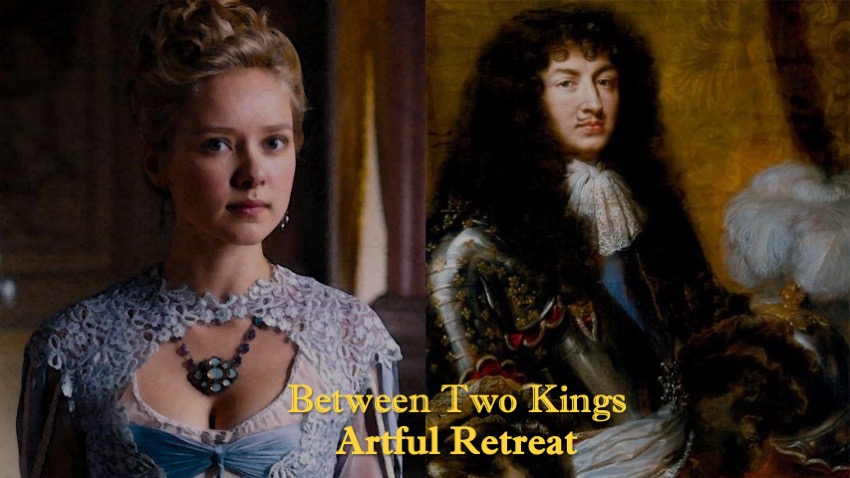
I am your King, Monsieur!
If he were still the man Captain d’ Artagnan recruited, impressionable and awestruck by the Musketeer legends, Fabien Marchal would have sought the counsel of Captain d’ Artagnan, whom he revered, and those he called his trusted friends: M. de Rohan, Layla Grimaud, and Raoul. But Fabien Marchal has outgrown that impressionable, awestruck youth just as he has outgrown mentors and friends.
When last he measured himself against those he called his trusted friends, all highborn and noble, Fabien Marchal saw himself for the pariah he really was in their eyes. He saw charitable condescension where he once thought himself a peer, among equals. He has seen all three of them advancing while claiming disinterest–the hypocrisy of nonchalance that is the mark of their privilege–his own ambition, an indictment and a slur: ambition in a bastard from the Court of Miracles can only be crude. In his old Captain and in his Captain’s friend, General du Vallon, the other orphan from the Court of Miracles, Fabien Marchal sees only weakness. He is abhorred by their lack of discernment, by their blind eagerness to emulate. Unlike him, they have been content to deceive themselves. They have failed, and it was inevitable. He, Fabien Marchal, chooses a different path. The bastard from the Court of Miracles will be as ambitious as he is crude. He has no stomach for so-called mentors and friends, or for the travesties of love. Sophia de la Croix taught him that last painful lesson, and strangely he is grateful, otherwise, he would never have been prepared for one such as the Duchess de Chevreuse. Quid pro quo is a premise far more honest and reliable than friendship or love.
I am your King, Monsieur!
If Fabien Marchal were the man Captain d’ Artagnan recruited four years back, he would have confided in those he trusted. But he trusts only himself. If he were still that man he would have hastened to the Palais Royal, raise the King from his bed, if necessary, and alert him to the impostor and the conspiracy threatening the crown, as is his duty. But Fabien Marchal has tasted the fruit of forbidden ambition, reaching as close to the throne as any crude bastard from the Court of Miracles has ever ventured, and it has taught him the value of silence.
He rides back from the Bastille to his office at the Garrison, without pressing his horse, breathing in the night air that is crisp enough to mask the feral fumes of the city. Once there, he stands before the window behind his desk, following with his eyes the path of the setting full moon, not particularly concerned that the rantings of Henri Bernard have any substance, but, rather, considering the aftermath. Is this the kind of danger a King must hear about immediately or is it best if he waits to tell the King after the danger is averted, which will be very soon. Henri Bernard’s declarations are treason and Henri Bernard does not strike Fabien as the kind that survives the rack to make it to the scaffold. Does he follow his training and hurry to the Palais Royal to warn the King or does he play a calculated game, announcing it to the King after the sordid affair is over with the same disinterested nonchalance that marks men like Raoul?
It is the very thought of Raoul that stirs and enrages Fabien. The man’s unmerited privileges. Raoul’s treasonous double dealings, for Fabien has no doubt that Raoul is protecting his father and his father’s friends; the duc d’ Herblay whom the King wants to see executed for treason–what treason it is does not concern Fabien, although he has some idea. Raoul’s scornful disdain even while interrogating a prisoner. Raoul’s men–that devious de Beaumont–taking over his own investigation. The threats, as if Fabien is a dunce who has not heard the rumors and did not have to accept Mazarin’s nephew in his regiment, a man without any experience and of no merit besides his uncle’s name, fully aware that M. Mancini is meant to replace him. No, Fabien decides, as he picks his cloak and hat from the chair where he left them, the bastard from the Court of Miracles will not emulate but will remain true to his ambitious crude self.
“M. Rochois, take over the morning call,” he orders his first lieutenant whom he meets on his way out of his office. “I must speak to His Majesty.”
⚜️⚜️⚜️⚜️
“His Majesty’s petit levee is not for a good two hours,” Bontemps protests. The King’s valet abhors any breach of protocol but this early morning he sounds more vexed than usual.
“Then, by all means, let us wait,” Captain Marchal scoffs. The valet scowls and clicks his tongue impatiently before he disappears into the King’s apartments. There is commotion, servants coming and going carrying water, washing basins, and trays with food and drink–Louis has a very healthy appetite especially in the morning. When finally, Fabien is admitted, it is to the King’s bedchamber, and to his surprise he finds the King in his shirtsleeves but not like a man forced to rise from his bed earlier than usual. A simple riding doublet is thrown over a chair. Louis has been out riding without an escort, a dangerous habit considering the attack at Royaumont that almost killed Layla Grimaud, even if that attack was against Raoul; in Fabien’s eyes, another instance where Raoul endangered the King but escaped unscathed.
In vain, many have tried to dissuade the King from his dangerous habit these past four years including his mother and the Cardinal, and most recently his wife. Bontemps with the help of his son, Alexandre, whom he has been promoting to replace him in the King’s service, are hastily setting a table near the fireplace with a small repast. Louis usually likes broth this early in the morning but sometimes he prefers red wine and freshly baked bread, and this seems to be one of those days.
The King waves Fabien to come inside. He has changed shirts, it seems, because the shirt he is wearing looks immaculate for a man who has been riding since before dawn, and it hangs loose, the sleeves rolled up, the King’s hair pulled back with a plain black ribbon, and his arms and chest still wet from washing. Alexandre Bontemps hands him a clean towel. “Come in, Captain,” Louis says, wiping his hands, and in a peevish tone adds, “yes, We have indeed been out riding and this is the end of that conversation.” He slants a vexed look toward his old valet indicating that although the admonishment was meant for Bontemps, it is best if his Captain of the Musketeers refrains from any pertinent remarks also.
Fabien makes the faintest shrug, and Louis returns a quick satisfied smile as he throws himself into an armchair by the fireplace and picks up his glass of wine. “I come from the Bastille,” Fabien says, and Louis is smiling no longer but sets his glass back on the table and sits back fixing a probing gaze into the eyes of his Captain.
“Out!” he orders. “Everyone out!” he repeats, impatiently as the servants, including the younger Bontemps, taken by surprise, hurry to finish their tasks as best as they can before scurrying out of the room. “You too, Bontemps,” Louis demands of his old valet.
“But, Your Majesty…” the valet protests.
“You too,” Louis insists.
He waits for everyone to leave and for the door to be closed. “Well, Captain? We read the reports about Rochefort’s house at the Rue Couture St. Catherine. Yours and the Marquis’ report. Empty, and no sign of the fiend. But his adopted son, that Henri Bernard, is speaking– the Marquis de Normanville’s presence seems to have loosened his tongue.”
Fabien ignores the gibe. He keeps his tone impassive and his words to the point. “Henri Bernard demanded to see me early this morning, Your Majesty. He had something to say.”
“About his adopted father? Finally, he relents!”
“Not exactly,” Fabien continues in the same impassive tone. “The message was for Your Majesty.” Louis raises an incredulous, disdainful brow. “He asks to see you.”
“Indeed!” Louis springs to his feet, enraged, and walks behind his chair. “Perhaps someone should explain to that insolent man that he is in France, not in Rome or in Florence. The King of France does not pay visits to prisoners, nor can he be summoned to the Bastille.”
“Your Majesty, what Henri Bernard says, which I must convey, is ample proof that the man’s mind is gone already,” Fabien says quietly. “I have asked myself whether I should report to you the words of a madman…”
“We ordered you to report everything to Us, Captain. Would you defy Our orders?”
“If there was a chance that Your Majesty might be injured…”
“The King of France cannot be injured by the words of some demented wretch,” Louis’ voice thunders in the room. He eases his tone: “What did Henri Bernard have to say?”
“That he is the grandson of King Henry. That he is the only legitimate male heir to the throne of France.”
⚜️⚜️⚜️⚜️
It is not what Fabien expected, although–admittedly–he did not distill and scrutinize his expectations. After all, he is no clever tactician like the Marquis de Normanville. But what happens next is not what he expected. Later, Fabien will ask himself if the moment he announced Henri Bernard’s rantings, he detected, in Louis’ eyes, some evidence of shock or anger or scorn. After all, the words of Henri Bernard are the most blatant kind of treason. Much later, he will tell himself that perhaps he did not observe Louis as carefully as he should have. But then, he is no clever tactician like the Marquis de Normanville.
Louis paces behind his chair for a few moments and when he stops, he levels an inscrutable pair of eyes. “I see,” he says and motions to the chair where he had thrown his doublet. “You and I, we must ride out of here immediately without being seen.”
Fabien follows Louis through the trapdoor behind the painting next to his bed, and to the stables. He knows exactly where they are going: Val de Grâce.
⚜️⚜️⚜️⚜️
“Your visit, no matter how rare, fills me with joy always,” Queen Anne says. She sits next to the fireplace in her private chamber which is sparsely furnished but comfortable. There is concern in her voice, in her eyes too. Louis is leaning against the mantle of the fireplace, dressed in his plain riding clothes. “Did you ride here all by yourself? You know what I think about that dangerous habit…”
“Fabien is with me,” he says quietly. “He waits outside.”
“What if you were…”
“I wasn’t. Do not concern yourself on that account, Mother. No one saw us leaving, except the guard at the Palais Royal and the guard here and both are Fabien’s men. Those who would notice are still asleep and those who are awake are too busy.” He runs a hand through his hair.
“What troubles you, my love?”
He smiles a faint, wry smile. “You are not angry with me?”
She gasps. “How could you ever think that? I am your mother!”
“But…”
“I am your mother. Nothing will change the love I have for you and your brother.”
He lowers his eyes. “I know.”
“What troubles you so, my love?”
Now he fixes a probing gaze. “Henri Bernard?”
She gapes at him, bemused. “Who?”
“You don’t know…” he sounds surprised. “Rochefort’s adopted son. He is a physician. He was in my cousin’s court at Saint-Fargeau. A good physician by all accounts. His mother, Agnes Bernard, is a commoner from Nanterre.”
The Queen-Mother is shaking her head as she listens to his explanation, still bemused, but fixes her eyes on him the moment he mentions Agnes’ name. “From Nanterre, you say?”
“Yes! Yes! Do you know the woman?”
Queen Anne gasps and sits back in her chair. “Good God!”
“So, you do know her!”
“I don’t, and never wished to.” She draws in a deep breath. “I thought that woman dead. Her infernal child too.” An angry chuckle escapes her lips. “This was one time that I fully agreed with Richelieu. Does it surprise you?” His eyes are fixed on hers, perplexed and full of trepidation. “I suppose I should take this from the beginning.” He nods. “To be honest, I don’t fully know the beginning, and it is because I did not want to know. Those were terrible days for me. Painfully sad. My husband…he would not…” she smiles bitterly to herself, “he would not come near me. I had lost a child you see, and he blamed me for it. I blamed myself for it more than he did.”
“But it was Chevreuse’s fault,” he interrupts her.
“No, it was mine. Marie is reckless, but I should have known better. I was not some silly girl, I was the Queen of France, eleven years married and childless. There was already talk of an annulment. Richelieu was lining up potential brides for the King, with better prospects for France. He never liked Spain. And then, the Queen Mother showed up in Paris defying her exile and the King, her son.”
“I’ve heard,” Louis says. “She wanted to be reconciled with him.”
“On the face of it. In fact, she had a card to play. Against Richelieu who had supplanted her as her son’s closest advisor and devised her downfall. Against her own son.”
“And against you!”
She shrugs. “I was the childless Spanish bride, Marie de Medici was Queen of France, and there was a male heir… in her hands.” Louis gasps. “No one talked to me in those days. No one gave me a second thought. I was a childless foreigner, counting my days, soon to be replaced. But I had my sources–yes, Chevreuse was one of them, she was always eager with intrigue.”
“So what Henri Bernard claims is true? He claims he is the grandson of King Henry. He claims he is the only living male heir to the throne of France! How is this possible? Was his mother a mistress…”
“From what I understand that poor woman, his mother, was married to the King’s older brother.” Louis narrows his eyes, puzzled. “King Louis had a twin brother–born second, conceived first, and thus heir to the throne of France. Only the infant was deformed and sickly. He was given to a priest in Nanterre–not expected to survive beyond infancy. But he did. And a good woman fell in love with him. Whether she knew the truth about him when they married, I know not. Why that priest allowed the marriage, I do not understand. Perhaps they eloped.”
“But this older brother of the king died.”
“A terrible death, I understand. Still, they had a son. And that child in the hands of Marie de Medici, who had been exiled for attempting to depose her own son and sought revenge against Richelieu, was a challenger and a deadly weapon. She could overthrow her son, remove me to some godforsaken monastery or return me to my brother in Spain, execute Richelieu for treason, and restore herself as Regent. She could unite a divided France under the banner of a promising, strong young dauphin against a weak childless King, as well as against the King’s reckless younger brother, Gaston, who had secretly married the daughter of Lorraine, an enemy of France at the time, defying the explicit demands of his brother the King, Richelieu’s politics, and the advice of the Parlement. That boy in the hands of Marie de Medici endangered everyone: the King, Gaston, Richelieu, and me. I had never seen eye-to-eye with that devious priest until that moment. I decided to keep myself aloof, pretending I was ignorant; an obedient wife; a good daughter-in-law. Then, the child disappeared with his mother. All I knew was that one of Richelieu’s guards threw the baby into the Bidasoa at the border with Spain and the mother jumped in after him. Both drowned. I never cared to learn more about that sordid affair. Defeated, Marie de Medici was forced back to her exile, and with the death of that child and his mother for me, at least, one threat disappeared. Richelieu’s threat remained.”
“Still, the mother was a commoner, and the father had been removed from the line of succession,” Louis reasons.
“As Regent, Marie de Medici could have issued a new Act of Succession. I doubt, however, that the father was ever removed from the line of succession. A twin always poses danger in royal houses. The superstitious even see twins as a sign of bad fortune and calamity. A sickly twin, not expected to survive beyond infancy, would have been kept a secret. Why stir any divisions? To remove him from the line of succession demands an act to be approved by the Parlement. To remove him would make his existence known. As for the morganatic marriage,” she shrugs, “he would not be the first royal son to marry a commoner and have legitimate children in the line of succession. And he will not be the last.”
“Your wisdom is invaluable,” Louis whispers wistfully. “I miss that…”
Queen Anne smiles wistfully. “I miss being at your side. I am no Marie de Medici.”
He chuckles. “No! Of course not!”
Queen Anne frowns. “And now, you tell me he is alive. That boy… Now a man! And claims he is the only living heir to the throne!”
He nods. “Yes, Henri Bernard. Adopted by Rochefort after he married the mother.”
“God help us! In Rochefort’s hands!”
“In our hands,” Louis corrects her, and she raises her eyes, alarmed. “Rochefort is nowhere to be found, but the son… Henri Bernard is in the Bastille.”
There is something in his tone, in his slanted gaze that makes her gasp. “Louis, what do you have in mind?”
“I am told he is kept just a few doors away from…”
“No!” she exclaims springing to her feet. “No, you cannot! You cannot spill royal blood! You cannot taint your hands with it. It is the gravest of sins. No throne is worth damnation!”
He moves closer to her, trying to keep his voice down, seething: “What are you saying, Mother? Henri Bernard is a threat to me, this adopted son of a man vowed to ruin you, to ruin us all. In the line of succession my brother and I have no position at all–you made sure of that–even though the late King keeps us protected. Henri Bernard must be removed. You were not so scrupulous when he was an infant!”
She returns a stern look, her tone aloof with a hint of a sneer: “It was Richelieu’s men who spilled royal blood–or so we thought anyway. I knew nothing. I did nothing at all one way or other. I was the ignorant, obedient, and quiet wife, remember?”
He steps back, gasping. “You never cease to amaze me.”
“You will not touch a hair on his head. He cannot be harmed by your orders, or you damn yourself.” He begins to pace the room, despondent, but she stops him. “Is he making demands?”
“He asks to meet with me.”
“That is out of the question. You are the crowned King of France.”
“How am I to counter such a threat?”
“You have countered many threats before, my love, and were victorious. That alone should be enough to make you King. How did you prevail all those other times?” He lowers his head. “Yes. Loyalty. The loyalty of those who love you. Your friends. Your brother. All those eager to give their lives for you–you, Louis, my beloved son!”
Tears glisten in his eyes, and in his voice, she can hear frustration and despair. “I am not sure I have friends…”
“That is not true,” she counters, seizing his hands. “A good King inspires loyalty and trust. And you are a good King. I know this because I raised you.”
“I want you to return, Mother,” he whispers. “I want you back, with me, at court.”
She smiles sorrowfully, and returns to her seat, crossing her hands on her lap. “I cannot do that, my love. Not when your father faces the executioner.” He frowns. “Such an injustice, wouldn’t you say? A royal son marries the woman he loves, a commoner, and their son can claim the throne, but a Queen cannot love…her sons are illegitimate…even though she marries him, whom she loves with all her heart. And he, who has been loyal and loving…he is deemed a traitor…”
“Married!”
She raises a defiant gaze. “Yes, married! Where is the sin, I ask you? Where is the treason? There is only love. And your father loves you and your brother!”
“Mother!”
She draws in a deep breath and straightens her shoulders. “I cannot return to court.”
“Is this your condition?”
“My love for you and your brother comes with no conditions. My love for your father is as strong. I cannot bear that your father suffers. And he…he loves you and Philippe… How to counter this threat you ask? Seek those of us who truly love you! Let us be near you!”
Louis rubs his forehead, the expression of pain in his face. “He is nowhere to be found. The duc d’ Herblay has disappeared.”
“He is never too far from you, my love. He will return as soon as he is needed. He has defended and protected you all his life.”
Louis nods and draws in a long, determined breath straightening his shoulders. He smiles a gentle, affable smile. “How can I refuse you anything? I have missed your wise counsel, Mother.” She smiles back and extends her hand which he kisses. “Then I shall see you this evening,” he says. “At dinner. Marie Therese will be overcome with joy. She loves her aunt.”
⚜️⚜️⚜️⚜️
Fabien Marchal has been patiently waiting in the antechamber of Queen Anne’s rooms at Val de Grâce. He keeps his mind busy going over the training roster for his men, rather than pondering about Henri Bernard’s claim, the King’s reaction, and this secret meeting between the King and the Queen Mother. After all, Fabien Marchal is no clever tactician like the Marquis de Normanville. Instead, he follows a blunt and simple principle: to overthink a problem is as bad as to ignore it. He straightens his shoulders and stands upright the moment he hears the door of the Queen’s rooms opening. It is the King himself who opens it. Fabien removes his hat and bows: “Your Majesty!”
Surprisingly, the King approaches Fabien and rests a friendly hand on his shoulder—a most unexpected gesture and, most unexpectedly still, the King speaks informally about his own person and addresses his captain by his first name: “Fabien,” Louis says. “My mother will be returning to court. I leave it to you to give orders to your men here so that she may be safely escorted back after morning mass. Send orders to her valet at the Louvre so that her rooms are prepared there and at the Palais Royal and so that her ladies wait for her.”
Fabien Marchal has no doubt that he is being privy to an unusual sequence of events but following his principle, he defers a deeper examination. “Immediately, Your Majesty,” he declares.
The King smiles approvingly but does not let go of his captain’s shoulder–a gesture of intimacy perhaps, but also a warning. “Tell me, Fabien,” Louis says, his tone nonchalant. “Where is this Henri Bernard kept at the moment? One of those dismal dungeons?”
“No, Your Majesty. The cell is decent enough. For the Bastille, that is.”
“Keep it that way. No more interrogations. Make sure he has a good breakfast, clean water to drink and wash, a change of clean clothes, that sort of thing.”
Fabien Marchal knows not to question orders although the turn is astounding and revealing. He nods and the King eases his grip.
“Good.” Louis sighs, mocking a mischievous tone. “I have missed my own levee this morning. Old Bontemps should be at his wits end. He is worse than Saint-Aignan and my brother put together. There is a royal council I must attend now. The Porte has been negotiating hard, and earlier this morning they finally made their proposal.” He slants a grin. “The Turk who visits at court, Salih Bey, is as brilliant a horseman as he is a mediator. He and I had …a bit of a race this morning. I won, of course.”
“Of course, Your Majesty.” He is being privy to something extremely unusual, of this, Fabien Marchal is now certain.
The King motions to move ahead but stops, as if it is an afterthought. “Ah, yes. I have a special mission for you. Come to me after the royal council meeting. Come to my private chamber, through the secret passage. Make sure no one sees you, not even Bontemps. By that time, I want you to find me a… place. Far from Paris. Remote. Defensible. A place that can nevertheless be furnished with every luxury.”
⚜️⚜️⚜️⚜️
When he enters the King’s private chamber, Fabien finds him alone, straightening the laced cuffs of his shirt before the mirror. He is no longer dressed in a simple riding outfit but wears an exquisite costume, gold-spun silk brocade with pink and blue ribbons. “Ah, Captain, you are here. We welcome back Our Mother this afternoon, as you know.”
He is ‘Captain’ now, Fabien notices so he bows accordingly.
“We see you carry a map, Captain. We must infer that you have an answer.” Fabien bows again and with his eyes points to the King’s desk. “Of course,” Louis says, inviting him to spread the map he carries.
“There are few places that fulfill most of what Your Majesty demands, but only one that fulfills them all. It happens to be a prison, however.”
Louis rubs his chin, pondering the conundrum, for a moment. “Well, in the end any such place will be a prison. Show Us!” Fabien spreads out his map and points. “Of course!” Louis exclaims. “Brilliant choice, Captain!” He walks to the other side of the desk and picks up a sealed order which he hands to Fabien. “You will transport Henri Bernard there. This is the order releasing him from the Bastille. As you will see the prisoner’s name is changed to Eustache Dauger. Henri Bernard is no longer. The transport of M. Dauger must be kept secret. I leave all the details to you, but no one must know or see anything, not even the guards outside his cell. Make sure he is not seen or recognized–take every precaution possible. The transport itself must be as comfortable as possible for him. No harsh treatment. Respect and courtesy above all. But he should not be allowed to speak to anyone during the journey, only to you and to your men who should be bound to secrecy about this mission. Choose good men. Not the likes of Gitaut,” he scoffs at the name. “Choose seasoned men who have proven their loyalty and courage over the years: M. Rochois, M. Bennart, M. Falaize… the old guard.”
“I understand, Your Majesty.”
Louis chuckles. “Leave the … new men… the Mancinis and such, to practice fencing, as they must. This is a mission for real Musketeers. Take all the necessary time, making sure you are not followed and use any places between Paris and your destination that you consider secure which can be used to divert anyone following you. When you and your men finally reach your destination, make sure Our orders are followed to the letter. M. Dauger shall be afforded every luxury, including guards who will serve him as servants. He must be able to take the air and exercise regularly. He must be allowed to pursue his studies and his interests unimpeded. He may socialize with other prisoners, provided that he never uses a name other than Dauger and that he never speaks about his circumstances. The moment he defies any of Our rules, the privilege of company will be denied to him permanently.”
Fabien bows. Now he is perplexed. “What about Rochefort, Your Majesty?”
The King raises a vexed brow. It was a mistake to ask, Fabien thinks. “Rochefort remains a sore point Captain, which you must remedy upon your return,” the King says testily and easing his tone he adds: “Have some of those … new men… show their true mettle–assign them the task to ferret out Rochefort in your absence.”
Fabien bows again. He is not in the least enlightened. “And the duc d’ Herblay?” he probes.
“Ah the duc, of course,” the King feigns a nonchalant tone. “The duc is no longer a concern.” He picks another sealed order from the desk, which, however, he does not hand to his captain. “It was a terrible misunderstanding between Us and the duc, that got out of hand, and We intend to chide the duc, for he is a proud, obstinate man, and set in his ways, but it will not do!”
Fabien manages not to gasp. “Your Majesty?”
“Return to your prisoner, Captain,” the King says affably. “Make sure that moving him from Paris goes smoothly. Remember, M. Dauger must be treated with respect and courtesy and must be afforded every comfort. That will be all.”
When Fabien Marchal steps out of the secret passage and into the officer’s courtyard, it is late afternoon. In his mind he has already planned the complete roster of everything that must be done–which men, how many horses, the carriage, the time of night, even the route. This time of year, all routes are impossible so Henri Bernard must be moved from one place to another until the weather allows them to reach that prison which Fabien has chosen for him. This is a good plan, Fabien decides, because he cannot be too far from Paris, not at a moment so crucial and not while Rochefort roams free. And no, he is not willing to allow the Mancinis and Gitauts to ferret our Rochefort or anyone else.
A chuckle escapes Fabien’s lips despite himself. He may not be the clever tactician that Raoul is, but he is no dunce either. The Court of Miracles where he was raised was full of blind folk who could thread a needle in candlelight and lame folk who’d grow limbs and dance a jig. Court is not so different after all: a king who is a man, and a man who is a king. And here I am, Fabien thinks ruefully, caught between these two. Which one will it be, the man or the king? He grabs the reins of his horse and vaults into the saddle.
He does not have to decide yet. Fabien Marchal is not a clever tactician, but he understands the fundamental premise of his circumstances. ‘Quid pro quo’ he whispers under his breath, as he spurs his horse to a gallop toward the Garrison.

 Twelve Years After