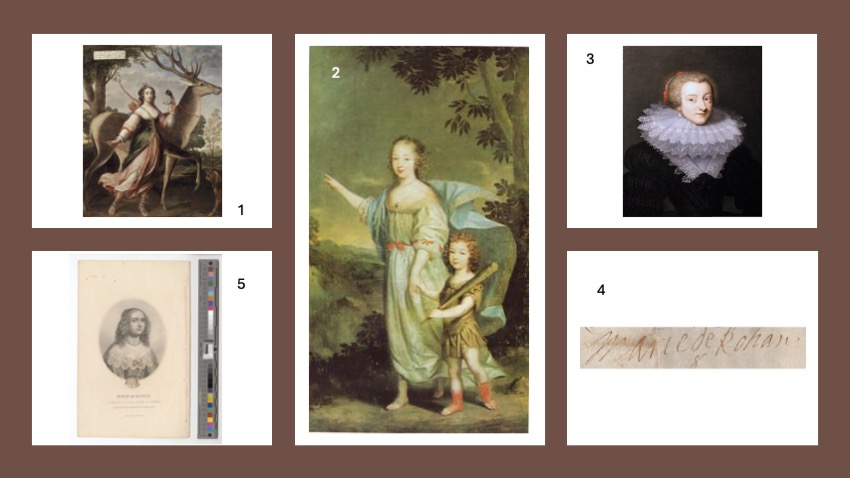
1. Attributed to Claude Deruet , Portrait of Marie de Rohan, Duchess of Chevreuse (1600-1679) as Diana the Huntress (circa 1627), Palace of Versailles; 2. Marie with her son Louis Charles; she poses as Diana and her son as Hercules; 3. Entourage of Daniel Dumonstier , Portrait of Marie de Rohan, Duchess of Luynes (circa 1621), location unknown; 4. 1663 signature of Marie de Rohan, Duchess of Chevreuse; 5. “Marie de Rohan, connétable de Luynes, duchesse de Chevreuse” / engraved by Capewell & Kimmel from the original portrait.
Marie de Rohan-Montbazon, Duchesse de Chevreuse (Marie Aimée; December 1600 – 12 August 1679) was a courtier mostly known for her participation in a number of intrigues and conspiracies during the reign of Louis XIII, during the Fronde, and during the early part of the reign of Louis XIV.
Family
Chevreuse was the daughter of a peer of France, Hercule de Rohan, duc de Montbazon (27 August 1568 – 16 October 1654), by his first wife, Madeleine who died in 1602. Her father’s second wife, Marie d’ Avaugour de Bretagne (1612-1657), is also featured in this gathering and in our first book “Twelve Years After” and you can read more about her here.
Marriages, Friendship with Queen Anne, and Rivalry with Richelieu
In 1617, Marie de Rohan was married to Charles d’ Albert, later the duc de Luynes (1578-1621), a favorite of Louis XIII, whose untimely death afforded an opportunity for Richelieu to step into the role of Louis’ most trusted advisor. In 1617, Louis and d’ Albert successfully conspired against the Queen Mother, Marie de Medici, and had her favorite Concino Concini assassinated on April 26, 1617 and his wife, Leonora Dori Galigai, executed for witchcraft on July 8. This story, especially the story of Galigai, is a significant plotline in our second book “The Florentine Conspiracy”. In 1618, a year after her marriage to d’ Albert, Marie de Rohan became superintendent of the household of Anne of Austria (or first lady-in-waiting), a position that reflected the rising power of her husband. She and Queen Anne became close friends. During this period, Queen Anne suffered a series of miscarriages, and in one instance, in 1622, the King who was growing disenchanted with his wife, blamed Marie for the miscarriage.
Marie was widowed in December 1621, and in April 1622 she married the powerful Claude de Lorraine, duc de Chevreuse. She was involved in court intrigues including her failed attempt, together with people like her lover Henri Rich (later Earl of Holland), to bring about a liaison between Queen Anne and the Duke of Buckingham. This is a major plotline in Dumas’ The Three Musketeers, but not in the BBC series. She was involved in several conspiracies against Richelieu, whose policies were meant to consolidate the power of the monarchy, reducing the power of ancient noble families. Chevreuse–like many other nobles–was threatened by these changes and by Richelieu’s influence over the King.
The scheme they devised was to replace the (yet) childless Louis XIII with his younger brother Gaston, the duc d’ Orléans, or at least have Gaston leave court and forge alliances with the Huguenots. It is possible that Queen Anne was also involved in this conspiracy.
In 1626, Chevreuse, together with Jean Baptiste d’ Ornano, the governor of the King’s brother, Henri de Talleyrand-Périgord the comte de Chalais (perhaps her lover), and others, opposed Gaston’s marriage with the duchesse de Montpensier. This was a highly advantageous union: the duchesse de Montpensier (later, mother of the Grande Mademoiselle) was extremely wealthy and from a powerful family. Both Richelieu and Louis XIII were supporting this union, whereas Gaston was averse to it. In the end, the (forced) marriage took place and the conspiracy failed–Gaston named names. Ornano was arrested and eventually died in prison. Chalais, who was not as noble as the rest of the conspirators, was the only one executed. He suffered a horrifying execution in the hands of an unskilled executioner. Chevreuse was exiled to Poitou. From there she withdrew to the duchy of Lorraine where she persuaded Charles VI to join Buckingham against the French. Richelieu permitted her to return to France in 1628.
Compared with Dumas: The events described in the Three Musketeers cover three years 1625-1628, although it appears as if the story takes place in just one year (and d’ Artagnan never ages). Chevreuse, who remains invisible to the reader, is supposed to be in exile, which is true for the period 1626-1628, and the execution of Chalais is, in fact, mentioned as having occurred.
In 1633, Chevreuse was exiled again, this time to Touraine for betraying state secrets to Spain, extracted from her lover, the Marquis de Châteauneuf who served as Keeper of the Seals. In 1635, France finally went to war with Spain, and two years later, Richelieu discovered that the Queen and Chevreuse were conducting treasonable correspondence with the Spanish court. The Duchesse was exiled but managed to escape from the Château de Loches with a maid, disguised as a man and flee to Spain (Sept. 3, 1637). This is a story Dumas uses in Twenty Years After. Chevreuse was also involved in the failed conspiracy of the comte de Soissons and the duc de Guise (1641) to assassinate Richelieu.
She was so notorious for her scheming that at the death of Louis XIII, a clause in the testament of succession forbade her return to France. A decision of the Parlement of Paris was required to overturn the clause.
The Fronde and the Cabale des Importants
When Anne became regent (May 14, 1643), Chevreuse was again allowed to return to France, where she resumed her intrigues. She was one of the so-called “Cabale des Importants” (Cabal of the Important, or Conjuration of the Important) a conspiracy organized at the end of August 1643, that also involved François de Vendôme duc de Beaufort (16 January 1616 – 25 June 1669), Claude de Bourdeille comte de Montrésor (c. 1606–1663), Charles de l’Aubespine marquis de Châteauneuf (22 February 1580 – 26 September 1653), Louis d’Astarac de Fontrailles Marshal of Marestaing and Vicomte de Fontrailles and Cogotois, Henri II 5th duc de Guise (4 April 1614 – 2 June 1664), Bernard de Nogaret de la Valette duc d’ Épernon (1592 – 25 July 1661), and Charles II, duc d’ Elbeuf (5 November 1596 – 5 November 1657). The conspirators plotted to assassinate the Queen’s first minister, Cardinal Mazarin. The conspiracy failed but without any evidence to incriminate Chevreuse, Queen Anne asked her to leave court.
Chevreuse first retired to the family Château de Couzières with her daughter Charlotte, where she continued to receive friends that Mazarin thought were suspect. In April 1645, Queen Anne further distanced herself from her old friend, and Chevreuse escaped first to Saint Malo, and then to England, where she hoped to be received by King Charles I. He was, however, fighting against Cromwell. Chevreuse and her daughter ended up blocked for two months at the Isle of Wight by Cromwell’s roundheads. The intervention of the Spanish ambassador allowed them to escape to the Spanish Netherlands and settle in Brussels.
When the Parliamentary Fronde (First Fronde) broke out (1648) Chevreuse was in Brussels. Nevertheless, she was still popular among the rallied aristocrats, as is evident from pamphlets such titles as: “L’Amazone française au secours des Parisiens ou l’approche des troupes de Mme de Chevreuse ou L’Illustre Conquérente ou la Généreuse Constance de Mme de Chevreuse” (The French Amazon to the Aid of the Parisians or the Approach of the Troops of Madame de Chevreuse or The Illustrious Conqueror or the Generous Constancy of Madame de Chevreuse.) The party of the Fronde was eager to involve her, in particular, one of its most important leaders, the Coadjutor of Paris M. Gondi. Thus, he brought her close to a friend of his, the Marquis de Laigues, who became Chevreuse’s lover.
After the peace of Saint-Germain on April 19, 1649 that ended the Parliamentary Fronde, the Duchess returned to Paris without even waiting for the Queen to give her permission. In the Fronde of The Princes or the Second Fronde (1650-1653), Chevreuse supported the party of M. Gondi, who was the lover of her daughter Charlotte, against the party of Condé (and Madame de Longueville). Chevreuse and her daughter worked to bring Gondi closer to the Court, which led to the arrest of Prince Condé, his brother Conti, and his brother-in-law, the duc de Longueville (known as “the arrest of the princes”). In the meantime, Chevreuse managed to have her former lover Châteauneuf reinstated as Keeper of the Seals.
At the beginning of 1651, the alliance of the two major parties of the Fronde led to the exile of Mazarin and the release of the princes. A marriage between Mademoiselle de Chevreuse and the Prince de Conti was to seal the rapprochement of the two families (Condé and Rohan), but the Duchesse de Longueville thwarted the marriage scheme. The alliance did not last. Mazarin returned from exile on April 28, 1652 and on July 2, 1652 the royal forces led by Turenne defeated Prince Condé at the Battle of the Faubourg Saint-Antoine. The Prince escaped to Spain and Gondi was arrested and imprisoned first in Vincennes and later in Nantes.
From that point on, Chevreuse kept herself aloof from the last vestiges of the Fronde. Still, she carried out some secret negotiations at Mazarine’s requests, which earned her a place in some Mazarinades and the leniency of Queen Anne. In Nov. 1652, her daughter Charlotte died, which caused her great pain.
After the Fronde
Chevreuse divided her time between the Court and the Château de Dampierre en-Yvelines, the Chevreuse family home. That would be an earlier structure and not the later Hardouin-Mansart building which one can visit today. Following her father’s death Chevreuse had to fight with her brother over issues of inheritance because the duchy was threatened with sequestration.
Chevreuse’s second husband died in 1657, and she became a widow again. According to the memorialist Saint-Simon, she secretly married the Marquis de Laigues who had remained her lover. After his death in 1674, Chevreuse retired to the Château de Maison-Rouge in Gagny where she died on August 12, 1679. She is buried in the parish church.
From her first husband, de Luynes, Chevreuse had three children, one of them the 2nd Duc de Luynes, a peer of France (1620-1690). From her second marriage she had three daughters. The older, Anne Marie de Lorraine, and the younger, Henriette de Lorraine, became nuns, and her middle daughter was Charlotte (1627-1652), her favorite.
The Duchess de Chevreuse In Dumas

Athos (Veniamin Borisovich Smekhov) meets Madame de Chevreuse (Olga Kabo) to introduce their son Raoul. Russian 4 episode, 1992 TV adaptation Мушкетёры двадцать лет спустя (Mushketeri dvadsat’ let spustya), dir. Georgi Yungvald-Khilkevich. This is the closest adaptation of the novel alongside the BBC 1967, 16 episode adaptation entitled The Further Adventures of the Musketeers.
In Dumas, Chevreuse is a significant character. In the Three Musketeers, she is Queen Anne’s best friend, Aramis’ lover, and the Musketeer’s secret ally, although she never appears in person in the novel. In her correspondence, she uses the alias “Marie Michon, the Queen’s needlewoman,” and she is involved in the Buckingham plot and in subsequent plots to protect the Queen against the Richelieu, and Constance against the Cardinal’s agents: Rochefort and Milady.
In Twenty Years After (action begins in 1648) we find out that Chevreuse is the mother of Raoul de Bragelonne after spending one night with Athos.
They meet at the village Roche-l’Abeille (chosen randomly by Dumas). Chevreuse is escaping from the Château de Loches at Tours disguised as a man with her maid (Kitty, formerly Milady’s maid) and seeks shelter for the night at the house of the village curate. There she finds Athos, also seeking shelter for the night while on an important mission (which is not explained further). Thinking he is an abbe the mischievous Chevreuse decides to tempt him, and Athos obliges without explaining that he is not the curate. He does, however, eventually recognize Chevreuse because he knows her maid, Kitty, who was originally Milady’s maid. A year later, Athos returns to that village (unclear why) to find a bemused abbe who, only a week prior, received a cradle with a baby boy three months old, a purse of gold, and a note with only the date written on it: “Oct 11, 1633”. The baby is Raoul and Athos takes the baby to raise him as his son. Raoul is supposed to be 15 when Dumas begins the novel, in 1648, and according to this timeline, he was conceived in 1633 although, of course, the historical Chevreuse escaped the Château de Loches in 1637. Dumas’ timeline is fictionalized even though he relies on history.
Like her historical counterpart, in Twenty Years After, Chevreuse is a Frondeuse and involved in all sorts of intrigues. She is, however, an ally of the Musketeers, especially the two Musketeers who are part of the Fronde: Athos (with whom she has a son) and Aramis (her old lover) who is portrayed as the lover of Madame de Longueville (Chevreuse’s political/family adversary).
We also find Chevreuse involved in the conspiracy to replace Louis XIV with his twin brother in Man in the Iron Mask, this time siding with her old lover, now a General of the Jesuit Order: Aramis.
The Duchess de Chevreuse in this story
Our story derives from Dumas but also from the BBC series, which has changed significant Dumas plotlines and removed others. Because of that, we write Chevreuse mostly based on her historical counterpart.
We first meet Chevreuse in “Twelve Years After”, upon her return from Brussels, as she navigates the Parliamentary Fronde alongside M. Gondi. In our story, Athos remains a Frondeur. Aramis on the other hand is her enemy. This is because of how the character of Aramis was rewritten for the BBC series, especially his relationship with Queen Anne and his elevation to some kind of political position (Queen Anne’s First Minister?) at the end of Season 3, which mirrors Mazarin.
In our version, once Aramis was elevated to First Minister, Chevreuse conspired to assassinate him. Thus, we “rewrite” the Cabale des Importants as a conspiracy against Aramis, not Mazarin. Even though eventually we introduce Mazarin in the story, and maintain the Dumas backstory that Aramis and Chevreuse had been lovers in their youth, we do not make them allies–and in truth, even in Dumas’ Twenty Years After, their alliance is tentative.
We have also fictionalized some of Chevreuse’s family relations. For example, we make her a cousin of the Comte de Wardes and we also make her a relative of Marie Mancini, Louis XIV’s lover and niece of Cardinal Mazarin. Neither is true. Furthermore, in this story, Athos and Rochefort are cousins through Athos’ adopted father, and Chevreuse is related to Rochefort. The Rohan family, from Brittany, was one of the most ancient families in France, and there is a Rohan-Rochefort branch which inspired this fictional genealogy for Rochefort and his son, Jean Philippe de Rohan (now Baron de Rohan-Rochefort).

 Twelve Years After
2 thoughts on “Duchess de Chevreuse”