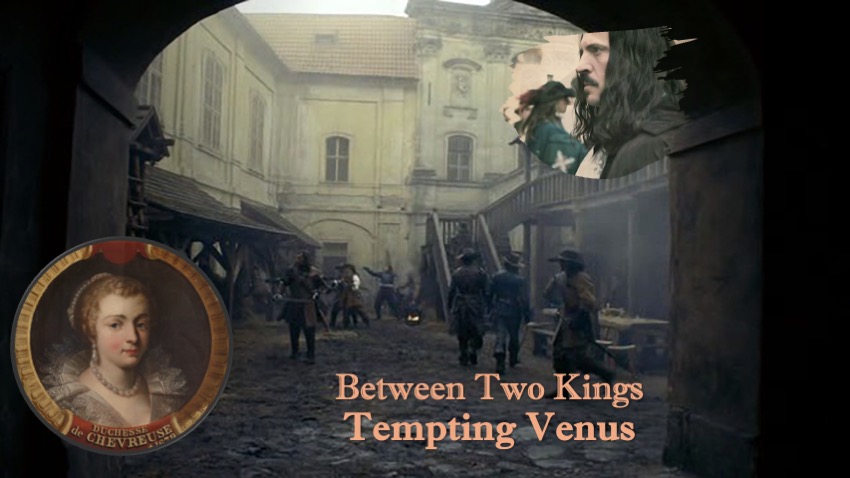
“What is all this?”
Captain Marchal is not in a good mood. He removes his hat and gloves and throws his muddied cloak on a chair upon entering his office. He and his men have just returned from Royaumont riding all night in freezing rain, the roads treacherous, all slush and dirt. The pile of reports and papers on his desk makes his headache and his mood worse.
“They have kept arriving, Captain, almost since you left yesterday,” M. Rochois explains in a businesslike manner.
“What are they about?” Marchal is already sorting out the pile. Some of the reports are sealed, for his eyes only.
“From what I am allowed to read, Captain, they are about a gathering at the house of the Duchess de Chevreuse yesterday morning. Much of it is gossip…” M. Rochois sounds dismissive. “There is a report that the Marquis de Normanville and the Baroness de Rohan-Rochefort were seen yesterday morning too, getting into an unmarked carriage at a respectable inn, at the rue de Seine. It is not far from her father’s wharf. What they were doing at that inn, or whence they came is unknown. They may have arrived in disguise overnight. The innkeeper is loyal to the Duc du Plessis, so there is not much information from that direction unless we use force. The carriage entered the city through the Porte de la Tournelle and was seen arriving at Saint-Germain at the house of the Marquis de Normanville.”
Captain Marchal has already browsed that report. There is more in it, all concerning. He sits and continues to read. “I need hot water, a clean change of clothes, and some food and wine. Isn’t Certel in charge of the barracks this week?” The Lieutenant nods. “Have him send everything up here, not in my chamber. Are Bennart and Falaize back?”
“Yes, they reported back early this morning.” With his eyes Rochois points to a report on the desk sealed with the coat of arms of Cardinal Mazarin.
“What about Gitaut?”
“He has not returned, Captain. There is another report. Pajot and Truyart were found dead but he was not with them. I have sent Goulart and Dathie to make inquiries. So far nothing. Not even his horse. It is strange…” Captain Marchal levels a look indicating he agrees. “What if he…Captain, I know His Majesty insists about Gitaut, but the man is…” Captain Marchal raises his hand, silencing his lieutenant.
“Let us be careful about what we say even here. I know who the man is… I know what he is too. We both do,” he says quietly. “You are right. If Gitaut was dead, even if his body was thrown into a ravine we would have found something. His horse. His weapons. Pajot and Truyart were found. We must assume he defected to his brother’s side. Rochefort’s side. Keep your men looking for him. Perhaps there is another way to find Rochefort after all.”
“Anything else, Captain?”
“Don’t go too far. There may be new orders for us.”
Lieutenant Rochois salutes and closes the door behind him, while Captain Marchal sits back, reaching for the report with the Cardinal’s seal. It is not the Cardinal who has sealed it or written it, it is his man, Colbert. The Cardinal has become the governor of Vincennes, however, and this letter confirms the safe delivery there of a masked and cloaked prisoner named Eustache Dauger, who has been offered ‘a comfortable residence’ at the quarters of the late governor, M. de Chavigny. At least this part ended as planned, Captain Marchal thinks. Henri Bernard is no longer in the Bastille and he no longer exists but Eustache Dauger will remain at Vincennes until the roads to where he is destined to spend the rest of his life become passable again, especially the mountainous route between Grenoble and the coast.
“Enter!”
The servant has arrived, followed by Certel, the cadet in charge of the barracks. They are carrying hot water, food, and a clean change of clothes. “Captain, Lieutenant Rochois ordered us to…” Marchal points to a table near the fireplace and waves his hand–and the cadet and the servant obey in silence and retreat, closing the door.
He washes and changes, and despite the protocol he has established among his men– a stricter protocol than Captain d’ Artagnan’s– he chooses to remain in his shirtsleeves for the moment. He eats quickly, downs a glass of wine, and fills it again. He drinks as he walks to his desk and the infernal pile of reports, pamphlets, and gazettes that he must scrutinize.
They confirm the suspicions which led him to Royaumont. Raoul rode to Royaumont in disguise, of this, Captain Marchal is certain. Raoul rode there with Layla, and the report about their covert return to Paris using her father’s friends attests to that. They must, therefore, be together in this: Raoul, Layla…Captain Marchal wonders if M. de Rohan, a man of such probity, impeccable and honorable, would have agreed.
But the pamphlets and La Gazette report a most unbelievable story: that M. de Rohan and the Marquise de Normanville arrived together at Chevreuses’ gathering, stunning everyone with their beauty and elegance, but even more scandalously, that M. de Rohan treated the Marquise as a lover, including lavishing her with expensive gifts. Captain Marchal plans to confirm this story with Sylvine, but it is unbelievable that M. de Rohan would ever have any illicit affair let alone an affair with Raoul’s wife, his wife’s best friend, no matter how perfidious the lady. This looks like a ruse and part of their plan, so Rohan despite his probity, must be in their confidence. Perhaps it is what those three comprehend in the old Musketeer oath.
Raoul’s and Layla’s secret journey, Rohan’s and the Marquise’s scandalous escapade, the mysteriously deserted estate of Royaumont, and Sophia de la Croix’ valiant effort at dissimulation, combined with the reports and the gossip in the pamphlets can mean only one thing: that Captain de la Fére, Captain d’ Artagnan, General du Vallon and the Duc d’ Herblay were, in fact, at Royaumont. And not just them but their wives and children. Captain Marchal’s spies around the estate report coaches and carts leaving, and in haste.
Captain Marchal is no fool even if they think him too crude to grasp their clever games. He sees many more connecting threads: the disappearance of General du Vallon’s family from Paris on the same night as the soiree at Captain d’ Artagnan’s house. The urgency with which Madame d’ Artagan decided to take her two children, one of them an infant, out of Paris for a pilgrimage in the middle of the winter. The house of the draper at the Rue des Fossoyeurs, so close to Saint-Sulpice, where Madame d’ Artagnan knew that the Marquise de Normanville kept her illicit meetings with Henri Bernard; not only knew but was herself there with the two lovers. And the draper, Bonacieux, isn’t he a relative of the lady’s first husband? Captain Marchal marvels at Madame d’ Artagnan’s scheming. He thought it was Captain de la Fére’s wife who was supposed to be the scheming one. Madame d’ Artagnan he has known for years, thought he knew her well too, thought the lady determined, courageous, perhaps outspoken at times, but never scheming. Clearly, he has been wrong. Madame d’ Artagnan has played a significant role in this vanishing act, as well as in protecting Henri Bernard and his lover, the Marquise de Normanville–is the Marquise not the daughter of General du Vallon whom Captain d’ Artagnan considers a brother, the marquise herself raised as his niece?
And what about Raoul? Why would Madame d’ Artagnan protect the cheating wife and the lover instead of the husband who is the son of the other man that Captain d’ Artagnan considers a brother? The only possible answer is that Raoul asked her; Raoul who has been protective of his perfidious wife despite knowing about her escapades. Raoul who must know everything about Henri Bernard as well. Is he not the Spymaster of France? He most likely knows that other, darker truth about Louis, the truth which Captain Marchal is not supposed to be clever enough to surmise. Raoul seems to have picked a side: the honorable side perhaps but, currently, the losing one. Captain Marchal does not have the luxury of such a choice. Quid pro quo is the only principle he can abide by, and Louis, no matter how illegitimate, is King, and Captain Marchal’s only recourse.
What is the role of the Duc du Plessis in all this, Captain Marchal wonders? The Duc does not strike him as a man who’d get involved unless he had some personal stake. There is Layla’s friendship with Raoul and her connections with Captain d’ Artagnan, Captain de la Fére, General du Vallon, and the Duc d’ Herblay. But would that suffice? Those four and the Duc du Plessis have been mortal enemies since the Duc killed Captain de Treville, perhaps even earlier, if rumors among the veterans and the gossip at court are to be believed. In the years that Captain Marchal has known the four and Lucien Grimaud, they have hated each other even when they were forced to fight on the same side. Captain Marchal has been a witness to this himself. He even played the role of Lucien Grimaud once.
And yet, it seems that the Duc du Plessis is involved. Would Sophia de la Croix harbor these men with their wives and their children, at her family house, endangering herself and her own children, without her husband’s knowledge? Sophia de la Croix waited at Royaumont while everyone fled. Captain Marchal is certain. Would the Duc du Plessis, the Lucien Grimaud that Captain Marchal knows, allow his wife to take such a risk? No, and she would not, unless she was protecting her own. Her daughter Suzanne most likely, who was a friend of Henri Bernard and his mother in Venice. Her husband too. But why?
Captain Marchal stands from his chair and paces his office pondering on that very question. What is Lucien Grimaud’s involvement in this sordid story of conspiracy and treason? Could there be another connection to Henri Bernard, he wonders, other than the friendship with Suzanne d’ Armas and her husband? There must be, although Captain Marchal cannot see it. But he begins to see another connection, and it is most troubling.
It was the Duc du Plessis who intervened at the Louvre when Captain de la Fére stormed in with all kinds of vile accusations. It seemed like a valiant intervention, the Duc standing up to protect King and Queen, and magnanimous too, for it was the Duc’s investiture that Captain de la Fére interrupted. The Duc hurried after Captain de la Fére, fighting him off, or did he? He must immediately interview all the guards who might have witnessed that fight, Captain Marchal realizes. He swears under his breath while he paces. How could he have missed something so obvious?
Still, it does not answer why Lucien Grimaud would let his mortal enemy go, and offer him and his friends shelter at the family estate, endangering his family, allowing his wife to endanger herself on their behalf, forcing the family to flee to God knows where. The only connection that Captain Marchal can find is Alessandra Morosini, of whose disappearance both Captain de la Fére and Raoul have accused him. He sent Gitaut with Pajot and Truyart to keep an eye on that treacherous lady, it is true, especially after what happened with Esther and the lady’s unquestionable involvement with Agnes Bernard.
Captain Marchal stops pacing and clicks his tongue testily. There it is again, he realizes: another connection with Agnes and Henri Bernard. Alessandra Morosini was the notorious spy of Cardinal Richelieu and most likely of Rochefort, and it goes without saying she’d know about Agnes Bernard and her son! And is it not common knowledge that Alessandra Morosini and the Duc du Plessis are old friends? Most likely old accomplices given their past. Is it a stretch to imagine that the two at one point or other could have been Rochefort’s accomplices together and that this is the hold Rochefort has over all of them?
It annoys Captain Marchal exceedingly that he is so close to the truth and yet cannot grasp it. Perhaps, if he were a man like Raoul or even Rohan, he would have been able to see clearly where he can only see shadows. But he has no doubt. Archenemies or not, they are all together in this conspiracy, masterminded by Rochefort, that revolves around Louis and Henri, and he, the vile dupe from the Court of Miracles, is the only one who stands between them and Louis. The illegitimate king, but the only king there is. Quid pro quo.
Captain Marchal returns to his desk and the piled reports, his mind, however, drifting to the events at Royaumont, not so much Sophia de la Croix’s defiance or her contempt but the sense of satisfaction–nay gratification–that came from their confrontation no matter how fleeting and how ephemeral. I am a marked man now, he tells himself with an amused chuckle. The Duc du Plessis–nay Lucien Grimaud–will not let such an injury go unpunished. Captain Marchal cares little about consequences, however. Unlike Lucien Grimaud, he is a true son of the Court of Miracles and in that world you learn from birth to seize the opportunity the moment affords, be it the fleeting power over an old, disdainful lover like Sophia de la Croix, or the fleeting power of an illegitimate King like Louis. Besides, aren’t the Duc du Plessis and his disdainful wife up to their neck in treason? Quid pro quo.
“Parbleu!” She catches him completely off-guard. She is standing in front of his desk, wrapped in a deep purple, fur-lined cloak, a mischievous smile on her perfect lips. “How did you get in here?”
She shrugs. “Your men are well trained at discretion. Don’t take everything so seriously, Captain. Not everything is a conspiracy!”
“How did you know I was here?” She clicks her tongue and raises an amused brow. “Do you have spies among my men?”
She moves languidly around the desk. “No, not among your men!” She hums the words.
“Servants then.”
She giggles softly as leans closer, her breath brushing against his skin, her fingers barely touching his bare arms where he has rolled up his sleeves, her fragrance bold and sweet overwhelming him. “All that matters is that I am here,” she teases, sliding between him and the desk. Under the fur-lined cloak she wears almost nothing.
“Madame…” He protests feebly and she smiles a satisfied smile.
“You missed the small gathering at my house yesterday and it was noticed.” She hums the words again, fixing a pair of large, blue mischievous eyes. In the glow from the fireplace, her beauty is breathtaking. Marchal can no longer remember what it was like to love Sophia de la Croix. He can no longer remember what it felt like to accost her in her own house to satisfy his resentment. “Madame…” he attempts another protestation but all he manages is a gasp his senses overcome, his body inflamed by the gentle pressure of her toes traveling up his thigh. He springs to his feet and with a swift wave of his arm sweeps the piled reports and pamphlets from the desk shoving them onto the floor just as he lays her on it. He was right: under that fur-lined cloak, little separates him from her breathtaking beauty.
⚜️⚜️⚜️⚜️
She draws in a deep breath and slants an impish look. “I have always wanted to damn a Captain of the Musketeers.”
He returns the look as he rolls next to her on the desk catching his breath. “I thought you already did that with de la Fére.”
She sits up, pulling the fur-lined cloak to cover her naked back and shoulders and he sits up too. “He was not a captain when I damned him, and, to be frank, I prefer a man who enjoys damnation. Besides, to damn a Captain of the Musketeers is one thing. To damn him right at the place where he works… On his very desk…” she giggles. “Sacrilege!” He chuckles, shaking his head. “But you don’t care, of course you don’t! We committed sacrilege on someone else’s desk!” She feigns a scandalized tone.
“It was supposed to be a secret.”
“What is a small gathering to admire fashions for, if not to learn such secrets? He was there, M. Mancini, your successor, blabbing as always.”
Captain Marchal frowns, no longer amused. “About what?”
“This and that.” She clicks her tongue. “At ease, Captain. Not everything is a conspiracy! Besides, Mancini only talks about himself. You know that!”
Captain Marchal slides from the desk and offers her his hand, leading her to one of the chairs by the fireplace. He fills a glass with wine and she takes it as she sits, wrapped in her cloak, comfortably tucking her feet under her. “We should do this again in your new office,” she teases.
He fills his own half-full glass and sits across from her. “It is a dungeon.”
She sips and clicks her tongue dismissively. “I have heard about that. No, not that dismal place. Your new office, I hear, is close to His Majesty’s apartments, much closer than that of the Marquis de Normanville.”
He tries to remain expressionless. “Did you hear that too while entertaining your guests and admiring fashions?”
She twirls the glass in her hand, the mischievous glimmer in her eyes enhanced by the fireglow. “No. I heard it from Bauvilliers.”
Now he is baffled. Paul de Bauvilliers, the son of the Duc de Saint-Aignan, is vying to replace Raoul as the King’s favorite and winning, but he styles himself as too much of a scholar and an academic, at times too prudish, for entertainments like a fashion exhibit at Chevreuse’s house which he would certainly dismiss as frivolous. “Where?”
“At court, darling, where else?” Chevreuse’s tone is no longer jesting. “Anne has returned to court, as you know. So have I.” She sits back in the chair and sips from the glass. “As of this morning I have returned to court, first-lady-in-waiting to the Queen Mother. And before you ask…Sourface is gone. Vanished it seems, and good-riddance, I say, to her and her ridiculous son.”
“Thomas de Renard and his mother, gone?” He chuckles. “That is impossible. Well… Mademoiselle Mercier will be disappointed.”
“You are unfair to that poor child! She always preferred you to Thomas de Renard.” Chevreuse mocks a protesting tone and he raises a disbelieving brow. Chevreuse sighs. “I suppose she can never marry you now. You are too high above her station. It will break her heart but we will find her another appropriate husband.”
“I am just a commander. I have been removed from the position of Captain of the Musketeers and…”
“Nonsense! Unless you want to believe it,” she interrupts him. “You are Commander of the newly minted King’s Guard. It comes with a title and an estate.”
“Says… who?” He fixes his eyes on her. He cannot read her expression or her tone. He cannot tell if this is a tease or a provocation.
“Beauvilliers,” she says quietly, and he realizes she is not jesting. “He seeks powerful allies as he must, if he is to overshadow the Marquis de Normanville as the King’s favorite. You are one such powerful man now, not a particular admirer of the Marquis, his vile mother, and his father, especially after recent events, and on your way to replace the Marquis de Normanville one day as the King’s…most confidential agent…shall we say?” The playful glimmer returns in her eyes. “You are close to His Majesty. You have powerful friends at court, who are close to the Queen Mother too, and she is now as close to her son as she has ever been.”
Quid pro quo, Captain Marchal thinks. He raises his glass to her. “To M. Beauvilliers then and to powerful alliances.”
“To powerful alliances!” She sets her glass on the table. “I must return. The Queen Mother retires early.”
“I will escort you.” She begins to object. “I will,” he insists.
She smiles playfully. “Make sure you dress then. Full regiment attire. You are still Captain of the Musketeers and soon to be much more. The two of us in a state of dishabille might raise many a bitter tongue, and Beauvilliers pretends to be a prude. We can’t afford a scandal.”
He chuckles as he slips on his doublet and fastens his paudlron. “Unlike the Marquise de Normanville and your cousin?”
“Oh you are good, Captain!” she giggles. “Too good!” She walks up to him and fixes his collar. “Perfect. Well… about my cousin. My cousin, the Baron de Rohan-Rochefort is a most elegant man and too noble–and yes, I know what you are thinking–but his father–yes Rochefort–was a model nobleman even when he was a double spy for Spain. He is ancient nobility, darling. From his mother’s paternal side, Rochefort is connected to the Merovingian line. What? You don’t believe me?”
“No, I do.” Not long ago, with Raoul and Rohan they sought Rochefort’s grave at the Abbey of Montmartre, where the Benedictines allow only members of the Merovingian line to be buried. They found a body in that grave, he recalls, and it looked convincing. He wonders now if he was the only one of the three who was duped.
“Noble blood through and through,” Chevreuse is saying, “my cousin is very much like his father in that, but that is where the similarities end. My cousin has too much of a heart, I fear. He was even kind to my poor Sylvine I was told. In our midst a kind and generous heart is a fatal flaw. His other major flaw is that he is in love with his wife. That kind of eccentricity can destroy a man and a man’s reputation at court.”
“And yet he arrived with Normanville’s wife.”
“Pfff!” she scoffs. “I believe none of it. Besides, she has a lover. And the Marquise de Normanville was in fact dismissed from court, she did not retire as she pretends. I am certain her charming charade with my cousin has to do with that. A fake scandal can do marvels in restoring a woman’s reputation at court, and she needs to return to court desperately…Her entire family needs it. Her extended family too.”
“You don’t like her, do you?” Captain Marchal makes way for Chevreuse to walk to the door.
“Not at all, and it’s not because she is some footsoldier’s orphan. I despise her connections: Athos de la Fére, his son, that entire family. My cousin’s wife too, who is her best friend, and her family–her vile father, Richelieu’s bastard. I despised Richelieu and it was mutual. Of course, I understand that my cousin’s wife is your friend and old comrade…” He shrugs and she smiles. “Madame de Normanville thinks herself better than all of us, and more clever. She is neither.” Captain Marchal opens the door for the lady to cross. “He is the physician in the court of the Grande Mademoiselle, her lover, is it not so? Rochefort’s adopted son?”
“Her lover is dead,” Captain Marchal says. He follows the lady through the corridor that connects the office of the Captain of the Musketeers with the Louvre.
⚜️⚜️⚜️⚜️
Captain Marchal is fastening his gloves as he is walking hastily back from the Louvre to the Garrison, the setting sun casting a warm glow although the afternoon is cold and a freezing wind is blowing from the river. He avoids thinking about Chevreuse’s revelations concerning his future, although there is a bolder stride in his gait, and in his demeanor something more forbidding than before. Once he sought powerful allies. Now he is being sought after. Quid pro quo.
“Captain!” He stops and turns.
The man hurrying after him is short and slender, with bony features, an aquiline nose and high cheekbones, features that should render a man handsome, but the man’s face reminds Captain Marchal of a mouse. It has been so since Captain Marchal first met M. de Beauvilliers in Blois, when Louis visited his uncle with the Queen Mother and the entire court. M. de Beauvilliers is more elegantly dressed than most courtiers–the gentleman is known to spare no expenses when it comes to his appearance even though he is not as rich as M. Fouquet–and as with all court dress, his clothes are too flimsy to be walking down a drafty empty gallery in the middle of the winter.
“Wait Captain!” M. de Beauvilliers flashes an affable smile as he approaches. “What a cold day. One would never know with this beautiful sunshine!” He blows into his hands and rubs them together briskly. He leans closer. “Madame de Chevreuse considers you a friend.” It sounds like a question but it is the beginning of a proposition.
Captain Marchal nods. “We are indeed… friends. Yes.”
“Ah! Good!’ M. de Beauvilliers sounds relieved. “You are the very man needed, Captain!” He assumes a tone that is obsequious and confidential. “Perhaps I should say, Commander, or maybe…Chevalier.”
Captain Marchal likes what he hears, but the man’s tone annoys him. “Captain will do.”
“A man of fine sensibilities and a soldier through and through” M. de Beauvilliers marvels. He shakes his head and sighs. “I must confide, Captain. His Majesty is in a state this afternoon.”
“Indeed?”
“Yes! He has shunned everyone from his apartments. All of us, his best friends and companions! Only Bontemps’s son remains with him. Not even old Bontemps, his most loyal valet! We are very concerned.”
“Perhaps His Majesty has something else in mind,” Captain Marchal ventures.
“A tet-a-tet, you mean? No! His Majesty is a most attentive husband, soon to be a father. No, His Majesty is brooding and the reason is this evening!”
“This evening?”
“It is tonight, Captain!” He scans Captain Marchal’s face for signs that he comprehends the meaning but the Captain knows how to appear inscrutable. “The soiree at that infernal brothel at Saint-Germain-en-laye!” M. de Beauvilliers insists. “The soiree that no one knows or talks about although everyone has been soliciting invitations.”
Captain Marchal has some vague notion, but he was not invited. Rumor has it, it was the idea of Petit Monsieur, the King’s brother, Philippe, the Duc d’Anjou, who is a patron of the notorious establishment as are others at court–M.de Guiche, for instance–just to annoy and embarrass his brother.
It is not that Louis and Philippe do not love each other. Captain Marchal’s experience all these years, including the battle he fought alongside both young princes at Rouen, attests to the strong bond between the two brothers. But Philippe likes to provoke, especially when the King of France cannot afford to appear provoked. “I fear there is little I can do, Your Grace. Should your petition not be to His Majesty’s brother?”
M. de Beauvilliers looks bemused but only momentarily. “Oh no!” he chuckles. “The Duc d’ Anjou is not behind this depravity! It is the Marquis de Normanville.”
Raoul, Captain Marchal thinks! Raoul, with his high principles and his moral imperatives. Would Raoul have done something so reckless? “Are you certain, Your Grace?”
“Well, I can’t be entirely certain. They have been very good at keeping it a secret. But the Chevalier de Beaumont has been all over this matter. De Guiche too, and although I would consider de Guiche capable, the presence–-I should say the omnipresence—of Beaumont makes anyone wonder. And what do Beaumont and Guiche have in common?”
Raoul, Captain Marchal thinks.
“The Marquis de Normanville!” M. de Beauvillers declares triumphantly. “And such demeaning depravity is not just an insult to all upstanding men at court, but a direct provocation against His Majesty and His Majesty’s honor.”
Beauvilliers antagonizes Raoul and is not invited. As for Louis: the King cannot go to brothels, of course, and he is probably seething after some encounter with his brother who is not only invited but also a patron of the place. “Still, I cannot see how I could be of any help, Your Grace. I take my orders from His Majesty.”
M. de Beauvilliers clicks his tongue impatiently. He has lost his feigned obsequiousness. Perhaps it is the bitter cold. “Madame de Chevreuse indicated that you find it…equally offensive that a foreigner…a Venetian…should claim so much power at the French court. That he should determine our very fate.”
“I see.”
“That Venetian, with the impropriety and indecency particular to his race, adds insult to injury, attempting not only to corrupt the decent men of the French court, but most importantly, to demean His Majesty’s honor.”
“His Majesty has not spoken to me. I have no orders from His Majesty on this matter.”
“His Majesty is too generous and loyal a friend to the Marquis,” M. de Beauvilliers says with spite. He leans even closer. “His Majesty would never give such an order. Not directly.”
“Indirectly then?”
“There are many of us who would like to see Normanville and his influence removed from court, from France even,” M. de Beauvilliers says. “As for His Majesty, giving orders directly or in any other manner to that effect would be beneath his dignity. A good courtier must always anticipate his King’s wishes. It is the same with the Captain of the King’s Musketeers, is it not?” He smiles cunningly. “Besides, no one would ever accuse you of being overzealous, Captain, especially if what you uncover at that den of corruption causes a scandal. Consider all those who will be there tonight, gambling away their money and dignity, thinking they are immune, and how grateful many will be to you, if you choose to protect them later.”
Quid pro quo, Captain Marchal realizes. Now he is truly in the game. Take them all out with one sweeping move. The King may be annoyed at first but the arrests alone will make up for it. And who knows who else may be hiding in that place. And yes–he’d like to remove Raoul altogether, replace him too as spymaster. Captain Marchal does not think that raiding a brothel will achieve that, but if enough indictments and accusations accumulate against Raoul, then his own path is clear.
Captain Marchal sets a friendly hand on M. de Beauvilliers shoulder. “I will ride to Saint-Germain-en-laye with my men right away,” he says and M. de Beauvilliers clasps his hands with gratitude.
“Madame de Chevreuse was right!” Beauvilliers exclaims. “She was right about your devotion and loyalty.”

 Twelve Years After
Hmmm, Fabien is hopeless. He has known Raoul for years, and it still never occurs to him that if Raoul is behind something, it is for a reason and not for entertainment. I understand Fabien is carried away by the promotion hinted at by everyone, but really, this is disappointing.
It’s surely interesting what will happen at the soiree, but what of Alessandra?! All the other characters seem to be more or less enjoying themselves, big family dinners, returns to court, finding relatives, while she is close to death and at the mercy of that nun. I wonder if Radu is able to move her to Rochefort’s estate – it seems like her condition won’t allow it, even if he drives away Henry, Catherine and Thomas. I also wonder if Loup tracks down that fellow from La Rochelle who was hired as a servant to the de Winter family together with his wife… so many questions there that need answers, and I can’t wait for the events to unfold in that part of France.
LikeLike
This is a great comment! It is very much as you say, when it comes to Fabien. He has power now and that is all that matters to him. He will exercise it. That is his mindset and this kind of opportunism is a survival skill–that is how he lived all his life, until he joined the Musketeers. I am not sure that anyone is enjoying themselves in the story- at all. They are in danger. They have to device ways to escape as far from the reach of Louis and Fabien as possible and/or to distract (e.g. Rohan and Marie Cessette). Sophia was attacked trying to shield those escaping. They all do what they must to protect each other as events unfold before them. France is an enormous country if you are trying to find someone without knowing where to look: it was the same with Constance and Alexandre and with Bianca and Rayya. Besides, all these different characters are acting at the same time, within the same month or so. Obviously too, not everyone is invested in finding Alessandra. Fabien is not invested for example (he even “exchanged” information about Alessandra in his “quid pro quo game” with Chevreuse). Athos, Raoul, and Lucien are the most invested and they are doing all that is possible: Athos and Lucien followed the leads at Bragelonne all the way to Bourlone-Marlotte. In Paris, Raoul has figured out Rochefort is not really involved, which is important because Rochefort was the prime suspect. To find his mother, it is important they discovers where to start looking, and have an idea of who might have done this. Strangely, Rochefort is invested in finding her too- his reasons are always complicated. When it comes to Athos specifically, we opt for Dumas’ version of Athos, rather than the common fanfiction trope of him as the “accursed hero”: a soldier first and foremost. As a soldier, when tragedy strikes, Athos has the discipline to do what must be done and complete the task before him. We saw this when Raoul was thought to be dead. We also saw it with Bianca- there too he faced multiple challenges including what happened to Layla. Here, he does the same; Alessandra is missing and he must at the same time get his daughter out of danger away from Paris. Now his daughter has him only-in fact, Alessandra would do the same, and we have seen that she has done the same. Athos must protect the rest of his (extended) family too because they are his family and because their safety is Bianca’s safety. As soon as he finds a clue about Alessandra he moves ahead, as you see, even though probably he, just like Lucien, he is not entirely convinced by that information.
LikeLike
What I meant is everyone else’s situation is still by an order of magnitude better than Alessandra’s. And the most important thing is that for all the afflictions they face, they still have each other, while she is alone in the world, at least the way she currently perceives her situation. She even still doesn’t know anything about Raoul. I can’t imagine what she holds on to right now. Yes, Francesca is there for her and the baby now (finally!), but still…
LikeLiked by 1 person
That is all very very true. We have not seen Alessandra (we saw her only once) for a reason. All I can say at this point… stay tuned and watch this space. 🙂
LikeLike
Yes, depending on what comes next, I have some questions that I can’t wait for you to give me an opportunity to ask 🙂
By the way, do I understand correctly that Alessandra is kept in the ancestral home of the de Mouys family in Saintogne, not in ruins of the de la Fére mansion that she burned down many years ago?
For some reason I can’t post this as a reply to your comment above, only as a new comment 🤔
LikeLike
Yes you are right! She is at Saintonge (which is not far from Glenay ironically).
I wait for all your questions as this dramatic plotline unfolds…
PS: I have no idea why you cannot post the comment…
LikeLike