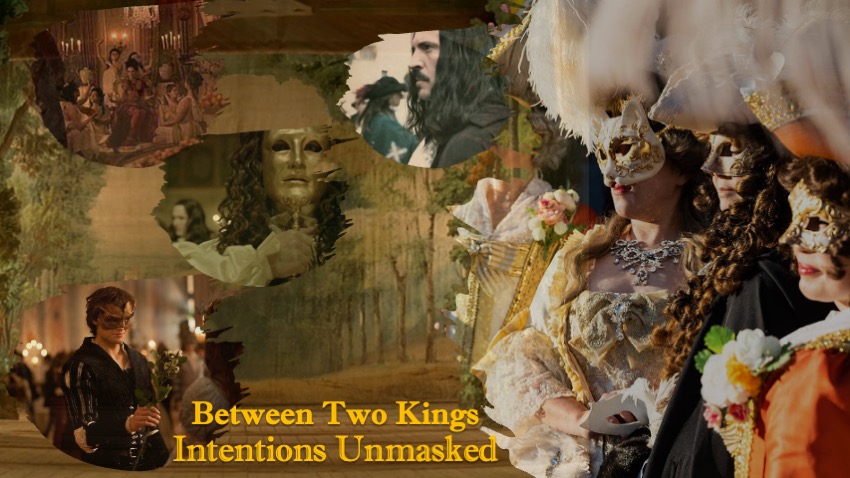
In the crowded, luminous hall outside, the undulating din of laughter, chatter, and tinkling glasses subsides. A melodious voice is singing:
Dove ne vai, crudele,
E non fuggire,
O di mio bene
L’aspre mie pene,
Che se fai vaga,
De la mia pega,
Volge tuo squardi
Ch’al cor son dardi.
Torna, torna crudele,
E non fuggire.
The handsome masked foreigner seated across from Raoul sighs a wistful sigh. He is dressed in an exquisite cavalier outfit, crimson brocade with gold trimmings adorned with rose-colored ribbons and lace. He anticipates the next stanza of the song, his voice as melodious as that of the singer in the hall outside:
Dove mi lasci,
E non partire,
Tem’il mio fuoco
Ch’in voi n’ha loco,
Sol sia l’ardore
Di questo core,
Mio sia il martire
Vestro’il gioire.
Torna, torna, crudele,
E non fuggire.
“You know it?” Raoul’s other masked companion, seated next to him, sounds impressed. He is also exquisitely attired although in a restrained manner, his costume evoking something of the Spanish fashion; a fair-haired, tall, handsome courtier of understated, yet studied elegance.
“Of course he knows it! Our Traveler from the East knows us better than we know ourselves!” Raoul’s third masked companion, the Frenchman, chuckles, amused. He is seated next to the Handsome Foreigner, the traveler from the East. Of the four young men, his dress is the most exquisite: dark blue velvet interwoven with gold thread. It makes his outfit change colors from almost black to dark purple depending on the light. It is trimmed carefully, with orrin, gold lace from Arras, whereas the sleeves and collar are adorned with point d’Alençon. His mask too, is all gold lace.
“I am but a mere student,” the Handsome Foreigner protests humbly.
“I find myself in agreement with the Frenchman,” the Spaniard remarks, raising his glass. “You know us better than we know ourselves.”
“We have many similar songs about the cruelty of love,” the Handsome Foreigner says.
“Geh hayâl-i tîr-i gamsen sîne-çâk eyler beni…The arrow of your glance pierces my wounded heart.”
“Ah the plight of the scorned lover! Where would poetry be without his endless longing and unabated suffering!” teases a masked lady, breathtaking in her beauty, who enters this private salon, that is furnished in the oriental style, with luxurious silk cushions and beautiful rugs, the air fragrant with musk, and sandalwood. She carries a crystal wine decanter shaped like a lily, filled with red wine which she sets on a sofra between the four companions that is decorated with mother of pearl.
“Madame,” the Handsome Foreigner teases back, “we are all your willing victims!”
“Not the Spaniard,” Raoul chuckles, tilting his head toward his elegant companion seated next to him.
“Indeed, the Venetian is correct as always,” the Frenchman chuckles. “Our Spaniard is too principled; rare for a Spaniard.”
The Spaniard laughs. “Whatever virtues I may possess, I owe them to France.”
The Frenchman smiles and bows his head, as if accepting the compliment. He raises his glass to toast his companions and at the same time, signals with his eyes to Raoul and to the Spaniard seated across from him, and to the lady who has walked behind them. She sets a gentle hand on the Spaniard’s shoulder. “I venture, then, to tempt this gallant Spanish knight to follow me into the Kingdom of Arcadia.”
The Spaniard chuckles and shakes his head.
“The Spaniard is too gallant. You will need reinforcements for such a valiant effort,” Raoul says and stands.
“I accept the challenge,” the Spaniard acquiesces. He sets his wineglass on the sofra and stands also.
“We will join you in the groves of Pan shortly, to examine the Spaniard’s progress,” the Frenchman teases.
⚜️⚜️⚜️⚜️
“Why is he here? What is Louis doing here?” M. de Rohan whispers to Raoul the moment the two of them and Valentine de Faye walk out of the private room and into a bright, crowded hall, decorated in the most fanciful and theatrical manner, like a Grecian temple in the midst of a grove, with flower garlands and a tall fountain in the shape of a cornucopia flowing with wine instead of water. The most beautiful, masked creatures dressed as nymphs, in fine transparent fabrics, and as satyrs, wreathed and bawdy, walk among the guests serving, touching, and seducing.
“He is here to negotiate,” Raoul replies, his eyes carefully scanning the crowded hall.
M. de Rohan frowns. “This does not enlighten me at all. He should not be here. Did you invite him?”
Raoul shakes his head. “You don’t invite the King of France anywhere, Jean,” he whispers, still scanning the crowded hall. He recognizes M. de Guiche with Nicolas Fouquet and M. d’ Aumont in the room with the gaming tables. Beaufort is here too with M. Mancini, who is soon to replace Fabien as Captain of the Musketeers. Although masked and in the costume of a Roman senator, M. de Costes whom Lorain has sent to report back for La Gazette, looks too much like himself, whereas Galoys who writes the scandalous libels and pamphlets and has been recruited specifically as part of Guiche’s and Fouquet’s plan to expose Thomas de Renard, is completely invisible masquerading as a plague doctor.
They are singing a different song now. Bawdy and mischievous and well-chosen. Timothee and Guiche have planned everything about this night, to the finest detail.
“Gerineldo, Gerineldo, mi caballero pulido,
Quién te me diera esta noche tres horas a mi servicio.”
“Como so vuestro criado, señora, burláis conmigo.”
“Yo no burlo, Gerineldo, que de veras te lo digo.”
Valentine de Fey wraps her arm around M. de Rohan’s. “I meant what I said about tempting you, Gallant Spaniard. Rumor has it that you can, indeed, be tempted with the right inducement!” She pushes him gently forward, but he resists and gasps, pointing with his eyes to a corner of the hall, not far from the fountain, where a masked guest in an attire reminiscent of a Roman general is enjoying wine and the beauty of a most enticing red-haired nymph. “Good God, is that…”
“Yes, that is the Italian,” Valentine de Fey shrugs. She turns to Raoul. “You were absolutely right once more, my love, he was expecting our invitation too.”
“The Italian!” M. de Rohan sounds scandalized.
“Napolitan and from Abruzo to be more precise,” Raoul corrects his cousin, ignoring his cousin’s astonishment. “Although he would like us all to believe that he is Roman, thus the attire, I suppose.” He slants a mischievous look. “We…Italians… are very particular about this sort of thing.”
“How can you be jesting about this enormity…He is the Card…”
“Masked,” Raoul interrupts him. “He is masked. As are all of us, may I remind you. No one is really here.”
“What about the other Italian over there?” Valentine, tilts her head toward another man in a most colorful outfit seated by the fountain and drinking alone.
“He is not Italian,” Raoul remarks tonelessly.
“He looks uncharacteristically forlorn for d’ Arnauld,” M. de Rohan says, intentionally, it seems continuing to call people by their actual names.
“He misses his best friend at court, I suppose,” Valentine says. She turns to Raoul. “I invited the Englishman. I know you said I should not…”
Raoul clicks his tongue disapprovingly. “He would not come, and we would gain nothing by inviting him. We already know whom he works for.”
“He would come,” she insists. “He would come because he is resentful and seeks revenge for what happened at Saint-Sulpice. He would come because even after that, he is jealous. He is jealous of you. He detests you, in fact, which you know. Your father too. He almost killed your father. But that is not it…” Raoul narrows his eyes, perplexed. “There is more. I sent the invitation late…this morning. I debated, you see, between your plan and my curiosity about the Englishman. My messenger returned not long ago. The house is empty.”
The last time Raoul saw de Winter was at Les Gobelins. They exchanged menacing words. He tries to remember their precise exchange. Something tells him it matters. He tries to remember their exchange before that, in de Winter’s house the morning after Saint-Sulpice. Raoul has the frustrating feeling that he has overlooked something; something very important. “What do you mean empty?”
“Empty. No servants. Locked.”
“Are you talking about the other fake Italian who is an English mercenary?” M. de Rohan interjects, not naming names this time. “If so, he is most likely somewhere protecting my father or doing his bidding. He is my father’s henchman after all.”
That is not it. Raoul knows where Rochefort is, and he is protected by Radu’s men. At least, that is what Rochefort wants Raoul to know. Where could Rochefort have sent de Winter? Comminge’s men are around Nantes guarding the trade routes to Lorient. Where the hell is de Winter? Raoul should know this.
“Shameful! Keeping Valentine de Fey from us and not deigning to join us at the game tables!” The gentleman who speaks so excitedly is dressed in an exquisite outfit that includes a most extravagant silk sash, made of goldthread, which is not wrapped around his waist but over his shoulder, like an ancient scion. It is matched with a gold-leaf wreath adorning his hair. His companion is most elegantly dressed and handsome, his outfit, including a silver pauldron and a blue cape, makes him look like one of the noble knights of yore.
“And who are you two supposed to be?” M. de Rohan chuckles at the sight of M. Fouquet and M. de Guiche.
“He is not supposed to be anyone, my dear Spaniard,” the Knight interjects. “He is, in fact, Croesus. As for me… Well…” He straightens his shoulders and declares proudly: “Lancelot is fitting enough!”
M. de Rohan mocks a perplexed tone. “Fitting enough! Would Lancelot ever come up with a night such as this, I wonder?”
The Knight levels a mischievous look toward Valentine de Fey: “With the right accomplice, he just did.”
“And yet, here we are and not at the tables!” Croesus insists peevishly. “My bets are waiting!”
The Knight, Lancelot, leans closer to Raoul and M. de Rohan: “Croesus most likely owns the tables too. He can’t wait to see Renard ridiculed. And frankly neither can I. What say you, shall we amuse ourselves?”
“This is a house of pleasure, Messieurs,” Valentine de Fey feigns a stern tone. “Neither I nor Madame Zola want to see our clients humiliated.”
“Thomas de Renard is not your client,” Croesus interjects dismissively.
“I meant everyone else. Even if you own the tables Monsieur Croesus, you should let others win occasionally,” she admonishes, and M. Fouquet acquiesces with an elaborate bow. “Shall we move to the gambling tables, Messieurs? I fear M. Croesus, here, will disavow this happy establishment and then where shall we be?” Valentine once again urges M. de Rohan to follow her, Raoul too. This time, M. de Rohan moves along but Raoul remains behind.
“I will follow you by and by,” Raoul says, and Valentine clicks her tongue frustrated.
“Let the Venetian be,” Lancelot says as the company moves toward the gaming tables. “It is his nature to be distracted by one thing or another.”
Raoul is indeed distracted, but it is not his nature. He has the pressing, vexing feeling that he has made a serious error, not now, not here, but early on; that he has missed something vital, something obvious. That he has been duped.
There is much commotion in the hall now. Excitement and laughter and applause. A beautiful young maiden, raven-haired and dressed as a shepherdess, is hoisted high up in the air, on a theatrical platform adorned with clouds and fanciful birds. She dances to an old pavane surrounded by young boys dressed as cupids, while her companion, dressed as a shepherd too in a grayish-green doublet with matching ribbons, pretends to be seeking her desperately among the guests in the hall.
“Near the ancient city of Lyons, in the direction of the setting sun, is a land called Forez,” a sonorous voice recites. “Celadon was one of those who felt the tyranny of Love most deeply, for he was so taken by the perfections of Astrée that the enmity between their parents could not prevent him from losing himself entirely in her.”
“We have something very similar!”
Raoul turns, feeling a friendly hand on his shoulder. He smiles at the sight of Salih Bei, the Handsome Foreigner, who has stepped out of the private chamber where he was meeting with Louis, the Frenchman. “This is the story of Céladon and Astrée the shepherds from the kingdom of Forez on the banks of the river Lignon,” Raoul explains.
“Ours is the story of Mejnûn and Leylâ. His real name was Kays but everyone called him Mejnûn-which means ‘driven mad by love’. His beloved was the beautiful Leylâ, and I believe you know what her name means,” the Handsome Foreigner says. He is very good, this smooth-spoken spy sent by the Sultan to negotiate with France’s new King, Raoul thinks. And like any good spy, he is well-informed and conveys his messages most clearly.
“Does it end well?” Raoul evades.
“It never ends well. That is the point.”
Raoul raises a playful brow. “Ah, but Céladon and Astrée, after much philosophizing and politicking, find each other in the end. That is also the point.”
“How very…French. Conquering untamed desires…Mind over heart.”
“Practical and expedient.”
“Yes. A perfect description. By the way, he is both. The Frenchman, I mean,” the Handsome Foreigner says, fixing his eyes on the marvelous spectacle before them. “Of course, at a masque, one cannot be too careful.”
“I have always thought that a mask reveals as much as it hides,” Raoul replies, his eyes fixed on the spectacle too.
“This is why I like you, Venetian Falcon, your turn of phrase rivals my own. Or should I call you Doğan Bey, I wonder,” Salih Bey chuckles.
Raoul laughs. “You should have seen that costume. It was a good.”
“I heard.”
“I had no choice but to come as the Venetian that I am,” Raoul mocks a disappointed tone.
“A better choice of costume, if I may. The Sun is meant to awe and blind me for I am but a humble mortal and a Foreigner. But the Falcon I understand. The Falcon preys and is preyed upon. He is a hunter like me. Unlike the Sun, his master, the Falcon flies closer to earth, his eyes infallible.” He slants a meaningful look. “What does the winged hunter see, I wonder?”
“Opportunity,” Raoul replies quietly.
“I am eager to hear more about that,” Salih Bey says.
Raoul nods and then slants an impish look. “The Falcon also sees one very scandalous revelation about to happen.” Just as he speaks these words the raven-haired shepherdess on the floating stage that has been slowly lowered back to the floor, strips her white dress with one quick move to the gasps and excitement of the spectators, revealing underneath it the hunting costume of an elegant cavalier. Long raven-black hair pulled back, the young hunter jumps onto the floor in the midst of applause and excitement. He embraces and kisses his co-conspirator who is still dressed as Celadon. The music immediately changes:
Amis enivrons-nous du vin d’Espagne en France
Il n’est pas bon dessus les lieux
Icy nous le buvons avec plus d’assurance
Qu’on ne boit le nectar à la table des Dieux.
Ne perdons pas de temps à dire tope et masse
Laissons boire Philippe il revient de la chasse.
Ce subtil inventeur d’une chasse nouvelle
A bien fait de se retirer :
Il a pris en courant le renard de Bruxelles
Qu’on lui donne du vin pour se désaltérer.
Ne perdons pas de temps …
“Is that…” Salih Bey-the Handsome Foreigner-ventures pointing with his eyes toward the young hunter, and Raoul nods.
“Indeed, he is.”
“He promised us a surprise tonight and he has delivered.” Valentin de Fey has walked back from the gaming tables with the Spaniard. “We knew nothing about it…” She pauses mid-sentence to extend a deep reverential curtsy, just as Raoul and Salih Bei, realize that right behind them, the Frenchman-Louis- has opened the doors of the private chamber, and stands at the threshold, his disapproving frown evident even under his gold-laced mask.
“One could call it surprising indeed,” the Frenchman remarks coldly.
“It is all in good humor. An inspiring performance,” the Handsome Foreigner ventures and the Frenchman attempts an appeased smile.
“Astrée must be congratulated, you are right.” The Frenchman turns to the Handsome Foreigner. “Come. I will introduce you to those two inspiring performers. I happen to know one of them like a brother.”
Louis pushes ahead with Salih Bei and into the crowded hall toward his brother Philippe, the duc d’Anjou and the Chevalier de Lorraine.
“Does the duc d’ Anjou know that his brother is here?” M. de Rohan once again refuses not to name names. Raoul shakes his head. “Then, he is about to have a very big surprise of his own.”
“There are more surprises still,” Valentine remarks.
“At the gaming tables? What? Croesus is losing?” Raoul chuckles.
“He never loses,” Valentine says. “But his entire plan of revenge has fallen through.”
“Renard is not here, Raoul” M. de Rohan hurries to add.
“What?” It returns, the feeling Raoul has had all evening that he has missed a most vital clue, that he has made a serious error in his calculations.
Valentine is shaking her head. “He bribed and threatened and blackmailed to be invited. Now he is not here.”
“He was not at Chevreuse’s either. His mother was not there either…” M. de Rohan pauses; they all do, because all around them, the hall is filled with black-clad Musketeers, pistols and swords drawn, and everyone is panicked, people screaming, gasping, trying to scurry away.
“No one leaves! You are all under arrest!” a commanding voice echoes in the crowded hall, which Raoul immediately recognizes.
“Is he out of his mind?” M. de Rohan too has recognized their old comrade, Fabien Marchal.
Valentine covers her mouth to suppress a loud chuckle. “Well, in a night full of surprises, Captain Marchal is about to experience the greatest surprise of all.”
Raoul is not laughing. Fabien’s calculation, no matter how crude, is expedient, and Raoul failed to anticipate it. Louis is the same: ‘expedient and practical’. Salih Bey, like the good spy he is, sized up his adversary most accurately. “Fabien is here to arrest me” Raoul says.
“What?” Valentine gasps. “He is out of his mind then.”
Raoul shakes his head. “He plays by his own rules, which we think are crude. He has failed today perhaps, but there will be a day, soon, when he will fail no longer.”
“I will not allow myself to be rounded up in a brothel–forgive the language, Madame– by Fabien or anyone else,” M. de Rohan growls.
Raoul smiles and removes his mask. “Then it is time to meet our old comrade face to face.”
⚜️⚜️⚜️⚜️
Captain Marchal is surrounded by masked faces, panicked eyes, anxious, angry, some forbidding, and all of them familiar. After a few moments he recognizes them all: d’Arnault, de Guiche, Fouquet, d’ Aumont, Lorraine, Beaufort, Mancini–soon to replace him as Captain of the Musketeers–Good God is that the Cardinal? Is that the duc d’ Anjou? He understood the crudeness of this move when he decided on it but now, he wonders if it was downright a mistake. The answer arrives immediately.
“Captain, this is a private gathering.” Dressed as a Venetian merchant, Raoul is walking up to him unmasked, followed by a masked beautiful woman that Captain Marchal does not recognize, and a masked man dressed as a Spaniard that he’d know anywhere. “What are your reasons for this raid?”
“I do not need reasons to raid a den of depravity!”
Raoul smiles. “It would indeed be so, if this was as you say.” He points with his hands to the crowd all around him. “But this is a private house and who is here, Captain, except masked faces? No one at all. The only one who admits to being here is me.” He bows deeply. “Therefore, you are my master, if indeed you must make an arrest.”
Arresting Raoul is beyond what Captain Marchal had hoped for. But this is different. This is unexpected. There is some calculation behind Raoul’s offer, which Fabien cannot grasp. Fabien is determined not to budge, however, even if he is being played. He will not budge before all these witnesses, and he will not budge to Raoul. “Then I will arrest you.”
“You will arrest no one,” a voice echoes from behind the Captain and the crowd opens so that a most exquisitely dressed cavalier, his mask all gold threaded lace, approaches. Captain Marchal would know the cavalier’s voice anywhere. Captain Marchal would know him anywhere. He manages not to gasp and motions to remove his hat and bow but stops. He is expected to recognize no one, because no one is here. Only now does Fabien grasp Raoul’s calculation, and, to his astonishment, it is meant to protect him as much as everyone else in this depraved house.
Fabien clears his throat. “Indeed, I see no one besides the Marquis.”
“The Marquis can visit a private residence at Saint-Germain-en laye or anywhere else. He can entertain himself as he pleases with whomever he pleases, whenever he pleases in private,” the cavalier with the gold mask reasons coldly.
“Indeed.”
“There is, therefore, no reason for anyone to be arrested tonight,” the cavalier insists in the same cold tone.
“No, indeed.” Captain Marchal waves his hand and his Musketeers surrounding the hall lower their weapons and step back.
“Your zealous defense of moral principles is a credit to your position, Captain, and to His Majesty,” Raoul declares. “Long live the King! Long live His Majesty King Louis!” he exclaims and those gathered applaud, repeating Raoul’s words.
⚜️⚜️⚜️⚜️
“Wait, Captain!”
Raoul catches up with Marchal at the marble staircase leading to the main door of Zola’s house.
Captain Marchal turns. “What is it you want? My gratitude? To gloat?”
Raoul stops half-way down the stairs on the landing. “I wanted to tell you it was a good move.” Captain Marchal stops too. He narrows his eyes, perplexed. “It was a good move. I would never think to make it.” Raoul makes a half-shrug. “From one spymaster to another.”
He means it, Captain Marchal realizes, and this is what makes Raoul different from any other man he has ever known. Different from him. Better. A better man. “I am no spymaster.” Fabien says it in an embarrassed tone before he has time to check himself, and it vexes him.
“Well, it was a good move. Only a matter of luck that it did not work.”
Captain Marchal raises an amused brow. “I should practice, gambling more.” He motions to walk down the rest of the stairs but stops and turns back. “You have accused me of many things. Your father too.” Raoul stands on the landing silent, as Marchal continues. “I will not apologize for my actions. They were all necessary. But I will not be accused of things I have not done. Indeed, I encountered your Mother at the Garrison and indeed I sent Gitaut and two more men to keep an eye on her at Bragelonne. She was meddling where she should not. But I have nothing to do with her disappearance.” He wishes he could read Raoul’s expression, but he cannot, so he continues. “I am certain that you know this, but you should hear it from me also. It is a matter of principle. My principles. Gitaut has disappeared. I believe he defected to his brother’s side. He killed his two comrades with the help of his brother most likely and defected. Comminges works for Rochefort and so does that Englishman–the Comte de Marsica or whatever nonsense title he uses for himself. His real name is Henry de Winter, as I am sure you know. He is your mother’s relative. And he is married to Catherine de Renard as everyone knows. She is your father’s relative. Strange is it not? Catherine de Renard certainly detests both your father and your mother. This too is common knowledge. With her son she has been petitioning for some title ever since I remember them. Thomas de Renard has been bemoaning his lost inheritance to anyone who will listen.” He shrugs. “Anyway. I am not telling you anything you do not know. Perhaps what you may not know yet, is that Catherine de Renard has disappeared; nowhere to be seen at court, not even after the Queen Mother returned. I think it’s strange.” Fabien turns and hurries down the stairs and out of the door not expecting an answer.
Raoul stands motionless on the landing, clarity striking him like a thunderbolt. How could he have been so blind? How could he be so blind to those closest to him? How could he have missed so many clues and for so long?
“What happened? What did he do? Did he threaten you again?” M. de Rohan, no longer masked, is hurrying down the stairs followed by Valentine. “Raoul, what happened?”
“I am a blind fool!” Raoul exclaims. “Sang dieu! That is what happened.”
“Is this what he said? Did he dare insult you?” Valentine growls.
“No, he made me see it!” He rakes his fingers through his hair swearing under his breath.
“Raoul, you make no sense,” M. de Rohan sounds alarmed.
“I must leave!”
Valentine gasps. “Now? Where to?”
Raoul paces the landing for a moment and then stops and walks closer to his two friends, speaking in whispers. “Glenay. I must go to Glenay immediately. I must speak to my father and Lucien. I know what happened to my mother. I know who has her! It’s not Marchal. It’s not Rochefort. It is those goddamned de Renards, Sourface and her son, and her new husband, de Winter.” It is M. de Rohan’s turn to swear under his breath. “I need a good horse and weapons.”
“I have all you need here,” Valentine says. “I keep some of my horses here. Weapons too. Go to the stables and tell Zacarie–you know the boy?” Raoul nods. “Tell him to saddle Paladin for a campaign. Zacarie keeps everything ready. He knows exactly what to do.”
“Henri…” Raoul whispers. “You must take care… He must be at the Wrecks…”
M. de Rohan sets a steady hand on Raoul’s shoulder. “We will take of Henri,” he tilts his head toward Valentine who nods reassuringly. “Layla too. Marie Cessette too…We are all together in this, remember?”
“Be careful, Jean!”
M. de Rohan smiles encouragingly. “Worry about your mother. We will do what must be done.” Valentine pushes Raoul gently down the stairs. “Go!” she urges. “Go immediately!”

 Twelve Years After
Finally!!!! (Ten lines of exclamation marks follow). Fabien had to spell it out for Raoul though, and I hoped someone was going to piece it together without a helping hand. But well, even the best minds need help sometimes… And I do want “to see” Constance’s face, once Raoul breaks the news to everyone! I am glad Fabien did something good for a change, too 🙂
Well, I still hope someone tracks down that Ballesdens fellow in the meantime. Because they still don’t know where Alessandra is, even if they know who has her, and Ballesdens may be their only lead. I am not sure anyone will be able to make the connection to Saintonge otherwise any time soon, and Fabien will not be there to help 🙂. And there is Radu out there somewhere, presumably already at the doorstep by now, intent on taking her to Rochefort. This is something nobody will ever detect at all, so I do hope Radu fails to move her to Rochefort for whatever reason and she will be rescued from Saintonge. It will be a bit ironic if it is going to be d’Artagnan & Porthos who rescue her, with Athos & Lucien trapped by the weather in that monastery indefinitely, though 🙂
I must have missed or forgotten it, why was Fouquet going to make a fool of de Renard at the gaming table? Was he also a victim of his blackmail?
I am also wondering whatever happened to Aramis returning to court. Is it just that they cannot find him to share this happy news, or does the King sit on it intentionally despite the promise he made to his mother?
LikeLiked by 1 person
LOL! Only ten lines?
Raoul is brilliant but even he can make a mistake, a serious one too, like this. He has a blindspot when it comes to his parents: we have seen it repeatedly. Part of it, is that he intuits a darker story in their past which he does not want to know (in fact, he did tell his father that he would rather they keep their secrets to themselves) so every time he must deal with his parents there is a hiccup, a “holding-back”, and this is his blindspot. At the same time, Catherine, de Winter, and Thomas, are the kind of evil that “blends” with the rest of the “noise”. It is an evil as insidious and deadly as e.g. a good-old villain like Rochefort, but hides in plain sight because it is banal and at times even ridiculous. Here, the revelation comes together because some of those organizing this soiree want to ridicule Thomas de Renard. They call Catherine “Sourface” and we have seen that she knows they are ridiculing her at court. This is a serious lesson for Raoul, and we think that in this story it is important that characters, like people, falter, make mistakes, learn and grow. By focusing on the “bigger game” at the upper echelons of power Raoul has missed all that banal evil that festers, that is personal too. Thomas de Renard is behind some of the most crucial turning-points in this entire story: he was an accomplice in the murder of Cecile du Puget to frame Raoul (that’s how he started his “career”); he killed the blackmailer Servien and stole his “clients” but at the same time implicated Alessandra in Servien’s murder (which led to Athos and Alessandra parting ways); he paid Gabriel Martinez to kill Raoul and Layla (Thierry at the time) was almost killed instead; he masterminded two attempts against Bianca: one in Venice, which was averted, and a second one in Paris which almost succeeded; he seduced Rayya and abducted her; he conspired and plotted very opportunistically, for and against his ex-lovers Chevreuse and de Wardes, with Sylvine. And he is a blackmailer. We do not explicitly go into details about his business but we include many hints that this is how he makes his “living” at court and that is what keeps him “in power” at court. We have also hinted that he (may) have been blackmailing Fouquet and others in the close circle of Louis. They all hate him because he is in many ways “lowborn” and in their midst, because he remains in their midst due to his “business” and most likely, because he blackmails many or all of them to ensure his position and fortune. I hope this answers your question about Fouquet too.
As for Radu: we know he was sent to Saintonge and we know that Rochefort ordered that he takes Alessandra from Saintonge and to his estate which neighbors Saintonge. We have not seen Radu yet in the story, but that does not mean he is not somewhere–we just have not “seen” him yet.
Aramis returning to court: we have seen that Louis is not that committed. He implied it to Marchal right before Marchal “decided” to raid Royaumont. Louis basically said: “well, I want to keep my mother happy, but if–let’s say–you go to Royaumont (let’s say) to “inspect the premises looking for Athos” (let’s say) and the duc d’ Herblay happens to be there and he resists and is killed (let’s say), it will be very unfortunate.” I do not think that anyone is fooled about Louis’ intentions; not really; deep down, not even Queen Anne.
The rest of your excellent questions/points will be answered almost immediately in the next few installments including Radu in fact, so I cannot say more now.
Thank you! We love your comments!
LikeLike
Yes, it’s only ten this time – I am saving the rest for the chapter in which Alessandra is rescued 😄
I actually think Raoul should not be castigating himself the way he does for not realizing it is the de Renards sooner. He went through so much in the recent months that it is a wonder he is functioning at all, and as the Spymaster of France too. He is still processing everything he learned about the King, his parents and their friends, trying to play both Rochefort and the King and save his parents and their friends from them, and then there’s Henri who he tries to save (oh, I think Rohan & Co will fail spectacularly at rescuing him in Raoul’s absence)… I can’t imagine how he juggles it, so it’s small wonder he missed something. But I did think that narrowing it down to the de Renards was going to be a result of some collective effort of the protagonists at Glenay… oh well. Like I said, Fabien got to do something good too! (Though wasn’t it an outright lie that his men were only going “to keep an eye on Alessandra at Bragelonne”?! Talking of “his principles”!!! I am running out of exclamation marks!).
How is it possible for Rochefort to still have access to his old family estate? I thought that after his alleged death (and as a traitor to France, too), all his property was confiscated by the Crown or something like this?
LikeLiked by 1 person
LOL! Hold on to all those exclamation marks!!!!!!!!!
You are absolutely right about Raoul but on the other hand, and from his perspective, this is about his mother so the mistake is a very serious one. Can’t say much about what happens next with Alessandra and Henri because… all this will be happening next.
From Marchal’s perspective, he is not lying. We, the readers, may not agree, but he sees things differently and Raoul understands this even though, of course, he also disagrees like we, the readers, do.
Finally: answering your question about Rochefort’s estate. Yes, but remember he “died” and resurfaced as a very powerful banker, whose bank owns most of the French court, and he operates directly (as the bank) and indirectly ( with different names, and through companies like the Company of the Orient and through other agents all over Europe but also elsewhere) which means that he could have bought that estate or he could have bought the debt of whomever owned that estate, including the crown. In other words, he can very well own it, but not as “Rochefort”. Very good question though!
LikeLike
It sounds like the next several chapters will be very dramatic!
Here’s my theory: Radu won’t be able to take Alessandra from Saintonge, because Henry, Catherine and Thomas won’t let him. They are desperate, Catherine has been working towards this for two decades, and she won’t let Alessandra out of her hands. Henry has been humiliated by Rochefort repeatedly, he has just seen Raoul take over as Rochefort’s second-in-command and de-facto heir, and Raoul has humiliated him as well. (I actually do think that Rochefort went too far with Henry, there’s only so much a man can take even if he owes you everything, and de Winter is not exactly spineless. As Rochefort himself said, a man still has his pride). He can’t let it happen again, even if the alternative is an open mutiny. As Radu has a carte blanche from Rochefort, it will come to a fight, and I think Radu and his men will be killed. Henry & Catherine, however, will understand that, with Rochefort knowing where they are and looking for Alessandra, they cannot wait until summer and decide to execute her immediately. And I do hope that the whole thing will be stopped by Athos, who will somehow make it there on time (Loup, where are you with the information on Ballesdens’ whereabouts?). If Athos and Alessandra are to ever make things right between the two of them, this just has to be the starting point. Given how Alessandra in her heart of hearts never moved past being abandoned at that makeshift gallows and with Athos ardently wishing “to rewrite their story”, the Milathos fan in me just really hopes for him to find and save her and their baby!
Okay, now I will mentally prepare to see that beautiful theory debunked – by something undoubtedly better😉
LikeLike