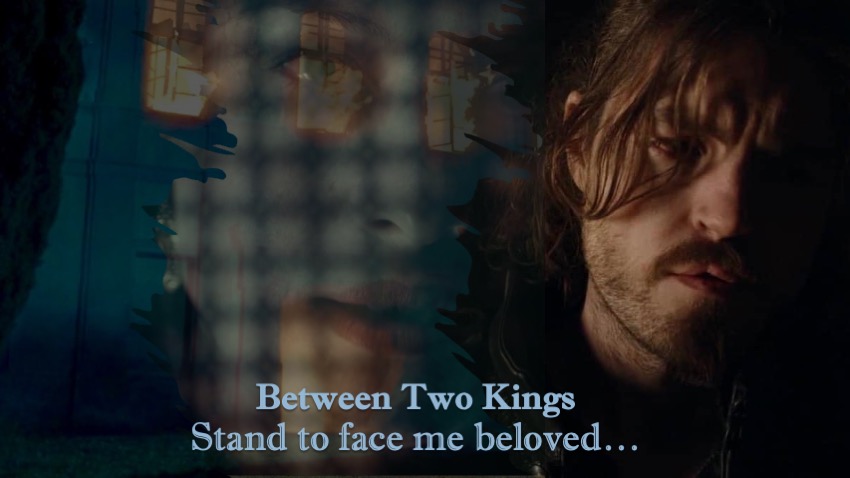
Stand to face me beloved…
…and open out the grace of your eyes (Sappho 138, transl. Anne Carson)
“Where is Raoul?”
Athos storms into the hall of Glénay. If there is a footman at the door or servants in the hall he does not see them. What Lucien and Aramis are saying as they walk into the hall, behind him, he does not hear. It has been this way with him since Jasper and Tomaso arrived with news and, then, all the way back to Glénay from the wild goose-chase the three of them knew they were undertaking at Bourbon-les-eaux. But Athos will follow every path that opens before him. He will oblige every fiend and play every one of Rochefort’s cunning games. He will not stop until he finds her.
“Where is Raoul?”
Athos dashes up the stairs, climbing them two at a time.
⚜️⚜️⚜️⚜️
Raoul stands before the blazing fireplace crossing his hands behind his back. Outside the heavy snowfall that caught up with Athos, Lucien, Aramis, and the mercenaries, between Montcontour and Glénay has turned into a storm. “It was neither Fabien nor Rochefort,” Raoul concludes his account of the extraordinary events at Zola’s house and the reasoning that has brought him here, to those gathered in the salon: his father, his uncles and their wives, his cousin Alfonso, and his grandmother. “Now you can see why I am convinced that my Mother was taken by Henry de Winter, Catherine de Renard, and her son, Thomas.” He shakes his head. “I have been fooled…They have been there, before my very eyes, Catherine and her son, and I did not see. It took Fabien…” Lucien clenches his jaw at the mere mention of the captain’s name.
“De Winter works for Rochefort,” d’ Artagnan interrupts Raoul. D’ Artagnan too does not care to hear about Fabien Marchal. No one in this room cares to hear anything that might afford the slightest glimpse of redemption to the captain of the Musketeers.
“De Winter works for himself,” Raoul counters. “What happened in Genova is proof. I had a very long time to think about what happened in Genova.”
“He attacked you and sold you to slavers,” Porthos says.
“I happened to be at the wrong place at the wrong time. Or, rather–if you were de Winter–I was an unexpected gift. He was not in Genova for me. I am certain of it …” Raoul pauses and everyone understands what he refuses to say; that he will not mention Gabriel Martinez in the presence of Sophia, whose expression is inscrutable, and of Lucien, whose eyes flash with rage that Athos recognizes, for he felt it too when he thought Raoul was killed.
“Henry de Winter has always been resentful and bitter,” Athos says. How much to reveal? How much would Alessandra want Raoul to know?
But Aramis, with his natural astuteness, has made a different calculation that circumvents any awkward revelations. “Henry de Winter accused Alessandra for the death of his older brother, George, almost as soon as his brother had died.” Aramis speaks with the authority of the Prime Minister that he once was. “I know because it was in Richelieu’s correspondence. Some of the letters were written by our old friend, Rochefort. He was reporting to Richelieu meticulously. He mentions the two de Winter brothers, their politics, and Henry de Winter’s many grievances.”
“Alessandra had nothing to do with George de Winter’s death,” Athos manages to keep his voice from trembling with anger. Aramis speaks about Richelieu, his father, and the mere thought opens before him a dark abyss that he will not be drawn into. Not now. This moment is about Alessandra.
“Alessandra did not kill George de Winter, no. They all knew it,” Aramis agrees, “but she was convenient: a young French girl without family or connections that good-old George de Winter, three times her age and twice a widower, fancied, made his mistress, and then married and brought to England.”
Raoul chuckles ruefully. “When I was young, at first, I thought my father was someone called de Winter. My mother would receive letters addressing her in that name,” he slants a meaningful look at Aramis, “some were your letters, I have come to realize. I asked her about him. She said he was not my father but he was a good man who perished in the hands of an unscrupulous one.”
“She was right,” Aramis says, voicing Athos’ thoughts. “George de Winter was old-fashioned perhaps. A man from a different era. But he had integrity. From what I have gathered, getting rid of George de Winter was Gondomar’s idea.”
D’ Artagnan clicks his tongue. “Gondomar… My father called him Macchiavellian.”
“In Galicia, we praise him as a hero,” Afonso counters, frowning.
“Well…Gondomar was a politician and he was determined to end his career as Spanish ambassador to England with a royal marriage between England and Spain, and the young prince Charles was in need of a wife. Of course, we all know how that sordid story ended: Charles married France, he became King of England, and then he lost his head on the scaffold. But, if I understand Alessandra at all–and I am not sure that I always do–I suspect that the unscrupulous man in her story was not Gondomar. It was Buckingham.”
“I met George de Winter and his brother Harry…Henry at court, in London. They had recently returned from France.” Athos says. “I was in Buckginham’s retinue in those days…Everyone was in Buckingham’s retinue or they were nothing.” Those were strange days indeed. Athos was a foreigner and an exile and Buckingham…
“Buckingham was King of England,” the Duchess d’ Aiguillon remarks, making no effort to conceal the sneer in her tone.
Then Richelieu rose to power, Athos thinks, but once again pushes the thought of his father aside.
“George de Winter was loyal to France, staunchly supporting the French match in England,” Aramis says. “ Buckingham on the other hand, the most powerful and influential man in England–some might say in Europe–would have Charles marry Spain. So, Buckingham agreed with Gondomar’s plan to get rid of good-old George de Winter who was becoming a compromise to all. It was very easy. George de Winter was old and infirm, and they could blame his young French bride, who was a nobody. In his letters to Richelieu, Buckingham boasts about how easy the scheme was. He wrote about all this to Richelieu when the two of them made amends after Charles married France. And they did, you know— they made amends. Buckingham and Richelieu played a cunning game until Buckingham missed a step.” Aramis levels a perplexed look at Athos. “You know all this, don’t you?”
Athos nods but says nothing. He will never reveal that he has read Alessandra’s journal where she explains everything. She too had read these same letters. Richelieu let her read them. He did not just pay her handsomely to assassinate Buckingham, he gave her a reason to kill him.
That is how Buckingham never left Portsmouth and that is how Richelieu won at La Rochelle.
Aramis appears to be weighing what he must say next. Athos reckons that if Aramis knows the truth about George de Winter’s death, then he also knows that Gondomar used a pair of assassins in his Spanish retinue: a man known as Francesco the Priest and that man’s lover, Sofia Martinez, who now calls herself Zola, and is the aunt of Gabriel Martinez, Lucien’s illegitimate son, whom Henry de Winter killed in Genova.
But Aramis once again circumvents any mention of Gabriel Martinez: “What you may not know, Athos, is that Henry de Winter accused you of the same thing he accused Alessandra. He accused you of murdering his brother. Buckingham writes all about it to Richelieu and Rochefort reports it to Richelieu as well. After his brother’s death, with nothing but mounting debts, Henry de Winter goes around repeating a most plausible lie about two wily French lovers and the old husband with a fortune and a title…”
Raoul clicks his tongue testily. “So it is not just my Mother. It explains why de Winter attacked you at Saint-Germain-en-Laye, Father.”
“It explains why he attacked you in Genova,” d’ Artagnan points out to Raoul. “He hates both your parents. What better way to take revenge on them both. In other words, Genova was personal too.”
“It is all lies, of course,” Athos says. “Henry de Winter detested his older brother. George had inherited the family estate near Sheffield–a crumbling estate but it was something– and Harry got nothing. There was never any fortune.” He chuckles dismissively. “I had no need for George de Winter’s title.”
“D’ Artagnan is right, however. De Winter’s attacks against Raoul, against you, and now against Alessandra, are personal.” Porthos observes. “To find Alessandra, therefore, we must find Henry de Winter. So the question is where would he have taken her? To England?”
“Or perhaps we should ask where Catherine de Renard, de Winter’s wife, would have taken Alessandra,” Lucien corrects him. His tone is impenetrable but Athos has no doubt that his brother has understood all–even the parts that Aramis carefully left unsaid–and much more besides. You may be surprised about what I know, Lucien said and then revealed what Athos never suspected about Gallagher…about the attempt against the Queen…about the part Alessandra played…
“Let us not forget Thomas de Renard too,” Raoul is saying. “I have been thinking: Thomas de Renard has been involved from the beginning.”
“He is a blackmailer, everyone knows that,” d’ Artagnan says.
“Chevreuse’s lover. De Wardes’ lover,” Aramis enumerates.
“He was de Wardes’ accomplice when Cecille du Puget was murdered. It took me years to piece it together but eventually I remembered,” Raoul says.
“That murder was meant to entrap you,” d’ Artagnan remarks.
Raoul shakes his head. “There is more, I fear…” Athos knows exactly what his son is about to reveal.
“I will speak about that, Raoul.”
Raoul gasps. “You know?”
“He knows what?” Lucien’s tone is cold but his rage is palpable.
“Alessandra discovered the truth. As she would…” Athos turns to Lucien and Sophia. “ I doubt that Alessandra wanted me to know, and she would be right. But I discovered the truth…later… by chance…What I understand now is that Alessandra would speak to no one about this, because she was protecting your family…our family.” An angry chuckle escapes Athos’ lips. “It is not easy to think back to those days, but there we were…both Lucien and I…both of us enemies of the state and both of us, sworn enemies and eager to kill each other. Yet, both he and I owed our safety and the safety of our families to our two children and that is the humbling truth which Alessandra discovered. We owed our safety to Raoul who was Louis’ favorite and to Layla who…”
“Who was almost killed and before she even knew her family was removed to court, paraded and used like a pawn!” Sophia suppresses an angry sob just as Lucien presses his wife’s hand, his hooded eyes fixed on Athos, his wife’s anger reflected in them. “The Dauphin’s savior!” Sophia sneers.
“Only this is not true,” Athos says, quietly.
Lucien springs to his feet glaring at Athos. “What isn’t true?”
Raoul steps in the middle. “Father…Lucien… Please.” He keeps his arms wide as if to keep the two brothers apart and they step back. “I am the one who must speak about this, Father. In Layla’s absence, permit me to speak on her behalf.” He turns to Lucien. “Layla stood between that bullet and me, Lucien…Sophia… It was me, not Louis, that she defended with her life. She saw everything clearly. Layla is a sharpshooter, one of the best, so, of course, she’d see it immediately. She told me on that first dreadful night, in that small room, where she was fighting for her life. Later, when she knew who she was…she decided… we decided together… never to let anyone know. It kept everyone safe, all those that she and I care about…” He shakes his head. “Of course, my mother would find out…of course she would…”
Lucien jabs an angry finger at Raoul. “You decided!”
“I am only saying what Layla would say if she were here. Layla and I decided to let things be as they appeared to be. It kept everyone safe. Now I see that my mother thought the same. My father too…”
“Lucien, my friend!” Porthos has stood up and lands a friendly hand on Lucien’s shoulder. “I understand your anger. When my daughter was taken I was all blind rage, ready to kill everyone. But let’s direct our anger where it matters, here and now, and I think–all of us here understand –that the reason Raoul returns to that cowardly attack at Royaumont is to ask who was behind it.”
“We never truly determined that. Gabriel Martinez was paid by someone,” d’ Artagnan says. “And he was paid well. He went to great lengths, not so much to recruit good men, rather the opposite. He wanted to overwhelm with numbers–his men were old, veterans, thugs, and such. He cared little whether they survived or not and most of them did not. Whoever paid him wanted no witnesses. They wanted to make it appear like an attempt against the Dauphin. When we arrived, there were only bodies left–the few we arrested and interrogated were pitiable. They could tell us nothing of value. Personally, I suspected that the Comte de Wardes was behind the attack, although his motive was never clear to me. Why attack the Dauphin in whose circle he aspired to rise? But the question remains: why would de Wardes attack you, Raoul?”
“At the time,” Raoul replies, “Layla and I thought that it was someone wealthy from court. I was a favorite and favorites have many enemies and are never liked. Although neither of us ever spoke his name, we both suspected de Wardes also. But now I must ask…”
“Could Thomas de Renard afford to pay for such an attack?” d’ Artagnan anticipates Raoul’s question.
“Not on the face of it, no… At the time, Thomas de Renard and his mother were seeking powerful connections at court and were grateful for Her Majesty’s generosity. But…” Aramis rubs his chin calculating, “but… Thomas de Renard had become de Wardes’ lover, and de Wardes was known to lavish his lovers with gifts and money.”
“His first lover was Thomas de Renard and then it was Gabriel Martinez,” Raoul says.
“So those two were rivals,” d’ Artagnan says.
“So those two met,” Lucien interjects. “This is what you are driving at Raoul, isn’t it?”
Raoul nods. “Whether they were rivals or not, I can only surmise. But Thomas de Renard and Gabriel Martinez crossed paths twice. First, as the lovers of de Wardes. Later, with Henry de Winter.”
“What does he look like, this Thomas de Renard?” Lucien interrupts Raoul as if a new idea has occurred to him.
Raoul shrugs. “Average courtier?”
Lucien frowns. “Specifically.”
“Not too tall…not too short…” Raoul shrugs again. “There is nothing particularly memorable about Thomas de Renard.”
“Besides the fact that he advances himself through blackmail and intimidation, you mean?” Aramis says.
“Truly, he fades from memory easily,” Raoul says.
“I beg to differ, Raoul,” Porthos objects. “We met the man at the soiree, at d’ Artagnan’s house, on the same night that the children and Elodie escaped, didn’t we Constance?”
Constance raises her eyes for the first time, as if jolted from a trance. “Yes, of course, we did,” she mutters.
“Well what did you think?” Porthos pushes. “Women are better at this sort of thing!”
She smiles awkwardly. “I don’t really know…”
“Pale?” d’ Artagnan hurries to offer assistance to his wife.
“Oh come now!” Porthos exclaims, exasperated. “I am no judge of appearance but his appearance struck me, perhaps because I know the sort of man he is, blackmailer and all.” He turns to Lucien. “The word that came to my mind the moment I saw Thomas de Renard was angelic.” Raoul raises an amused and astonished brow, Athos notices. But what does Thomas de Renard look like really? Athos met Catherine’s son once, at the theater at the Marais, while riding in Chevreuse’s carriage, but his memories of those days are confused and confusing… but …angelic?
“Angelic!” Lucien marvels.
“Yes! Angelic! Blue eyed and…” Porthos is waving his enormous hands as if trying to conjure up de Renard’s elusive image, “… wavy hair, all fine curls, and rosy cheeks… and fair… but not fair like our Rohan is fair, not at all… our Rohan is very different…Our Rohan is …”
“Not angelic,” Lucien says, and in his tone there is something that urges Athos to push too:
“You’ve met him, Lucien? You have met Thomas de Renard!”
“No, but the description is familiar.” Lucien paces the room for a moment and then stops and leans against the back of his wife’s chair. “We have been blind,” he declares with an angry chuckle. “All of us have been blind. Those deplorable cowardly fiends have been seeking revenge and my daughters suffered for it!”
Sophia gasps. “Daughters?”
“The man responsible for what happened to Rayya,” Lucien stresses every word.
“We never found that man at the Wrecks, Lucien,” Raoul says.
“You wouldn’t and this is your lesson in this sordid affair, Raoul, and just as you said. You see, here is a different kind of villain: the coward who hides in plain sight.” Lucien fixes his eyes on Athos, his words dripping with disgust. “The fiend who attacks children instead of their parents, babies like Bia, and seduces innocent girls for his entertainment.”
Thomas de Renard attacked Raoul at Royaumont, but would he have sunk as low as what Lucien surmises? Athos does not know Thomas de Renard, but he knows Catherine, and years ago, at Pinon, he met the Baron de Renard, Thomas’ brutal father, and Edmond, Thomas’ half-brother, who was equally odious and died pierced by Catherine’s bullet and not because she was trying to do the right thing. Would Catherine have sunk as low as Lucien suspects? Would Henry de Winter? Athos does not need to think hard to find the answer. Neither Catherine nor Harry would hesitate. Both are as vile as Lucien thinks.
“The fiend was slippery. He was masked. But Rayya is a clever girl, and a keen observer,” Lucien is saying. “The closest I came to the fiend was a description which fits Porthos’. Do you know who gave me details about the man, though? A little servant girl named Sylvine who passed his messages.”
There are horrified gasps all around the room.
“Sylvine? Sylvine Mercier?”
“Passing messages!”
“She is no little servant girl. Sylvine Mercier does Chevreuse’ bidding!”
“She is Thomas de Renard’s lover!”
“Is that girl not supposed to marry Captain Marchal?”
Athos clenches his fists to stop his racing mind as everything falls in place with terrifying speed and clarity…everything… from the day he arrived at Pinon with Alessandra…ney even before that…when he met her in England…and further back…when he first saw her at Solanges’ house where his cousin, where Rochefort lured him… no…further back… further back…
Sandretta…
“Let’s waste no more time reasoning. There is enough to confirm Raoul’s suspicions; what he came here to tell us. Where would these three cowards have taken Alessandra?” Porthos insists with his usual common sense.
He brought his young wife to La Fére and allowed her to be attacked. Athos cannot pretend that he did not expect it would be so, or that he did not know that it happened. He decided to be blind. He decided she was a girl that he met at an expensive brothel, a vice he could not resist, while his heart remained impervious and unaffected. It was all lies. And his stepbrother, Thomas, had been bitter and resentful years before Alessandra arrived at Pinon. But Athos preferred to deceive himself that Thomas’ anger and violent outbursts–which Catherine also endured—were because he was left to care for an estate that he would never inherit and because of the burden and the shame of their father’s discomfiture. Did Thomas know that Athos was their father’s adopted son from early on, Athos wonders? Perhaps he thought Athos was a bastard… As for Catherine, she was passed from one brother to the other… Greedy. Ambitious. Bitter. Vain. False… Abused. The truth is, that Athos had disliked Catherine from the moment he first met her but his adopted mother liked her well and he would not contradict his mother, for she was the kindest of women. In the end, Athos let Catherine win. Knowingly. Where is your heart Olivier? Alessandra had asked him when he signed her execution. He buried his heart along with all the memories, and chose to be blind.
“Pinon, perhaps,” Athos hears d’ Artagnan suggest tentatively and realizes that everyone waits for him to give them an answer. He is the only one who should know where they’d have taken Alessandra, but he knows nothing. He no longer knows himself.
Lucien clicks his tongue. “Where the hell is Pinon?”
“Picardy, near Aisne,” Aramis explains.
“Is that La Fére?” Elodie ventures, and Athos can hear the Duchess d’ Aiguillon, his mother, whisper to Elodie something about La Fére, at Pinon, being a small estate which had passed through a dowry to the family of the Marquis de Mouy. Where is your heart Olivier? Alessandra’s voice echoes in Athos’ mind, and he clenches his fists tighter, so that the stabbing pain returns him to the only thing that matters: Find her! He pulls his wits together: “There is nothing at Pinon,” Athos says. “That old house is a ruin. I gave that estate to the farmers who used to be tenants. Loyal, good people.”
“If not there, then where else?” Porthos counters.
“Athos, if I recall, there was some part of the house left intact,” d’ Artagnan pushes. “A cellar…An arsenal?” His friend is carefully tiptoeing around, what he knows are uncomfortable memories. That arsenal is where his stepbrother, Thomas, is buried. Would Catherine have taken Alessandra there? It would make sense in her quest for revenge…but somehow Athos does not think so. Catherine’s avarice is stronger than her desire for revenge and she has nothing to return to at Pinon. The villagers detest her.
“Could Mother have been taken to Pinon, Father?” Raoul insists. “Perhaps they took her to the estate of the Renards.”
“We are not riding off to some godforsaken estate at Aisne, on another wild-goose chase,” Lucien objects.
“What alternative is there? If I understand Catherine de Renard and her son at all, they are obsessed with lands and titles they demand for themselves,” Aramis is saying.
“At least we know that place. We know Pinon,” Porthos agrees.
In the din of an argument that is becoming heated, someone enters the room–Yusuf–Athos notices him whispering something to Afonso who then whispers something to Lucien. Athos cannot hear Lucien’s voice in the rowdy room, but he can read his brother’s lips and his stunned expression.
“What is going on?” Athos presses, just as Yusuf clearly says: “Kardes, you must hear this.”
“He must hear what?” Athos insists and perhaps it is his tone or a fortuitous moment when all voices in the rowdy gathering subside but Athos’ voice resonates just as the room falls silent. Athos turns to Yusuf, directly: “What is it that Lucien must hear?”
Lucien makes an almost imperceptible nod, and his man speaks, although reluctantly. Yusuf weighs his words carefully too: “Our…people… at La Rochelle…they found Bellesdens.”
“The man who sent the false message about my Mother being kept at Bourbon-les-eaux?” Raoul inquires and Lucien confirms with a faint nod.
“Our people…they know how to…” Yusuf hesitates, his eyes fixed on the side of the room where all the ladies are seated, the Duchess d’ Aiguillon in particular.
“Please, speak freely, Monsieur,” the Duchess urges Yusuf. “We are, all of us in this room, far more concerned about the fate of a mother, a daughter, and a sister rather than our fine sensibilities.”
Yusuf bows to the lady. “Our people can be persuasive,” he says, “but Bellesdens was impenetrable. Still, our people do not give up easily. So, the Quartermaster ordered some of his…less conspicuous men to follow Bellesdens after they released him. And follow him they did, to a large estate, not far from here. Saintonge is the name although it is deserted, it seems. Our men found that the villagers are friendly, eager to talk.”
Athos did not expect to hear that place mentioned. Saintonge was the estate of his adopted father, the estate that his father was forced to relinquish to the crown alongside the title of the Marquis de Mouy, after he was falsely and unjustly accused of treason. “Saintonge!” Athos hears his mother gasp. “Good heavens…I have been hearing from neighbors that poachers are back in those lands.”
“What is Bellesden’s business there? Did they uncover that?” Lucien urges.
“Yes they did. Bellesden’s wife, his daughter, and his son–and there is quite a sordid story about those three, but for another time– they seem to be…working at the estate.”
“Working?” the Duchess d’ Aiguillon frowns, perplexed. “That is not possible. That estate belongs to the crown.”
“Exactly, Your Grace. It signifies that the people at Saintonge are not poachers. Trespassers perhaps, but not poachers. The villagers, furthermore, speak about people with a carriage and fine horses. Our men saw people moving in and out of the house too–and none of them looked like poachers. One of them was a lady.”
“A lady!” Sophia gasps. “Could it have been Alessandra?”
Yusuf shakes his head. “Not from the sound of it, no, Your Grace. There’s more. Our men made friends with an innkeeper–the inn is not far from the estate. If I understand the subtleties, like many of the villagers around Saintonge, this innkeeper would rather pray to his God in French and detests that he is forced to do it in Latin. And they all feel abandoned. The estate has turned into a ruin and fertile lands are left barren so their villages are poor and sometimes in the winter they starve.” Sophia nods indicating she understands. “Well, they thought the place was to be inhabited again, and rejoiced, thinking the King would finally redeem them from poverty, only to be disappointed again. So the innkeeper did not mince his words. He has no stomach for trespassers–poachers he understands. He too speaks about cavaliers–more than one in fact–coming and going. One of these men, he says, sounded like an Englishman, and stopped at the inn on his way from Saintes to the estate with a lay sister from the Benedictines of Abbaye aux Dames. They know her well in these parts because she is a nurse and a midwife. Her name is sister Therese-Humbeline…”
“Do we need to hear more?” Athos is dashing to the door, and everyone is springing to their feet.
“Athos wait!”
“Father!”
“Brother!” Lucien seizes Athos. “Wait…Wait…” Lucien’s lips are saying although Athos is not able to hear anything besides rage throbbing in his temples. Someone wraps his arms around his shoulders–d’ Artagnan– “We must make a plan,” d’ Artagnan is saying and to Athos the thought of another moment lost is unthinkable.
When his mind is finally focused, Athos finds himself standing with the rest, around the table which is now covered with maps and drawings–Sophia, Elodie, Constance, and his mother, no longer in the salon. “Our men report movement on the road from Nantes,” Afonso is tracing the road on the map with his finger.
“Men paid by the Company of the Orient have been on that road, we knew that,” Lucien reveals reluctantly.
“No, that is different,” Yusuf objects. “Ver and Crotte…they are among those Loup sent after Bellesdens. They know what they saw. Those were indeed Company men, riding south in troops of ten or twelve. At first, Ver and Crotte thought they were riding to La Rochelle. It would make sense. But no…”
“They are gathering an army at Saintonge!” d’ Artagnan says.
“Well… we have an army here and they must know it,” Lucien reasons. “We must have caught them by surprise. Think about it. They carried Alessandra here, to an abandoned estate, thinking no one would ever consider this place–after all it belongs to the crown and they are brazenly trespassing. They thought they’d pass as poachers, perhaps, and the villagers would indulge them because the villagers in these parts…understand poachers and protestants. Then we showed up at Glénay with our little army of mercenaries spoiling their plans.”
“De Winter has access to Rochefort’s army of mercenaries too,” Aramis points out.
“The men our people have seen are French,” Yusuf counters. “Our people are not only certain this is so but they have recognized these men and their leader.” He chuckles, turning to Lucien: “You will like this, kardes…”
A snarl crosses Lucien’s lips, but Athos too knows the answer. They all do. “Let me guess,” Lucien says, “Comminges.”
⚜️⚜️⚜️⚜️
The gallery with the family portraits is dark and the air frigid. The only light coming through the windows is the pale moonlight reflecting off the snowed countryside around Glénay. Athos sinks on a narrow bench, across the portrait of his grandfather, René de Vignerot. During the time they have been at this house, Athos has often studied this portrait and others, trying to trace any family resemblance and seeking half-forgotten memories.
“Wait! We cannot go to the garden without Maman!”
Dashing ahead of him is the dark-haired little boy with the wooden toy horse in his hands and the gallery with the portraits is imbued with bright, warm summer light. It is morning.
“Xanthus has a new red saddle! He must ride off to war!”
“Lucien, wait!”
“Xanthus and I are faster,” the dark-haired boy teases, in a singing voice: “Catch us if you can, Old Man! You and Little Sister will never catch us!”
He is holding her hand and she is looking up at him. Large eyes, almond shaped and slanted, glowing like emeralds in the warm morning light; beautiful eyes, trusting, her long, black eyelashes touching a line of small freckles on her cheeks. “We can prove him wrong!” she says with a small mischievous giggle, and to his ears, her voice is the sound of pure joy.
Sandretta…
“I take it Bia is finally asleep?” Lucien sits next to Athos on the bench in the dark, cold gallery.
“Raoul has taken over from me, reading Fortunio from the beginning for the third time,” Athos says and Lucien chuckles. “She keeps asking for her mother. Just when you think she is distracted, she returns to it.”
“They are relentless at that age.” Lucien offers Athos neither remedy nor solution, because the only remedy is to bring Alessandra back. “Do you really not remember your house at Saintonge?” Lucien is thinking exactly what Athos is thinking it seems, working their plan in his mind, calculating. The only remedy is to bring Alessandra back.
“Not well, no. Strange, because I was raised in Saintonge. It is a very large house and we were only allowed in the wing with our rooms and in my father’s…my adopted father’s… library. Sometimes we were allowed in the great reception hall…” Athos shakes his head. “It is strange, but the memories I have are of this house…this house, and another house by the sea.”
“I remember nothing,” Lucien sounds sorrowful. He points all around. “Mother says you spend time looking at these portraits.”
“It helps me think.”
“We will find her,” Lucien says after a moment of silence, as if he can read what Athos is really thinking.
“What if…”
“Don’t say it.”
“What if…” Athos insists.
“Alessandra is strong and…”
“No,” Athos hears his voice trembling with anger. “No, you said it yourself, remember? You said it to me at Fontainebleau and I will never forget your words. She is not as strong as she tries to appear, you said.”
“Athos!”
“No. You were right.” Athos rakes his fingers through his hair, letting his head drop. “She has been gone for forty six days, twenty two hours, and thirty five minutes,” he whispers.
Lucien leans closer, his tone stern. “You must stop this! You cannot falter now, Old Man. This is not the time.”
“Is this not a good time?”
Lucien almost springs to his feet. Athos too. Their mother is standing across from them, although neither of them heard her approaching. She signals them to remain seated. “Is this not a good time?” she repeats.
“It is always good fortune to see one’s mother on the eve of a battle,” Athos says, attempting a smile.
She raises an amused brow, and turns to Lucien “is that true?”
Lucien grins mischievously, “he is the older brother, he knows best.”
The Duchess d’ Aiguillon smiles sorrowfully and draws in a deep, determined breath. “I have much to tell you both. Too much for a moment like this. But I want you to know that she was here, in this house. She was here with you. She was here with her mother and her father. I owe it to them. I owe it to her. You must bring her home.”

 Twelve Years After
I love that things are moving quickly now! And Loup didn’t disappoint! The question is, however, if it is all quick enough for Alessandra – your earlier comment that we have only seen her once in this installment for a reason doesn’t bode well at all!
I can’t wait to see what Athos and Lucien’s rescue plan is – obviously they cannot just storm the house, no matter how many men they can bring, because Henry or Catherine can simply kill Alessandra the moment they see them approaching. Will they perhaps try to secretly reach out to Therese-Humbeline first in order to gauge the situation? I have a bad feeling about Therese-Humbeline – she seemed like a good and knowledgeable person, and she may have realized by now that things are not what they seem in that house. But even if she hasn’t, I don’t think the (de Winter’s) plan is to ever let her return to her convent. … I wonder if Alessandra managed to tell her anything in her moments of lucidity.
And then there’s still the Radu factor. It would be a catastrophe if he managed to take Alessandra away from Saintonge before the Glenay rescue party arrives, but my theory is still that he’ll be killed by de Winter’s men or the man himself. Radu doesn’t expect to face an army, so he will likely be outnumbered, and he is facing three very desperate people who cannot let Alessandra slip out of their hands
Looking forward to tomorrow’s chapter!
LikeLike
Hi Dinny! What a great comment to which I cannot answer because the story unfolds one chapter at a time now. You are right, however, timing is important. Intentions too. For example: they can indeed simply kill Alessandra if they realize there is a rescue attempt as you say. On the other hand, she is valuable to them, to Catherine in particular, and her desire for revenge or they would not have brought a nurse but would have just let her die and be done. Remember, Catherine was very angry and upset that she found Alessandra the way she was, and having brought the nurse compromises their plan but she wants to keep Alessandra alive in her twisted idea of revenge. On the other hand all this may be a moot point too. For example: we don’t know what Alessandra might do and the reader has seen very little about her. We don’t know Radu’s role in this either besides the orders he has received, and furthermore, we don’t know how the addition of the men Comminges brings along changes the picture. Radu and Comminges do not see eye to eye even though they are both in Rochefort’s pay- Comminges, like de Winter, has moved independently of Rochefort’s orders in Genova and elsewhere. Comminges and his men also have an axe (or two) to grind with Alessandra and the rest. We have “players” therefore that have remained obscure to the reader, who are important in the way this part of the story unfolds. I’d say expect your questions to be answered as the story now unfolds one chapter at a time. Thank you for the great comment!
LikeLike
I actually did think it was going to be “la guerre de tous contre tous” at Saintonge, with so many variables and opposing intentions of different players. Once Radu strikes (and he must strike, because he has a direct order from Rochefort and he must report back, and he is the biggest force majeure for everyone involved, because nobody expects him or knows what he is after), chaos will ensue on all sides, and our rescue party from Glenay will have to interfere, no matter their original plan. Really, I do hope the narrative doesn’t take us to Paris/Vincenne in the middle of that battle to check on Eustace Dauger (by the way, I like how you use the actual name the man in the iron mask went by in prison!). Sorry Agnes, but not now! 🤭
LikeLiked by 1 person
Hi Dinny (no worries about the second comment)
All I can say is: it is all happening!
Of course we’d use “Eustace Dauger”! It is such a great name too! And maybe we have a better answer, as to who the mask was? At least a more satisfying answer for our readers? 😉
LikeLike
Sorry the above comment was from me, but I tried to log in with my E-mail, and somehow it didn’t recognize me the second time around. I’ll stick to Facebook for authorization then.
LikeLiked by 1 person
Hmm, I think different readers may have different ideas of a satisfying answer to who is going to end up as the mask in your story 😉 For me personally, Henri ticks ALL of the boxes, because, on top of many other things, that adds the tragedy to the plot that is supposed to be there (Dumas too made us feel sorry for his “iron mask” who was just as innocent as Henri is). I said it early on, too. But I do understand that within your story there is no way most of the protagonists can accept and live with that, so either there’s some way of keeping them unaware of his final destiny (e.g. they will all think he escaped and sailed off to Hispaniola, while in fact he didn’t), or it’ll have to be someone else completely, while Henri does escape and the King & Co continue to believe he hasn’t and he is the prisoner known as Eustace Dauger. In the latter case I hope it’s not going to be Rochefort in his place 🤭 I think we all agree he deserves a “grander” exit, so to speak!
LikeLike
Of course, different readers expect different outcomes. Henri, when we thought about him and “mapped him” as a character, is an ordinary person caught in extraordinary circumstances–which is a shorthand, I know, and perhaps a trope (but isn’t everything a trope?) Still we do not have many “ordinary” people in this story, beginning with the Four. Henri gives us a POV of an ordinary man looking at all these extraordinary people and then finding himself in the midst of the most unbelievable life-twist. That is not exactly the character of “Philippe” in Dumas (that is the name of “the masked prisoner” which strangely overlaps with Louis’ younger brother Philippe the duc d’ Anjou). In Dumas, Philippe-the-Mask is “special” and what makes him even more special is that he is the twin/spitting image of Louis XIV. He ends up at Saint Marguerite, nevertheless, a prisoner for life vs. almost every film version of the Dumas story that vindicates him. The BBC Musketeer series flipped the story of the twin brother ingeniously, and did not deal with “the masked prisoner”. The series Versailles picked up the masked prisoner story, at the end of the last season, and it was rushed and disappointing (in my very humble opinion). In writing this plot-line we could “go” in many different directions, in other words, given the wide-ranging fictional “canon” available plus the historical case (whatever is known about this prisoner). In the end, our inspiration came from a most unexpected source. That is all I can say!
LikeLike