“Come not within the measure of my wrath”
— Shakespeare, Two Gentlemen of Verona, Act 5 Scene 4, line 125
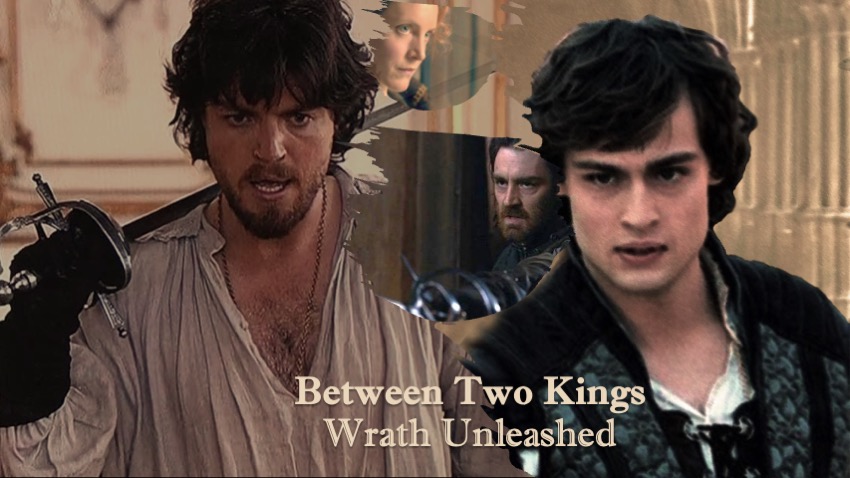
Athos fires his last bullet and the iron latch cracks. He kicks open the front door, and they ram into a dim hall. He remembers it wider, brighter, not crowded. Comminges’ fiends are lined up expecting them, bullets ricocheting from both sides.
“Make your bullets count!” Athos heard Lucien caution Raoul and Olivain as they were advancing to the house, the faces of their enemies hard to distinguish in the frenzy, stepping over bodies. Fighting hard around them was Porthos with Martin’s and Gasparo’s men, in a deluge of firing from the watchtowers and the ramparts by Aramis and the sharpshooters that Aramis and Lucien handpicked: four men from the Aigle, one of Lucien’s mercenaries called Adolphus, and Orazio, the youngest of the Rizzo brothers who arrived from Messina along with his cousins when they joined Gasparo’s men.
“Fils de pute!” Lucien springs to Athos’ left just as they enter, and his blade, already stained with blood, pierces through any flesh he finds.
“This way! Olivain!” Raoul and Olivain push to the right, disappearing in the haze, the clatter of swords echoing in the dim hall, accented by grunts and swearing, and every now and then, by the sounds of furniture crashing and doors smashed, grenades blasting, explosions, and pistols fired elsewhere inside this house and under their feet– d’ Artagnan and Yusuf must have made it inside– and at the courtyard outside where the battle rages.
Athos frees his sword from his dead opponent and swings a lateral slash with his dagger, warding off another man who has jumped at him from the back.
“Leave the wretched bâtard to me!” Lucien snarls, intercepting the man’s blind thrust and finishing him off. He wipes his face with the back of his hand, panting, drenched in blood and sweat, just like the rest of them. “Go!” Lucien pushes Athos. “Go find her!”
⚜️⚜️⚜️⚜️
“Mother!”
“Madame!”
Olivain swears under his breath, at the sight of another empty room. Another winding corridor opening to another deserted corridor. Another dead end. They can hear Comminges’ men approaching, “are you lost, ladies?” they sneer just as an explosion rattles the walls and a beam crushes down from the ceiling.
“This infernal house is a labyrinth! It could take days to find your mother!” Olivain grunts, as they are obliged to turn back toward Comminges’ men.
“Let’s finish off these wretches.” Raoul says. “Labyrinths are where I am at my best.” Before him, he sees only blood. It is not a new sensation. Raoul has encountered this darkness many times, beginning at Béthune, and always checked it, dreading that it might consume him. At Çeşme he accepted it as part of his fate. Now he cares about it no longer. Now, he welcomes the darkness. “No Messieurs,” he sneers back at Comminges’ men swinging the Hautelere in his hand, inviting them to attack, “we have found exactly what we were looking for.”
⚜️⚜️⚜️⚜️
He would stand on this landing above the hall as a boy, waiting. His brother would stand next to him–not his real brother, not really– kicking the balusters and complaining. Thomas had no patience. Athos remembers it clearly: standing here, waiting for his father to return from Paris–not his real father, not really, only the good, kind man who adopted the bastard son of the man who would destroy him. The marquis used to march into this hall where, now, his brother fights to the death— his real brother, Lucien. The marquis would look up to this landing smiling, waving his hand with excitement, holding up a tightly-strapped, leather tube: “I brought you maps from Paris, Olivier!” In the evenings they’d study the map of Paris together, the marquis seated in his chair at the library and Athos sprawled on the floor in front of the fireplace memorizing every inch of a city he had never seen. “Take me from the Notre Dame to Les Halles,” the marquis tested him. “Tell me all the main roads that converge at Les Halles. Now take me from Les Halles to the Louvre…” Thomas was never with them. He thought maps were boring.
Where was that library? Standing on the landing Athos remembers: next to the great hall below, through a corridor, right across from where Lucien fights. And the wing where they lived–that was up two flights of stairs. The west wing. It is where he will begin.
⚜️⚜️⚜️⚜️
They don’t bother to wipe their swords clean. Olivain and Raoul stride over the dead and the injured, climb over the fallen debris from the ceiling and the walls, and return whence they came. “This way,” Raoul says, bursting through a side door into another, shorter corridor which leads to just one room and to what appears to be a winding staircase nested at the very end, the sort of narrow staircase meant for servants to move without being seen. There is a low and narrow door next to the staircase too. It is the sort of door that is also meant for servants to move in and out of the house, perhaps to a backyard, or affording a shortcut to the kitchens.
The room would have been a fine library once, and it has a second, main door right across from them, that must be closer to the hall, because they can hear the fighting. The room is almost empty but someone has been here recently. Raoul and Olivain find the embers at the fireplace still warm, and on what must have been the desk, there are six copper tankards half filled with wine, a copper plate with leftover morsels of cheese and bread, and a man’s hat, expensive, with a fine, gray feather. A cloak has been thrown over the back of a chair. Olivain picks up one of the tankards and smells the wine. “This is fresh,” he says, and with a wry smile, adds: “We must have disturbed their supper.” He sets the tankard on the table. “Six. Comminges, Godier, Muldarc… Who else?”
Raoul points to the hat: “Henry de Winter,” and then points to the cloak, which belongs to a woman: “Catherine de Renard.” Olivain opens his mouth to add the sixth, most obvious name for this company, but stops, just as Raoul signals him to stay silent. Even with the noise from the hall, they hear it clearly: someone is scuffling noisily in the same corridor that also led them to this room, most likely coming down the narrow winding staircase. They are dragging a sword and moving toward the same side door that Raoul and Olivain used to enter.
Without exchanging a word, Raoul and Olivain slide to the two sides of that door, with their backs against the wall. They don’t have to wait long. The intruder opens the door, tentatively and sneaks inside. He seems much more concerned in case he has been followed because he walks into the room with his back turned, but both Raoul and Olivain recognize the man immediately. Raoul jumps at him first, locking a tight grip around his neck with his elbow, and pulling him back into the room, while Olivain slams the door closed, blocking it with his body, the tip of his sword aiming at the man.
“Well, well…” Olivain scoffs. “Look who has joined us, Raoul! The scum of the earth.” He mocks an apologetic tone. “Forgive me, M. de Renard!”
Raoul flings Thomas de Renard to the flagstone floor with so much force that the man travels across it and ends up crashing against a wooden bench in front of the fireplace.
“Fiends…A whore’s bastard and a peasant.” Renard is coughing and moaning, curled up in pain, blindly reaching out for his sword which has rolled away from his hand, landing next to Olivain’s feet.
Olivain picks it up. “Looking for this, Your Grace?” he mocks just as Renard manages to sit with his back against the overturned wooden bench. Olivain sets the sword on the desk neatly, next to the remnants of the supper and de Winter’s hat.
“What?” de Renard mumbles half blinded by the blood dripping from his temple. “What? Are you going to murder me? Two against one? Against an unarmed man.”
“You dare!” Olivain growls. He springs against Renard but Raoul stops him, stepping in between.
Not yet, he signals to Olivain. He takes a few strides closer to the fallen man. “Where is my mother?”
“Oh, where is Maman?” Renard sneers “You have not found your bitch of a mother, have you? You will not! You will never find her!” He chuckles mockingly, as he wipes the blood off his cheek, and the sight should be enough for Raoul to thrust his sword through the fiend and be done, but instead, it brings about clarity, and for the first time in his life Raoul is grateful for the darkness that is part of him.
“Where is my mother?” Raoul repeats.
“To hell, where she belongs!’ de Renard spits back. He attempts to stand but slides onto the floor again. He fixes a pair of defiant eyes. “You will get nothing from me! You two cowards will kill me anyway.”
“I will gladly finish him off,” Olivain growls and pushes forward again, and again Raoul stops him. There’s rage in Olivain’s eyes, and a name that he is too noble to speak, this gentle and timid lover, but it is all over his face, and Raoul reads it as if he is an open book: “Rayya”.
“But then, you will get no satisfaction, my friend, and I intend to be satisfied today one way or another,” Raoul observes coldly.
“Satisfaction? Is that what you call murdering an unarmed man!” Renard pushes.
“Where is my mother!” Raoul insists.
Renard crosses his arms over his chest, fixing a condescending gaze. “I have nothing more to say about the murdering whore. I can tell you what I planned to do with her other spawn, your sister, who looks just like your whore of a mother if you’d like. Virgin baby flesh brings in a small fortune at the brothels of Martinique and Guadeloupe. Lucky little brat. She escaped twice. Oh, no!” he feigns surprise, “the great Spymaster didn’t know! Yes, twice. Once in Venice. Once at the Wrecks.”
“Give word, and I will shut his vile mouth forever”, Olivain whispers to Raoul.
“But your luck was even better than your sister’s,” Renard continues. “Grimaud’s bitch of a daughter saved your miserable life! I wasted a fortune.”
“I am flattered,” Raoul sneers back.
“Your whore of a mother wasn’t that lucky. I’d say it’s been the best payback. Every single time I got her. When I killed that viper, Servien, and she happened to be there. Then, at Saint-Fargeau. And every time, it was your hapless father who finished the job for me.” He chuckles. “But what else to expect from a bastard, like your father, who thinks himself part of nobility! Of this noble house! My noble house!”
Olivain pushes forward once more, sword pointed at Renard: “How fitting that you’ll die here then.”
“No, no, no. It’s what he wants, Olivain. He has nothing to lose. Or so he thinks. Don’t taint your sword. I would never taint my father’s sword with the blood of … of this.” Slowly, and deliberately, Raoul wipes clean the blade of the Hauteclere and sheathes it. He approaches Renard, who cowers as far back as the overturned bench permits him. “Well, Renard. We’ll call this your last confession. Now it’s Judgement Day.” Raoul says and plants his fist into de Renard’s face. The man gasps and falls unconscious and bleeding to the ground.
“We must gag and tie him,” Raoul says in a businesslike manner. “We must cover his face. Then, I have a secret mission for you.”
Olivain frowns, as he hurries to tear a rope from one of the old falling curtains. “Why not just kill him? He will not help us with your mother.”
“Because I will make him suffer as much as he has made others suffer. For the rest of his life.”
⚜️⚜️⚜️⚜️
“Alessandra!”
Athos breaks down every door. Empty rooms, some that he remembers, his bedchamber and Thomas’, perhaps his mother’s salon…
“Alessandra!”
There is no one here, except ghosts and the echo of his voice; of his rage. It is all he has. Rage and that instinct which he always resisted and never trusted because it came from the heart, defiant and overpowering and terrifying; that instinct that spoke to him of her and her alone, not of Sophia de la Croix, or of Lucy Murray, or of Ninon de la Rocque, or of Sylvie Bodair. Only of her: Sandretta. It tells him that he will not find her in these old rooms. It tells him that she is alive.
Athos turns and darts toward the opposite side: a longer, darker corridor, the eastern wing of the house, of which he remembers nothing. And there it is–his instinct vindicated–in the dim light of the corridor, the shape of man. He stands guard outside a room it seems, and Athos knows him although he cannot see his face.
“Comminges!” Athos’ voice, Athos’ rage, thunders as he marches toward the man, sword drawn.
“Captain! There you are at last!” Comminges sneers, as he too strides to face Athos. “Looking for your Venetian whore…” He gasps and chokes his words, blood flooding out of his mouth, his throat sliced side to side by Athos’ dagger, with one quick, silent move.
“I promised her to kill you,” Athos snarls. He strides over Comminges’ dead body and kicks open the door of the room where Comminges kept guard.
It is a bedchamber, and it is not empty. He sees an old woman, a nurse or a nun, cowering at a corner.
A woman’s voice, familiar, and frenzied hits him from the other side of the room. She is screaming, cursing, incomprehensible and vile.
Catherine.

 Twelve Years After
I am very curious about where the story is taking Athos as a character. Not only in his relationship with Alessandra, but in a broader sense. I quite agree with his assessment in a previous chapter that he doesn’t know himself anymore, it is natural after what transpired about his parentage. In a way, the story has been taking things away from him, one after another, including that impeccable aristocratic background that is such a pillar of the character in the books. So it’s very interesting what he will be getting in return in the end. A literary experiment!
As for his and Alessandra’s future, I think it’s all about whether he is going to be able to act on all these latest insights and revelations. I mentioned it before: the thing is that we saw Athos experiencing moments of truth about Alessandra and the nature and depth of his feelings for her quite a few times in the story, but whenever a new crisis strikes (and to be fair, Alessandra never fails to ensure it is the worst possible scenario), it’s like it all goes out of the window for him. I hope we’ll get to see Athos stopping himself midway and preventing another catastrophe in future- simply because he knows better now, not because the situation is easier to deal with.
Obviously, Alessandra needs to learn too, but I’ll wait until she is saved before singing my usual tune about her 🤭 Right now it doesn’t look like it’s happening in the next chapter, as she is probably not even in the room judging by Catherine’s meltdown.
P.S. Thomas as a replacement for Henri as the man in the iron mask IS an elegant solution! (Granted they manage to free the good doctor, which I am still doubtful about!)
LikeLike
Hi Dinny and thank you for the comment. I will do my best to address the questions you raise, as I understand them.
For more on Athos I refer you to the entry on this blog about the historical Athos, the character in Dumas, the character on film, and the character in this story.
Re: “taking away his impeccable aristocratic background which is a pillar of the character”.
I am not sure what “other things” the story has “taken away” from the character:
In this story we write Athos as a father, with children and with a family that includes not just the Four (and their families; he and Porthos are related, their children are married) but also a brother (Lucien) who has a large family (in effect, Athos has many nephews, nieces, and even grand-nieces), a mother, and even a somewhat questionable cousin (Rochefort) and a nephew from that cousin (Rohan). In this story, Athos has an equally large and powerful family in Venice.
Unlike Dumas’ rather isolated and increasingly “saintly” and removed Athos, we have made this Athos not just a Frondeur but a revolutionary, as well as the Ambassador of Venice (for a time), and because of his Venetian connections as well as by the fact that he is the duc de Richelieu he is inevitably linked into politics–this is not the case of Dumas’ Athos who increasingly “fades away” until he fades out altogether.
In effect, I am not sure I understand the first part of the comment well enough to answer as you probably would like me to answer. Perhaps your objection is that we have not kept him as isolated and removed as Dumas does. Again, I refer you to the blog entry on Athos on that specific point.
Regarding Alessandra’s rescue: In all the many chapters of this story not once have we ever written a “knight on the white horse” rescuing “the damsel in distress” and neither Athos nor Alessandra qualify for these two respective tropes. A rescue, a battle, or a fight, are not a purpose in themselves–not in Dumas and not in any literature that we find compelling (I speak for both of us, the writers, here). A rescue, a battle, or a fight are compelling when they are meaningful in building the arcs of characters or of relationships or in creating connections (or all the above); when they add a “hue”, a “dimension” that has been hidden from the reader until that moment. In effect such dramatic events are dramatic not only for the action but for what the action reveals for the characters.
Athos here is learning to trust his feelings– and specifically his feelings for Alessandra. This is where his mistrust begins after all: before mistrusting her, he mistrusted what he felt for her; he mistrusted or feared that his feelings for her would consume him (like an addiction perhaps?). Unless he deals with that, his character is left a rut and writing stalls. In the story as we imagine it, the relationship between Athos and Alessandra cannot “move” toward any direction unless these two characters also “move”. But that must happen with integrity, in ways that are plausible and consistent, rather than some revelation or “big act” (Season 3 did this with Athos for example). This is not unlike the arc of Lucien and Layla–and they are still “moving” and changing too.
Regarding Thomas de Renard’s fate: I cannot really comment on this because any comment could be spoiler-ish.
Again, thank you for the comment.
LikeLike
Hi Mordaunt, and thank you very much for your detailed response! I guess my comment indeed was a bit vague, sorry about that and the delay in response. I’ll make up in length what Iacked in clarity 🤭
What I meant by saying that the story takes away things from Athos is that he loses one certainty after another, the way I read his arc.
To me, the character, whether in the books, the series or in the beginning of your story (and I did read the blog entry on Athos a few weeks ago! – I do my homework :)), is someone with a clear-cut system of values or ideals. The nature of these values is not the same: in the books, I’d say it is Athos’ noble/aristocratic legacy and honour, while in the series it is his sense of duty, the need to do “what is right”, that is rooted in humanistic ideas rather than in class values, in fact, his aristocratic background is something secondary until it is written off altogether. The way I read your story, I think you gave your Athos an interesting combination of these values making it one of the drivers of his arc. In each case (books/series/story) the character sees things, including his own actions, through the lens of these values and has a very clear idea of what is right and what is wrong. This, in turn, gives him a certain moral superiority compared to other characters, makes him someone other characters look up to, and I believe that in this we agree, as I seem to remember you mentioning it on Facebook in the discussion of the Part I chapter “In Tenebris”.
Within your story, this also means that at the outset Athos has very clear opinions about the things and events that have defined him, the way he sees himself. I would say that these are his noble/aristocratic background (the ultimate expression of which is the family oath he takes in the prequel “Past Forgotten Past Remembered”), his love for Alessandra, her execution on his orders, his musketeer identity that he adopted in an attempt to start a new life and his friendship with d’Artagnan, Porthos & Aramis. Specifically, he is still committed to many values and ideals of his class, although he developed a deeper, kinder, more humane understanding of them. He is still tormented by having condemned Alessandra to death, but he has rationalized this act to some extent and probably believes he has atoned for it at least in some ways by years of service as a musketeer and also, quite possibly, by the loss of Sylvie and their child. And he sees his friends as his closest family (by the way, as you mentioned it in your comment: I never saw this particular family-like connection as something unnatural for the character. I find both the book Athos gravitating towards isolation and your Athos being part of a bigger family-like tightly-knit community two very convincing possibilities, and I think that’s what fanfiction is for: explore new options for beloved characters!). Back to the topic in question, I think this knowing who he is, these certainties, even if some of them are bitter and painful, are very important to Athos as an extremely introverted character whose life is hidden deeply within.
And in that sense, as the story unfolds, these certainties dissolve one after another. His family turns out to be his adopted family, and one could argue Athos was, unknowingly, an apple of discord in it. He stood between Thomas (who apparently suspected or was told something at some point) and his rightful inheritance, and I think his adopted parents were concerned about this, and Alessandra with her dubious past got caught up in this family dynamics later on. The family honour he felt he may have compromised by marrying a girl from a brothel was not his to uphold in the first place, just like the brother he may have felt he had to avenge. And on top of that, what seemed to be a dispensation of justice, no matter how tragic and cruel, turned out to be nothing of the kind: not only was Alessandra defending herself and their child from a deliberate and well-planned assault, but Athos also chose to overlook that he knew this was a possibility. And he ended up causing the death of their unborn child. Which alone, I think, takes away any moral superiority or any certainty of being right or wrong at least in the self-perception of the character himself! And then Athos does something very cruel once again, taking their children away from Alessandra, leaving her unprotected and ultimately Catherine’s victim once again. (And then there’s still the de Chevreuse adventure in his “credit history”).
In addition, Athos’ true parentage is not without some serious complications either. I fully agree that both the Duchess d’Aiguillon & the Cardinal Richelieu were as noble as they come, but their relationship was still illicit, incestuous and for him as a bishop represented a most serious breach of his vows. To say nothing of the fact that it was enforced on her. I think any child born out of such a union would be deeply confused about it and find it difficult to take pride in their family…
In that sense, I think that the only certainty that has lasted for Athos so far in this story is his friendship with the three. But even here things are drifting, because he now has a true brother in blood, and their connection on some level seems to be an even stronger one than that friendship. And this brother used to be his sworn enemy, and they could have killed each other several times in the past. I know I would find all of this absolutely earth-shattering!
One could argue that his love for Alessandra is another constant, but right now their relationship Is non-existent, so to speak, and we as readers can only guess if and how they manage to rebuild it…
So I fully agree with the previous chapter’s assessment that Athos no longer knows who he is. And he definitely can no longer be the man he thought he was. All these old and new pieces of his life must take on a new configuration now, which is what I meant when I wondered what he would be getting in return. It’s really interesting who he will become at the end of this journey!
LikeLike
Hi Dinny and again thank you for the great comment.
Permit me to push what you write a bit further and say that the purpose not just of fanfiction but of any fiction that is in some way derivative (as most fiction tends to be) is to explore all those “what ifs”. To us, I speak for both of us writers here, the qualitative difference lies in whether that exploration is done with integrity and whether it maintains the integrity of the character.
Athos in Dumas is not a character however. He is an archetype, and that archetype sets specific parameters which we call “canon”. He is reticent, removed, principled (not disciplined), and duty-bound, and those qualities constitute part of “his essential nobility” (this is a romantic era canon).
We know what happens to that Athos because Dumas writes him to the end.
What captures our imagination with Athos is the mystery that is built into the archetype; that reticence and isolation which three or five or six (depending on how you count the romances) volumes later lead to an almost ethereal being that vanishes because in fact there is no place for him to “go”; after all archetypes are not meant to go anywhere. Archetypes are meant to denote “essence” and as such cannot change, move, develop.
When writing Athos as a character, there is always a tension between the mystery inherent in the archetype and the demands of a character. An archetype needs only essence. A character has motivations, and those motivations are grounded in experience and experience is historical, contingent, and often inconsistent. No one can plan their life perfectly; there is randomness and dead ends. The tension when writing Athos as a character is in historicizing “noble essence”; turning “inherent inclinations” into motivations driven by experience. At the same time, the integrity of the character demands that you don’t “explain” him too much-that “mystery”, that aloofness, must remain.
Authors we admire (I speak for both of us writing this story), who write derivative literature around Athos-like archetypes (e.g., Sherlock Holmes, Mr. Darcy, Edward Rochester) face the same tension I describe above. We have been following closely the ways they resolve this tension and we are also interested in reading examples where the resolution(s) do not seem to work (in our opinion). There is a very very fine line here: how far one “explains” so that there is a character with a plausible arc, who “grows” with integrity, rather than an archetype that by definition can never escape the confines of the “essence” given to him when that archetype was first conceived (with the morals and ethics and belief systems of a bygone era).
It is interesting that the BBC series chooses to “read” Athos through Edward Rochester in this sense; and that the most recent French version of the Musketeers chooses to completely historicize Athos to the extent that (in our opinion) this is no longer Athos.
If Athos is a character, then he is shaped by interactions, and those include the four, but also Alessandra. You cannot write him as a character without factoring in those relationships and when we come to Alessandra in particular, that starting point must be the BBC series because she is changed, intentionally, from Dumas’ archetype to an actual character already. In effect, any Athos written vis-a-vis that Milady, can only be different.
In our story we create a “what if” that includes making mistakes, youthful folly, misjudgments, prejudices–experiences that is, shaped by the actions of others (his real parents, his adopted parents, his real brother, Richelieu, etc) as well as by contingency and by the times he lived in–he being a man, and raised as a nobleman (which is different from being “essentially noble”)–to the extent that we can fictionalize a 17th c man of his status; we do not claim authenticity, we only strive for the appearance of it.
I would not say that he is stripped of anything in our “what if”, but he is challenged. The challenges he faces shape his experiences and motivations so that we can follow him as he “finds himself” with integrity that befits “Athos” which means, find himself while always keeping something from us. In other words, and this is not a spoiler, but do not expect that he will be “explained”. The archetype was “mysterious” but the character is a private man.
This is a fascinating discussion, so thank you for your comment.
LikeLike