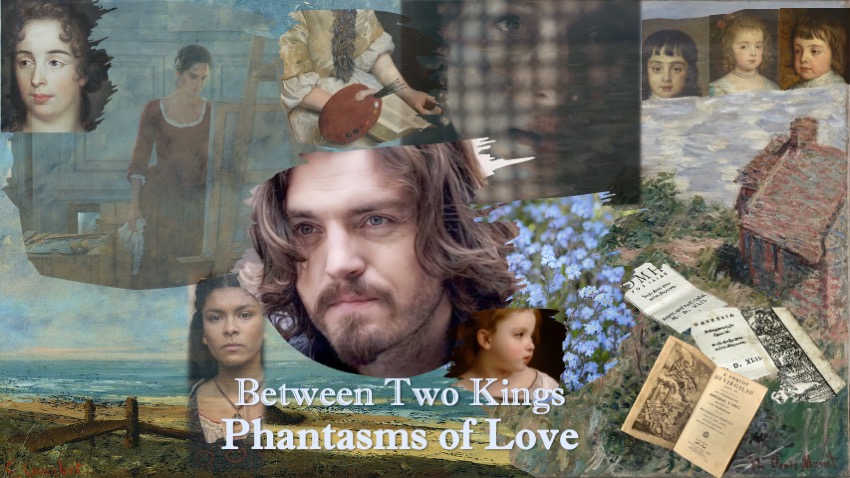
The country road crests to a rocky ridge and slopes sharply downward. Riding ahead of the carriage once more, the first thing Athos sees right below him, upon reaching the top, is the tiled roof of the pretty cottage that was visible from the cove, where the tide is beginning to flood the shore, as the day wanes.
He dismounts at the front yard of the house. It is larger than a cottage– “manoir” his mother called it–and something about the bay windows feels familiar, only he remembers them opened in bright daylight, the laced curtains wafting in a summer breeze. The neat garden with the parterres and pebbled trails is familiar too, and he has the impression that they circle to the back of the house, where one trail breaks away and continues under a leafy archway to a chapel and an orchard, and that somewhere along that path…
The carriage stops behind him just as the front door of the house flings open, and a woman hurries down the few steps toward them. She looks more like a housekeeper than a servant. “They are here! Guillaume they are here! Come quickly! Oh my poor old man, why are you lingering back there? Come! Come! Oh goodness me! They are here!” She is waving a laced handkerchief and waddles as fast as she can–she is a large woman and tall, and Athos is grateful for the commotion she causes, because he does not care to push the memory of that lonely trail to the chapel.
From the side of the garden that Athos would rather not remember, a man is walking fast toward them too, hat in hand, followed by two excited young Poitevins. Like the woman, the man is past middle age. He looks agile and strong and he is well-dressed, more like a steward or gentleman farmer than a servant, and Athos knows him just as he knows her–not their names or anything else about them–only a sense of familiarity. He helps his mother from the carriage first, and then Giulia and Colette, Petite jumping into his arms last. She hates carriage rides but this time she hummed to herself joyfully and chattered all the way from the cove, about the sea that looks like Venice, about spring and Maman who is coming home, about everyone being together. He sets his daughter onto the ground and Petite takes a few steps but pauses shyly at the sight of the approaching strangers and hides behind Giulia’s skirts just as the woman reaches them.
She is indeed a towering woman, fine and sturdy, and whether you’d call her beautiful Athos does not know but he is drawn to her wide rosy-cheeked face and her blue eyes, all kindness and fixed on the precipice of a smile. The woman clasps her hands together, excited and joyous. “Marie! My darling pet!” He is surprised to hear anyone address his mother thus; he never imagined anyone would. His mother returns a joyful smile, allowing herself to be buried into the woman’s big embrace.
“As I promised, May,” he hears his mother whisper to the woman, and turning to the rest, the duchess says: “M. and Madame Charbonneau are as close to me as any family.”
“Look who is with us, Guillaume!” Madame Charbonneau cheers. “Come, my old man, come quickly! Look at my poor husband,” she chuckles as her husband arrives panting, “thinking he is still a strapping lad!”
“Madame! Praise be to God! You have come!” M. Charbonneau laughs good-heartedly at his wife’s teasing, and kisses the duchess’ hands. “This is a happy day for us, Madame!”
His wife turns to greet the rest of them and her gaze freezes on Athos. “Goodness me!” she gasps and takes a step back, her blue eyes flooding with tears. Athos notices his mother’s imperceptible nod, and that she steps aside for the woman to move closer. It is awkward. It is unsettling. Athos abhors being gawked at and is not used to such sentimental outbursts by strangers, no matter how familiar they may feel. But the woman’s surprise, her tearful eyes, how she reaches out to him without daring to touch him are genuine. “Oh Marie! God is kind…” the woman gasps and moving closer to Athos, but still not daring to touch him, she whispers, “our darling boy!”
It is not Athos’ intention to be discourteous, but the woman’s lack of reserve and in the presence of Giulia and the maid, vexes him. “Do you know me, Madame?” He sounds aloof and it vexes him worse that he is unable to muster a more fitting tone.
She does not appear in the least offended or deterred. “What sort of question is that!” she chuckles gently.
“Now, now,” her husband intejects. “Marguerite, my dear, you know you can be overwhelming at times. My wife is easily carried away but she means no harm,” he apologizes.
Madame Charbonneau does not hear him. She keeps her eyes, gleaming with tears, fixed on Athos, “oh Marie, our darling boy… our darling boy…” she repeats, “Look at him… tall and handsome and noble…of course he would be…Our Olivier!”
Athos did not expect to hear that name spoken by anyone or in this manner. All this time, since the truth has been revealed, not even his mother has called him by that name. He is seized by the urge to grab his daughter, and ride back to Glenay with her, everything else be damned. Lucien was right, Athos thinks, I should never have agreed to this. But Madame Charbonneau has turned to his mother and he can hear her whisper, “and our other boy?”
The duchess shakes her head, “not this time.”
“But he is…You have…”
The duchess nods with a reassuring smile, and Madame Charbonneau crosses herself, “Praise be to God!” and then, with more enthusiasm, she waves to them all, “come inside, my dears! Come inside! Everything is as you asked my pet–we prepared everything as you asked, and…” She pauses mid-sentence, because Bianca’s little face has emerged from behind Giulia’s skirts. “Good God! Who do we have here?” She clasps her hands together and then lowers herself slightly–she is a tall woman. “Is this…?”
“One of my granddaughters, yes,” the duchess says. “I will tell you about them all, as I promised.”
“Let me look at your lovely face, little dove!” Madame Charbonneau invites Bianca, who, to Athos’ dismay, returns a wide smile. Madame Charbonneau fixes her eyes on Athos. “Your daughter! Of course, she would be. And her beautiful mother’s spitting image…oh dearest boy! Of course… of course!” It vexes him that this woman knows what he struggles to remember; what he’d rather not remember. Lucien was right. He should never have agreed to come here.
Madame Charbonneau winks playfully at Bianca and extends her hand to her. “Let’s go inside. How about some fritters and a nice cup of frothy hot chocolate?” To Athos’ chagrin, Petite bobs her head excitedly and happily prances to take the woman’s hand, as if she has known her all her life. When did Petite start to like fritters? Above all, she is too trusting and the woman is a stranger. He must be scowling because his mother slants him a stern look and he has no other recourse but to follow the joyous company into the house.
⚜️⚜️⚜️⚜️
He must speak to his mother immediately. Athos is intent on leaving with Petite before nightfall, and by the time he washes and changes into a clean shirt he has already calculated how fast they can have the carriage with Petite to Glenay and back to fetch his mother the next day. He puts on his doublet just as he hears a knock on the door, a servant, he assumes, to remove the water and the towels. He should ask where his mother’s room is although this is not a large house, but he refuses to remember anything about it.
“Enter!”
It does not sound like the servant he expects so he turns, and to his chagrin it is Madame Charbonneau, and she is trying to close the door awkwardly while carrying a tray, so he is compelled to assist her. The tray is covered with a laced linen towel, immaculately clean–everything in this house is neat, and immaculately clean and that too vexes him, as if a flaw, any flaw, would make things easier.
“I didn’t think you’d come to my kitchen as you used to,” she smiles a coy smile as she sets her tray down on a table. She expects to be invited to sit and once more he is compelled to acquiesce.
He has no idea what to say, his mind still calculating the finer details of their urgent departure. “You have no cook?” What an absurd retort, he thinks.
“Let another in my kitchen? Never!” She sounds offended but in a moment the kind, loving glow in her blue eyes that makes him uncomfortable, returns, and she wags a warning finger, her tone playful. “I know you are used to being around real kings and queens, but remember that I am queen in my own kitchen.”
“I apologize, Madame Charbonneau.”
“You used to call me Tatie May.” She sounds disappointed.
“I don’t remember, Madame,” he lies.
“I thought it might be easier if I talked to you in private. Perhaps…bring you your favorite?” She smiles encouragingly, her tone coaxing, and uncovers the tray–she has brought freshly made fritters. “You always preferred them with Guillaume’s honey.” It is a strange memory and overwhelming, because he can taste them, soft, pillowy, scented with almond and lemon, and dripping with honey that smells of wildflowers. He pushes the memory back. He despises sweets, fritters in particular. And he is leaving this place with Petite within the hour.
“The little dove likes them dusted with sugar, like her Maman.”
He will permit no one to speak of Alessandra. Not in this house.
“Your brother…now, he was a finicky one. He preferred…”
“Thank you, Madame,” he interrupts her indecorously, covering the tray.
“Guillaume said I should keep the formalities as is expected of us,” there is regret in her voice. “I try, but how can I? You are a noble lord, I know, but all I can see is my darling boy, the darling boy I nursed, who was taken from you dear mother, from me, from us…” She is weeping and Athos is at a loss for words, but tells himself that words have never been his metier. It was a mistake to come here. Lucien was right. “And your brother, my mischievous little squirrel…what he had to endure… ” her voice breaks and she wipes her eyes with her laced handkerchief. Athos wonders if Lucien is better with words– he never thought to notice. Perhaps Lucien would have something fitting to say to put an end to this, but he has nothing. He is scowling, he is certain. She stands picking up the untouched tray. “I should be fixing dinner.”
⚜️⚜️⚜️⚜️
Defenceless.
Never before has Athos felt like this, and it is disconcerting. He paces the room. Leaving is cowardice and staying is impossible and he has brought himself to this unfathomable, ridiculous impasse. Enough, he decides, he must speak to his mother about leaving and that’s that, they cannot waste another moment, it is dark already. In the corridor outside, he pretends not to remember what lies behind each closed door, all the while marching to the room that he knows is his mother’s room. And then he hears it.
Giggles first.
Then Petite’s little voice, humming one of her pretty tunes.
There is joyous applause and “sing one more for us, little dove!”
He knows where they are. The aromas fill the air, spicy, savory, and sweet. He can almost see them, gathered around the worktable while food is being prepared. He remembers it, the Wunderkammer where Tatie May is queen.
“All my granddaughters are talented. My grandsons too. Talented, beautiful, clever, and kind. I am a very proud grandmother,” he hears his mother boast and it surprises him that she would; that she’d speak so freely. His mother is happy here, his daughter too, even though Petite has only been here for a few hours. Athos takes another step, less certain than before, but what comes next is no longer Petite’s voice humming one of her spontaneous little tunes. This time his daughter’s voice is different: studied, melodious, and resonant. The song stops him in his tracks.
King Louis stood on his bridge
His little daughter in his arms,
It is the handsome Deon the knight
She wants to marry.
Sweet daughter, do not love Deon
For he is an outlaw
The poorest knight
His valor, not yet proven.
The first time Athos heard Alessandra sing this lullaby was the night Petite was born. Alessandra wept that night as she sang, and he knew not why.
I like Deon, and love him
I love him for his beauty
More than my beloved mother
More than my beloved father.
How could he have been so blind, so deaf, so unaware? Not just then, but before…Before la Fére, before England. Before… And every single time.
-My girl, this love you must forget
Or to the tower for life you go
– My father, I choose the tower
Than to ever forget my love.
He knew her the moment he saw her at that brothel where Rochefort, his cousin, whom he trusted, whom he thought a friend, took him, supposedly by chance, supposedly to celebrate before leaving for Spain.
-Rather than deny my love
I prefer to die in the tower.
-Then daughter, you will die there
And never find peace.
Rochefort was not his real cousin. He was Richelieu’s godson and his spy. That night at Solange’s brothel, was a ruse, a trap, like every other trap that Rochefort laid out for him from the beginning–all those warnings from M. de Treville that Athos chose to ignore. Why was he lured to Solanges’ to see Alessandra? Was it Rochefort’s cruelty or Richelieu’s scheme? Did he know his son had been brought to court? Was this the reason Richelieu destroyed the Marquis de Mouy who had adopted his son?
As beautiful Deon, rode by,
A letter flew his way
It spoke and it said:
‘Beautiful one, do not forget me’
And Alessandra? Why her? Richelieu bought her a few days after Rochefort had lured Athos to that infernal house. Athos knows this, because Alessandra has written about it in the writings she left for Petite; writings that Athos has read without her permission. But what was the connection to Alessandra? Why was she so important?
Pretend to be dead, he said
Let them take you to Saint-Denis;
Carry you underground
To your sepulcher.
And where was he in all this? What was his role in their scheme, because he is certain that they used him, and he allowed himself to be used. M. de Treville warned him but he chose not to listen.
The beauty followed the words,
he spoke to her as he rode by,
And let herself be buried,
Underground in Saint-Denis.
In the courts of France and England, surrounded by people like Rochefort and Buckingham, he learned to mistrust his heart, to think that the love of a woman is man’s inevitable weakness. Was Alessandra not a woman he had met at a brothel? Was she not an old man’s widow–which is always suspect? Was she not another obsession, like drinking and gambling and dueling? Was he not bound to fall, as every noble man since the beginning of time, prey to the wiles of woman? Was she not meant to be perfidious, and he, destined to be tormented by the jealousy, shame, and guilt that she brought upon him?
The beautiful Deon rides by:
“Stop, priests, stop there!
Do not take her away,
But let me gaze upon her!”
He delivered Alessandra to Thomas de la Fére and to Catherine, to sate their long-held resentments, which he knew. When Alessandra fought back, he never thought twice. She fulfilled his expectations for a woman of her kind.
He pulled out his fine gold knife
And unstitched her linen shroud:
She sighed as he kissed her
He marveled at her beauty.
He abhorred what Alessandra became, even though he had a hand in it. In truth, he abhorred what it signified for him that she was alive. He was jealous of every man who ever came near her, those he imagined and those he knew, George de Winter, King Louis, Lucien, even, at times, d’ Artagnan and Aramis because in his mind, only he should possess her. Such a foolish notion to possess.
Alas! Such betrayal
by my daughter and the beautiful Deon!
They must be married now,
And never be talked about again.
So many years laden with guilt and twisted by clever machinations, by desire and obsession. So much time he has wasted trying to possess and conquer, to atone and redeem instead of loving. It has taken his daughter’s voice, melodious and clear, singing her mother’s lullaby in this house, among people he almost remembers, to make him see it.
Sound trumpets and violins,
My daughter will have the beautiful Deon.
When a Girl loves,
A Father cannot stop her!
“I will not be that kind of father,” he promised Alessandra when he first heard her sing the lullaby, the night Petite was born. He will keep his promise. He will waste no more time. They are staying.
⚜️⚜️⚜️⚜️
He does not touch the sumptuous dinner that is spread on the table before him but he is delighted to see that his daughter’s appetite has not only returned but that she is eager to try everything–even foods he thought she does not like. Petite is breathlessly telling the story about Raoul’s wedding when she kissed Alexandre, following a string of other stories, about Olivier who is too serious, about Cronus, the pony Alexandre gave her, her cousin Layla’s wedding when she danced before the King and the Queen Mother, about riding Atlas at her uncle’s house and about her cousin Rayya who is the best musician in the world. They are all happy stories–he marvels at his daughter’s ability to set aside the heartache and wonders if this is what happened to him, to Lucien, and to Alessandra. To his astonishment his mother encourages Petite, chiming in at times, especially when the stories involve extolling her grandchildren. Madame Charbonneau listens with genuine enthusiasm, laughing, and clapping her hands with excitement, even though the stories involve people she has never met.
“I am told that you make wines at your estate?” M. Charbonneau has also been listening attentively to Petite’s stories, just like his wife, and, perhaps, Athos thinks this is the man’s awkward attempt to engage him in polite conversation of some kind. But Athos is in no mood for polite conversation, just as he has no appetite for food.
“Yes, at Blois.”
“Ah, good soils there at Blois. All the rivers and the lakes. Around here the soil is mostly limestone and sand, and not as good as around Saintes. But we make our own eau de vie,” with his eyes, he points to a bottle at the edge of the table, an invitation and an offer. Athos would rather not oblige, but he has already been perverse and contrary with people who have only shown generosity and kindness, and he will not insult his mother.
He attempts a smile and M. Charbonneau springs to his feet to fetch the bottle and two clean glasses. “Not as good as the brandy from Cognac, and our vineyards here are small” he sounds apologetic.
“It’s very good,” Athos counters as he tastes it, and it is true. He tastes it again. “Very good. It has fruit in it, which is to be expected, you are in the territories of Bois Ordinaires.” He tastes the brandy one more time. “How large are your vineyards? Perhaps you can think of a red, and… perhaps you can mix your excellent au de vin with grape must… I have read it somewhere…We don’t make eau de vin in Bragelonne, but there’s a legend of sorts, and from these parts of France, about mixing grape must with eau de vin.”
“Perhaps you would like to visit tomorrow and see what we have?” M. Charbonneau urges. The conversation around the table has stopped, Athos realizes, and three pairs of eyes are fixed on him–different expectations in each, but all three hanging from his lips.
“I would be happy to do so- before we leave,” he says quietly and there is a muffled giggle as Madame Charbonneu presses Petite’s hand. He hears his mother’s relieved exhale too although nothing in her countenance has betrayed any concern.
⚜️⚜️⚜️⚜️
Sleeping is as impossible as eating. Sleeping in this room–this is his old room–is unfathomable. The more Athos paces the more he recognizes; they have kept it mostly unchanged. Funny how memory works. It is the details he remembers first. There was a desk right under the window–now moved to the other side, closer to the bed. A shelf where he used to line his toys that is now empty, and another with his favorite books. They are here. He recognizes the faded leather of the spines, the way they feel as he touches them, even though no longer with the fingers of a boy. The Odyssey. The Iliad. The Aeneid. He reaches for the Aeneid–he does not remember having that book as he remembers the rest–and flips open the cover. He gasps despite himself.
The writing is beautiful cursive:
“To learn is to study with mind and heart combined. Remember this, Olivier, my brilliant and promising pupil.
Andrea Morosini-“
He remembers–not a dream, but a vivid memory. It was not in this room. It was in the salon across his mother’s chamber that has a view to the sea. They’d sit around the fireplace, not his mother–he does not remember his mother—but he remembers the man: tall and lean Athos thought him and of his features what he recalls are his eyes, bespectacled and green like Alessandra’s, and his hair, deep red, the color of fire. Monsieur Andrea. He had an accented voice, deep and resonant, and when he read entire worlds opened before Athos’ eyes. He’d read from the Aeneid when they were in the salon and Lucien would listen, mesmerized–clutching his toy horse with the red saddle. Lucien loved that small wooden horse, Xanthus, named after one of the horses of Achilles. And Sandretta would sit between them on the settee and some evenings she’d fall asleep, her head leaning on Athos’ shoulder and those were his favorite evenings.
He closes the Aeneid and returns it to its place on the shelf. Does he dare? Well…since he started…
Of all his old books, the Iliad is the most battered.
“Sing, O muse, of the rage of Achilles, son of Peleus, that brought countless ills upon the Achaeans.”
Avid boyish fingers have turned these yellowing brittle pages over and over; not just his. On the margins there are scribblings and drawings and notes in his own hand, and, right next to the scene of Achilles’ greatest triumph over Hector, Athos sees another hand—nothing like his neat cursive now, Athos thinks–angular and a bit untidy, a little boy’s first attempts at writing, but also full of excitement and determination:
“Xanthus” he writes, and then again, in all capitals “XANTHUS”, “XANTHUS” and to leave no doubt as to the author he signs: “Lucien.”
Athos covers his mouth with his hand to muffle an unexpected chuckle but finds that it is impossible to stop himself from chuckling and his eyes from tearing up and whether this is real laughter or frustration he does know. It is for the best that he has been in this house first, that Lucien is not here–a good decision on Lucien’s part to avoid it, Athos thinks. He exhales hard trying to stop whatever this is, vexed with himself: can a man his age get the giggles in the middle of the night?
He returns the book to the shelf, and picks the Odyssey, determined to finish what he started. Since he met her again in England and since they got married, the Odyssey has been the book that he and Alessandra always preferred. This here is smaller than the other two books, its leather cover still an unfaded dark blue color. He is relieved to see no traces of avid readers in these pages, although it looks like a well-read book and he recognizes a few of his own scribblings. He is about to close it and put it back, but as he flips the book all the way to the end, he comes to the last, blank page, and his heart sinks.
Two different hands write on this page, and one is his but the other–the other Athos would recognize anywhere , for it has not changed. She writes his name: Olivier and he writes hers: Sandretta.
⚜️⚜️⚜️⚜️
Across from his chair, through the window, Athos notices the dark blue line rising in the horizon that signals the coming of dawn. He does not know where the night hours went.
He agreed to follow his mother here to distract Petite. He agreed because he had to do something, anything, since following Lucien to La Rochelle was out of the question. He never expected to find Alessandra, everywhere in this house, with the people who still live here, with her father, with her mother who has painted the cove below over and over, with Lucien, and with himself. Before coming here, he was certain that Alessandra is still alive, because, if she were not, he’d know. But now; now, he is not only certain, he knows she is close. So close he can almost touch her. Where are you? Athos leans back and closes his eyes.
At the end of the cove, where the steep rocky promontory casts a deep shadow over the shore, Francesca stands in the haze of early morning, waving. “Papa! Papa!” He is running toward her and she is laughing, teasing: “Faster, Papa! Faster!” He is neither tired nor slowed down by the wet sand. But the cove is long, longer than he thought, and the distance between them remains unchanged. “Come Papa! We are here!”
Now he sits on the old pier and Francesca has disappeared and the sea is calm, a gleaming mirror with no end, reflecting the gold of the sky. “Sometimes she comes back.” He turns. She is seated next to him on the pier, Sylvie. “Did I startle you?”
“No.” She has fixed her eyes away from him on the gleaming unrippled sea. “Are you angry, Sylvie?”
“I am angry that I am here. I don’t want to be here. I want you to let me go. I was never her. But that is who you saw, someone like her that you could save.”
“I am so sorry. So very sorry.”
“Better not love me at all than to love me instead of another. Better not to love me at all than to love me with regret.”
Athos is jolted out of the dream. Outside the window, the dark blue line in the horizon has turned deep purple. He rakes his hands through his hair and stands. He avoids drinking but somehow a glass of that fine brandy seems like a good idea.
⚜️⚜️⚜️⚜️
The house is quiet, but he knows his way to the kitchen. Besides a large gray cat that raises a sleepy head from her cushioned basket, blinks at him, yawns, and goes back to sleep, he finds the kitchen empty, only the large, clean, neat hall with the vaulted ceiling and the large fireplace, imbued in the pale rose-colored light of early morning that floods inside through the high windows. He remembers it; he remembers himself here. What he does not remember is where they keep the brandy.
“Can I help you?”
He turns, startled. “Forgive me, I disturbed you.”
She is neatly dressed, her hair tucked under a fine laced cap. She does not look like a woman stirred from her bed. Madame Charbonneau smiles. “Not at all.”
“I…” He feels like a boy caught with his hand in a jar. Which he never was.
She smiles again and points to the bench at the large worktable in the middle of the kitchen. “Everyone will be waking up soon. I must get to work.”
He obliges. “I must apologize. I have been rude.”
“No, not at all!” She clicks her tongue, sorrowfully and after a momentary hesitation sits on the bench next to him. “Of course you’d be unsettled, and then, to have to endure foolish old me ranting and coming to your chamber.” He opens his mouth to object. “No, I am unpardonable. Guillaume warned me, and still…” She shakes her head. “I raised nineteen children. First my brothers and sisters when we were orphaned. I was thirteen. My father had a fishing boat–God bless his soul–he was an honest man and a good father, but could not keep a sol in his pocket. My mother died in childbirth. And one night my father was swept away by the sea. Just like that. One day we were motherless orphans, and by the next morning we had nothing. That is when I met your maman. She was very little, around your daughter’s age, and would come to the village with her father. God bless his soul, what a gentle and generous man your grandfather was! He helped us through the hardest times. He brought me to the chateau to work as a maid to your maman. Then he died, and your maman left, but we stayed with the household–your grandfather made sure your uncle provided for us always. I married Guillaume when I was fifteen. His wife had just died and, the poor man, he needed help. Your mother and your uncle, her brother, blessed our wedding. Guillaume had seven children when I married him, and I raised them all. Then we had six children of our own. It was not easy at first but with time, we were very happy. And then, there was you and your brother. My two precious boys, taken from us.” She wipes her eyes and he feels compelled to reach for her hand. She smiles. “Bless, you, my love. Pay no heed to my sniffling. Just a foolish old woman who does not know better.”
“My mother brought us here.”
“You were both born here. In this house. Your mother wanted to keep you safe. My sweet pet, she tried.”
Against Richelieu, Athos thinks. A young mother, trying to escape Richelieu–to protect her two children–knowing that his indiscretions would be blamed on her; knowing that in the end he’d prevail, because he always did. “And…” he hesitates. “And what about…”
“That beautiful little girl? Sandretta?” She reads him very well, and it no longer vexes him. Her demeanor changes, sorrow and anger combined. “She was here that summer. The happiest of times…the worst too.” Athos wonders if that was the summer of 1615, the date inscribed by Alessandra’s mother, on the study for the Miracle of the Sea that Alessandra gave him. “Your daughter looks a lot like her. And like you.” Madame Charbonneau points to a stool at the other end of the kitchen. “Do you see that? She would stand on it and sing every song there was. Like your little dove. She was such a beautiful, bright little thing, always singing, always laughing, and sometimes getting into trouble with that mischievous little squirrel, your brother, who was curious about everything. The two of them could be naughty–but not you– you were always serious!” Athos lowers his eyes and shakes his head and she pats his hand. “You are still not very good at being praised.”
“Did they stay long?”
“A few months. They left, and very soon after…” she sighs and crosses herself. “Her mother, whose name was Bianca, like your little dove, came here to draw a portrait. Her father–he was a very erudite man and very serious–he became your tutor. There’s some of his books upstairs, I’ve kept them as they were. But the lady, her mother…she was unusual… I had never met a lady painter before and have not since. The lady and your maman became as close as friends can be.” She smiles impishly. “And of course you were enchanted, and how could you not be? We were all enchanted by her. Not your little brother, he was too young for that, and liked to tease her, and you. Ah!” she exclaims, as if she remembers something and springs to her feet. “I have something to show you.”
She walks up to a carved wooden cupboard decorated with painted birds and flowers and unlocks a drawer. “There it is.” She returns to sit next to Athos, with a medallion in her hand, a miniature painting set in a simple wooden frame. “The lady painter, her mother, she always painted, and always sketched, even here in my kitchen. She painted the flowers and birds on that cupboard. She liked my pots and pans–said they captured the light just right, whatever that meant.” She places the medallion on the table. “I asked her and your mother if I could keep this one.”
The miniature painting shows three children, two boys and a girl between them. They are seated on top of an overturned carcass of an old boat–and Athos knows where that was, and when. It is the same boat inscribed with the date on the painting he owns. The drawing was made quickly and effortlessly, by a masterful hand: delicate, nimble lines, and the color applied sparingly, to hint at depth, or some particular feature and object. Lucien’s gold-colored toy horse with the red saddle–Xanthus; the dark blue leather cover of Athos’ book–he is holding the Odyssey; Alessandra’s green eyes, and, most astonishing, a bouquet of flowers in her hand, with small blue blossoms. Forget-me-nots.
“You made such a fuss, that day and the day before,” Madame Charbonneau says–perhaps noticing how his eyes linger on the flowers. “Your maman would not allow you and your brother to leave the house, and you insisted. You wanted to give your little friend forget-me-nots you said because it was her favorite flower. How that came about no one knew, but you were very upset crying all night, and early in the morning Guillaume went out and picked a small bouquet. Oh you were so happy! And she kept it and pressed some of the flowers…”
“I don’t remember this,” he says sorrowfully, tracing her face with gentle fingers.
“Why don’t you keep it, love? Keep the drawing.”
“I could?”
She nods. “It is not mine–it belonged to her mother and to your maman. They let me keep it… I understand that she… She is…” Madame Charbonneau shakes her head. “I never pry, but I spent last night with your maman. Talking. She did not say much, but she said enough for me to gather that…”
“She is missing,” Athos says darkly. He cannot take his eyes from the delicate drawing.
“What does your heart tell you? It is the only thing that matters.” Madame Charbonneau declares with certainty, as if it is the simplest thing in the world, and that is how it feels: perfectly simple. “Your maman is concerned,” she says. “She thinks she may have made a mistake asking you to come here–fears you are too burdened.”
“No, not at all!” Athos presses her hands. “Not at all.” He means it. “In fact…” he makes a small coy shrug, “I fear I may have to impose on you… Those fritters…” She chuckles although her eyes glisten with tears. “I would very much like…” She kisses his hands and springs to her feet.
“Dripping with honey!” she promises.
⚜️⚜️⚜️⚜️
The chill of dawn gives way to a bright spring day, cloudless blue skies as far as the eye can see in the horizon, to the end of the cove and the small islands that enclose it in the distance. It is low tide, and the dark blue rippled water rolls gently to the shore and everywhere there’s movement and life, unlike his dreams.
Athos sits at the edge of the old pier, breathing in the fresh sea breeze, his mind numb after the sleepless night, his heart still overwhelmed. He does not hear her approach, only feels her presence the moment she sits next to him.
“You rode here. It takes twice as long,” his mother says. “There is a shortcut. You can walk here from the garden at the back of the house.”
“I did not know,” he lies. He is not willing to make that walk. Not today. “Besides it is good to ride with Balignant in the morning, he needs the exercise.”
“I fear this was a mistake,” his mother ventures.
“No, not at all.” He turns and reaches for her hand. “Not at all,” he stresses each word. In the distance, there is laughter and giggling and happy chatter. Coming from the house, Petite is prancing excitedly along the sandy shore with Collette. Giulia is following close behind although at a slower pace. “She laughs again,” Athos says quietly.
His mother smiles sorrowfully. “She will collect shells to make a necklace. Rosie and Renee will help her make it. She has planned it all out. She will give it to her Maman when her Maman returns.”
“She was here, her Maman. That summer. Alessandra was here.”
“That last summer,” his mother says.
They sit in silence for a few moments, the only sounds besides the soft rolling of the waves and the seabirds, the joyous voices of Petite, Colette, and Giulia searching for sea shells. There is much that he should ask, but he can’t bring himself to do it. “Is all this part of the estate?” he evades instead .
“The manoir and two fishing villages, yes,” his mother says pointing back to the direction of the house. There are small vineyards there, just as Guillaume said, and they cultivate oysters closer to the fishing villages. “This is a remote part of the estate. Not so close to the chateau, but my father loved the manoir, and I grew to love it also.”
Athos points to the other side, the steep precipice where in his dream Francesca stood waving. “That too?”
“Only the cove underneath,” his mother says. “The land above, no.” She smiles wistfully. “That land…funny how life would have it. That land is part of Rochefort.”
“Rochefort!”
She nods. “His father’s estate. But since he was deemed a traitor, the land has been taken from him– it should have returned to the crown. Perhaps even to Anne, just like Saintonge.”
“I found a pink one! Come see! Look! It is lovely!” Petite is calling Collette and Giulia. The three have moved closer.
“We should be getting back to the house,” his mother says. “We must make preparations before leaving.”
“I wanted to speak to you about this,” Athos says. “I wonder if Petite and I could stay a little while longer.”
She presses his hand, smiling. “I hoped you would. I hoped you could see the beauty of this place… Why it is so important… And Tatie May and Guillaume…it will make them very happy.”
Click HERE to read more/listen to the song in the chapter.

 Twelve Years After
Hi Mordaunt,
I truly love how you made Francesca their whole family’s guardian angel – admittedly, it’s one of my favourite details in the story! Now I hope Athos & Lucien will concentrate really hard and read the clues: Radu, Rochefort’s neighbouring ancestral estate and Francesca’s words. Fabien is not around to spell it out for them this time! 😉
I think that you have managed to convey the feeling of childhood happiness that Athos used to know in this house, despite his initial misgivings and even panic. Beautifully done! I also liked that forget-me-nots came back into the picture – we saw little of them before, and the last time we did they were showing their scorpion grass side. It’s nice that it was Athos who gave Alessandra her first bouquet of them ❤️
While I still have some doubts about whether Athos’ epiphany (-ies) about Alessandra will stand if put to the test in a crisis, I hope that he is now “ready” to find her and will therefore finally succeed.
LikeLike
Hi Dinny,
Thank you for the comment. Athos has “seen” Francesca before in this specific setting, and, of course, we can read her as a guardian angel and/or as a manifestation of something a character already knows (subconsciously).
We have “built up” this place already since the previous “book”, through a series of paintings, sketches, studies on drawings (all by Alessandra’s mother), a cipher, and dreams (or sometimes memories that felt like dreams). Mostly through Athos’ eyes; a few through Lucien’s; only once through Alessandra’s. She is the most resistant in remembering any of it. There is a “Dickensian” story at the core: three children who met one summer that marked all three of them for the rest of their life- and who meet again and again as adults, drawn to each other. One could call it “fate” but we can definitely also call it recognition. Athos is the first to acknowledge that past. He was older, and a child that had assumed too many responsibility for his age. There is still a part of that past he finds very hard to face.
The forget-me-not detail is not in Dumas. It is a BBC addition to the story and it works beautifully here- we wanted to do this for a long long time: that he gave these flowers to her first. We always thought that there should be more “history” in this and not just the superficial name of the “forget me not” flower.
Epiphanies are important if a person is self reflective. By definition Athos-the archetype- is the romantic “cursed hero”, but one can write a more nuanced version, we hope. We do write him as someone who reflects deeply, so these epiphanies should make some difference. How far, remains to be seen.
Thank you for the comment.
LikeLike
Thanks for answering! I always look forward to our discussions! Is there any particular reason for why Alessandra remembers (or subconsciously chooses to remember) so little of that summer? I guess we haven’t seen some pivotal things that happened back then yet, but did they perhaps affect her so strongly that as an adult, she is, as you say, more resistant to these memories?
It’s interesting that you mention “Dickensian”, because, as I read this latest chapter, I had to think of Wuthering Heights in fact. That bit when Athos discovers his and Sandretta’s scribblings in The Odyssey felt like an allusion to the fragment in that novel where the narrator sees Catherine Earnshaw’s scribblings in her old books about her & Heathcliff. (I love that book, by the way!).
LikeLike
Hi Dinny
I enjoy these discussions also.
One reason Alessandra does not remember, which would be the same for Lucien is that they were both younger and the events (of which we have only “seen” snippets–there is much more story there to be told) were too traumatic (as the expression is today). We definitely know that Alessandra willingly does not want to remember: it is in her backstory (AO3) which we have brought into this story too because it is so important (Twelve Years After in AO3), especially the writings. She says that her life began when she was found by Solange in a tent full of orphaned children after the raid that killed her parents. Throughout the story too, she insists to Athos, for instance, that she never has dreams and that she does not care about the past. It is a major point of contention between them at times, and it fits with the BBC series which has the character of Milady explicitly tell Athos that the “past is dead” and him countering that it can never be dead. I suspect the BBC series only harkened to the killing Thomas story with that; we decided that it means much more for both these characters.
You are absolutely right about Wuthering Heights! It was an inspiration for this storyline, including Catherine Earnshaw’s scribblings about Heathcliff.
LikeLike
Yes, I understand, and we discussed it before, that Lucien and Alessandra being younger than Athos is one of the reasons why they remember little, but I did think there should be more to that than just their age. There’s still the drowning accident, among other things. Can’t wait to find out more 🙂
I believe Alessandra is a bit of an “unreliable narrator” in some cases, and her statements about how she feels about the past is one such case. We know she does have dreams (and we hear about that from her too, e.g. when she speaks of her dreams about Raoul and Bianca), and she definitely remembers many things from the past in great detail and thinks of them a lot. I understand it’s her self-defense mechanism to insist none of it matters or even holds a place in her memory, too bad people around her believe that too easily.
P.S. Great to know that little fragment was indeed inspired by Wuthering Heights!
LikeLike
Yes, Alessandra is an “unreliable narrator” but so are Athos and Lucien in this instance; unreliable in different ways perhaps, and with different nuances, but still unreliable.
The young age is important not only because children deal with traumatic events differently but because it is difficult for children to comprehend e.g. the enormity of such events, the complications, the context(s). They see them very differently and contextualize them differently. In other words, the younger the child the different the experience even if the “event” is the same. At a young age, as these children were, five and younger (we call these “formative” years today) even a year makes a very big difference in perception. What happened that summer was pretty dramatic, as we will find out, and what followed was equally dramatic. We have given readers clues but not the entire story and these three children were affected differently by all that but they were impacted and their lives changed.
In writing this story we have been using many different “genres” for inspiration, besides Dumas–and some are more obvious than others and a few have been very surprising to us but inspiration is inspiration! Dickens was definitely in the list and so were the Brontes–after all Dumas is a contemporary and the BBC series adds a very “Mr Rochester” dimension to Athos so we cannot avoid that either.
Always great to discuss these details with you!
LikeLike
Hmmm, no new chapter today? 🧐 I am worried!
LikeLike
Posted 🙂
LikeLike