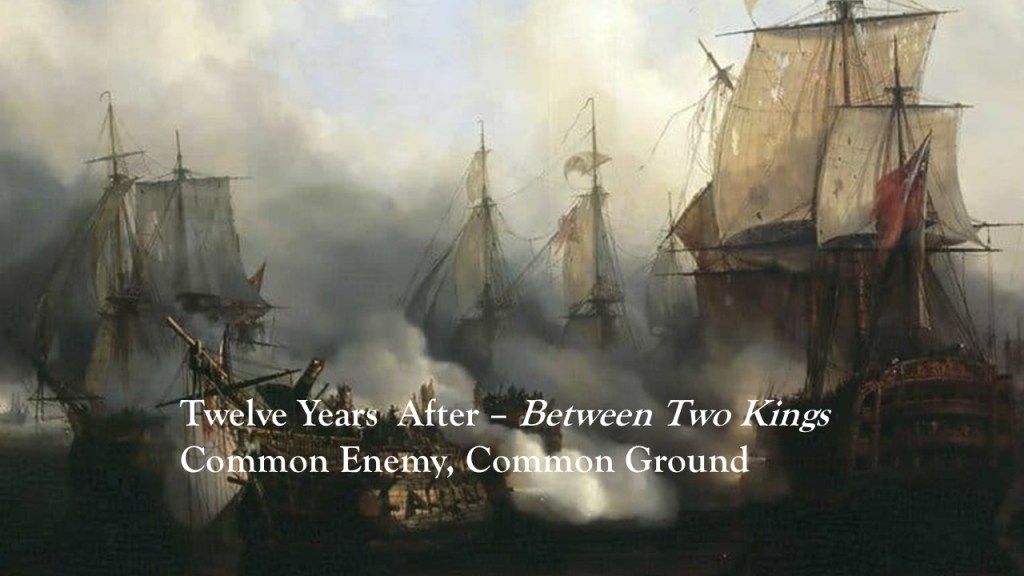
Dawn …gray tendrils of fog drift away. On the Spanish galleons, San Isidro, Rosario and Sagrio, sharp eyed lookouts on deck and high atop the masts brace their legs against the wind and swing their spyglasses, searching for the enemy, noting positions to their captains. One ship they do not see is a masted pinnace with only a three man crew where eight to ten should be. Only the Belladonna knows of this ship, tucked into the ship’s wake and under the fog that still hovers over the coast and sea. Its crew slept fitfully and in shifts to maintain a watch.
‘Here Cap’n. There’s a bit of the bread left.’ Loup hands Lucien a tin cup with a swallow of wine and a chunk of stale bread. Lucien sits up and rubs his face tiredly, scowling at the dispersing fog and silently begs for a few more minutes of its camouflage. He dunks the bread into the wine and chews. ‘Now I am restored,’ he jokes. He glances at Loup, ‘think our little deception will work?’
‘A little late to be wondering about it,’ Loup mutters bluntly, ‘sorry Cap’n…’ Lucien waves an impatient hand at his worry about decorum gesturing to the cannon in the bow, ‘I am wishing for more than six pounders. Not much firepower.’
‘The balls are small enough that Ver is carrying the cannon shot in his pockets,’ Loup agrees with a wry laugh. Their situation and their strategy is either brilliant, hopeless or comical. Or all three. He glances at Lucien, ‘a dead on shot with a six pounder can do some damage. The twelve pounders are below and since we are now wishing picaroons, then wish for sneaky to be worth more than the weight in a cannonball. After all, we learned sneaky from the best of them, and you will remember that Ver is a very good shot.’
‘I don’t remember Ver ever shooting anything.’
‘Then wish for that too!’ Here is what you better know,’ Loup points up at the frigate, ‘this ship will balk at the rudder, best to be well tucked in.’ All three men anticipate the hard over command that will move the Belladonna to reveal the pinnace to the San Isidro, a moment of extreme danger. They have muskets, but no crew to shoot into the San Isidro and disrupt their action. The bow guns in the pinnace are primed and ready. Lucien maneuvers the pinnace as close as he dares to the Belladonna stern and rudder.
Lucien glances again at the Belladonna quarterdeck. In the night, he caught glimpses of the captain, a shadowy figure in the gray gloom, a tall man pacing just as Lucien would be before the dawn of a battle. He does not know this captain, they have not talked or sent messages to each other. He doubts that either of them truly understand the reasons the Spanish are attacking, whether it is personal or an ordinary act of piracy. Nevertheless, they understand they have common ground, to move from suspicious adversaries to allies against a common enemy. Lucien is certain the captain will try to take one of the Spanish ships as a prize. The opportunity is there, and Lucien knows, if not for the Aigle, he would be thinking of that. The Belladonna captain would make himself and his crew rich, increase his reputation and gain leverage and power. A savvy man, Lucien thinks to himself, if he can pull it off.
‘It is time Cap’n,’ Loups says in a low voice. The fog is lifting, the sun fully risen.
‘Ready guns,’ Lucien shouts to Ver over the wind and the waves crash against the bow, sending up spray over the deck soaking them. Lucien shivers involuntarily, more from anxiety than the cold. The next few minutes will tell their tale. He makes a quick glance in the direction of the Aigle. His ship is under attack. He cannot think of anything else to do in this fight. But Loup is right and if Benito were here he would be bellowing … move your picaroon arse … its always impossible until it is done pup…
‘Guns ready,’ Ver bellows feet braced, protecting the lighted match in the linstock from the wind with his body. The San Isidro fires one of the smaller bow cannons at the Belladonna, the shot going wide of the deck and splashing into the sea.
‘That’s a warning,’ Loup says, ‘they intend to board her.’ The Belladonna fires back, the reply from the San Isidro is another cannon blast that shatters the rail, and a longboat tied down on the deck. Sharp shooters with muskets and harquebuses are shooting from platforms high in the rigging raining down shot at the Belladonna. Injured men cry out and one man falls from the rigging into the sea.
Captain Renacer glances over his stern at the pinnace below. Timing is critical. The Belladonna slides forward, gun ports still closed, gun crews ready to heave their cannon into position. All three men on the pinnace strain to hear the orders being shouted on the Belladona. ‘They prepare to ease sheets Cap’n!’ Loup has seen what he needs to know. Captain Renacer’s booming voice carries across the deck of the Belladona.
‘Hard to port! Now!’
The Belladona groans, sluggish to the hard turning of the wheel, the rudder fully deflected. Men grasp the nearest fixed object. Waves of gray green seawater wash over the deck sweeping men’s feet out from under them, sliding across the deck in danger of being washed overboard but for the saving grip of fellow crewmember. The ship hovers, ‘ease the wheel!’ the captain shouts. The ship bucks the waves, rolling and rocking as it settles, the captain bellowing, ‘beat to quarters!’ Feet pound up the ladders and along the deck as the crew races to their positions to defend the ship. A few men with harquebusiers slung over their shoulders climb swiftly aloft, others to positions along the rails.
‘Putain enfer! Sharp shooters on the Belladonna!’ Ver shouts with glee, ‘that will give the Spanish bastardos some trouble.’
‘Here we come…surprise…’ Loup mocks a falsetto voice tinged with teasing malevolence.
On the San Isidro, Spanish harquebuses are raining down shot. Captain Don de Velasco surveys the damage done to the enemy ship through his spyglass, grimly pleased as cannonballs tears through sails and throws up great splinters of wood. ‘She is ours,’ he says confidently to his quartermaster. ‘Ready the men to board.’ Suddenly, from the top comes a panicked cry …
‘Barco muerto por delante!’
Captain Don de Velasco whirls … and stares speechlessly at the clearing fog, the masts and sails dead ahead. Where did it come from…? he wonders, his hand holding the spyglass suspended in mid-air. He does not need a spyglass to see a pinnace, the cannon in the bow, a dead on shot, the man lowering the match to the touch hole, the flash of fire, a great booming explosion, smoke billows and cannonball smashes through the bowsprit and across the bow killing the men who rushed to fire the cannons. The second shot careens across the deck, splintering wood, decapitating the quartermaster, driving a foot long sliver of wood into de Valasco’s chest before breaking through the taffrail and splashing into the sea. De Velasco is thrown to the deck and crawls instinctively to the side for what limited protection it offers, blood pouring from his wound.
‘Fuego,’ de Velasco calls weakly, slumping over as blood pumps from his body to pool under him waiting for a blast from his bow guns that does not come. On the Aigle, the men are at the rails, on spars and ratlines cheering wildly as they see the pinnace, their mates and the captain. It is the last sound de Velasco hears.
Gun ports snap open on the Belladona. ‘Fire!’ ‘Fire!’ and cannon shot rakes the side of the San Isidro. On the pinnace, below deck, Ver is a one man gun crew, reloading powder, shot, tamping in the wad and waiting for the order to light the serpentine. He braces one hand on the beam above his head, peering through the gun port and seeing the side of the Spanish galleon coming into view. He readies himself for Lucien’s order.
On the San Isidro, the gun crews are outraged by the sly tactics of the little pinnace. With grim determination, they heave the cannon carriage forward, ready for the order to destroy the little pinnace and her murdering crew.
‘Now Cap’n,’ Loups hollers, hauling the sail taut as Lucien works the wheel, the pinnace leaping forward eager to race alongside the Spanish ship.
‘Godspeed,’ Jacquari mutters as the pinnace disappears on the opposite side of the San Isidro. ‘We have our own fight to disable this ship,’ Captain Renacer reminds his quartermaster. He points to the Rosario, ‘that is our quarry.’
The pinnace is close enough to the Spanish galleon to see into the open gunports and the snarling faces of the Spanish gun crews. They can hear the curses thrown at them, the insults to their manhood, their king and county and the terrible death that awaits them from Spanish cannon fire. The gunners insolently salute the pinnace as they light the touch holes one after the other, belching flames and smoke billows. Cannon shot arcs up and over the pinnace, splashing harmlessly into the sea. Cursing viciously, the Spanish gun crews yank the blocks out from under the guns and reload quickly. But again, the shot sails over the pinnace splashing into the ocean.
‘They cannot lower the guns to hit us!’
Loup is shouting curses and insults to the Spanish gunners who are working feverishly but they all know it is useless. The great guns cannot be angled to get a direct hit on the pinnace. Not at this distance.
‘Fire!’ Lucien roars and Ver races along the gun deck lighting every touch hole. He cannot miss at this distance and two direct hits smash through gun ports killing the men there, igniting loose granules of powder scattered on the deck, small flames growing quickly. The second blast crashes through the rail, a low hit to main mast, splintering wood, but the shot is not heavy enough to break it. It takes a second cannonball from the Belladonna to bring greater damage to the mast and with an ominous cracking sound it topples over, sails and rigging landing in the ocean and the ship tilts to the rails, sea water rushing over the decks and into open gun ports, dousing the smallest fires which has spread to the upper beams. Men are ensnared in the rigging, unable to free themselves and drown quickly.
Captain Renacer looks for a moment longer at the San Isidro gauging the threat the ship may still pose. The pinnace has made another tack and is gaining speed, racing away from the galleon toward the Aigle, threatened by the Spanish ships trying to box in the sloop.
‘M Jacquari, set a course for the Rosario. M Burkeart! Ready guns!’
On the Aigle, the mood has changed. Resigned to following their orders Bulle and the crew were preparing to spread sail and flee rather than face three Spanish ships. But the tactics of the Belladonna, the stunning attack by the pinnace now racing towards them, their captain at the helm recklessly weaving around galleons, dodging cannon fire and smoke, fires up the Aigle crew into fearsome fighting demons They shout and jeer, exchanging insults, curses and insolent remarks on the motherless bastards, and the dubious virginity of wives and sisters.
‘Shut up you picaroon bastards!’ Bulle rages at his men, ‘you want to end your days a slave, rowing a Spanish galley chained and beaten? Now! Beat to quarters! M Fleury, guns!.’
‘Ready!’ M Fleury shouts back walking the length of the gun deck, slapping his men into order, ‘shame that our captain should see this melee! Prepare to fire!’ His scowl is ferocious, and the gun crews quickly straighten to their task, but M Fleury does not miss the gleam in their eyes. He smiles to himself. A fight is coming, and the crew is ready for it.
‘Take down that mast!’ commands the captain of the Sagrio and the gunners make adjustments, the shot ripping through the sails and tearing up the deck on the Aigle.
‘Those bastardo putas mean to board us,’ Bulle growls to Poilu who strides the deck exhorting men to keep their weapons close, sending some below deck to protect stores of shot and powder and to organize an assault on the enemy through a hatch. The Belladonna is crowding the Rosario, cannon fire exchanged, choking the air with billowing smoke. Despite the fighting, the Rosario is closing on one side of the Aigle, the Sagrio on the other.
‘Bulle, we are not leaving our captain and mates to the Spanish dogs,’ Crotte has the helm, ‘luff the sails, let them see us straggly and disorderly, not ready for a fight. The captain will figure out how to get aboard. But let them come now, we have few injuries, and our men are eager for it.’
‘What are they doing?’ Ver cries out from the pinnace, ‘this is no good! They waited too long! Bulle!’ his shout is futile as Bulle cannot possibly hear him. ‘Go!’
‘They would not leave us to the Spanish,’ Lucien says grimly, ‘we must get aboard.’
‘Cap’n, we cannot get close enough.’
‘No,’ Lucien murmurs, ‘but the Belladonna will do it for us.’ He watches the Spanish ships maneuvering, one to a side to pin the Aigle between them. The Belladonna has ceased its guns, hovering not far away, sails flapping, smoke rising from the deck, a disordered crew rushing around the deck trying to put out fires and help the wounded. The Belladonna appears damaged, and drifting, drawing closer to the Rosario. The galleons ignore it, focusing on the real prize. When the Aigle is taken, they will avenge the San Isidro and deal with the limping Belladonna and the brazen pinnace.
‘That captain is a clever bastard,’ Ver remarks. It is high praise for the deceptions practiced by the Belladonna captain. ‘Not Wijard’, he declares emphatically. The three men exchange a wicked look and shout together, ‘not Wijard! … it is now a battle cry.
Bullets flying from all directions, men falling where they stand or over the side into the sea, grappling hooks are thrown from the Sagrio on one side of the Aigle and the Rosario on the other side. Spanish men crowd together to be the first to board and start the killing, shouting their war cry, ‘Santiago y cierra, España!’ They grab a rope and swing to land on the deck, daggers in their teeth, swords in their hands. They rush over boarding planks, climb up chain ladders – the onslaught of the enemy is ferocious.
‘Aloft now!’ Bulle bellows and orders every man with a musket, pistol, and harquebus to shoot into the Spanish crew. Wielding daggers and boarding axes the Aigle men rush to repel the invaders, the fighting is close, fierce and bloody, men can smell each other’s sweat and foul breath. Once on deck, the Spanish push hard to get to the ladders and the lower decks for control of the great guns and the powder. M Fleury, Crotte and Fou block the stairs, leading their fighting men- the gunners, the ship’s carpenter and purser, the cook and the ship’s boys, ‘stop them! Attack Attack!’
On the Rosario, the few men left behind use pikes to fend off the drifting Belladonna. ‘Did they lose the rudder?’ one seaman wonders to the other. ‘Ahoy the ship,’ he shouts trying to raise a crewman. One man pops up from behind the rail, glances up and down the Rosario deck and drops down again. The Spanish seaman scoffs, ‘what the…’
Suddenly, a huge roar goes up as men swarm over the rail from the Belladonna onto the Rosario, killing the Spanish men and rushing across the deck to attack the Rosario crew from behind. Shocked, Rosario men turn from attacking the Aigle to defending their ship. In the confusion, Loup, Ver and Lucien fight their way across the Rosario and onto the Aigle tossing the grappling hook, gangplank and a few Rosario men into the sea to be crushed between the two ships. They snatch up the pikes to push the Rosario away from the Aigle. Men rush to help.
‘Heave men!!’ Lucien roars and they lean hard against the weight of the Rosario, the sea helping to push the ships apart. Together, they shove the Rosario into the arms of the Belladona. Locked in a fight of their own, the Rosario and Belladonna move away from the Aigle, taking the Spanish fighters intended to help seize command of the Aigle.
For a moment Lucien watches the Belladona. They fought well together disabling the San Isidro. But now, it is up to Belladonna captain and crew to secure their prize. ‘Good luck friend,’ he murmurs to the unknown captain and turns back to save his own ship.
‘Cap’n!’ The Aigle crew shouts their approval. Furious at their antics, Loup grabs men by their collars shoving them back towards the action. ‘Standing about, your mouths hanging open like mackerels! Repel those bastards! Attack! Attack!’ Loup roars, brandishing his sword and leaping into the melee. ‘Kill these perros bastardos!’ Just to be sure the invaders understand he is referring to them, he uses their language.
Their resolve energized, Aigle men form up to follow Loup and their captain who is wielding his dagger and sword in furious action. The resident maniac on the Aigle is on the heels of his captain, shrieking his strange vocabulary of howls, squeals, yips and yaps, adding high pitched screeching as he grapples with the enemy, laughing hysterically as he slashes and stabs. Against the renewed ferocity of the fighting, and the loss of the men from the Rosario, the Spanish are falling back.
‘Browning your breeches are you?‘ Poilu taunts the Spanish, ‘smell their fear mates!’ Poilu guts a man who drops to his knees, begging for mercy as he frantically tries to push his guts back into his slashed stomach.
‘Give it up,’ Poilu advises and slashes his neck open. The deck is a shambles of broken wood, dead and dying men, tangled netting, shredded sails, slippery with blood, severed limbs and other grisly parts, but the killing, maiming and driving the enemy from the ship is relentless. Hatch covers are thrown back, Crotte, Fou and their motley fighting crew surge up attacking the Spanish from behind. Suddenly, the enemy is turning to flee, leaping the gap to the Sagrio, kicking the gangplank into the sea to prevent the Aigle men from following them. Sharp shooters on the Sagrio are firing into the Aigle, slowing their assault as the men dive for cover from the barrage of bullets. The Sagrio is poling off, men rushing aloft to drop sails, others hauling on rope, a man at the helm turning the ship to catch the wind.
‘They are running!’ Lucien bellows whirling in all directions. ‘After them! All hands! Odysseus! Where is Odysseus! Where is my sailing master!’


Lucien being his cool self! He is really a force of nature. But he also has a lot of luck, I should add. And a combination of these two makes him formidable. Interestingly, compared to his brother, he seems to be “more whole”, of one piece, if you see what I mean, despite his tumultuous past.
I wonder if we will see Lucien remembering some more of that fateful summer too. And then there’s Louis the King who may want to claim some return on his investments and demand something from Grimaud in exchange for all the titles & estates.
LikeLike
Hmm, I remember leaving a comment here… Did it say something wrong and get removed as a result? I thought it was totally legit though!
LikeLike
I do not know! I was writing an answer, on a topic I love to discuss, almost finished and it and your original comment vanished. I do not know what I did, I must have pushed the cursor to a delete tab? hit something on the keyboard? I could not find my response or your comment. Actually today it occurred to me to reply to a different message, but you sent this one and…well here we are! I have no explanation, but it must have been some inadvertent error on my part and I am very sorry. It was not intentionally removed, I don’t remember all of your comment, I mostly responded to your observations on Lucien – a man who you described as lucky. I do not disagree, but even Lucien would be the first to say, ‘luck runs out’. He is uncanny in assembling information from observation and mixing it with experience and take calculated gambles – good field commanders and others with leadership abilities show these talents. The lopsided attack on a warship between a two other ships of vastly different capabilities seems on the surface to be ridiculous. But the maneuver Lucien pulled was actually done in a real navy battle. If you’ve been reading for awhile, then you have seen this before in different form. The reckless part is the dodging cannon balls while sailing a sloop among war ships – also done in real navy battles – but I think that was mostly luck! Thank you Dinny for your patience and great comments. Sorry for this confusion. Please let me know at least if you receive this!
LikeLike
Corso the Comment-Slayer 😊 Good to know my comment was blameless!
Yes, I fully agree that in Lucien’s case it is not just about luck. Certainly he is a very experienced, trained, determined and intelligent man, but luck is definitely on his side too. Which is exactly what makes him so formidable. I also think that what helps him is that he is a “whole” person, he is true to himself and not torn inside, despite the many adversities he faced in his past. People like that have inner strength stemming from this “wholeness” or integrity that gives them an edge in the trenches of life.
By the way, if I may ask, is Corso a name from Perez-Reverto’s novel?
LikeLike
That’s me! not trustworthy with a keyboard.
Yes, I agree that despite what seems obvious – Lucien’s inner compass is intact. He is wholly comfortable in his own skin – even when making terrible mistakes – ‘its what I do – too’. He takes risks for people he cares about, or sees at some disadvantage that he, in that moment, can fix. He has a tight inner circle around him – but seeks his own solitude. I agree, this type of personality has great reserves of inner strength. Lucien is rarely conflicted about right and wrong, although what fits into those categories has been the focus of conflict with others who seem criminality in black and white terms. For Lucien, poverty is not chosen, but imposed. People survive however they can, and in their actions, Lucien rarely judges or condemns.
Yes! I see you are a reader of Perez Reverte – a writer I admire and read. Corso is a character in the Dumas Club,(which you must have read) ‘a book pirate’. I loved that. The word in Spanish has many meanings, the one I like describes privateering or piratical enterprises. Thank you Dinny! I managed to reply and not delete us both! Best wishes!
LikeLike
Actually, I only read one book by APR, and it wasn’t The Club Dumas, but The Nautical Chart (and unfortunately, I can’t say I really liked it). So I didn’t know Corso is the name of APR’s character, until I googled Corso & Dumas looking for a connection, and the search returned that novel 🙂 I didn’t realise that Corso also has an additional meaning in Spanish – makes lots of sense!
LikeLike