It bothers him.
In the mornings, long before Petite wakes, Athos rides with Balignant down to the sandy cove. Even after a week he refuses to walk there using the shortcut through the back of the garden. From the old pier he watches the dawn, every dawn a different array of colors, and the low tide simmering in hues of gold and red and purple, as far as the eye can see. He thinks of Lady Bianca’s painting, how it grasps this moment, even though this moment is never the same. He thinks of Alessandra. He feels her too– closer every day. Since he arrived at this strange haven, Athos has found it hard to distinguish between his heart and his mind. At first he resisted–could this be like wine, he wondered, could this be another way to seek oblivion, as has been his inclination? Could he lose himself at this place where the man found the child he once was, where the heart and the mind meld into one? He was wrong on both counts. The child completes the man, he has discovered, just as the heart completes the mind, and Alessandra occupies both his mind and his heart. Athos remains thus until the cove fills with the sounds of a new day, and only then, he looks up, to the promontory.
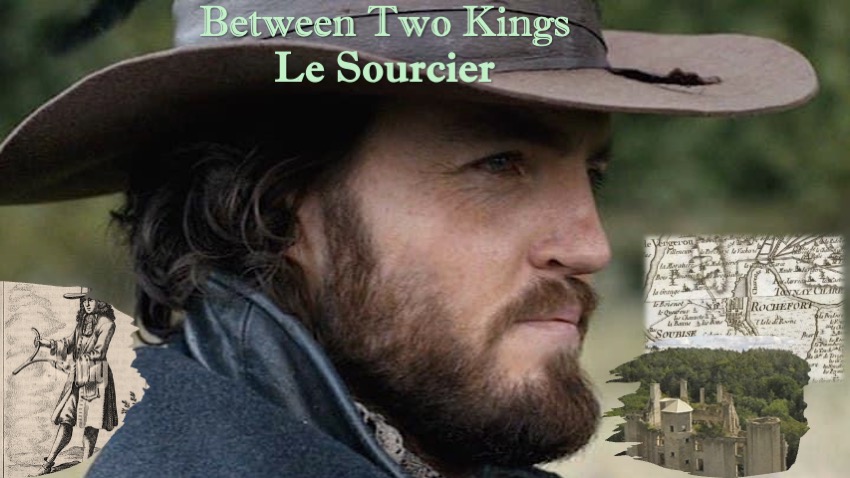
It bothers him that it towers over him, Rochefort’s paternal estate. Even in this haven Rochefort trespasses. Athos has a feeling that he is missing an important piece, and for the first time he trusts the feeling, and sees no need to belabor the reason.
It is around this time of day that Petite comes prancing from the house to kiss him good morning. She always gives him a breathless account about all the songs she has sang already and what is happening in Tatie May’s busy kitchen, and about how she must tell her Maman some new exciting thing now that Maman is coming back. This is how every one of Petite’s accounts ends: with a list of things she will tell her Maman.
Every morning, at the cove, Petite is followed by Colette and by Giulia who strives to catch up with both girls. Collecting sea-shells for her mother’s necklace has turned into an ongoing expedition for Petite. She runs it with the discipline of a general and the focus of a scholar. It begins on the shore with Colette and Giulia, continues on Guillaume’s rowboat, and ends, like everything else in this household, in Tatie May’s kitchen, where the shells are washed and boiled carefully, then spread out to dry thoroughly, before they are subjected to Petite’s final and rigorous inspection that leaves only a selected few to be polished. Petite has a clear idea about what the necklace will look like and is very particular about how things must be done. Athos did not know this about his daughter. Tatie May claims that she is just like her father in this and Athos is not sure he likes it. But then Petite plops before him the natural history book that Alessandra’s father left–a book that Athos must have read– and points to a drawing of the radially ribbed shell that is common to these shores declaring “Venus was born from this. It is in Signor Boticelli’s painting” and Athos is relieved, because she sounds exactly like Alessandra.
Petite’s ongoing expedition allows Athos to pursue his own. He rides further and further daily. This wine-country is different from Bragelonne, in that it is not a wine-country at all, only small producers who make wines for their households, while most of their livelihood depends on fishing and cultivating mussels. The soils are different in these parts, some with more limestone, others with more sand, and their parcels are small, but the arrangement works, because every small winery is different, and some of the producers, like Gervais Emery, a childhood friend of Guillaume and a Marandais as well, are eager to try out Athos’ idea about mixing their local eau de vin–which is not as fine as that from Cognac–with grape must. It is a close-knit community, Athos discovers, with families spread in dozens of hamlets and isolated homesteads along the mudflats and the canals, each carving out a living mostly harvesting the sea. He visits many in his daily excursions. Word about him and his little daughter has spread fast and in the eyes of those he meets, he comes with a lineage that strongly connects him to these parts. He is one of M. de Vignerot’s grandsons and one of Madame’s sons, he is Guillaume’s good friend, and one of Tatie May’s beloved boys. Athos rides north as far as Angles and Saint Michelle en-l’ Herm, to Ribadon and to la Dune, but never to Luçon, where his father, Richelieu, began as Bishop. Just like the shortcut to the cove through the back garden, there are places here, where Athos will not go.
When the talk of grapes and soils and the right wood for wine-caskets dies down, Athos returns to the one and only thing that he wants to know, the thing that bothers him: the land that overlooks his mother’s cove, the Rochefort estate.
Older folk remember the father–the old Comte de Rochefort–and not kindly. They think themselves fortunate to have been tenants of Madame d’ Aiguillon’s father, M. de Vignerot. Rochefort was a brutal seigneur, they tell Athos, with nothing but contempt for those who worked his lands, and his tenants suffered from his cruelty even though the lands are prosperous and the soils better than those of M. de Vignerot. They remember little else about the Comte, only his cruelty and that he died after an accident and a long protracted illness, and that suffering did not make him a better man. His wife, the Comtesse, was rarely seen in these parts, not even when he was ill and dying, they tell him. She was a very beautiful woman, some recall, but distant and cold. Others say that he did not treat her well, but was that not true for everyone, including the Comte’s son? The boy grew up here, without his mother, and some even remember him riding with his father, but mostly they remember that he was sent off to court soon after his father became ill. He never returned, not even when his father died, although the father, they tell Athos, was not buried at Rochefort, but was taken to Paris–to some family vault, for he was from an ancient family, some say even of royal blood.
Athos knows about the last part and it’s true. The Marquis de Mouy was very particular about teaching him heraldry, especially concerning the family, and Charles’ father was the Marquis’ younger brother although from a different father. “And the estate?” Athos insists.
The son never returned after his father’s death, they tell him, but kept the estate prosperous, and that is because he chose a good man to manage the land, M. Rapin, whose family hails from Esnandes. Whether the young Comte de Rochefort was well-advised or he, himself, was a good judge of character, no one knows for no one has ever met him. But those were good years for the tenants and prosperous too.
Then soldiers arrived, and they wore red cloaks and crosses. They were the Cardinal’s men– that would be the great Cardinal, Richelieu, who was raised in these parts himself and was once Bishop of Luçon. The young Comte de Rochefort perished in Spain, they announced in the churches and the village squares, and the land now belonged to the Cardinal, for he was the young Comte’s godfather and had taken care of this land before, when the young Comte was still a boy right after his father died. M. Rapin, the old steward, was dismissed and only allowed to rent a plot of land. His Eminence, sent his own people to manage the estate–among them, a Franciscan called Pére Joseph, and sometimes the Cardinal himself would come, and once or twice he even came with the King. Those were the days of the war with England and the Cardinal and the King were often in these parts. Then things changed again. The Cardinal died and word arrived from Paris reinstating M. Rapin to his former position, and even more astonishing, it seemed that the Comte de Rochefort was not only alive but Prime Minister. It was about this time that M. Rapin died, and his son, Medart, took over, a good man also and as well-liked as his father. Then soldiers came once more, and with them came men from Paris who looked like lawyers and notaries and accountants. They closed the chateau and every other house in the estate, and locked all the workshops and the warehouses. They counted everything there was. Medart and his wife and children were turned away too just like everyone else–they live at Charron now, which is his wife’s village, they tell Athos. The lawyers from Paris then brought their own people to manage the estate, none of them locals. Everyone assumed the Comte de Rochefort had died or something worse had befallen him, for this was an ancient title and it looked as if the crown had reclaimed it, not unlike what happened at Saintonge, further south. Many of the old tenants chose to abandon their parcels and return to their fishing villages, for the crown is known to pay pittance and enforce exorbitant taxes. New people came to work the fields paying rent to the crown for a few years and moving on, never mingling with the locals.
“You should talk to Medart,” M. Emery and Guillaume advise Athos. “He knows more than anyone about the estate. He knows more than anyone about every inch of land between La Rochelle and Angles, and has walked them all. He’s a sourcier. It’s how he makes a living since he lost his position, and he is the best there is. He and his little daughter Celestine, who shares her father’s gift.”
⚜️⚜️⚜️⚜️
“Have you ever witnessed dowsing, Your Grace?” They are riding with Guillaume side by side to Charron.
“Once, near Le Grange where we keep most of our vineyards. Bragellone is well irrigated but this small parcel was not promising and remained fallow. My manager, his name is Gerard, swore to me that this man, Poto, could work miracles. I still do not understand how the man did it, but he did. The parcel produces excellent wine.”
“Medart is the same, and, I suspect that like your man in Bragelonne, he is humble about his gift and only shares it with those he trusts. Gervais has already spoken to him, so he expects us. He is a good and honest man, you will see Your Grace.”
⚜️⚜️⚜️⚜️
It is a one-room house, frugal but very neat. They sit outside at a table covered with a clean and well-pressed linen tablecloth, under a thatched canopy, one of its sides closed with a makeshift timber frame instead of a trellis for fragrant honeysuckle and clematis to grow. Medart Rapin looks like every other hard working man of these parts, tall, strong, and wide-chested, roughened hands and sunburned face but meek, and even-tempered. A little girl of eight or nine years of age, fair-haired and blue-eyed like her father, serves them a homemade wine, sweet for Athos’ taste, but welcomed especially after riding in the sun.
“Is this your daughter?”
M. Rapin smiles proudly while the girl lowers her eyes blushing to her ears. “Yes. My Celestine. We have been blessed with seven children, Monsieur, my wife and I, all of them boys, and we love them dearly. But we wanted a girl and prayed–have made many pilgrimages–and God was kind to us, later in life. So here she is, our gift from heaven.”
Athos smiles to the little girl who blushes even more–if that is possible. “I have a daughter too, her name is Bianca, she is younger.”
“Ah, Medart, she is the most beautiful young lady and so accomplished!” Guillaume extols. “She sings, and plays music, and writes it too. She dances and reads! Why, she has even danced before the King!”
“I hear your daughter is very gifted, M. Rapin,” Athos interjects, trying to mitigate Guillaume’s enthusiasm.
The man nods with a proud smile, and to Athos’ and everyone’s surprise, the little girl says: “I would like to learn how to read.”
“Celestine!” her father gasps. “Forgive the little one, Your Grace. She speaks her mind too freely.”
“It is a good thing, M. Rapin,” Athos assures him and turning to the little girl he says gently, “Let’s see what we can do about that.”
“His Grace has some questions about the estate, Medart.” Guillaume begins.
“Anything. Just tell me how I can be of service, Your Grace.”
“Is it abandoned?”
“Some of it. They have been selling it piece by piece.”
“They, who?”
“Good question. Lately there is a lawyer from Paris. His name is Walter Kyrle.”
Athos narrows his eyes perplexed. “That is not a French name.”
“Exactly, Your Grace! I told my wife that. Sometimes he meets people at the Crane and the Mussel at Esnandes. It is the only inn between here and Marcilly and my younger brother owns it–Matilde, my wife, works there all day, every day, our sons too.”
“What people?” Athos probes.
“English, Dutch, Flemish… foreign… They are looking for land around here.”
“And this lawyer… He comes to Esnandes, you say. Does he stay long? Can I speak to him?”
“That I don’t know, Your Grace. My wife says he never stays long enough and you never know when he’ll show up. Sometimes it’s twice in a fortnight, sometimes he does not show up for two or three months.” He looks embarrassed that he cannot offer more.
“I have attempted to approach the chateau,” Athos says. He has on several occasions but besides abandoned hamlets and barren fields, he has found that the chateau, which is further from his mother’s estate, and closer to La Rochelle is surrounded by fences and a thorny wilderness, as well as treacherous marshlands. This is the reason he has come to meet M. Rapin, but he must tread very carefully. What he has in mind involves trespassing and placing this good man in harm’s way.
“Oh, you can no longer get to that chateau, not from any of the roads, Your Grace,” M. Rapin says. “The men who came from Paris, they brought workers and fenced off everything and then they let a wilderness grow around it. Now it is impossible to cross that wilderness. There are dogs too and a groundskeeper, his name is Muscadet. He lives somewhere in that wilderness like a hermit with the dogs.”
“A brute, Your Grace. He wants nothing to do with any of us,” Guillaume says.
“I am not sure the man can talk. I am not sure he is sane,” M. Rapin says. “Then, on the other side, there are the marshes–and those are very dangerous, your Grace, and they are everywhere, not only where you think you can see them. A man must know where they are stepping or they will be sinking in mud, drowning in minutes.”
“But you know,” Athos pushes.
M. Rapin smiles a small, meaningful smile. “There is a way to the chateau. I have been inside a few times through the years. A very sad place. Haunted, some say. The roof has caved in, and some of the walls have collapsed. It is a ruin. I remember it differently. It will be harder to get there now, than when I was there last, I’d say about nine years ago. Celestine was not yet born. There’s little to see, Your Grace. Why would anyone want to go there?” He rubs his chin. “The other side of Rochefort, however, the side that is closest to your mother’s estate…There is a smaller house there, did you know? It is well hidden.”
Athos shakes his head. Can what he seeks be closer still?
“That house has been sold recently.” M. Rapin says.
“Sold by this Walter Kyrle?”
“Ermm…I am not sure, Your Grace. There’s a Dutchman going around the villages… Ah yes! Guerin Spranger, that’s his name. He says he’s an agent, brokering land.”
“An agent for…”
M. Rapin shrugs. “Some say for this Walter Kyrle. Others say for himself. One of my nephews who lives at Breuil, told me that a Dutchman, and I assume it is the same man, is going around selling bonds for a new colony…”
Breuil, Athos almost gasps. Anne de Breuil. Sang Dieu!
“That is all very good, prosperous land, the land near your mother’s estate,” M. Rapin is saying. “Unlike the chateau, this house is well kept and very nice indeed. The Cardinal–the great one–he built it for himself. In the days of the war, he’d come often and sometimes he’d come with His Majesty, who stayed at the chateau.”
“Who bought the house, do you know?”
M. Rapin shakes his head. “I’ve never seen them. No one has. Foreign, I suppose.”
“Can you take me there?”
“That I can do, Your Grace!” He smiles the same small meaningful smile again. “But we must be…discreet.”
⚜️⚜️⚜️⚜️
It is not a path that Athos ever noticed although he must have ridden past it with Balignant dozens of times. The path rises high above the cove which he can see every now and then through the undergrowth. At times, he can even see the roof of Tatie May’s house across the bay. It is a very steep climb and they must stop occasionally, to catch their breath.
“There are caves below us,” M. Rapin exhales hard and removes his hat to wipe his forehead with his hand. “There was a bitter dispute about them. I heard this from my father. The old Comte de Rochefort, he claimed the caves under his land were his, although they were part of your grandfather’s estate. I’ve heard other stories too, that the old Comte wanted them because he had all kinds of nefarious dealings with the Protestants of La Rochelle and the Isle de Re.”
Athos drinks water from his flask and passes it to M. Rapin. “It is highly unlikely. He was a staunch Catholic.”
“Thank you, Your Grace,” M. Rapin says, drinking thirstily. “That’s what my father said too. Others claimed he had dealings with pirates, hiding contraband. He was a very wealthy man in those days. These caves are right above the house that the Cardinal built.”
Athos does not negate this rumor. In fact, he wonders if there is truth in it, and if the reason Richelieu chose to build a house here, so far from the chateau at Rochefort where the King stayed, were these caves. It is something he must tell Lucien–Lucien will be able to find more connections than he can.
“Not too much more to climb,” M. Rapin says, handing Athos his flask and putting his hat on.
“Before we start climbing…” Athos hands M. Rapin a heavy purse. “I know you refused this before but I want you to take it. For the family.”
“Your Grace!”
“No. You must take this. And I want you to consider another offer–you do not have to decide immediately–but just to consider it. My daughter could have a companion–not a maid, you understand, but a companion. Celestine is a clever girl.”
“Oh she is a good girl, Your Grace! Keeps the house all by herself and cleans and cooks and washes clothes while her mother works all day.”
“She can learn how to read and write. She can learn music, if she likes. She will have a good dowry and when the time comes I will arrange a good marriage for her.”
“But she is our precious little one.”
Athos presses the purse into M. Rapin’s hand. “Just think about it. Consider it with your wife and your sons. Tell Guillaume when you decide.” He draws in a deep, determined breath. “Alright, time to scale the rest of this path.” He pauses for a moment. “Ah. If we meet anyone—anyone at all–I will not have you compromised or endangered. So, follow my lead.”
“I will, Your Grace!”
⚜️⚜️⚜️⚜️
The house that Richelieu built is nested further back, behind a high wall that looks new, and a dense grove. It appears that someone lives here. Athos can see part of the roof, and there is smoke coming from one of the chimneys. He attempts to peek through the wooden gate, to no avail. “Do you know any of the servants?” M. Rapin shakes his head. “No one from our parts. They are foreign.”
Foreign… For the first time, the word strikes Athos. “Foreign how?”
“What are you two prowling about?”
A man has walked out of the undergrowth it seems. Between his accented French, his outfit–he is too well dressed for a groundskeeper or a house stewart–and the walking stick he carries, which is crested with a pommel that looks silver but is not, something tells Athos that this is the Dutchman, Guerin Spranger. Athos feigns a most affable tone and smile, and a heavy accent.
“I travel in these parts, and you…you live here… Monsieur…. ”
“Meneer!” the man corrects him, and Athos knows this is his man.
“Ah! Meneer…”
“Spranger!”
“Your servant, Meneer Spranger! Athos bows politely. “I am a foreigner–I do business in La Rochelle and Cognac, and the other day I heard that there is good land to be had around these parts. Do you live in this fine house, perchance?”
The man’s demeanor changes immediately. “No, but I do business here also.”
“A fellow businessman then! I decided to take a walk in the countryside and Monsieur…” Athos tilts his head back toward M. Rapin. “Monsieur…” he clicks his tongue as if trying to remember the man’s name, “Monsieur Soret is it not?” M. Rapin is bobbing his head, playing along as he agreed. Athos turns to the Dutchman, “Well, M. Soret, whom I met on the way, was kind enough to show me how to get closer to the coast. I fear I got lost.” The Dutchman frowns, Athos notices.
“It is not safe to get lost. There are treacherous marshlands. I can show you around.”
“M. Soret warned me. You know these parts well, then?”
“Of course I do! Better than anyone, ” the Dutchman announces majestically. “I sell this land!”
Athos clasps his hands together making his tone as excited as he can muster. “Such good fortune!”
The Dutchman leans closer with a suspicious glint in his eyes. “And who might you be? Italian?”
“Ah, you can tell! You must be a man of the world, Meneer Spranger!” Athos removes his hat and bows again. “Conte di Stampalia, at your service!”
“Venetian!” the Dutchman marvels. “ Some of my best clients are Venetians!”
“I am certain we can do good business together then!” Athos turns to M. Rapin who has been observing the entire charade with great interest, and places a coin in his hand fixing a meaningful gaze. “Thank you M. Soret. I believe I found what I was looking for.”
M. Rapin gapes at Athos for a brief awkward moment, and immediately mocks a naive smile. “Thank you, Your Grace,” he keeps bowing as he retreats,“God bless you.”
“Ah, peasants!” the Dutchman sneers watching M. Rapin walk away. “They are the same everywhere: a greedy, ignorant lot.” He smiles a wide, fake smile. “You are interested in purchasing land, then?” Athos nods. “Well, Signor Conte, why don’t we sit down and talk about business? There is a decent little tavern not too far from here–down this road in fact.”
⚜️⚜️⚜️⚜️
They set their hats on a table and order wine. “Why would a Venetian be seeking land in these parts?”
Athos smiles kindly at the serving woman, taking the tankard she brings. “I am a winemaker,” he says, “and I also trade in wine.”
The Dutchman feigns an impressed look. He is not persuaded. “I did not know this was wine-country.”
“Bordeaux is. But we are close to Cognac,” Athos corrects him, sternly.
“Forgive me! I did not think of that.”
Athos shrugs. “I have my trade, Meneer Spranger, and you have yours.”
The Dutchman smiles his fake wide smile. “Truer words were never spoken. You must trade in Malvazia wine! You see, I know something about wines myself.”
Athos mocks an impressed look. “Indeed you do! The brandy from Cognac interests me. There is a very good market for it and I would like to expand my business both in trade and in winemaking.”
“You have the funds then!”
“My business has been successful. I have a very good idea about what I want. I want something on the side of Cognac, for that is where the soils are the best. I was told that there is land to be had there.” He leans over the table, making his tone conspiratorial. “I was told that there is an old chateau…”
“Rochefort!” the Dutchman gasps, and it is not feigned.
Athos sits back with a smug smile, crossing his arms over his chest. “The very place!”
“Well…ermm…” The Dutchman leans over the table and whispers. “It is very expensive.”
“That is not a concern.”
An excited chuckle escapes the man’s lips. “Oh, Signor Conte! This is a fortunate day!”
“I hope so,” Athos says. “I gather from what you said, that you are an agent for whomever sells the land?”
“I am the agent!” the Dutchman corrects him, peevishly.
“Forgive me. So… If I were to purchase this land, I’d …”
“You’d be doing business with me!”
Athos makes sure that his smile is no longer affable and his tone is rather menacing. “You have the deeds for a chateau that belongs to the King of France?”
“Signor Conte!”
“I make it my business to know the particulars before I decide to buy land in a foreign country, Meneer Spanger. If I am to purchase this kind of land, then I must make certain that the sale is legitimate.”
“Of course, it is legitimate! Forgive me, if I have overstated my role.” The Dutchman sounds subdued. “The man I work for has those deeds. Monsieur Walter Kyrle, that is his name. He is a lawyer of great repute. He is associated with the offices of Jean Doujat in Paris. You can write to them yourself and they will confirm.”
Athos is astonished by this unexpected turn. M. Doujat is a highly esteemed lawyer and professor of law, and his offices in Paris are most reputable. How can his name be dragged into this scheme? “ I hope the precaution is understandable.”
“Of course, Signor Conte. A most prudent course of action.”
“Perhaps I can meet with this Monsieur Walter Kyrle, if he is available. I have no doubt his business, and yours, is legitimate and while waiting for a confirmation from Paris I do not see why we cannot move along with the purchase.”
The Dutchman sounds relieved. “Your Grace is a practical man.” He sits back as if calculating. “He will not be around here for another month.”
“I leave in a fortnight,” Athos declares. “If I cannot meet Monsieur Walter Kyrle, the deal is off. There’s other land to be had, and other business to be pursued. I cannot delay.”
“Hmmm,” the Dutchman assumes a confidential tone. “You can meet him. Only not here.”
“I am willing to travel if I must.”
“Saint Malo. He is doing business at Saint Malo at the moment. I will let him know to expect you. You can find him at the Barbe d’ Or. The inn is behind the cathedral.”
A lawyer representing the offices of M. Doujat, doing business out of an inn at Saint Malo, Athos thinks, what could possibly be wrong in this picture? He smiles and reaches for his hat. “Well, it seems that we have come to an arrangement, Meneer Spranger. I will write to Paris immediately and you should write to Monsieur Walter Kyrle. Let him know to expect me at Saint Malo in three days.” He stands up and sets a purse on the table. “This will cover the wine and the fee for your services.”

 Twelve Years After
A beautifully melancholic and pensive chapter that is at the same time very intriguing. Who are all these people buying and selling Rochefort in piecemeal fashion? Undoubtedly they are doing it on Rochefort’s own instructions, but his intentions are, as always, a mystery.
I wonder if Alessandra is in fact kept in Richelieu’s former house – from the sound of it, she is, as there seems to be no other suitable place on the estate (that you made so wonderfully sinister with just a couple of paragraphs, the House of the Usher, almost!). And to think that Athos stood right at the gates!
I wonder too if Spranger recognized him, at least by name. He seemed too anxious to walk him away from the house that is supposed to be his office. After all, it is common knowledge that the Conte di Stampalia aka the Comte de la Fére was the ambassador of Venice until a few months ago. And if he did, whether Athos will be walking into some kind of trap in St Malo. In any case, I guess the moment Spranger or that lawyer (who will definitely recognize him) mention Athos to Rochefort, the whole thing will become a trap.
I am a bit confused about the chronology, though. Do the events of the chapter The Man Called Guerin Spranger take place after this chapter? It is implied that Athos has returned to Glenay, but in this chapter he is still at the cove and seems to have no intentions to return at least until the meeting with the lawyer. And I can’t believe he hasn’t tried to check out Richelieu’s house before leaving. Has something happened in the meantime that will be told in the next chapters?
I loved the de Breuil reference ❤️ Hope we’ll hear more about why Alessandra ended up taking that name if she didn’t (want to) remember anything from that brief stay in the area!
LikeLike
Hi Dinny! Thank you for the great comment. I am glad you enjoyed this chapter. Athos has not stopped looking for Alessandra, but here in this place where he has found himself, he has also found himself–he has a new sense of who he is (and I don’t mean just the genealogy, I mean the sense of himself and a sense of belonging).
I admit I loved writing about the Rochefort estate. There are ruins of a medieval chateau at Rochefort, and that gave me the idea. You are right, it is a bit like the house of Usher! I was also somehow thinking of the Hound of the Baskervilles for some reason! Somehow in researching the area for this part of our story, lots of things fell in place and I don’t think it’s magic, I think that Dumas simply used names from the region like “de Breuil” (very interesting-real- story there which of course we will use). After all the historical Richelieu was from this region.
No, Athos has not returned to Glenay… Has been here at this house at the cove all this time. Hmmm…
Thank you for the great comment!
LikeLike
I also loved the bit about Athos being that “Ancien Régime” Comte for a moment wanting a companion for his daughter with an, erm, slight disregard for the feelings of everyone else involved (including Bianca – who knows if she even wants a companion, let alone this particular girl!). I really like that generally, despite the multiple anachronisms and liberties that the BBC deliberately infused the show with and that you had to inherit or work around, the attitudes and relationships of characters in your story seem authentic and true for that period of time, at least to me. I remember you said that while you can never be 100% accurate in portrayal of that time, you still strive for it, and the little details and moments like that really shine!
The reason I asked about the chronology is that the chapter The Man Called Guerin Stranger ends with Constance heading for Athos’ apartments in Glenay to impart the news from Malcolm, so since he is not yet there I assumed that chapter will chronologically fit after this one. Anyway, I guess I’ll have to wait until the next week to find out!
LikeLike
Hi Dinny
Thank you for the kind words! There is an interesting history of anachronisms in the genre. Dumas’ story is anachronistic with many 19th century elements from details to significant plotpoints. I give you a detail I recently noticed, “Camille Bois Tracy,” the name of Aramis’ lover whose handkerchief becomes part of the d’ Artagnan/Constance early plotline: Camille is not a 17th c name but it is a very late 19th c name. The BBC series’ anachronisms (in season 1 and 2) are (in my opinion) “inter-textual” in that the writers of those two seasons “play” with Dumas’ style. In some respects the series is a (very) British/BBC and 21st c variation of Dumas. The choice of “steampunk style” besides the obvious BBC aesthetic fits in that; steampunk is “victorian reception”. Season 3 is anachronistic in ways that are neither intertextual nor have anything to do with reception. Season 3 is lazy writing by people who either were not paid enough to take time to write, used discarded scripts, could not access previous plotlines and arcs because of copyrights, or all the above. What I am trying to say is that there is anachronism and anachronism. Studied and playful anachronism that adds to a story is different from lazy writing.
There is another dimension to this and it has to do with historical fiction and the question of “authenticity”. I refer you to a series of wonderful essays on the topic by Hilary Mantel (whose lectures both of us, the writers here, had the fortune of attending during a historical fiction writing seminar).
Can historical fiction be “authentic”? My answer to this is that it cannot–it is impossible. First of all, this is fiction, so even let’s say if we were 17th century writers writing for a 17th century audience we’d be fictionalizing using norms and tropes recognizable by our readership. Our writing styles would also be impacted by our gender, our social class, and our religion. But let’s say if we were French, educated (some social class that made it possible and acceptable to write fiction), and male–romances were not so common for female writers because they were considered improper although there definitely were trailblazing women–I give you some women in the circle that Moliere ridiculed calling them “Precieuses”. But if we were a relatively educated French male of a middling class, let’s say, then, we may have gotten away with writing a romance (and what would be considered “risque” at the time would be markedly different; some topics would be impossible to write about-there was Inquisition in France too). That is exactly what happened with Gatien Courtliz-de Sandras. The closest to “authentic” for the story of the Musketeers are his romances. In fact, he claimed that his romances were “authentic”, that he based them on journals and that he knew d Artagnan. The latter is historically impossible, the former is a very common trope of the 17th century romance (fictionalized journals and/or epistolography-letters). His romances were so risque at the time that he had to fake everything, including the name of the publisher, the publishing house, and the place of publication. To the 21st reader there is nothing risque about them at all. The texts are not inaccessible to the 21st century reader, but they are not particularly “readable”. That is the most “authentic” version of the Musketeers, and clearly, even that is not authentic.
I would venture that any reconstruction of the past in the present, fictional or non-fictional, is inevitably impacted by the present because it is meant to be read by people who live in the present. If it is non-fiction, it addresses concerns and questions and interests of the present. “The past is a foreign country” (to quote Lowenthal) no matter how good we are at approaching it. We can approximate it closely but we can never claim an authentic replication. Hilary Mantel is by far more eloquent in this argument than I can be, but I agree with her that the best we can do is write fiction with enough historical understanding to make characters, arcs, and plot-lines feel authentic to the contemporary reader. I can never know how a 17th century nobleman would think, but I have read enough (I hope) historical literature on the subject of the 17th century French life/education of men in nobility (it exists also in the form of biographies) and enough fiction of that period/for that period to have an idea of what was important as well as how such a nobleman could be fictionalized. Consider a superficial side too. Our characters, for instance, speak English (we take great pains to avoid language that sounds too modern and hopefully we have not made egregious anachronisms) but the original characters would be speaking not just French but 17th century French and regionally dialectic variations of it, let alone e.g Venetian or Catalan etc.
We do not claim authenticity in other words. All we want is to create a fictional universe that feels authentic. I am so very very glad to read in your comment that it feels so–it is a lot of work even to accomplish that!
As for Glenay… LOL I don’t know where that is! Am I not reading something???? Anyway. No, Athos has not gone back to Glenay.
Thank you again!
LikeLike
Hi Mordaunt, and thank you for such a detailed response! Yes, I agree that are anachronisms and anachronisms, yet it is a very fine line to walk even with the best and the most enjoyable of them, because one can overkill it too easily and undermine the whole purpose of setting one’s story in the past with too many or too ham-fisted modern tweaks. I agree that while S1 & S2 of the show were just this side of this line, in S3 it really got out of control and stopped making sense. In a book, however, I personally prefer historical accuracy, even if it is fan fiction we are talking about, so I really appreciate that your story is rooted in historical realities (even if they are perceived realities).
It’s a great observation that while true authenticity in historical fiction cannot be achieved, one can strive for a story that feels/is perceived as authentic! I totally feel that way, though I probably wouldn’t be able to formulate it so succintly myself.
I once came across Umberto Eco’s funny side note to his Name of the Rose that, after the book was published, he was surprised by some of the letters from the readers, because they sometimes praised as highly authentic and “very Middle Ages” the bits that he knew were inappropriately modern, while some bits that were literally outtakes from the literature of the period struck others as “too modern”. So individual perceptions can also be misleading or simply wrong, of course, but to me, whenever something strikes me as unusual or not in line with my own understanding of a historical period or historical event, for example, it’s always an additional incentive to explore and learn something new.
It’s very impressive that Corso & you took a seminar on writing historical fiction! Hats off!
LikeLike
Hi Dinny
I love the story about the Name of the Rose!
LikeLike
It’s right in Eco’s wonderful essay “Postscript to the Name of the Rose”, which is actually a summary of his approach to writing historical fiction. Incidentally, he mentions Dumas and his musketeers there quite a few times. An enjoyable read overall, just the right mix of sophistication and accessibility, and very funny too. Among other things, I loved the bit where he says that before he started to write, he needed to know well every single monk in his abbey including those who the reader was never going to meet 🙂 I love that thouroughness!
LikeLike