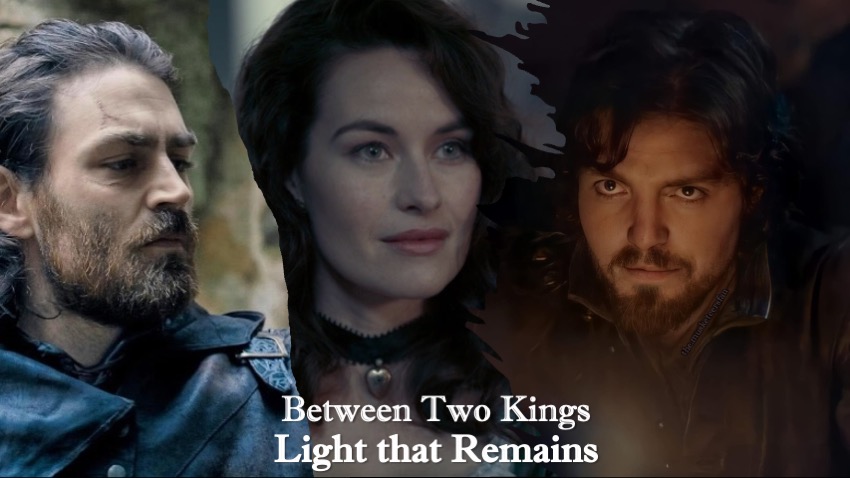
“Agreed. You drive the carriage. But I will be riding right beside you.” Lucien’s patronizing tone should have annoyed Athos once, but he is no longer bothered about such things. There is planning involved in their escape, but besides insisting he drives the carriage, Athos is content that Lucien has taken charge. All Athos cares about, as he climbs onto the coachman’s box and picks up the reins, is Alessandra.
How she is. How he found her.
He had left Lucien on the first floor of Richelieu’s house—their father’s house, a fact Athos has decided to ignore—and raced upstairs, climbing the steps two at a time, driven by unexplained certainty and urgency combined. He questioned neither, even though his entire life he has valued reason. But this was instinct, and as a soldier and a swordsman Athos knew never to question his instinct. The long empty corridor upstairs was flanked by rooms all with closed doors, save one, at the furthest end, from where soft, hazy daylight gently diffused outside. Like Saintonge, Athos thought, his heart sinking, his hand reaching the hilt of his sword. He took a step on the creaking floor, prepared to call out Alessandra’s name, and that is when he noticed the figure standing not far from the open door at the furthest end of the corridor. A small, shorthaired, figure, wearing what looked like a long white linen chemise. A boy, Athos thought, and it made no sense. The boy seemed unsure of his path, clutching an object and brandishing it as though it were a weapon. Athos took one more step and gasped:
“Alessandra!”
Something compelled him to approach her gently, and almost immediately he knew what it was. The dazzling green light of her eyes that had enthralled him since he first met her when he was a boy; that dazzling light, he could not see.
He addressed her tentatively, softly: “Alessandra?”
She was keeping her gaze lowered, blindly brandishing the weapon with a trembling, feeble hand. A dagger Athos thought, but the object was too small and flimsy. A knife? He could not see a blade.
Her voice was unsteady. “Stay back, fiend!”
“Alessandra, it is I. Look at me.”
He could not see her eyes. She kept her gaze lowered, and it alarmed him.
“Stay back, fiend!”
Carefully, he reached for her armed hand. “Alessandra … it is I. It is Athos.”
She chuckled at the sound of his name, and if it was disbelief it was deserving, but Athos did not care about what he deserved. He only cared that he could feel the fever which burned her before he had even touched her. That she was trembling, her hands ice cold, wielding what was a small copper spoon, as if it were a weapon. He seized her just as her knees buckled and she sank to the floor. “Lucien!” Athos shouted. “Lucien! Come quickly! She is here!”
The chamber with the open door at the end of the corridor, from where she had fled did not look like a prison. Comfortable, warm, and clean, with all the curtains closed, dimming the sunlight, except for those at the window furthest from the bed over a table covered with vials—the working table of a physician or a nurse. Athos carried Alessandra to the bed, covering her with blankets. “Alessandra, can you hear me?” he insisted, cupping her face, drawn and pallid, in his hands. “Alessandra, open your eyes!” he pleaded, and demanded, and pleaded again, but to no avail, just as the corridor outside echoed with hurried voices—he recognized Lucien’s—a stampede approaching.
Soon there were others in the room besides Lucien, circling the bed, fussing over Alessandra who remained unconscious. A nurse who seemed very competent. A physician. Dr. Guenaud. Athos did not care to be distracted by the unexpected, almost improbable, encounter, even though the doctor insisted on explanations.
“Your Graces, we meet under the most peculiar circumstances.” Unlike Lucien, who was pushing for the facts, Athos did not care about the circumstances the doctor was so keen to recount. “I am here at the behest of His Majesty. Upon my honor, Your Grace,” the physician was telling Lucien, “I thought this was a matter of discretion that concerned His Majesty given the lady’s advanced…” He cleared his throat. “I was ordered to bring my best nurse. Sister Theophanie works with me at the Hôtel Dieu.” Athos did not care about introductions and recommendations or to imagine the unimaginable implications of Dr. Guenaud’s revelation concerning an order by the King to keep Alessandra in this house. All Athos cared about was that Alessandra was still unconscious despite the nurse’s competent administrations. That Alessandra was too thin, and that her wrists were marked with bruises, the kind of bruises left by ropes and shackles.
“The lady’s lungs are infected,” the physician was telling Lucien. “Being with child raises grave concerns. I suspect the lady would have had a difficult pregnancy, notwithstanding the hardships she must have faced. Thankfully, the child is strong. She is a courageous woman.” Athos swore under his breath. What is the superlative of courage? Lucien had more to say about that and Athos was grateful for Lucien’s anger. He found that his brother’s anger appeased his own, even though Alessandra’s plight was not the poor doctor’s doing. “Someone decided to cut her hair short,” the doctor continued explaining to Lucien. “It is thought to alleviate the effects of high fever even though it makes no difference. More quackery than medicine, if you ask me, Your Grace. Given the state in which we found the lady when we arrived, I can say that she had been starved and imprisoned for some time before she was brought here. You can still see the bruises where she must have been restrained. I fear she has been mistreated. There are cuts and other bruises, but, thankfully, the baby has not been harmed. Her eyes are sensitive to light. She must have been kept in some dark place, most likely an oubliette, Your Grace,” the physician sounded apologetic. “Her eyesight at least is improving.” He sighed. “As you witnessed, yourselves, she tries to flee whenever she is alert, which is not often,” the nurse was nodding affirming the doctor’s sober recounting. “She is too ill to venture far, and the exertion is too much for her. Besides, I doubt that she knows where she is or recognizes anyone. This is serious, Your Grace.”
“We are taking her from this infernal house now,” Athos growled before the physician had a chance to finish his sentence. He pushed the nurse aside, and wrapping Alessandra in the blankets, lifted her in his arms.
“But Your Grace, she should not be moved…” Dr. Guenaud was appealing to Lucien.
“You marveled at her resilience and courage a moment ago, doctor. I am of the same mind. We are leaving,” Lucien said forcefully. He leveled a gaze that spoke of alarm, and something else, familiar from childhood. Athos recognized it also in the warm and fleeting touch of his brother’s hand, before Lucien rushed to the door keeping it open for Athos to pass carrying Alessandra. “Help us find a way to move her from this house. We need to find a carriage.”
“There is a fine carriage here,” the physician said. “It is how Sister Theophanie and I arrived.”
Alessandra is in that carriage now, a large and comfortable carriage, its doors fitted with the family crest of the duc de Richelieu–of all the many impossible things that happened this day, at this estate, in this house—the carriage that Athos insisted he drives. Lucien rides right next to the carriage door, armed, and with Athos’ horse in tow. The mercenary Radu offered to ride with them but only as far as Bressuire for it might endanger them, he argued, if someone at the village or the guards from the watchtowers of Glénay recognized him. This is yet another impossible thing that happened this day, and Lucien, Athos thought, handled it masterfully.
Alessandra travels in the carriage Athos drives, with the doctor and the nurse, and he tells himself there is no safer way for her to travel. She breathes and that is as good as he could have ever hoped.
⚜️ ⚜️⚜️⚜️
“Close the gate!”
Keeping vigil at the opposite ends of the battlements at Glénay, Gasparo and Afonso have already recognized the two riders from a distance and signaled their men to raise the portcullis and sound the summoning bell.
“Close the gate!” Raoul calls the moment he and Marie Cessette have galloped under the archway into the courtyard. He jumps from his saddle hurrying to assist his wife, although she has already dismounted.
They are surrounded by great commotion, not just the men hurrying to obey his orders and the stable boys leading away their horses, but the entire household dashing to the courtyard to welcome them. Marie Cessette finds herself in the arms of her father and mother, embraced and kissed by her sisters and brother and by her aunt and uncle after what feels like a lifetime; a lifetime being a person very different from the one they know. Raoul, too, finds himself welcomed with warmth and joy by his father’s friends, by his aunt, his cousins, and his grandmother. It is one person Raoul seeks among his loving family and friends, and the moment he sees her, he lifts her in his arms.
“Bia!”
Raoul kisses his sister’s pretty cheek, and the little girl wraps her arms around her brother’s neck giggling and breathless with excitement. “You have returned and Papa and Uncle Lucien are bringing Maman! We were in Tatie May’s house with Papa. I love Tatie May! I was making a shell necklace for Maman but then Papa left to find Maman with Uncle Lucien and then he sent word that I have to return to Grandmother’s house, and he and Maman and my Uncle are coming back! We must bring Tatie May and Monsieur Guillaume here too! Then we will all be together and I will Maman my song!” Raoul frowns. He has no idea who Tatie May and Monsieur Guillaume are, but what he understands is that his father and Lucien have launched another quest. He slants a worried glance toward d’ Artagnan, who happens to be standing next to him and has overheard Bianca’s enthusiastic proclamations. “Where is my father?”
“To fetch your mother with Lucien. We are told,” d’ Artagnan replies quietly, and fixing his eyes on Raoul’s, he adds: “We must talk. There is much to talk about, on our end and, I daresay, on yours too.”
“We must indeed,” Raoul replies. He sets his sister on the ground and leans closer to d’ Artagnan, whispering: “We are all still in grave danger.”
⚜️ ⚜️⚜️⚜️
But it is not for a few hours that they can talk. The happy reunion takes precedence, especially because so many children are involved. It is a silent agreement among them, to make sure the children are not frightened. When the makeshift festivities subside, Sophia, Constance, Elodie, and Suzanne announce that it is past everyone’s bedtime. “Yes, even for those young ladies and young gentlemen who expect to be treated like children no longer,” Sophia teases, because she can see the disappointment in the eyes of her son, Olivier, and Charlotte. Rayya on the other hand, Rayya seems eager to go to bed, and has been distracted all afternoon, even when she played the harp. Sophia knows the reason, although she pretended not to notice the sealed letter that Marie Cessette slipped into Rayya’s hands as soon as she had dismounted in the courtyard. Lieutenant Maillard seems to be safe somewhere, safe enough to write to Rayya. What would Lucien think about this, Sophia wonders? But Lucien is not here, and Rayya is no longer a child, even though she is not yet a woman.
They gather in the great salon with the large windows that have a view of the river and the forests surrounding Glénay. After a glorious sunset, the only light left is a simmering purple line over the horizon.
“There is much we can tell you,” Raoul turns to his wife exchanging a meaningful look, “and much that we cannot. We were successful in our cause.” There are sighs of relief all around, but he shakes his head. “Let us not celebrate yet. Henri and his mother are safely out of France. In fact, Henri and his mother never existed. Nevertheless, we, everyone here, is not out of danger. This is most urgent. Our plan kept changing and was haphazard. It worked in the end, more or less, and, that, I suppose, is good enough. But Fabien…I would not underestimate Fabien. He cannot be fooled for long, and he will not take it well that he was blindsided thus, by us, a second time. Not after the Conciergerie.”
“But the Queen Mother, is she not an ally? Surely, Marchal can be reined in. What does Aramis say?” Constance tries to sound hopeful.
“The duc d’ Herblay was instrumental to our plan. We could not have succeeded without him,” Raoul replies.
“Still, he thought our plan was reckless. We had to persuade him, Layla and I. I suspect he agrees with Raoul about the danger,” Marie Cessette adds.
Sophia does not sound satisfied. “And Layla? Jean?”
“Layla and Jean played their part brilliantly or we would not have made it out of Paris. I cannot promise that they are not suspected. Everyone connected to us could be suspected. But with Layla and Jean our plan proved most solid, and I cannot see how anyone might prove they had any part in Henri’s escape. Besides, Louis needs them–he needs Jean in particular–and I can explain that by and by, so it behooves him to protect them no matter what Fabien may suspect. But for the rest of us” he turns to his wife again, “we, all of us, here, we are not safe.”
“The King would not infringe upon lands protected by ancient decrees signed by his ancestors,” Madame d’ Aiguillon counters.
“I hope so. I hope he still sees the advantage of your connections, Grandmother. But what already happened at Royaumont raises grave concerns. How far Fabien will go interpreting the King’s orders, that is what worries me. Glénay is further from Paris than Royaumont and he can avail himself of the distance to wreak his own sense of retribution. Our plan to save Henri and his mother worked but not as tightly it should. There are loose ends. This–here–Marie Cessette and I arriving to bring you this news is a loose end that Fabien could use. Our very presence endangers you, so it is best if Marie Cessette and I leave. We will make our way to Normandy.”
“You two are going nowhere, and that’s that!” Porthos declares. “I speak for everyone here.”
“We have enough men to fight, if we must,” Afonso, always the practical one, interjects.
“And unlike Royaumont, Glénay is defensible,” Yusuf adds.
“Not if Fabien shows up with the King’s Guard,” Raoul objects.
“King’s Guard!” Porthos sneers. “I take it that the Musketeers are…”
“M. Mancini is their Captain now, Father. As expected,” Marie Cessette says quietly.
“Sang Dieu!” Porthos turns to d’ Artagnan. “You have nothing to say about this?”
D’ Artagnan shrugs. “What could I possibly have to say? Is any one of us surprised that it came to this? I am more concerned about the danger Raoul sees.”
“Yes, we must know more, Raoul,” Sophia urges, frowning. “We must plan.”
“Well…” Raoul begins but stops at the clanging of the summoning bell from the gate, and just as Martin, bursts into the salon followed by Jasper, his brother, and Marcello, one of the Rizzo Cousins. The men spring to their feet, reaching for their weapons.
“No, no, Messieurs!” Martin exclaims. “It is not enemies. Our men from the watchtowers are certain about whom they’ve seen crossing the bridge. Lucien…I mean, His Grace, M. le duc, and the Comte de la Fére. They are bringing a carriage.”
“Alessandra!” Sophia has sprung to her feet too, while Raoul is almost at the door.
“Mother!”

 Twelve Years After
Hi Mordaunt, and welcome back! ❤️ ❤️ ❤️
I can’t believe I lived to see this chapter!!!!! Finally! Alessandra is back with us the readers and her family in the story! Thank you 🙂
And that brings me right back to singing my old tune about Alessandra having to rethink her own choices too. Yes, the consequences of her choices are so devastating and tragic to herself, both in Part I and here, that it seems to render the question of her responsibility irrelevant. But the truth is, while Athos right now has decided to blame himself for just about everything that went wrong in their relationship (and to me it feels he goes too far here especially when he thinks he even knew Alessandra would be attacked by his brother and Catherine and still allowed it to happen), Alessandra was not exactly blameless. Especially in this latest catastrophe. Yet the last thing we heard from her on the matter in that parting letter was that she regretted none of her actions. So I kind of hope she realizes she also has some room for growth in their relationship! Maybe Francesca can get this message across gently 🙂 Because I don’t see who else can – Athos will be happy to wear his hairshirt for the foreseeable future (and with good reason), but he alone cannot make it work between the two of them.
I wonder if Fabien has something else in mind than to attack Glénay. It sounded a lot more devious the last time we saw him. Can’t wait to see what it is!
LikeLike
Hi Dinny. It is great to see you back. Very good points, as always.
We do not know what Alessandra is thinking. We have not been “in her mind” besides one chapter and that has been intentional given this main storyline and arc, which we have been building for some time, beginning in previous “books”.
The way I see Athos, at least the way we write him– and, of course, we have no control over how he is perceived by readers–is that he is past blaming, guilt, and atonement. He has done all that, and through all kinds of crises, some inherited from Dumas and the BBC series, some self-inflicted, some inevitable, and other purely accidental (as life would have it), pre-hiatus he reached a moment of clarity. He makes a case to d’ Artagnan about this in a following chapter–again, we have no control over how the case Athos makes in that chapter is perceived by readers–but that is how we write him. He is still the same principled man, who places value in duty and loyalty. This has not changed. In our story he is portrayed as a man who reflects and learns. Our intention was to write him as a character rather than an archetype, which means that he has moved on. On my end, I am intrigued and cannot wait to see what he has in store for us (the writers).
Regarding Fabien: he understands self-preservation and survival better than most, given his background, but he is also ambitious and at the moment he has made the choice to follow Louis even if that means follow him over a cliff.
Thank you for the great comment!
LikeLike
Hi Mordaunt, and thank you for your response! If I may offer my perspective as a reader, I do see that Athos as a character reflects and learns, but to me moving on means closing a chapter once and for all, I see it as a more fundamental process than just working through his guilt for this particular episode. And here I don’t think he can do that (or has a moral right to do that, in fact) until Alessandra’s fate is clear and until they make a decision about their future. He can’t even be certain that she and the baby will live at this point, and if they don’t, he will somehow have to face the fact that he is responsible for that too, at least to some extent.
Also, with regards to the past, Athos cannot be sure he has got to the bottom of their problems, or rather, his problems with Alessandra: as you subtly mentioned in passing in the chapter “The Past Is a Foreign Country”, deep down he realizes that as an adult he keeps punishing her for something that happened when they were children, but that he cannot remember yet. (In fact, in The Florentine Conspiracy, in one of his dreams that are also memories he relives a feeling of crushing loss caused by “her” leaving them, even though “she” promised she would not leave. When I read it for the first time, the automatic assumption was, of course, that “her” was his mother, but with the context you have given us since it is quite possible it was Alessandra whose departure hurt him so much). Looking back at the previous times when Athos seemed to have learned from his mistakes only to double down on them the moment he felt Alessandra deceived him or betrayed him, I am not sure he has really moved on from what is at the roots of their troubles in the sense that I attribute to the words. It is really “layer after layer”, and it seems to me he is still not quite there yet.
Finally, I think that to really move on (even if it is from this episode with her abduction only), he needs to be forgiven by Alessandra. Even if she doesn’t want to be with him anymore (even though I can’t believe she can resist him for long – she never could), he still needs to be forgiven and truly forgive her. So when I mentioned his hairshirt, I didn’t mean I expect him to be torturing himself endlessly, but I do think there are quite a few things that need to happen before there is “moving on” in my understanding of it 🙂
LikeLike