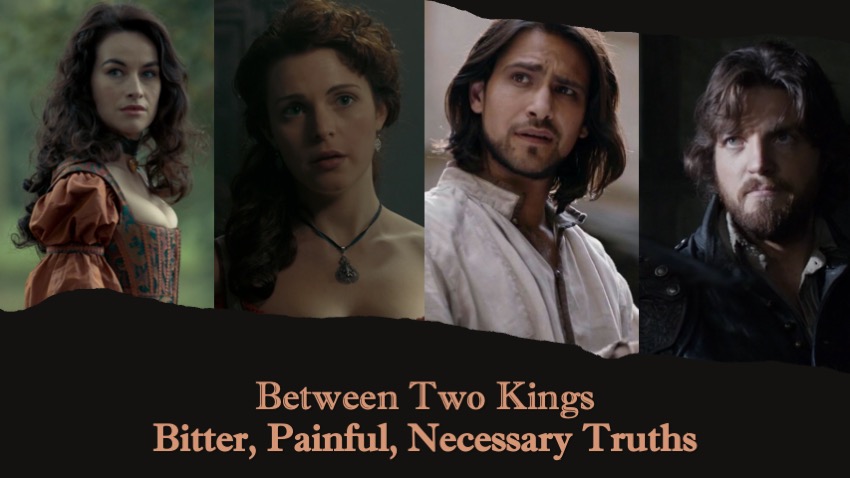
Constance knows she is not needed. Milady–Constance cannot think of her by any other name–is in the care of two doctors, two midwives, a nurse and those closest to her: Sophia, Elodie and their daughters, Marie Cessette who is her daughter-in-law, even the duchess d’ Aiguillon who holds masses for her twice every day in the chapel. How can anyone feel close to Milady Constance cannot fathom, but none of these women know Milady–the real Milady–for as long and as well as Constance does. And those masses, which Constance feels compelled to attend as any good Christian woman should, are futile in her eyes, because the Milady she knows, unscrupulous and unrepentant, would scoff at their prayers.
When Constance asks herself why she is in the woman’s sick room, the answer is always Athos. Athos who does not leave this room except for the few hours he spends with his daughter; Athos, who eats very little and sleeps even less. Who has endured adversity after adversity for the sake of this woman, with so much courage. When Constance shares her grave concerns about Athos with Charles he replies that in Athos’ place he would do the same, for it is what an honorable man would do. The answer vexes her because Milady is not the sort of woman who deserves the sacrifices of an honorable man. It vexes Constance too that Charles evades. She can hear it in his voice and see it in his eyes that he knows more than he tells her, and this, while she shares the truth with him without hesitation.
Charles seems captivated by the woman, why, even went to battle for her, he and the others. Constance said nothing at the time, they were determined, and Constance knows when she can push Charles and when he will do what he has decided no matter what she says. Sometimes Constance feels that she is the only person in this crowded house who sees things as they truly are. ‘This is Milady de Winter’ she wants to cry out at times, even though everyone appears to be as duped as Charles.
Yes, duped.
If she must be honest, this is what Constance believes. Milady is ill, but not as ill as she wants them to think and how she dupes two doctors, a nurse, and two midwives, Constance cannot imagine, but the woman is Milady after all. It is Athos that Milady means to torment with her duplicity. Athos, who is always inclined to do the right thing, never thinking about himself unlike his wife. When it comes to Bianca, Milady cares about her daughter as little as she cares about everyone else. No mother would abandon her daughter as Milady did, and soon after the little girl was kidnapped, to seek revenge against Rochefort at Saint-Fargeau befriending Agnes Bernard under an assumed identity. This is not what mothers do, even if Rochefort is a fiend. Besides, Constance has found it difficult to think of Milady as anyone’s mother, even though she likes Raoul and adores Bianca. All the goodness in Milady’s children comes from Athos.
It pains Constance to see Athos pale and haggard, his handsome features drawn. He deserves a happier life, she thinks. He stays with his wife day and night, holding her hands, tending to her as no man should, reading, and speaking to her while she exaggerates her ailments to keep him tethered and remorseful. Constance does not care to eavesdrop but, a few times, when the woman was awake, she kept asking about Raoul and Bianca–it was a well played hand, Constance thought–and then she spoke of someone called Francesca. ‘I saw Francesca’ she repeated, and Constance remembered that she had heard the name from Bianca but thought that the little girl only imagined an older sister, having been raised without any children her own age.
The performance on Milady’s part is very convincing, from the delirium to the labored breathing, and it angers Constance that she is the only one who can see through the deception. If there is indeed real plight, the woman selfishly brought it upon herself and that is that. It was not Catherine de Renard and her son, not even Rochefort. Milady brought all this upon herself with reckless actions, so unbecoming for a woman, and Athos and her children, her unborn child too, are tormented and suffering.
This is what Constance tells herself during the day. At night, she falters. Perhaps it is the calm that envelops this house. It has been many years since Constance lived in the countryside, at her mother’s house. Paris is where she has lived most of her life, and Paris never sleeps whereas the nights at Glénay are strangely quiet, except for the distant howling of the wolves in the forest. The silence unnerves her, sometimes reminding her of the sordid house at Saint Dennis where she and Alexandre had been kept prisoners. Mostly it unnerves her that at night, when Charles, Alexandre, and Juliette are asleep, she finds herself alone with her thoughts and with the one sore point which the demands of a busy day help her ignore: did she have a hand in this–not in Milady’s plight, she has no sympathy for that— but in Athos’ despair and the pain inflicted on his children?
“Constance, is something wrong? The children…” d’ Artagnan sits up in bed blinking and rubbing his eyes.
“No, no, Charles. It’s nothing. Go back to sleep.”
“What is it?” he insists. “Is it your mother?” He rubs his eyes and stretches. “Your mother arriving here so unexpectedly? She is truly a daunting presence. More than the duchess. To me, at least.”
She replies with a faint chuckle without turning her head. She has not thought too much about her mother arriving, and is content with the explanation that it was an opportunity to finally see her newborn granddaughter and her grandson whom she has not seen since he was a newborn himself. There is more to her mother’s visit, of course, that is why Benoit is here and Lucien probably already knows about it. Constance would rather Charles went back to sleep. She’d rather not talk about what really bothers her, but he insists.
“Is someone out there?”
To her dismay, he stands from the bed with a blanket which he wraps around her shoulders and peeks out the window, where she has been standing.
“What’s out there? It is cold, come back to bed.”
“Not yet, I just…”
He walks her to the settee across the fireplace and stirs the embers, throwing in some kindling so that the fire flares. “Better?” She nods.
He sits next to her. “Now, what is it?”
She draws in a deep breath. “Athos. I worry about Athos.”
He raises a brow that signifies that he is not surprised and shares her concern. Still he says: “Athos knows himself, Constance. Here, he is surrounded by his family.”
“We are his family!”
He smiles, pressing her hand. “Of course we are.” Something about his soothing tone vexes her.
“We have known Athos longer than many in this house. You have known him…”
A shadow crosses his eyes. “Athos is a private man,” is all Charles says, but his tone is stern which means that she has hit a nerve, so she pushes.
“They had a daughter before Bianca, before Raoul I think. Did you know?” He didn’t, and from his deepening frown, Constance can tell that the news is not only unexpected but disconcerting, so she pushes more. It vexes her that he is not as honest with her as she is with him. “You know, what happened between them, don’t you? What she did to him!”
“I know nothing,” he lies.
“That is not true. Why are you protecting that woman? Why do you not trust me with what you know?”
He springs to his feet. He keeps his voice quiet but she can feel his anger. He jabs his finger in the air as he speaks, and it is unlike him. She has not seen him this angry before. “I will not pry into another man’s life! It is none of my business and it is not yours!”
She will not be shamed by some trite pretext of propriety. And she does not like his tone or his finger jabbing, so she reciprocates. “This is about Athos, not some man with whom you exchanged niceties at court. This is the man you call your brother! What sort of brother are you? This is about what that woman did to him. What she does to him still. And don’t tell me that it has not crossed your mind. She is an artful manipulator.”
“She is very ill.”
Constance chuckles dismissively. “No more than I was when I gave birth to Juliette. And yes, I know she was there to help me, but not without calculation. Everything she does is calculated. Now she plays the part of the victim so perfectly because she knows the honorable man that Athos is. She will make him forgive her for everything.”
“She was abused and kept in an oubliette for months. You heard Dr. Gueanaud,” Constance cannot help rolling her eyes. “Do you say that she inflicted these abuses on herself?”
“Did she not place herself in that position? And for what? Some scheme against Agnes and Henri? Her personal little vengeance? Did she ever consider her children or her husband in her scheming? Look at all Athos has done for her! He even challenged the King! I cannot believe you are defending that woman!”
Charles narrows his eyes, as if he cannot believe what he hears. “The vengeance was Catherine de Renard’s.” He takes a step closer, his voice quivering with anger. “I heard the fiend when we captured her at Saintonge. I heard her vicious rantings, and now… now, God forgive me… Constance, you sound just like her.”
“I had nothing to do with Catherine de Renard!” The words slip out of Constance’s mouth before she has time to think about them. “I mean… I didn’t…”
He gasps. “Constance! What did you do?”
Her heart sinks, for here it is–and just because she could not hold back her big mouth–that sore point she refuses to acknowledge. “I did nothing!”
He sinks next to her on the settee, stressing every word, his voice unnervingly calm. “What did you do?”
But Constance will not be intimidated. Certainly not for Milady’s sake. She tells him everything: how she shared Catherine de Renard’s concern for Athos, how she abhorred the way in which Catherine de Renard was treated at the soiree, and what she said to Catherine de Renard that night. Constance has never put the story together before, only fragments of it, and now that she tells it, it sounds bad… it sounds terrible… She was so eager to embrace any enemy of Milady… Was she so gullible or so blinded by her resentment? It is the sort of thing Milady makes you do, Constance thinks, and is horrified because this is exactly what Catherine de Renard would have said. Charles is right.
He rakes his fingers through his hair, letting his head drop. “Mordieu, Constance!”
“Well… If they planned to attack Milady they did not need me to tell them when to do it. They’d have people…spies…”
He raises his hand. “Stop. Please.”
“Charles, I only told…It is not as bad as that, surely?”
He shakes his head, despondent, “Yes it is. It is very bad.”
She jumps to her feet, and begins pacing the room, Charles’ harsh words sinking in, his profound disappointment too, the part of her that is certain her actions were not significant now crushed, while the other part of her, the part she had managed to keep silent, castigating her for her bigotry. But Constance is not one to wallow in self-recrimination. She stops pacing. “I must tell Athos,” she announces.
“Mordieu! No! Never!”
Charles makes no sense at all.
“I must!”
He jumps to his feet too and seizes her hands. “For the love of everything that you and I hold dear and sacred, Constance, I beg you not to!”
“How can I not?”
“Think! What do you hope to accomplish with such a confession?”
What Charles demands of her is as dumbfounding as it is jarring. “I will not lie to Athos! I am nothing like his wife. That’s the sort of thing she does! Charles, how can you ask me to do this?”
He throws his hands up in the air, swearing under his breath. When he speaks to her again his voice is quiet, his tone stern and deliberate. It angers her that he speaks to her in this manner. “You will say nothing about this to no one. No one. I am not asking. I am telling you.”
He dresses quickly and seizes his doublet and sword from the chair where he had left them. “It’s almost dawn. I will be with the men fortifying the west wall,” Charles says but she knows that he is too angry to be in the same room and her heart sinks. To fight such a bitter fight with Charles, for Milady! To have to lie to Athos! No, Constance thinks, I am better than this.
⚜️⚜️⚜️⚜️
The hallway outside Milady’s room is still dark and Constance is surprised to see the maid already there and whispering to the nurse who stands at the threshold, keeping the door ajar. Constance attempts a fleeting smile and the nurse acknowledges her with a faint bow, continuing her instructions to the maid. “Is ….” Constance sighs for she must play along with this charade. “Is Madame better?”
“She took a bad turn overnight,” the nurse replies in her businesslike manner and motions to close the door but Constance stops her.
“M. de la Fére… Could I speak to…I will understand if he is not…”
The nurse looks annoyed. “They are in the library.” Once again she motions to close the door, and once again, Constance stops her.
“They… who?”
“Dr. Prujean, Dr. Guenaud, Madame and Mademoiselle Bourgeois, the Comte, and the duc du Plessis,” the nurse replies as politely as she can muster, finally closing the door.
Constance is not dissuaded, even though she finds herself walking timidly down the hallway, grateful for the dim light, trying to make as little noise as possible.
“Never!”
Athos’ voice echoes in the silent hallway, and Constance almost jumps, barely able to hold back a loud gasp. She moves closer to the wall, not far from the library door, leaning against a wooden pilaster that frames one of the rectangular niches decorating the entire length of the hallway.
There are voices coming from the library, some sort of intense argument. Constance recognizes Lucien’s voice too.
“Never!” Athos repeats, his voice resonating above the rest. “I will discuss this no further. I will not butcher my wife!”
Carefully, Constance takes a step back just as the door of the library opens and Dr. Guenaud and Dr. Prujean step into the hallway alongside Madame Bourgeois and her daughter. They are immersed in tense deliberation, so much so that Constance remains unnoticed, obscured also by the long shadows and the dim light. They walk past her, toward Milady’s room, and Constance sighs relieved. Behind the closed library door, she can still hear voices–Athos’ and Lucien’s she surmises. They are speaking quietly and she cannot distinguish phrases or words. Then the library door opens once more and Constance slides even further into the narrow niche lest she is seen. It is Lucien who exits this time. He closes the door behind him, and pauses for a moment leaning with his hand against it, running his fingers through his hair. Then he straightens his back and walks away toward the other side of the hallway perhaps to join Charles at the fortifications.
The hallway is once again silent, but now the bright daylight floods in through the windows and she can hide no longer. No more lurking in the shadows, she thinks. She draws in a deep, determined breath and clenches her fists. She will neither hide nor shirk from the truth.
⚜️⚜️⚜️⚜️
“Enter!”
Constance finds Athos standing with his back turned to the door, shifting through the pages of a book that is opened on the desk before him, some kind of medical book she reckons from that distance. He turns and blinks as if she is the last person he expected to see.
“Constance?”
His voice is gentle and she is struck by his drawn features, his handsome eyes deep-set, speaking of vigils fraught with despair and anguish. “Is everything alright? Are you coming from Alessandra? Is she worse?” It pains Constance that his every thought centers around this woman, the cause of his suffering. The sight of him strengthens Constance’s resolve, for friendship is based on trust, and trust depends on truth, which is the only cure for the pernicious evil that surrounds him.
“I don’t know how she is. I… I came because I wanted to speak to you, even though Charles warned me not to disturb you. But I feel I must.”
He attempts a faint smile and leans with his back against the desk. “Of course. Please.” He points to a chair but she refuses.
It is only when faced with his gentleness that she falters and Charles’ angry words return: ‘What do you hope to accomplish with such a confession?’ She pushes back Charles’ stern warning together with all her doubts. “I have a confession to make,” she begins.
Athos listens to her recounting of events, her admissions, her explanations, her suspicions and concerns. You deserve happiness, she tells him, you deserve so much more than this suffering. You deserve someone like Sylvie. He listens in silence, his demeanor as impervious as she has always known him, and when she has finished, he asks her the same question Charles asked:
“What do you hope to accomplish with such a confession, Constance?”
It is infuriating. What is it that these men cannot understand? “I want to prove that I am truly your friend who loves you, and, if I made a mistake, it was done with the best intentions. It was done because I want what is best for you.”
“I hope you have unburdened yourself then. Although I would recommend one of my mother’s priests,” he says.
She is taken aback by his disdain. She has never known him to be disdainful. But it is his gaze that gives her pause: gray eyes, unyielding and cold like steel. The eyes of a man Constance does not recognize. His tone too, is harsh and unforgiving.
“You are never again to go anywhere near Alessandra. She has no need of whatever services you purport to offer her,” he says as he motions to the door, not even deigning to look at her.
“Athos?” Constance whispers, dumbfounded. “Athos, please… Are you angry with me?”
He pauses at the half opened door, and turns, fixing the same unyielding, cold eyes. “I am more angry at myself. You see, I failed to protect Alessandra from people like you,” Athos says and steps out of the library, closing the door behind him.

 Twelve Years After
At last Constance found it in her heart to make that confession! I was already beginning to think everyone will find out from Catherine – and no matter how harsh everyone’s reaction is going to be now, it would have been unimaginably worse, if the information had come from Catherine.
It is interesting how the understandable mistrust and dislike of Milady that Constance felt have since developed into some sort of idée fixe. I understand it is also her defense mechanism that shields her from the feeling of guilt that would probably hit her otherwise. But she does sound like Catherine at times. Especially as her grudge is almost just as old. I have no idea if Athos’ reaction is going to accomplish anything here though, in terms of helping her realize just how unfair and simply wrong she is. Constance probably needs to hear the full story of Alessandra’s life to reconsider, but I don’t see how she can find out if she is so sure she already knows everything of importance and never cared to ask.
I was happy to hear that Alessandra is seemingly no longer completely disoriented, if she remembers who her children are. And she did not banish Athos from her room either! (Which is what I thought she might do the moment she regained consciousness. In fact, she might be thinking he only found her because of the child and only to take the child away from her when it is born). Very promising developments, and I can’t wait to see her POV once again!
LikeLike
Hi Dinny, and thank you for another great comment!
Constance in this story derives from the BBC character. I believe, they did a marvelous job imagining the character given the Dumas original, where she is written according to a specific archetype, the virtuous/angelic damsel in distress. Constance is purely a Dumas invention and does not exist in his source material, the Courtliz-Sandras d’ Artagnan Romance. Dumas writes her to counterbalance Milady, who, albeit not a major character in the d’ Artagnan Romance is derived from that original source. There she is called ‘Miledi’, she is English and is only involved in one “event”/ adventure of the young d’ Artagnan; her role in the Romance is nothing like in Dumas. Perhaps some other time we can talk about how she develops from that source material.
There is no source material for Constance besides audience and publisher expectations for the genre that Dumas writes which is the serialized novel, a kind of pamphlet. Despite the fact that Dumas writes for a genre that demands these archetypes and the tropes that go with them (e.g. the she-devil vs the she-angel) he still breathes in life into this character allowing the BBC writers to do the rest, esp. in seasons 1 and 2. It is not a spoiler, I hope, that Constance is poisoned by Milady in Dumas, which “tips” the balance leading to Milady’s execution. In one “reading” of this part of the book, Constance could be seen as a literary device because the execution is the point: it is the ultimate “glorification” of that cavalier/swashbuckling/male-camaraderie spirit that the book is meant to be about. Milady threatens that and it is not a coincidence that her execution is written as if all of nature rebels against this “unnatural” woman. I believe there is a relevant quote in the text itself, in case any reader doubts the point Dumas wants to make and the readership wants to read about. By the time of her murder too, Constance has (somehow) lost all and any of the spunk that Dumas infused her with in the first part of the book: she is a novice in a monastery and seems and sounds strangely gullible for a woman who, a few months prior, was involved in some of the riskiest court intrigues. But what Dumas needs is a crime for Milady that is so unjustifiable to warrant the kind of death he has in store for her–and that death is the point.
In other words, poor Constance in Dumas moves from archetype, to a potentially interesting “mate” for the main hero, to a blatant literary device. The BBC writers seize onto the “potentially interesting mate” part and build a character around it, that we absolutely love. Because Milady is so very different in the BBC series too, and there is no need for an execution to assert the male camaraderie, not only do they keep both these female characters living throughout but the BBC writers build a dynamic between them which does not exist in Dumas. Worth noting is that the BBC series kills Bonacieux, Constance’s husband, thus releasing her to marry d’ Artagnan, whereas Dumas keeps old Bonacieux alive. Not only that. Dumas brings him back in Twenty Years After, as a mendicant outside Saint Eustache and a leader of the Fronde in the streets (not unlike Flea in our story). I hope it is not a spoiler that d’ Artagnan kills him by mistake/in the course of a battle (variation of the battle of Saint Antoine) which he does not really want to fight (against poor hungry people) but he is forced to. Personally, I always found this “development” of the old Bonacieux one of the most implausible character developments in Dumas.
We used the BBC Constance character as the springboard for Constance in this story, and not Dumas’ Constance. We decided to build her backstory based on the hints from the BBC series, and give her–we hope–a few more layers that are consistent with the BBC source material but are not in the BBC source material. Our Constance, therefore, is likable–we hope!–she is loyal and direct and her intentions are generally good, but she can be a busybody. She can be bigoted. She thinks of herself as “good” and justified because “she is one of the good people”. Here she feels that she has a “claim” on Athos’ life–almost proprietary at moments–even though she is ignorant of a great many things, and there have been enough hints that she is ignorant, but she ignores them. In fact, she was duped by Catherine de Renard who manipulated her, using Constance’s “claim” on Athos and Constance’s consequent dislike of Milady, both of which Catherine could immediately recognize because she felt and expressed them in the superlative. So of course she “spotted” Constance immediately and knew how to manipuate her. Constance self reflects, but unfortunately, only up to a point. In other words, she is limited. She is not evil, she is a good person who can go only up to a certain point and no further. In discussing her character with Corso, we realized that we love such limited characters because they hold so much truth, precisely because they can never “break out” of their limitations. We both immediately thought about the character of Mary Musgrove, Anne Elliot’s sister in Austen’s Persuasion and it is characters like Mary Musgrove that make Austen’s stories the masterpieces they are. We do not have such high aspirations here, only to entertain!
I am not sure that Constance can hear the true story about Alessandra, and I don’t feel that she should. I cannot see either Athos or Alessandra or Lucien or the duchess d’ Aiguillon sharing such a private story with anyone, especially with Constance. But there is a role for her in the way this part of the story unfolds, and … it is coming up soon!
Thank you again for the great comment!
LikeLike
Hello Mordaunt, and thank you very much for sharing the thinking behind your and Corso’s Constance! She does come across as someone with limitations that she can’t break out of. If only she didn’t double down on them sometimes! I mean, she seemed genuinely surprised that Athos did not appreciate her half-hearted confession that managed to be another accusation at the same time! Did she expect him to say “Well-done, Constance! The two of us did such a good job on this one”? 🙂 I do hope he gives her some more of his patented Athos-in-anger treatment before things get better!
I wonder if the role that you have in mind for Constance in this part of the story somehow involves Catherine – it would be a nice symmetry if she did something to undermine Catherine’s plans (as I am sure Catherine will escape and try to wreak havoc again) after involuntarily helping her before.
LikeLike