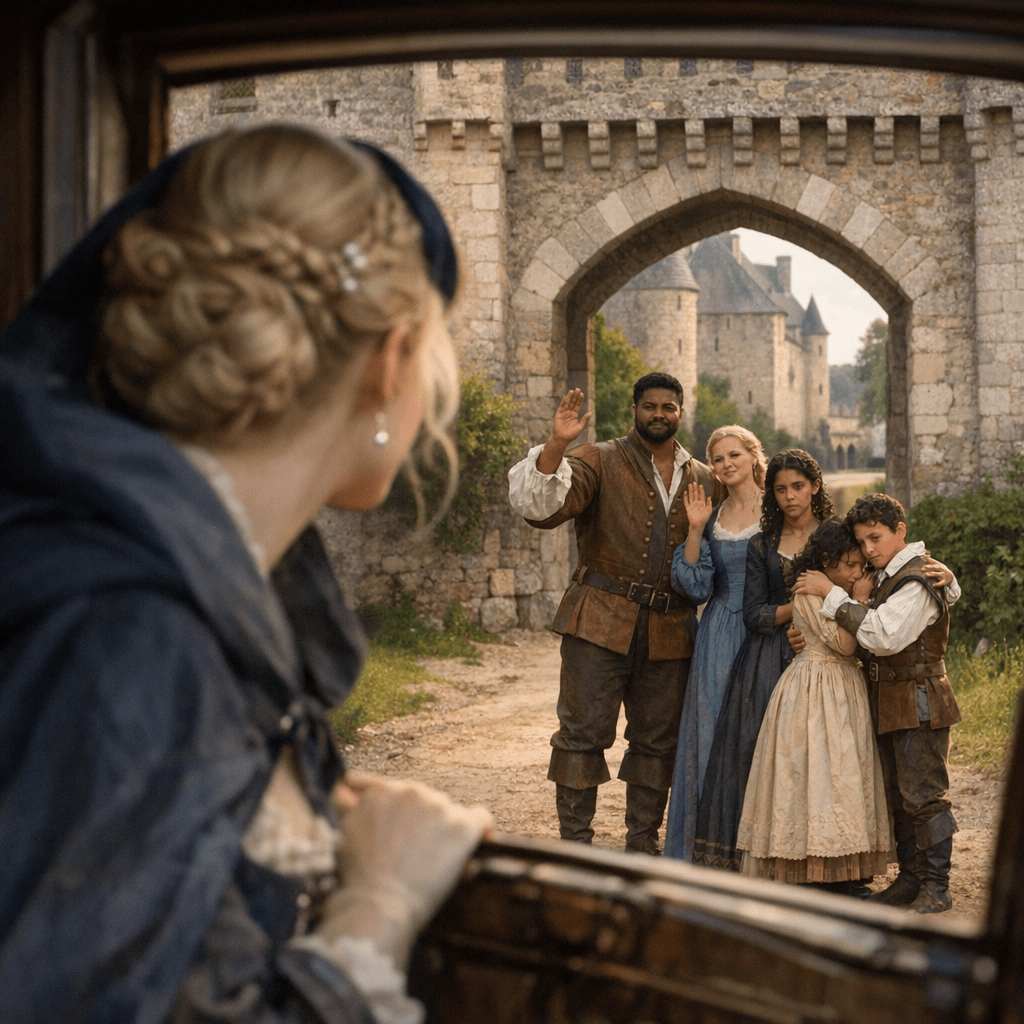
Leaving Glénay is not easy. There is too much uncertainty for those Raoul and Marie Cessette leave behind. There is too much uncertainty for the two of them also, even though neither has revealed the true extent of their concerns to their loved ones. At the courtyard of Glénay they say their last farewells, full of promises for a happy reunion but also full of tears.
Renée weeps in big, loud sobs that echo in the courtyard despite the crowd and the commotion, whereas Charlotte bites her bottom lip and blinks to mask her tears. Olivier stands between his two sisters, serious and sober, his arm lovingly wrapped around Renée’s heaving shoulders–my courageous, steadfast little cavalier, Marie Cessette thinks admiring her brother, and her heart sinks thinking how she must part from them. Facing her father makes departing even worse. Porthos keeps Marie Cessette in his embrace, refusing to let her go. “I understand that Raoul must return, but why must you? You must remain here, with your mother, your brother and your sisters.” Porthos understands his daughter’s plight and her uncertain future, and so does Elodie. But neither parent will speak about their fears to each other or to anyone else, nor will they give voice to vague presentiments.
Marie Cessette embraces her father tenderly and kisses him, and then climbs into the carriage. She waves from the window: “Beloved Papa, we will meet again soon! Dearest maman, my darlings Renee, Charlotte, Olivier, until we see each other again!”
Something about her promises feels hollow, however, and the unsettling feeling, combined with the last memory of her family standing at the open gate of Glénay, waving goodbye, will haunt Marie Cessette during their entire journey back to Paris and for many years to come.
⚜️⚜️⚜️⚜️
Louis momentarily stands in the stirrups to take a better look. “An elegant house and a beautiful estate,” he extols. He rides his gray Arabian purebred Pegasus, which he prefers since the arrival of Salih Bey, the sultan’s envoy, to court. Pegasus was one of the sultan’s gifts to Louis as soon as the sultan, Mehmed, had ascended to the throne after his father, Ibrahim, was overthrown and murdered. “From one hunter to another,” the sultan had written to Louis, who was Dauphin then, and this is how Louis customarily signs his letters to the sultan, and how he refers to him, a show of affability and friendship, in the presence of Salih Bey, his envoy. After all, the young sultan is known as Mehmed the Hunter.
On the plateau below them, the chateau of Bourron-Marlotte simmers in the morning sun, its neat blooming gardens spreading to the river.
“It is my small private retreat, Your Majesty,” Rochefort says humbly, bowing from his saddle, “still, and if Your Majesty does not mind the modest surroundings, I would be honored if you graced me with your presence soon.”
“We must indeed,” Louis says. “Her Majesty arrived yesterday at Fontainebleau. In a few weeks’ time, after Easter, when We join her with the court, We shall be neighbors, Comte.”
“I will be honored.”
“We have much to discuss regarding our agreement,” Louis says in a business-like manner. “Your return has caused a stir already.”
“I do not care for this to be known.”
“It is not entirely possible to keep it a secret,” Louis observes. “Certainly not from Our Mother–I would never underestimate her–and she has strong opinions on this matter and every other matter.”
“As she must,” Rochefort remarks coldly.
“There is always nuance and gossip. You have been to court long enough to know this.”
“Still, I prefer to remain…”
“In the shadows? Yes, and your request shall be honored to the extent that it is possible. On the other hand, it poses certain practical difficulties. Perhaps assign a proxy? The Cardinal seems eager.”
“I trust no one in that respect and neither should you,” Rochefort says sternly.
“And yet, We have placed Our trust in you,” Louis counters. “But then, of course, Our exchanges are not about trust, are they? They are about a good bargain, and so far, this appears to be beneficial to both parties.” Rochefort nods approvingly. “Still the King must have counsel.”
“The King must have good counsel,” Rochefort stresses ‘good’.
Louis raises a vexed brow. “You do not approve of the counsel We receive?”
“No, I don’t. You surround yourself with relics, opportunists, and sycophants, and banish those who would benefit you greatly, including some of those you have come to perceive as your enemies.”
“Condé, you mean?”
“Condé is one of the relics. He shall return to France not only contrite but ready to serve you, no longer a worthy political adversary.”
“Ah! you approve of your son’s appointment for the task, then?”
“Of course I approve. And it astonishes me that a man whose merit has been proven in deed and action has not been put to better use all these years.”
“And here We are, under the false impression that you detest your own son,” Louis scoffs.
“This is about the King’s counsel not about my long-standing family grudges.”
The King narrows his eyes, seemingly baffled. “Do you count Our Spymaster as good counsel?” he adds in a deliberate tone.
“I mistrust all and every Spymaster, even though they are a necessary evil.”
“And yet you have been one.”
“That is why I mistrust them.”
“Alright,” Louis insists, still baffled. “If it is not Condé, then whom have We banished that should return to the royal council?”
“Tsk tsk tsk,” Rochefort clicks his tongue disapprovingly. “You already know the answer.”
“D’ Herblay?”
“Not just d’ Herblay. Also du Vallon, d’ Artagnan, de la Fére, and the duc du Plessis.”
“Your mortal enemies!” Louis chuckles vexedly. “This is good. Very good, Comte. You are using the King to bring your enemies closer to you. And this, while your ships fight against the ships of the duc du Plessis.”
But Rochefort does not seem entertained. “First, let me assure you that I can reach my enemies whenever I please. As for the duc du Plessis, he and I are now on the same side. Your side. In other words, he and I now fight only against Your Majesty’s enemies. This has nothing to do with my enemies. These men have served you loyally. So loyally that they have been ready to sacrifice even their own to defend your secret. They remain loyal, and despite your persecution of them, they are still eager to serve you.”
Louis frowns. “You do not mince your words, even to your King.”
“It is best if we understand each other. Besides, I have served kings before you and men like Richelieu, who were more powerful than any king. They are all dead now. I do not fear you either, and I have made my reasoning perfectly clear. I am who I am and you are who you are, and I do no mean the King of France. This is the sort of counsel you should expect from me: blunt, direct, and from the shadows.”
“De la Fère is a Frondeur!” Louis protests.
“De la Fère brings you Venice. And there is more to the man, as you will find out soon. You have forced their hand and the actions of your brute–what’s his name, Fabien Marchal?– have placed you in a weaker position. And for what? You should never have cornered them as you did. All of them!”
“All? Ah, you mean that We forced the duc du Plessis to help them? Indeed, that was unexpected. After all, he was their enemy.”
“All. By that I mean Richelieu’s family. This is what you will find out soon.” Louis looks astounded. “Well, you might as well hear it from me,” Rochefort sighs. “They are Richelieu’s family. De la Fère is the elder brother, the duc de Richelieu. Lucien Grimaud, or rather, the duc du Plessis is the younger brother. In other words, and since you asked me about him, your Spymaster is Richelieu’s grandson. His grandmother, the great duchess d’ Aiguillon, brings you Rome as well as the colonies and missions she has been financing in New France, in Madagascar, even in China. You have a fleet now. My fleet and her son’s. In effect, before you now, lay open the same possibilities that exist for the Dutch and the English. But, unlike the Dutch and the English, you wield the sort of power that only Spain and the Emperor can rival. The Emperor is weak, and Spain is bankrupt and without an heir. Do you see now? Do not squander this opportunity. Act as it befits the kind of King only you can become. A King like none other in history.”
“Raoul has said nothing about this!”
Rochefort shrugs. “That is why I don’t trust Spymasters. But perhaps he does not know yet. Sometimes a man, no matter how inquisitive, can be blind to the secrets of his own family. It signifies nothing. You are a King who aspires to rule the world, not a fish monger at the Poissonnieurs, bartering in gossip and mired in pettiness.”

⚜️⚜️⚜️⚜️
The room is too large, too airy, and too bright, its tall, arched windows offering a view to the Carmes Déschaux and the Luxembourg gardens. Fabien Marchal tells himself that he is not used to a room so stately and formal–Treville’s old office–and not the office at any garrison but at Treville’s old townhouse which now belongs to Fabien. Who’d have thought that the bastard from the Court of Miracles would have this view?
Fabien shifts uncomfortably in the chair. He reminds himself that he has been in the saddle for too many weeks, outmaneuvered by the noble scion who once was his friend, the Spymaster who commits treason with immunity, and if it is the noble scion or the scion’s cheating wife who committed treason first, it is all the same to Fabien. The noble scion is also a foreigner and no longer a favorite, and the cheating wife is one of his many blind sides given his family and connections. The noble scion has too much to lose and he, Fabien, has found his leverage with the masked prisoner, who is not Henri Bernard.
Fabien swears under his breath as he keeps shifting. The fine chair at Treville’s desk is damn uncomfortable. Fabien tells himself that it must be that he is not used to chairs as fine-cushioned as this one. Even at the garrison, when he was Captain of the Musketeers, he preferred his stark, sordid lair in the crypt below the Captain’s office. There are dungeons in the bowels of this great house too, he made sure to arrange it, but it is this office, large, airy, bright, and comfortable, that he must endure.
“That is not the right face.” Bontemps, the King’s valet has walked inside unannounced and with a doublet of the finest wool draped over his arm.
“You don’t like my face?” Fabien growls, ready to take offense.
The valet shrugs. “A man who serves the King, as you do now, should maintain a much better face at all times.” Bontemps sets the doublet on the desk. “Of course, I am not your valet. My father was a nobleman and in the service of the King’s father, which is our family legacy. I serve no one but His Majesty. I happened to be at M. Carret’s, for my own purposes, and overheard from his assistants that you commissioned a doublet. I volunteered to deliver it. I thought it would be an opportunity for us to…”
“No, no, no!” Fabien stands from Treville’s uncomfortable chair clicking his tongue and wagging his finger, his tone threatening rather than playful. “That is not how it happened. Do you have spies everywhere, Bontemps, even at my tailor?”
“Doesn’t everyone who is concerned with the King’s safety? I am His Majesty’s valet. No other man is closer to His Majesty besides his confessor and his physician.”
Fabien smiles a lopsided, cunning smile and crosses his arms over his chest, leaning with his back against Treville’s desk. “Do they report to you?”
“No, but I am sure they report to someone. To the Venetian, I presume.”
“So this is what it’s all about, isn’t it? Normanville.”
“Only if you would like it to be.”
Bontemps speaks with the kind of aloofness and contempt instilled since childhood, and particular to those in royal service. Another kind of scion to contend with, Fabien thinks. “You don’t like him,” he observes.
“His Majesty trusts Normanville with a powerful position that is most vital to France.”
It is not exactly the endorsement it purports to be. “I see.”
“I thought you would. He has been with His Majesty all day. He carried a lot of correspondence too. His Majesty sequestered himself with him as soon as he returned from Fontainebleau and demanded that they be not disturbed.”
Fabien did not know this and is not pleased about it. The fact that he hears it from Bontemps makes it worse. Of course, Fabien has just returned to Paris himself but this is no excuse, especially since he intends to overthrow Raoul, nay, since he intends to remove Raoul altogether and not only supplant him but also make it impossible for the likes of Bontemps to run their own private spy rings around the King. The journey to the prison on Isle Saint Marguerite and back was long and tedious and the mountain passages were hell to cross with the snow melting. But it gave Fabien a long time to think about his ambition, and his plan.
“The Marquis de Normanville has been with His Majesty since His Majesty returned from Fontainebleau. His Majesty looked and sounded affable upon seeing him, which he made sure was witnessed not just by me but also by his brother and many of his gentlemen. In other words, the rumors and suspicions about the Marquis disappearing secretly from Paris have been refuted. His absence is fully endorsed by the King.”
“What about the Marquise?”
Bontemps levels a gaze, sneering and knowing at equal measure. “She has not been seen for as long as her husband has been absent, but, it is said that she works tirelessly for the unfortunate wretches at Saint-Severin, endangering her life, away from public view, as she must under these dire circumstances. It is proof of the lady’s selfless charity and counters the odious rumors about her.”
“In other words, no one has seen the saintly lady.”
“Well, no one is too keen to infiltrate a pox infested church and accost the courageous women serving the sick and the dying pulling down their masks to confirm their identity, Lieutenant. We are not vile thugs.The pox is bound to spread with the warm weather and the rain, and the Queen who is expecting was still in Paris until yesterday, when she left for Fontainebleau. None of us would dare venture at Saint Severin under the circumstances. But perhaps you are not fully aware of the circumstances, having been away yourself.” Bontemps sneers. His spies have their limits, apparently. “We are assured that the lady is there.”
“By whom? The pamphlets her husband’s friends write?”
“By people of impeccable probity,” Bontemps replies dismissively. “The priest, Pére Boisseau. The Baroness de Rohan-Rochefort who places herself in the same grave danger daily. The duc d’ Herblay who does the same. And most of all, Her Majesty the Queen Mother.”
Fabien recognizes the same little cabal of conspirators as always. The name of the Queen Mother in their midst does not deter him, because Fabien knows what most courtiers–Bontemps included perhaps–do not know about the Queen Mother and the duc d’ Herblay.
“If you hurry to the Louvre, I am certain that you may still catch up with the Marquis de Normanville,” Bontemps insists and it sounds as deliberate, offensive, and calculating as it is meant to be.
“I don’t care to catch up with anyone!” Unlike Bontemps, who has been trained since childhood, Fabien has yet to master the art of aloof restraint. Such lack of discipline is his own blind side. He regrets his words the moment he speaks them. They reveal much to a man as astute as Bontemps, who seizes the opportunity.
“Maybe you should try. Maybe you should make him an ally again. It is rumored that the Comte de Rochefort has been reinstated. That he counsels the King in secret. If this is so, your days and rein,” Bontemps points to the room with his eyes, “could end before they have even begun. You were the one seeking Rochefort out. Raiding his houses and arresting his son.”
“Whoever spreads such rumors about Rochefort is a traitor himself,” Fabien declares, but it bothers him. Not so much the rumor about the reinstatement–the court is rife with such absurdities–but that Bontemps will use anything to provoke him. The valet sets his hand on the fine doublet on the desk.
“This is a fine doublet, Lieutenant,” he says. “It signals a man of good taste. But it is not enough to put it on. Take this from someone trained in the sartorial arts since birth. Anyone can put on a fine doublet. Not everyone can wear it. I suggest you try the latter. Then perhaps you and I can serve His Majesty together.”
⚜️⚜️⚜️⚜️
He should hurry to the Louvre, but after the exchange with Bontemps, acting so impulsively would diminish him, not merely in the eyes of Bontemps and those he speaks for, but also in the eyes of the King. Still, the news about Raoul returning has unsettled Fabien. He wonders if his long and tedious journey to the Isle Saint Marguerite and back, which gave him time to plan his next steps, did not also place significant distance between him and unfolding events, making obstacles appear surpassable even though they are as insurmountable as ever. But Fabien is committed to his plan. It is a good plan and he sees his advantage: that he is no scion with a legacy to protect, just a bastard from the Court of Miracles who cares nothing about legacies or the future, and wants all the power he can wield for as long as he can wield it, knowing it will be ephemeral.
His plan is about striking high, but playing low, where he can be master. To remove Raoul, he must have his offensive well planned. He shall not be outsmarted again. Fabien rests his hand on the fine wool doublet. He must admit, to his chagrin, that Bontemps is right. Any clown can put on a fine doublet. It is not the same as wearing it. In fact, that has always been what Fabien admired about Lucien Grimaud. Grimaud would wear this well, Fabien thinks just as a chuckle escapes his lips. Such irony, under the circumstances, that Lucien Grimaud still shapes his aspirations.
He paces Treville’s office for sometime, pondering about his timing, trying to suppress his inclination to jump into his saddle and hurry to the Louvre to see for himself, hear the gossip even if it is as absurd as Rochefort being reinstated, seek out Chevreuse or his newfound ally, Saint-Aignan, and intuit what lingers in the air unspoken, in the gestures and in the slanted glances. He should be there, at the Louvre, but this is also a game of discipline and this time Fabien is determined to win.
⚜️⚜️⚜️⚜️
When he finally arrives at the Louvre it is early evening. “They are still together,” Bontemps cautions Fabien. The valet has been standing, waiting, outside the door of the King’s study, in the royal apartments at the Louvre. “No one is allowed inside, which makes certain people nervous,” Bontemps tilts his eyes to the furthest corner of the hallway where Saint-Aignan paces. “He’s been pacing for hours, he will wear out the floor,” Bontemps scoffs. “The rest of them left a while ago. There is a special mass at the chapel for the victims of the pox with the Queen Mother in attendance, and then the Cardinal opens his new palace for people to bring donations for the poor and sick at Saint-Severin. I understand there will be other diversions, appropriate however, for the Holy Week and the gravity of the occasion.”
“And the King has been with Normanville all this time?” Fabien wonders if his newfound discipline was a mistake, or, if having acted immediately, as he was inclined, he too would have been reduced to pacing at the other side of the hallway for hours, like Saint-Aignan. At least, he is spared that disgrace.
Bontemps nods. “The King only demanded food and refreshments to be brought in twice. I could see they were deep at work, poring over documents. I can tell you nothing more.”
Bontemps wouldn’t, even if he could, of course. I will wait, Fabien is about to say, but just as he is about to speak they hear the door opening. Raoul is standing at the threshold of the King’s study, carrying a thick leather folio and rolled parchments under his arm. He wears his doublet unlaced and his shirt loosened, a sign of informality resulting from these many hours of work even with the King. Raoul signals with his eyes to Bontemps that the long work session is over and the valet hurries inside, eager to anticipate the King’s wishes. Fabien stiffens at the sight of Raoul. It is not only because of what stands between them and what he plans to do. It is everything about Raoul that he despises. That air of effortless elegance and natural brilliance which distinguishes those who thrive in this world because they write the rules themselves; people like Raoul. Even in his fine new doublet, Fabien knows he is diminished. But Fabien’s power lies elsewhere, so he pretends to ignore Raoul altogether.
“Good evening, Lieutenant. That is a very fine doublet,” Raoul remarks as he passes by, and in his tone, Fabien decides that he hears not affability but a hint of condescension.
“Lieutenant Marchal!” Bontemps’ voice echoes from inside the King’s study, “His Majesty demands your presence immediately!”
⚜️⚜️⚜️⚜️
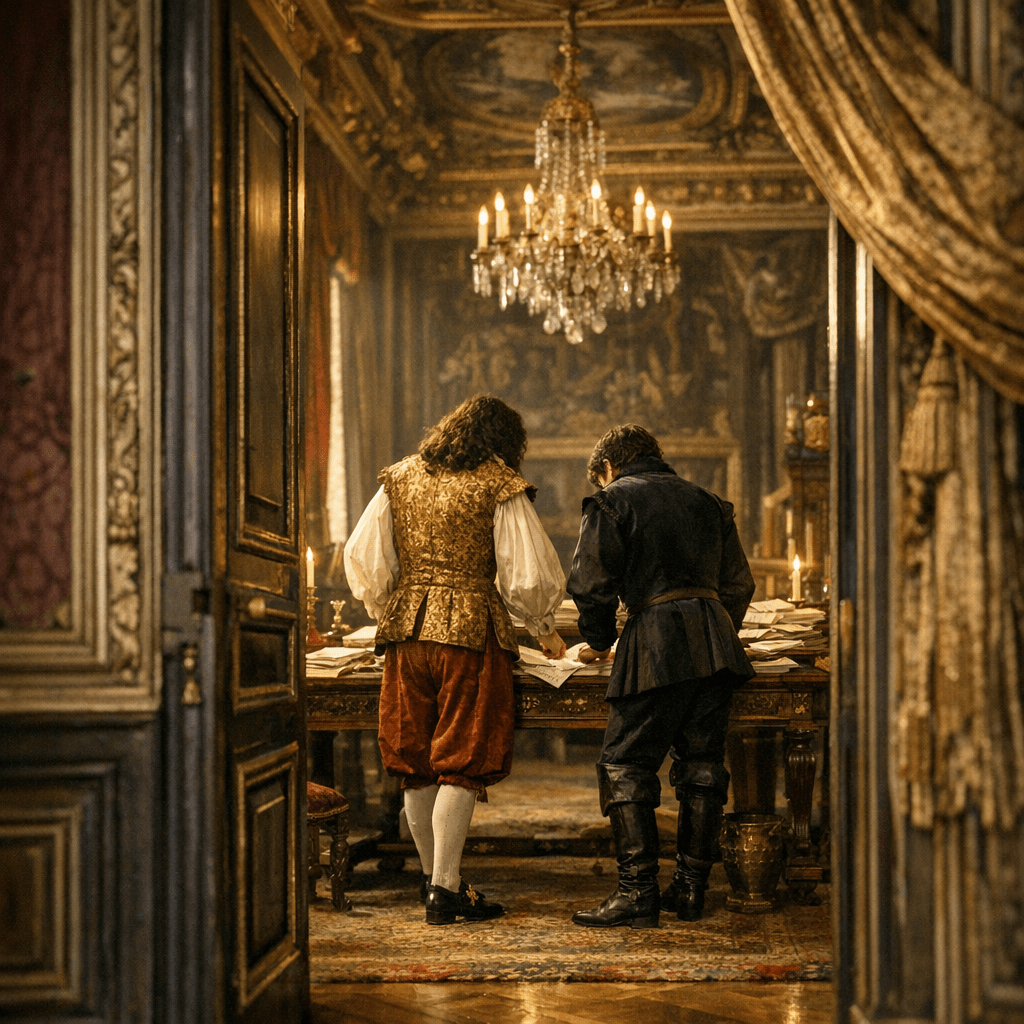
“Close the door Bontemps,” the King orders without raising his eyes. He is standing behind his desk busy sorting out papers, documents, and letters. “You are finally back, Lieutenant.”
Fabien has removed his hat. He bows deeply. “Yes, Your Majesty. We followed your orders to the letter. The prisoner is…”
The King raises his eyes; a disapproving gaze. “We do not care to hear about him again. May he live a long life in oblivion. If not, then may God forgive his sins.”
“Your Majesty, there was the incident at Vincennes,” Fabien insists. He is clear about his purpose, and this is as good a time as any.
“M. Mancini had a lot of explaining to do, but given the outcome, We shall attribute the unfortunate incident to his inexperience and credit the success of the operation to you and your men. As for Spain…”
“Your Majesty, I am not convinced that it was…”
The King sits in his chair, frowning. “Your man, Falaize, assured Us that you were certain.”
“Indeed, and it looks as if it is so—on the face of it. But my journey was long, and I had time to consider that…There was also the fact that the pris… That he had a lover. And she…” Fabien has no idea why he falters, he has thought this out so thoroughly, rehearsed it in his mind, what he must say, what he can never reveal. Perhaps it is the coldness in the King’s eyes that confuses him. He expected rage.
“Is there an accusation somewhere in all this, Lieutenant?”
Fabien straightens his shoulders. “Some facts do not add up. His Grace, the Marquis de Normanville disappeared almost at the same time. His wife too, who happens to be the lover of…”
“Enough!” the King slams his hand on his desk. “The Marquis’ business is not your business, Lieutenant.”
“Your Majesty’s safety is my business, and I care not who stands in my way,” Fabien declares fervently.
The royal frown eases, he notices. The King shakes his head. “The Marquis had orders. That is all you need to know.”
“What about the lady?”
The King sighs, impatiently. “The lady is at mass with Our Mother and Our cousin the Baroness de Rohan-Rochefort, having spent weeks tending to the sick and the afflicted of Saint-Severin.”
Fabien cannot believe this. He will not. “Are you here to malign the Marquis de Normanville and his wife with nothing but innuendo, Lieutenant?” the King rages, and it is not the rage that Fabien expected.
It is also not innuendo. Fabien’s proof lies with the masked prisoner who was left for him to find on the side of the road. The masked prisoner, who is not Henri Bernard but Thomas de Renard, the blackmailer who wore his resentment against Raoul and his family like a badge for years, and acted on that resentment again and again. But this is the one thing Fabien cannot reveal, for Raoul made sure to make him complicit.
“We will have no more of this!” the King stands up and walks behind his chair. “The matter of the prisoner is closed. You will refrain from any accusations against the Marquis. In fact, you are to leave for the château de Glénay immediately.” He picks a rolled, sealed parchment and a pack of sealed missives. “You are to deliver these.”
Fabien can already see ‘duc du Plessis’ inscribed on one envelope, and ‘Comte d’ Artagnan’ on another. “Your Majesty, perhaps I am not the right person to…”
“Yes you are. You are the very person. We have been informed of your exploits at Royaumont, Lieutenant,” the King replies sternly. “You will take Rochois, Falaize, and Bennart with you. None of your new recruits. Only men who will be recognized and will be well received at Glénay. You are acting in Our name as befits the Lieutenant of Our Guards and you will be visiting a most cherished branch of Our family.” Fabien is not surprised that the King returns to Royaumont. Even at the time, he knew that the King’s permission was given implicitly, and that he decided to interpret it as he pleased to satisfy his resentment against Sophia de la Croix. But this is different. He will be riding into a den of enemies at Glénay with just three men. The King has turned his back. “These are your orders, Lieutenant,” he says, “We expect you to depart immediately.”
⚜️⚜️⚜️⚜️
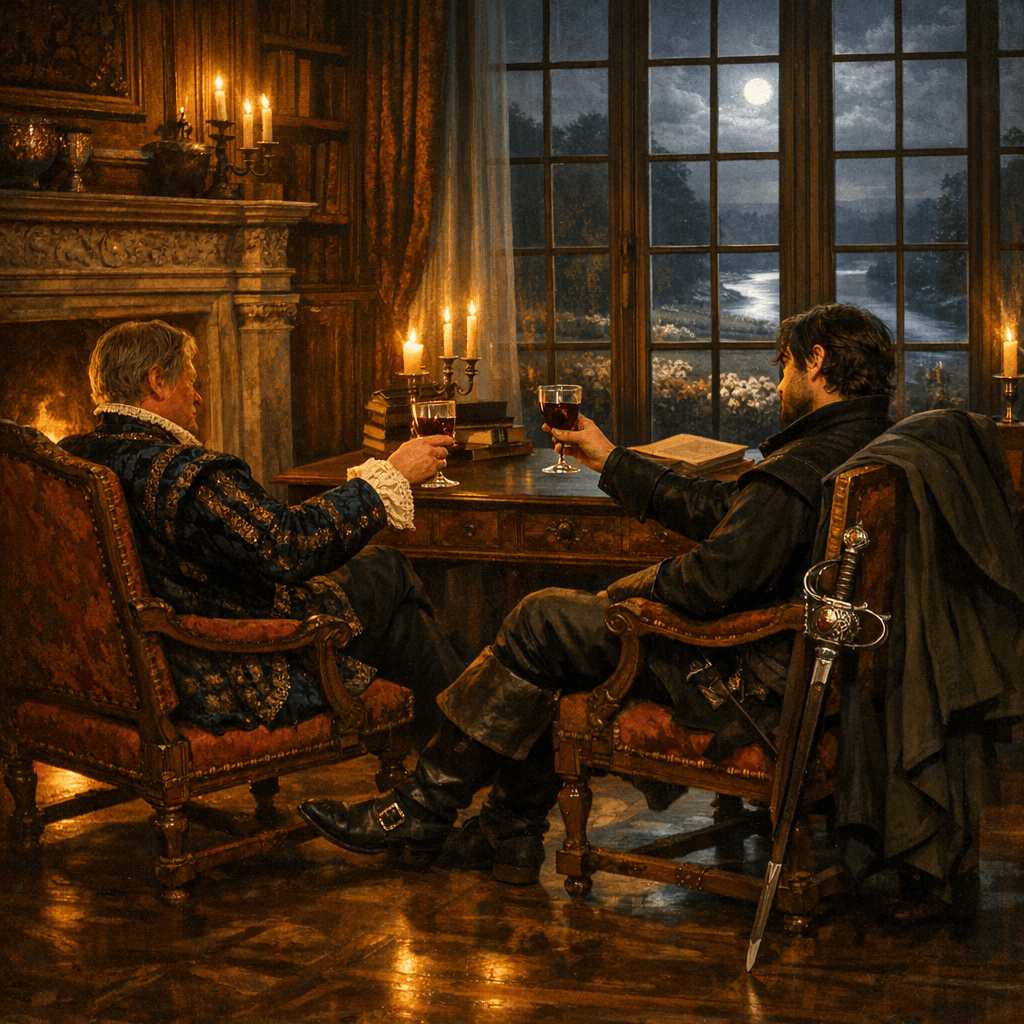
“You look tired,” Rochefort observes. He fills a glass of wine for himself and one for Raoul and sits across from him by the fireplace in his library at Bourron-Marlotte.
“It has been a long ten days. But I have had worse,” Raoul says. “We have much to talk about.”
“Indeed, but it is well past midnight, and these are delicate matters. We both need a clear mind. So let us share a drink and meet again in the morning. Your room waits, upstairs.”
Raoul smiles. “It was a well-played move. Risky but well-played”
Rochefort smiles back, raising his glass. “We make a great team.”

 Twelve Years After