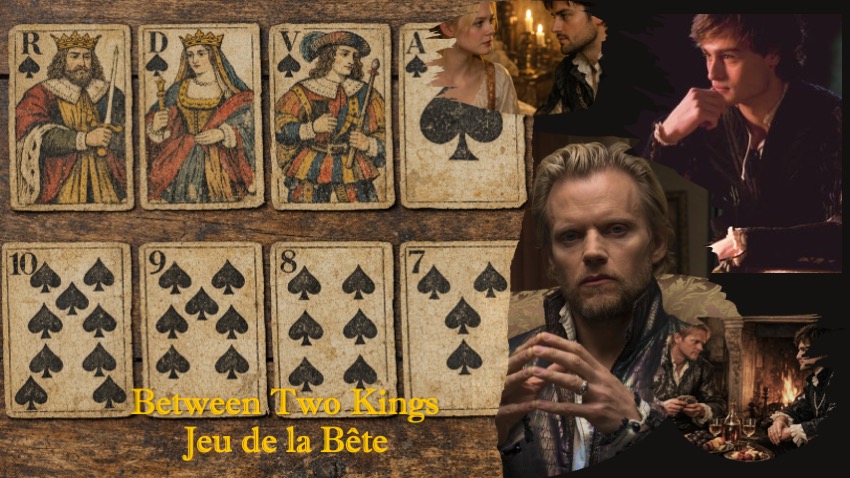
Jeu de la Bête was a 17th c French trick-taking card game, derived from the earlier (16th c) Spanish game Ombre (Homme, in French). It is named after the bête (beast), a term that referred to the penalty for failing to take the required number of tricks or for various infringements.
The silence that envelops the Château Bourron-Marlotte at night, is disturbed only by the soft, rhythmic patter of the rain against the windows. After Glénay, Raoul reckons, any place would feel silent. Restless, he tosses and turns in his bed. He tells himself it is because of the stillness but knows it is not. It is the calculations running through his mind, the moves he must anticipate and those he must execute. It is his mother’s and his baby brother’s life, both uncertain. It is Marie Cessette’s fate and the sting of betrayal which he pretends is beneath him. It is that he cannot offer his wife the love she deserves, and that even though he loves her well, this is not enough for her, as it is not enough for him. It is the deep ache that no matter how close he has come to love, it remains elusive. It is Jean’s concern that Rochefort is a pernicious influence, and Layla’s plea to return to her the man she loved, the man Raoul used to be. Nevertheless, Raoul is not one to wallow in guilt and misery. Gifted with an agile mind and a resolute, courageous heart, he knows that there is a way out of every labyrinth, for they are all man-made, and that he will find his way out of this one, as he has done time and time again. Still, he cannot sleep. So he closes his eyes and lets the soft, rhythmic pattering of the rain ease his thoughts.
When he walks into the library early in the morning, he finds Rochefort already there, standing with his arms crossed behind his back, in front of the large windows that offer a view to the river, only the view is obscured by dense fog and sheets of pouring rain. He sounds disappointed. “I thought we would go out riding this morning, but this storm makes it impossible.” He turns and points to a table near the fireplace, set up lavishly with silver trays filled with an assortment of fruit and freshly baked pastries. “I can only offer a country supper here, I am afraid,” Rochefort laments, and means it. He sits across from Raoul and does not touch the food, Raoul notices, but fills his glass and Raoul’s glass with a most unusual, golden-colored wine. “Try this. It comes from Tokaj. The Hungarians call Tokaji Aszú.”
Raoul tries it and is astounded by the unique and exquisite balance of flavors. “Citrus, honey and…apricot?”
“You should make your father proud.” Rochefort raises his glass toasting Raoul, who pretends to ignore the pointed remark about his father. “I know the man who makes it. Prince Rákóczi,” Rochefort adds as he drinks.
“I have seen the name, in the Company ledgers and in the correspondence,” Raoul observes.
“That is his son, and he is as reliable as any Hungarian–which means one must watch his back–and as reckless with his debts as most of these princes are, because they are raised to be dismissive of money but eager to spend it. Not as bad as the Ottomans, but close second. The father fought on the side of the Emperor, and successfully too. But the son is a realist, unlike the father. He has no choice. He inherited mostly debts and has seen what the Ottomans can do and how easily they crossed into the family’s territories which his father believed to be impregnable because they were protected by God. In other words, the prince needs money and allies and someone to keep the pressure on his Ottoman overlords, and we have leverage on all three counts. He can reciprocate with more than this excellent vintage. Mercenaries for instance, and weapons and ammunition not restricted by anyone’s sumptuary laws because the prince sets the laws himself.” He slants an impish gaze as he drinks. “If the Spymaster of France does not object to such seditious talk, of course.”
Raoul mocks a stern glare, raising his glass to Rochefort, who accepts the silent toast with a satisfied smile. “Well,” Rochefort continues, “this excellent vintage started with the prince’s mother, Zsuzsanna and the manager of the vineyards, called Szepsi–an enterprising man. I met him before he died. She knew about vineyards, unlike her husband, who only knew how to drink. Still, Prince Rákóczi trusted his wife’s talents and she was a talented woman in that respect. She ordered the harvest to be postponed while the Ottomans invaded. By the time the mayhem was over, the grapes had shrivelled into raisins, but Szepsi used them anyway. They were desperate for anything they could trade after the Ottomans devastated their lands. That has been Szepsi’s story and it is a good one,” Rochefort sips some more wine with a cunning grin. “But it is not true. I tasted this wine at least ten years earlier at… Well… Enough reminiscing. The Wine of Kings they call it, but I call it King of Wines. I have a feeling Louis will develop a taste for it.”
“Has he tasted it already or are you asking me if he would like it?”
Rochefort begins to laugh. “Would he?”
“Louis’ taste in wine is excellent, as is his taste in everything else. He is not keen on anything that competes with what he sees as French interests and wine-making is among them. With Louis, the art is to grasp his attention. It matters how you present a cause and what he stands to gain from it. It is the same with wine as with everything else.”
“And a bold move works. Your advice regarding making him a direct offer of the Company ships was invaluable. I have pushed further and I seem to be able to push further still.”
Raoul frowns. “You must tread carefully. He will retaliate if one pushes too far.”
Rochefort shrugs. “He has much to lose.”
“He is King.”
“Are you telling me to stop?” Rochefort sounds vexed.
“I do not presume to tell you anything. I only point out that even though raised by a Spanish mother, Louis is, in every way, a Frenchman, and this tribe, the French, you know better than me. I say this with the certainty, or the uncertainty, that my Venetian eyes afford me.”
Rochefort bows his head with an amused smile. “I stand corrected then, and will trust your Venetian eyes, for they have been without error so far. I invited Louis to honor this, my humble abode, as good neighbors must. He has agreed eagerly. You must join him.”
“That was a good move but, alas, I will not join him, because he will never invite me,” Raoul chuckles.
“And if he does?” Rochefort insists, keeping his eyes fixed on Raoul with great interest.
“If he does, then it is because he lays a test or a trap, and, which of the two it is, we will be able to determine only then and there. Louis will make such a move, sooner or later. It is the sort of thing he always does, for he trusts no one but himself. In that case, therefore, I will join him to visit you here, eagerly walking into whatever Louis thinks he has in store for you and me. You will do the same, because this is what we must do, if we are to walk away unsuspected and unscathed.”
Rochefort extends a satisfied smile. “Then, I look forward to the challenge.”
“As for the wine,” Raoul says, “the Szepsi story is a good one. I suggest, however, that you remove all credit from the Ottomans, even if the credit was unintentional.”
“My thoughts exactly,” Rochefort says. “And… with the Ottomans, how are we on that count?”
“The latest pigeon-post is that the Lune, carrying our man, crossed the Strait of Messina in fair weather yesterday. A smooth sail so far, and if it continues so, we should expect to hear from our outpost in Sardinia later today. The party will stay at Marseille for a week and from there travel to Paris. Of course, they will be followed discreetly. Once in Paris, our man will meet with you at Les Gobelins.”
While Raoul speaks Rochefort sets his empty glass on the table, and casually picks a deck of cards from a smaller side table next to him. “A good itinerary. Best if you remain invisible to our man,” Rochefort advises.
“I agree, or we endanger Salih Bey, without whom we would not have achieved this agreement, and who remains a valuable asset.”
“Precisely. Let me handle this matter, and then Querini can do the rest.”
“But not at our offices in Saint Antoine,” Raoul cautions.
“Indeed! We must find Querini a temporary office for this business, you are correct. We have an empty office at the Rue de la Tonnelerie, which the bank agents use from time to time. I will ask Querini to prepare it accordingly,” Rochefort agrees, while absentmindedly, shifting the cards in his hand with astonishing dexterity.
Almost as dexterous as Layla, Raoul thinks. A small faint chuckle escapes his lips and to Rochefort’s perplexed expression he points with his eyes to the cards. “I didn’t think you played games of chance.”
“Well!” Rochefort laughs as he looks at the cards in his hand. “I don’t. Relying on luck and giving fortune the credit is a waste. A pastime for indolent minds.” He sets the deck of cards back to its place on the side table. “I never liked games of chance, even though in my youth I was prone to many excesses, gambling included. I had convinced myself that gambling was not entirely chance. That there was some calculation involved making it worth my time.” He levels a playful, boastful look. “I was good at it though, and I liked winning. Unlike your father.”
This is not a turn Raoul expected, and it bothers him to be caught by surprise. But he recovers immediately. He is good at card games too, and likes them. “I can see my father not caring about winning or losing in a game of chance,” Raoul observes, choosing his words carefully.
“He had neither purpose and no method in his game and shrugged away losses and winnings alike. He wanted everyone to think he was disinterested, the true sign of nobility,” Rochefort scoffs.
Raoul knows that he is being provoked but, in this game that Rochefort clearly plays, he will never show his hand or his trick. He assumes an affable tone. “Or perhaps he is, by nature, disinterested.”
Rochefort fixes a steely gaze and Raoul feels a sense of relief because this is the Rochefort that he understands. “What your father is by nature is a moot point. He is now the duc de Richelieu. He must be disinterested. The same is true for your uncle,” Rochefort says tonelessly. “This is their family legacy. Your grandfather was masterful. A veritable sphynx.”
Raoul will not play the hand that Rochefort pushes him to play: “I have not thanked you for your intervention concerning my mother,” he says instead.
“I promised to protect your sister and ensure her happiness.” A condescending smile crosses his lips. “Has it been perplexing?”
“To me? No. To the rest, yes, and understandably so. You went to great lengths to…”
“There was urgency and it was within my reach,” Rochefort interrupts him. “Let us speak no more of it. Let us speak of another matter and most pressing in the same respect. I would never presume, but it is all over the pamphlets, and one cannot cross the Pont-Neuf without catching the occasional odious whiff.”
Raoul is prepared for this. “She leaves for Normandy in two days.” He is surprised to see astonishment in Rochefort’s eyes.
“Exile? Is this not excessive?” Rochefort leans closer across the table, a sign of concern and confidentiality, the kind of gesture that, coming from Rochefort, Raoul finds unsettling, because behind it lurks Rochefort’s real game, and Raoul has yet to grasp it. “This is an orchestrated attack against you, not her. We may discuss the man behind it, your old comrade Marchal, by and by,” Rochefort says. “But this is first and foremost about you; not the distraction–you are not a man easily distracted–but your happiness.”
Could this be a rare glimpse into Rochefort’s real game, Raoul wonders? It is not that Rochefort’s guard has slipped–impossible for someone so obsessed with control–but Raoul senses a hint revealed unintentionally, because no man is truly impervious, especially when they are confident they have a trick up their sleeve. And this is exactly what Rochefort thinks. “The appearance of severity is necessary,” Raoul replies, “so that she may return not only redeemed but, most importantly, that she returns justified. She and I are of the same mind about this.”
“She is a remarkable woman, and I do not say this lightly,” Rochefort says, and if Raoul did not know better he’d venture that Rochefort means it. “But your happiness concerns me as much as what the appearance of such severity might signify for you.”
“I am the indifferent husband already,” Raoul says. “I could also be a vulgar prude, which is what Venetians are thought to be.”
Rochefort clicks his tongue disapprovingly. “Or I can speak on her behalf. No, no, hear me out,” he adds, seeing Raoul ready to object. “I take your advice very seriously regarding how far I can push Louis. But I can push on this matter. I can even make it seemingly trivial, even though, of course, it is not. I can, for example…oh I don’t know…” he waves his hand in the air nonchalantly, “bring it up casually, while extolling a specific Hungarian wine only fit for kings.”
Whatever the real game is, in this round, Raoul will not play Rochefort’s trick because he will not compromise Marie Cessette, who has already suffered enough. “I appreciate the offer. But my mind is set. Hers too,” Raoul says quietly.
Rochefort does not look pleased. “Normandy is not safe. I am sure you know this. Condé’s sister, his brother, and his brother-in-law, having been released from prison, are scheming again.”
Rochefort is as relentless in his game as he is artful. But Raoul will not be lured to show his trick, nor will he play defensively. Instead, he decides to attack. “Have they reached out to you?”
Rochefort smiles a cunning and amused smile. “Very good, Spymaster!” He shrugs. “They are reaching out to everyone they can think of and many others besides. After their defeat at Stenay they find people less willing. If the Queen gives France a Dauphin, their cause suffers a blow from which it may not recover, unless, of course, Condé leads an attack against France and emerges victorious. I am sure you know all this. And everyone knows that Spanish troops are gathering at Valenciennes.”
Raoul reciprocates the smile, sitting back in his chair and fixing his eyes on Rochefort. “So it is not money they have asked you for. What then? Weapons?” Rochefort chuckles loudly even though the cunning glow still simmers in his eyes. He likes the challenge. He invites it. Raoul’s instinct pushes him to play a trick of his own. It is a risky move, and on a whim, but, unlike Rochefort, Raoul likes games of chance. “I presume whatever it is they asked you for can be combined with wine only fit for kings?”
“Sang Dieu!” Rochefort swears under his breath, and the astonishment sounds genuine. If Raoul did not know better, if this was not Rochefort, he would consider that the game was now in his hands. But against Rochefort, such confidence would be shortsighted and a mistake. He is right.
“Well now!” Rochefort sounds threatening. “One might think we are adversaries.”
“Our partnership is adversarial which is not the same thing,” Raoul remarks. “It must be adversarial or nothing at all. Neither of us cares for sycophants or those who will tell us what we already know.” At the corner of Rochefort’s lips Raoul notices an almost imperceptible wince, and knows that his risky move has paid off. “And to prove my point,” Raoul continues, “I will tell you something you already know but do not want to hear. Your scheme has a flaw. All that…fine wine arriving from Hungary to Normandy via… if I may venture… the Dutch? All that… fine wine could end up in Spanish hands.”
Rochefort rubs his chin. He sounds peeved. “I considered that.”
“And…?”
There is mischief in the man’s eyes. He is enjoying every moment of this, Raoul realizes, and it unsettles him. “And I will not let it happen! As simple as that,” Rochefort declares with a half shrug. “Either Condé is brought back to France repentant, in which case I trade the arsenal in Normandy whenever the need arises, or, Condé returns to fight another stupid war in which case I have leverage since the weapons he needs are those I procure. In other words, play both sides. I must. I am the banker, remember? Bankers have no enemies, only investors.” He points his finger to Raoul, his cunning grin returning. “You, on the other hand, Spymaster, you can only allow one of the two to happen.”
Raoul begins to laugh. “That is very good. Very good, indeed! Or I can simply show up and confiscate it all, in the name of the King, before the unrepentant Condé ever sets foot in France to start another stupid war. I promise to leave the wine behind, however, for the banker to offer the King. In which case, I play all sides, and everyone wins. Except Condé, of course, who is doomed every time.”
“Bravo!” Rochefort exclaims, clapping his hands. “I chose my heir well!” He pours wine for both of them. “All these are valid contingencies, and, between you and me, we can make them work for us, for better or worse, despite our banter. The truth, however, is that what is best for all, you, me, the Company, and the bank, is that Condé returns repentant, declaring his loyalty.”
Raoul picks up his glass and drinks. He is no longer laughing. “So you will be in Spain.”
“We must both be in Spain. We must both be here. We have no choice.” He is not laughing either. “Spain concerns me greatly,” he remarks gravely.
He means Layla and Jean, of this Raoul has no doubt. It is astounding. It is unsettling. What is the man’s endgame? Instinct tells Raoul that to push now would be a mistake, even though it is what Rochefort wants him to do.
“Spain concerns me also,” Raoul says, setting his empty glass on the table. “I have information that Vargas will try to cross into France, perhaps that he already has.” He can see that this is not the response Rochefort expected, but that he is intrigued nevertheless. “My concern is that my actions have precipitated this.”
“You mean Henri’s escape.”
“Yes. The Belladonna and the Aigle against three Spanish galleons. The Spanish offered an opportunity and I availed myself of it. To remove Henri from Vincennes the alias and the signature on the forged documents was that of Beltran de Guevaro, Seigneur de Oñate, who is an ally of Don Juan Jose. He seemed like a good choice. He is loyal but not among those in Don Juan Jose’s closest circle of allies. Close enough to be believable, but not too close to expose our scheme too soon. Now I ask myself if I went too far.”
“The plan worked, which makes it a good plan,” Rochefort says, setting his empty glass on the table also. “You are right to be concerned about Vargas. I don’t want him anywhere in France. He complicates matters for no reason.” There is disgust in his voice.
“We may have more complications to contend with.”
“You mean that monstrous ship. I am receiving messages about it from Brest all the way to La Rochelle.”
“That monstrous ship indeed, the Santissima San Pedro de Arbues,” Raoul sighs. “She sows fear and panic along the entire Bay of Biscay. People flocking at every port, many crawling on their hands and knees, others mortifying their flesh and wailing for mercy. The descriptions I am receiving are beyond disturbing. The Santissima’s wake has reached Paris making even the Archbishop and the Cardinal nervous. They fear an imminent effort to revive the French tribunals, made obsolete following the scandals and the savagery.”
“It is truly odd,” Rochefort muses. “What business has the Tribunal of the Holy Office of the Inquisition, sailing French waters with that monstrous ship?”
“Call me fanciful,” Raoul ventures, “but I cannot overlook the coincidence.”
Rochefort raises an astonished brow. “Could this be Vargas, you mean?”
“Could it?” Raoul insists. “You know Vargas better than any man. Could he be this bold? Could he be somewhere on that ship, pretending to be a monk or servant?”
A vexed chuckle escapes Rochefort’s lips. He shakes his head. “The Vargas I know would arrive on that monstrous ship as the Grand Inquisitor himself!”
⚜️⚜️⚜️⚜️
“Are you all packed up already?”
The sight of the room upsets him: the closed chests that are neatly stacked near the door, the boxes with Marie Cessette’s books. The emptiness. She seems to be taking mostly books. Raoul thought there was more time, but it occurs to him that this is the timing they had agreed upon, the timing he advised.
“You know me,” she replies with a small shrug as she moves between the chests and boxes, without turning to look at him. “I prefer to have everything ready. Father says one must be prepared, always. Always ready to move elsewhere.”
The emptiness strikes him. Raoul sits at the settee across the fireplace. “That is meant for soldiers.”
“It is how we were raised. Children of a general, always prepared to follow him somewhere. I think about my poor mother! Renée and Charlotte were each born at a different place, where my father was fighting battles. Only Olivier was born at home. As for me, I was born at… ah well… ” She picks up what seems to be the last stack of stray books and places them into the opened box before her. “That is all there is!” she declares dusting off her hands. She turns to face him with a feigned smile on her lips. “I asked Madame Idoine to store the rest of my clothes, so that they are not in your way. There is no need for court dresses and finery at Normanville, although I am taking your wedding gift. I cannot part with that.” She means the ancient Roman gold necklace with the carnelian stones he gifted her at their wedding night. “Books will be more valuable to me there, even though they are heavy.” Raoul did not consider what this house would be like without traces of her in every room. They have been apart before, but this feels different. Before, he was always the one leaving. He wonders if this is a miscalculation, and it vexes him because he is not used to second-guessing his plans.
“Sit?” he points to next to him. She smiles, affably this time, and sits. “Normandy is…” Raoul begins. Is this a miscalculation? “Normandy is not safe outside the boundaries of our estate. Longueville with her husband and her brother are arming themselves again.”
Marie Cessete looks incredulous. “Another war? Even after Stenay?”
He nods. “Condé will not return easily. It is the challenge Jean and Layla must contend with in Spain, and we, here, must face his closest allies: his brother, and his brother-in-law who were released from prison, and his sister, Madame de Longueville. They will do anything to return their party to power. They all are in Normandy, and no longer relying on Spain, as they did before, even if Spain is moving troops to Valenciennes. This time they will rely on their own resources, amassing weapons and ammunition, preparing for their own private war.” He fixes his eyes on her. “They know who you are and what you are to me. I am sending men of course…” he pauses, shaking his head. Is this a miscalculation?
“Are you thinking about Timothée?”
“Timothée would not do in Normandy. He stands out, he likes to shine. In Spain these are invaluable qualities, but in Normandy it is the last thing we want. Not only does it endanger this wretched scheme that demands this exile, but it endangers you, given the circumstances.” He presses her hands. “I beg you to remain vigilant. Avoid drawing attention to yourself especially if you must travel outside our estate. If you must, always use a carriage without insignia and travel incognito. Have an escort with you always, even within our estate. Never be alone.”
“Pére Gazil will be with me always. He escorted Layla to Saint-Fargeau but I was too sick to remember him on the way back. I need a confessor and I understand he is a well-traveled and well-read, a man with whom one can have good conversation. Your grandmother wrote to him from Glénay. I expect him to be here tomorrow. We travel together.”
“My grandmother suggested another man too,” Raoul says, “and he will be escorting you tomorrow as well.” Raoul levels a meaningful look. “Fra Raphael Clermont.”
Marie Cessete narrows her eyes, perplexed. “What is so particular about him?”
“He is a knight of Malta, recently returned from the Americas.”
She gasps. “Good God! I hope he is not planning to seek out conversos in Normanville!”
Raoul chuckles. “I understand that the Longuevilles are using Dutch smugglers, so, who knows, maybe he will counter reform some Dutch Protestants.” He fixes his eyes, no longer jesting. “Clermont is sworn to protect you. My grandmother has made sure of that, but I rely on your good judgement and your quick thinking much more than on any man’s sword.”
She smiles. “I will avoid the Longuevilles and their lands at all costs, and travel with an escort even within Normanville.”
“It is only for a few months,” Raoul says as if it is meant to appease himself. “This charade will be over by the end of summer.”
She shakes her head resigned. “The Queen Mother was very kind at chapel this morning. The Cardinal even condescended what I thought was a smile.” She slants him a mischievous glance. “But perhaps he was wincing at the thought that I would be arriving at his house later. What a way to open his new palace!”
“Marie Cessette!” he admonishes her gently.
“It is true. There was a lot of gawking and whispering at the chapel. Chevreuse conspicuously turned her head away as soon as I approached.” She presses his hand. “I do not care, Raoul. My Uncle and Layla were with me, and I had all I needed. I only care that it affects you.”
He lifts her hands to his lips. “I have not been a good husband.”
“You have been the best husband I could wish for. You are my best friend. What of me? What sort of wife have I been?” She smiles a sorrowful smile that pierces his heart. “Let us not commiserate. I hate commiserating,” she adds peevishly, “and I hate prolonged goodbyes.”
“Then we do neither.” He draws in a deep breath to suppress his frustration, but it overwhelms him. “I wish I could give you something! Something more than this!”
Tears glow in her eyes, shattering her brave façade. “Perhaps you can.” She smiles the same sorrowful smile. “I want a child,” she says simply, her tearful eyes locked onto his. “You’d make a wonderful father. And…” she swallows hard to hold back her tears. “I want to be someone’s mother.” A small angry chuckle escapes her lips, and she wipes the tears off her cheeks. “All those babies at Glénay… I am jealous of Suzanne. I am jealous of your aunt. I am jealous of your mother!”
Raoul seizes both her hands and pulls her closer. He had no idea. In his many calculations, not once did he consider this. “When you return…” he begins.
“No!” Her anger catches him by surprise. “No. I have waited long enough!”

 Twelve Years After