Marie Cessette is not surprised by Raoul’s pigeon post. Part of her wonders whether she has not known the truth already.
“Is it bad news?” Père Gazil wrings his hands anxiously. The visit to Le Maupertus has left him unnerved, and he has not kept his fears to himself. “We should never have come to this place,” he fretted the moment they were in their saddles riding away from the inn. “God forgive me, these are dangerous and wicked people.”
“Precisely the sort of people one expects to meet in such a place,” Fra Clermont replied in his usual dry tone, which only Caradas seemed to appreciate because he declared: “Do not worry, Père. We have God on our side and a well-stocked armory at Normanville, as God intends.”
Marie Cessette reads Raoul’s message again. “After what happened at Le Maupertus and with the Bohemiens whose allegiances are unclear, the Marquis, the duc de Richelieu, and the duc du Plessis are sending us men and ammunition. We should expect at least fifteen men, the Marquis says. It should please you, M. Caradas. You will be in command of a veritable détachement at Normanville. The men will be here in two days,” Marie Cessette says as she reads Raoul’s message, and Père Gazil crosses himself breathing out in relief. “There is more,” Marie Cessette adds. “Père d’Athénous, whose good intentions toward us are not in question, may be acting secretly in Normandy on behalf of the true king of England,” Marie Cessette announces.
“Well, that is no bad thing, is it?” says Madame Bonshoms who has stepped into the library, cloaked and ready. “The carriage waits, Madame,” she tells Marie Cessette.
This morning they are visiting some of the poorest families on the estate with Père Gazil, Madame Bonshoms, and Madame Dufay. Afterward they are expected at Saint-Marguerite where Pére d’ Athenous is to teach his first class in the new school.
“Not at all,” Marie Cessette says, reaching for her gloves. “Even though the Marquis de Normanville advises caution, he too regards it as a noble and worthy cause. The rightful King of England, first cousin to His Majesty King Louis, is a friend to this house. But let us make haste. This morning promises to be a busy one. Are all the packages and baskets in the carriage?”
“Yes, Madame. The families will receive a good amount of food, clothes, and other necessities,” the housekeeper says, hurrying behind Mare Cessette.
“We must explain the news to Fra Clermont on the way,” Marie Cessette tells Père Gazil and Caradas.
“I daresay he will not object to more men,” Caradas replies.
“And he is no friend of Cromwell or the Protestants I assure you,” Père Gazil adds.
“Who rides with us this morning besides you and Fra Clermont, M. Caradas?”
“M. Patris, Madame. M. de Seguzzo will remain here, to guard the house should it become necessary. This morning he is training M. Mustel, his brother, and their men in sword and dagger. Last night the Bohemiens attacked the manorhouse at Criquetot, which belongs to M. Péricard, the prévôt for the Abbaye de Montivilliers. God protected the family, for they were all at Goderville visiting kin, but the poor servants were terrified, the stables burned, the warehouse looted, and the horses stolen. The fiends creep closer to Normanville every day. More men and weapons from Paris will be a relief indeed. M. Mustel’s men are brave and loyal but they are farmers, and one does not turn farmers into soldiers in a few weeks.”
“I believe some of the men arriving will be German and others Sicilian, M. Caradas.”
“We have all fought beside Germans, Madame, and against them too. They are formidable,” Caradas remarks.
Marie Cessette stops and just before Herculles opens the carriage door. She smiles at his evasion: “And Sicilians?”
Caradas shakes his head with an amused chuckle. “Ah…Sicilians. They say that only madmen hire Sicilians, and God help those who find themselves on the wrong side of their blades. The hidden blades, especially. Sicilians in Normandy.” He laughs softly. “I should like to see how that works.”

⚜️⚜️⚜️⚜️
Marie Cessette has asked Madame Bonshoms and Madame Dufay, her sister, to make lists of everything the families need, especially the elderly, the sick, and the children.
“M. Dufay sends these families provisions once every fortnight,” Madame Dufay explains as the carriage takes them back toward Normanville and Saint-Marguerite, their morning rounds completed. “Herculles and Galliens take turns delivering the needed provisions, when their household duties permit.”
“The Marquis and I will not have our people in want or suffering,” Marie Cessette says. “M. Dufay must release some of his workmen so that all the necessary repairs we have noted are completed before the end of summer. We have seen which houses require attention. Roofs, hearths, shutters, and doors that latch securely are the chief concerns. No family living at Normanville shall face the winter without a warm and safe house. I understand that we can provide almost all the building materials but M. Dufay must make arrangements for whatever must be purchased.” She considers for a moment and continues. “Let Herculles, and Galliens increase their visits to these poor families to once a week, instead of once a fortnight. But to ease their burden, for these two boys already carry heavy household duties, I shall speak to M. Papon, and ask him to spare his eldest, Danyel, to be added to this roster.”
“M. Papon will be very pleased to see his son advance in the household,” Madame Bonshoms observes.
“Then it is settled,” Marie Cessette says. “And once the poorest children no longer have to work as much as they are forced to do now, we must consider how to bring them to the schools nearest their homes, both the boys and the girls. Even a few hours learning letters and numbers is better than no learning at all.”
“The new school at the church of Saint-Michel at Yprevilles would be the best choice for the children living farther north,” Père Gazil says, consulting his notes. He has been keeping meticulous records, alongside Madame Bonshoms and her sister during these visits, and has also taken care to hear the confessions of the elderly, the sick, and those who find it difficult to reach the nearest church.
“And, of course, Père d’ Athenous’ school at Saint-Marguerite is the other school,” Madame Bonshoms adds.
“It is where we are expected,” Marie Cessette says. Through the carriage window she can already see the first houses of the village of Saint-Marguerite.
⚜️⚜️⚜️⚜️
“Class dismissed,” Père d’ Athenous declares. His fifteen students, all boys, between the ages of five to ten, jump from their seats, eager to put the schoolroom to rights, carefully stacking their books and writing tablets, wiping the blackboard and collecting the chalk. It is a small but pleasant room with large windows on both sides, set between the presbytery and the church, and it is neatly furnished, with desks and chairs, a blackboard, a globe, and a large map of France. Already the back wall boasts the boys’ first drawings, inspired by the first words they have learned to spell that morning.
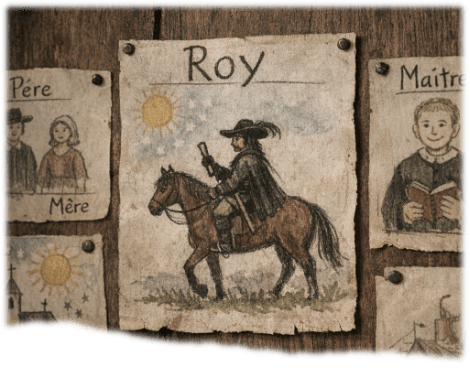
There is “Père” and “Mère”; “Dieu”, shown as a church beneath a sky filled with stars as well as a large and bright sun; and “Maître” depicted as a smiling fair-haired priest with a book in his hands.
“I am neither so handsome nor so tall!” Père d’ Athenous protests apologetic and embarrassed.
There is also “Roy”. To Marie Cessette’s surprise the child’s drawing shows a dark-haired cavalier, armed and mounted on a plain bay horse, with something in his hand that might be a baton, or a scepter, or, perhaps, a rolled message. Marie Cessette feels a small tug at her sleeve and looks down to find a freckled little boy, looking up at her, his clever blue eyes shining, his smile full of pride.
“Did you draw this one, Pomponne?” She asks slowly. Madame Dufay’s six-year-old nephew is deaf, but he reads lips very well. He nods eagerly. Pomponne does not speak much, not to people he does not know and trust, and it pleases Marie Cessette that he is always at ease with her.
He answers softly, with his deliberate, almost syllabic cadence: “He was here, Madame.”
She wonders whether in the boy’s imagination, the King resembles the royal officers Pomponne must have seen riding through these parts. Yet, on closer inspection, the cavalier in Pomponne’s drawing does not look like an officer, or soldier. Unlike with the other children’s drawings, here, Père d’ Athenous remains aloof, as if distracted by something Père Gazil is saying about the admirable size of the class on the first day of lessons. “Well, he is very handsome, Pomponne!” Marie Cessette praises the boy who beams with pride once more.
“This afternoon, we expect the girls,” Père d’ Athenous tells the rest of the party. “So far, eight families have promised to send their daughters, which will make twelve girls. It is encouraging especially after Le Maupertus and his brother attempted to terrorize even the families within Normanville with their vile pamphlets.”
“If even half of these girls come today, it will be a triumph,” Madame Bonshoms says.
“I suspect the number of girls may fall before they rise again and then settle midway,” Marie Cessette remarks. “It seems to me that we must persist particularly at the beginning with the girls. Only by persisting will we inspire confidence and certainty.”
She turns to Pomponne. “Would you like to ride home with me, your aunts, and Père Gazil in the big carriage?” He nods enthusiastically and hurries to seize Madame Dufay’s hand, prancing around his aunt with excitement.
“I shall follow you to the carriage presently,” Marie Cessette tells her party, choosing to walk slowly behind them alongside Père d’ Athenous.
“I must apologize,” Père d’ Athenous says after a few silent moments. “Pomponne is my most promising pupil, but I fear I did not explain the meaning of “Roy” adequately.”
“He spelled the word perfectly. And drew what he knows,” Marie Cessette says. She stops, and Père d’ Athenous stops beside her. “Let us take a turn about the church yard before I return to the carriage,” she proposes and he bows, following her away from their party which continues down the pebbled path toward the carriage, where Fra Clermont, M. Patris, and Caradas wait on their horses.
“I have disappointed you, Madame,” Père d’ Athenous despairs.
“Not at all! You have evaded carefully. It is understandable under the circumstances.”
“Does the Marquis know the truth?” He gives a small embarrassed laugh and shakes his head. “Of course he does. It is a foolish question.”
“You have friends in France,” she says gently. “Good friends.”
“And enemies on every side. My father, my brothers… their courage and commitment unshakeable, they risk their lives, while I hide in this conveniently humble parish.” He bows his head. “It is the question you urged Père Gazil to ask me with great subtlety when we first met, and it is the answer I evaded. I believe learning and education joined with the word of God make better souls and bring about peace, you see. Meanwhile, my father is ruined and my brothers are bleeding for the Stuart cause. I think myself a coward.”
“That is not true. You are a generous and modest man and destined to be a great teacher. As for the rest, it has been my experience that courage is not found only at the edge of a sword, and that a good man acting alone is never enough, not for a cause as difficult as yours.” She meets his eyes. “My husband writes, and I repeat it precisely as he writes it: ‘the rightful King of England has good friends in Normanville.’
Père d’ Athenous smiles sorrowfully. “Madame, how can I show my gratitude?”
“Let us first show our friendship in deeds rather than words. My husband tells me that the rightful King of England may attempt to cross onto French soil.” Père d’ Athenous gasps. “So it’s true,” Marie Cessette says and the young priest nods reluctantly.
“Please do not mistake my hesitation for mistrust. It is quite the opposite, Madame,” he says. “His Majesty escaped after the battle at Worcester and has been hunted by Cromwell’s spies and assassins ever since, as he tries to reach the French coast and reunite with his family here: his mother, his sister, and, of course, his cousin, King Louis. Their passage to France was blocked, however, Tresco and Bryher having fallen to Admiral Blake and the Parliamentarians, and Guernsey having surrendered. Jersey was where His Majesty found shelter, but when that Spanish monstrosity of a ship appeared the plans changed. That ship drew far too much attention, and Saint-Malo, across the bay, was already teeming with spies and opportunists. The plans keep changing because of it.” He draws a breath. “They communicate by pigeon post when they can, but two days ago a messenger came here. I know the man well. He fought at Worcester with my elder brother, Thomas, and was the one who saved my brother’s life. I fear he is the man Pomponne must have seen, for the boy was here with his father, helping me prepare the schoolroom. My heart sank when I saw the picture he drew.”
“It is a boy’s drawing,” Marie Cessette says. “Not easy to decipher.”
“Ah, but those spies, Madame, are cunning and now they have a leader in France. That was the message. Three days ago, George Francis Mordaunt was seen at Saint-Malo.” He speaks the name as if it should mean something to her. “I suppose you have never heard of the man.” She shakes her head. “He is one of Cromwell’s secretaries, but in truth, he is much more. Some say he volunteered to replace the executioner, when the late King’s allies contrived to make the executioner of the city of London disappear, in one last desperate attempt to save His Majesty from the scaffold. I do not know whether it is true, but I would not put it past him.”
“A spymaster then?”
“No. I would not give the man such credit, nor such power, and neither would Cromwell, who trusts no one. What I know is that he is a nobleman.”
She gasps. “What nobleman volunteers for such an atrocity even in rumor?”
“One who harbors hate and resentment against the King. His father was George de Winter, Lord Sheffield, who died when the boy was still young. Lord de Winter was a good man, and too honest for King James’ court, according to my father, who knew him. There was some scandal surrounding his third wife, a young Frenchwoman, but I do not know the particulars and neither does my father, for at the time he did not move in the King’s closest circle. This George Mordaunt, however, is the son of Lord de Winter’s second wife, who died at childbirth. She was a niece of the Earl of Bristol. When Lord de Winter died, he left little to his son besides the title. There was some money from the mother’s estate, but I understand that it vanished long before he came of age. Lord de Winter had a younger brother, you see, who was made guardian of the boy. This younger brother had inherited nothing at all and had expensive tastes.”
Marie Cessette gasps. “Henry de Winter!”
“You know the man!”
“I know he is dead.”
“God forgive me for saying this, but that is no great loss. The man was odious. He became a mercenary to escape his debts, my father says. He squandered his nephew’s meagre fortune and burdened his brother’s estate with so much debt, that, in the end, whatever remained was given to Henry de Winter’s creditors; and still that was not enough. His nephew was left peniless in the streets, and no one knew what had become of the boy, until he showed up again, as one of Cromwell’s secretaries. He claims that he was taken in by a Calvinist minister, a certain Samuel Francis Mordaunt, who raised him in the so-called true faith, and gave him an education. Now, Samuel Mordaunt I do know of, and very well. He died not long ago of apoplexy, but he was notorious for his radical preaching, for which, I understand, he was thrown out of Cambridge and even imprisoned. Such are the men who make Cromwell’s followers and his army.”
“So this George Mordaunt, Cromwell’s secretary, who has been seen at Saint-Malo, is Henry de Winter’s nephew!”
“Indeed. And he hated the late King, whom he blamed for not restoring his title, as much as he now hates King Charles. Like the most radical factions in Cromwell’s party, he abhors everything and everyone connected to nobility, which must include his late uncle. It is resentment, not politics or religion that drives him, my brother Thomas says. Thomas was interrogated by Mordaunt after Worcester. He says the man is pure cruelty and evil, but you would never know, for he deceives perfectly.”
“And you have never seen him?”
“No. Nor has anyone I know. Not even my brother saw his face, for the man was masked and hooded when he interrogated my brother.”
“Then you are right to be concerned.” She reaches for his hands. “Here is what you must know. In two days, more men and weapons will arrive at Normanville from Paris. The estate will be well protected and fortified. And at Normanville you have friends and supporters of your cause.”
⚜️⚜️⚜️⚜️
It is indeed a détachement that arrives at Normanville: twenty five men, not fifteen as first expected. They bring with them not only weapons and ammunition, but also gifts and letters. To Marie Cessette the letters are the most precious. They come from those she loves, including Layla, who has not yet departed with JeanPhilippe for Spain, for, as she explains, every order is suspended until the Queen is delivered. Marie Cessette’s father has sent men, as have her uncle Charles, the duc d’ Herblay, and, of course, the duc de Richelieu, and his brother, the duc du Plessis. It is a strong company of well trained soldiers, who have served in the Musketeers and in the army under her father, together with mercenaries, German and Sicilian. Some of these mercenaries Marie Cessette knows by sight, if not by name, from the time she spent at Glénay.
But the letters matter most to her. Among them, she is surprised to find a brief one from the duc du Plessis who has never before written to her.
“We have scarcely been able to contain your father,” the duc writes. “He has been threatening to invade Normandy, and I admit that my brother, your father-in-law, and I do not find the idea objectionable at all, and shall err on the side of prudence only for the next two months. Thus, you should expect to hear more from us soon. Know that Le Maupertus is a dangerous foe, an old associate of de Soto, and among the worst of his kind on your shores. His wife conducts all the business, and his three sons are brutes. He has a brother, who is as rotten as the rest of them, although he passes himself as some sort of saint. They work the coast between Saint-Léonard and Étretat, so, I will tell you what I always tell Layla: know your bearings and watch your back. These men defend their territory just as you must defend yours. He will push, and so you must be prepared with your defenses; but you must also be ready to push back, or you will have no leverage, no matter how many men we send to protect the estate. I leave it to your good judgement how far to push and when, until we arrive. Use my name if you must, but use it sparingly or it loses its bite. I do not know what Raoul, your father, or my brother write to you in their letters, but know that we all agree: the masked mercenaries must have been sent by Rochefort. It is a move that none of us fully comprehends, so tread very carefully. As for the Bohemiens, the name Voyvode is spoken of at the Court of Miracles, which means this is serious and no mere gang of desperate wretches. You will hear from me or from Raoul as soon as we know more.”
It is the duc du Plessis’ letter that helps Marie Cessette connect the details supplied by her husband, her father, her uncles, and Layla, who is closest to court, it seems than all of them these days. And it is these connections that she weighs against what she herself knows, very late that same night, in the library, unable to sleep, while the rest of the household has long since fallen silent.
Then everything changes.
There is commotion in the courtyard. She hears M. de Seguzzo exchanging words in German, followed by the hard thud of a galloping horse. Another messenger?
Marie Cessette springs to her feet, and hurries to the library door, just as a man is admitted into the house, having roused poor Herculles and M. Bonshoms from their sleep.
“Madame!”
Père d’ Athenous stands at the library door, breathless and dressed as a cavalier, with sword and pistols. He removes his hat, his face pale with despair. “Forgive me, Madame, but I could think of no other recourse.”
“Has he landed in Normandy?”
“How well you understand these matters, Madame!” he marvels. “I have received a pigeon post. The ship, the Surprise, is being followed. She may already have been captured.”
“By whom?”
“The message does not say. Only that it has been decided that His Majesty and the most valuable of his men must leave the ship in a small skiff. God willing they should land at Fécamp before dawn.” He runs his fingers through his hair. “This reeks of a trap. Mordaunt and Cromwell’s men will be waiting for them there, I have no doubt. Or else, brutes such as those we met at Le Maupertus doing their bidding. His Majesty will be seized before he sets one foot properly upon French soil.”
Fécamp lies within what the duc du Plessis called the territory of Le Maupertus, Marie Cessette thinks. ‘These men defend their territory just as you must defend yours,” the duc wrote. Well, now far more than the territory of a smuggling gang must be defended at Fécamp.
“Not if we can help it!” Marie Cessette hurries to the door. “M. Bonshoms!” she calls to the stewart who seems fully awake now and dressed, his two sons ready, beside him. “Find M. Caradas and Fra Clermont at once.” She pauses. “And Père Gazil. We need as many priests as possible and men who can pass for priests.” She turns back to Père d’ Athenous measuring him from head to foot. “This will not do. Do you think one of Père Gazil’s Jesuit cloaks might fit you?”
“You have a plan, Madame?” Père d’ Athenous asks, hope stirring in his voice.
“No, I have an idea. I fear that we must devise the plan as we go, for dawn is only five hours away.” She draws in a deep breath. “How would His Majesty feel about pretending to be a workman or a servant?”
“His Majesty never objected to such ruses when necessity demanded them.” He hesitates. “But, Madame, if by the Grace of God we arrive in time to prevent this disaster, where can His Majesty be safe and without endangering others?”
“Here, in this house, of course. This estate and this house are now as fortified as we can make them.”
The young priest reaches for her hands. “Madame, how can I ever repay…”
“Do not thank me yet, Père,” Marie Cessette says. “Let us first succeed.”