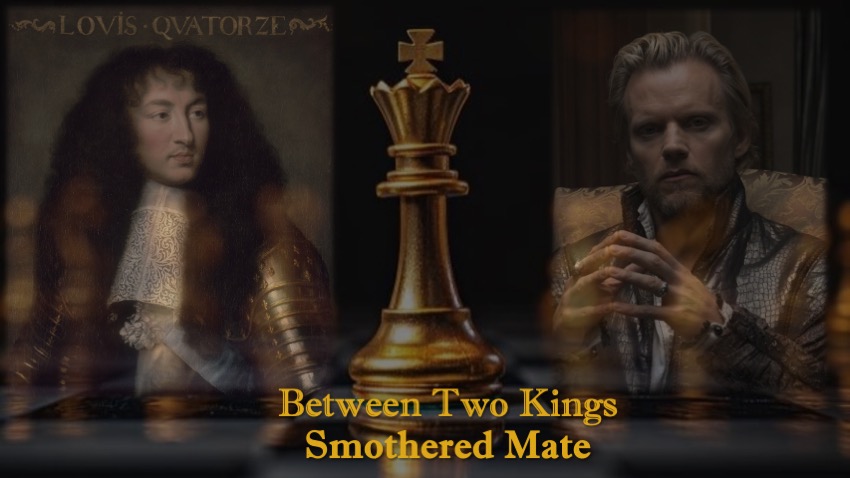
In chess, a “smothered mate” is a checkmating method whereby it is necessary to sacrifice pieces to smother (surround) the king so he is unable to move. The method is known since the 15th century, and was described in Luis Ramírez de Lucena’s (c. 1465 – c. 1530) book Repetición de Amores y Arte de Ajedrez con CL [150] Juegos de Partido (“Repetition of Love and the Art of Playing Chess with 150 Games”), published in Salamanca around 1497. Later known as Philidor’s mate or Philidor’s Legacy, the method involves checking with the knight, forcing the king out of the corner of the board, moving the knight away so as to deliver a double check from the queen and knight, then sacrificing the queen, forcing the rook next to the king and mating with the knight.
⚜️⚜️⚜️⚜️
The elegant townhouse at the Faubourg St. Antoine, the new secret headquarters of the Company of the Orient, is buzzing with activity.
“We did not expect you.” Signor Querini closes the office door behind his hooded and cloaked visitor, and the din of movement and voices outside subsides to a rhythmic, pulsating murmur that sounds like a heartbeat. “Is it safe for you to be here, Your Grace?”
“Not at all,” Rochefort says, lowering his hood. “But it will not matter soon.”
“I dare not ask what that means,” M. Querini remarks.
Rochefort removes his cloak and throws himself comfortably in the chair behind the desk. “You should! For what comes next it is important that we move first.” M. Querini raises a knowing brow and sits across the desk, as Rochefort scans the room. “I see that he is keeping you very busy.”
M. Querini chuckles. “Indeed. He has manned every post and very efficiently. He is just as you said and more. He reminds me of Your Grace increasingly, how he plays different chess boards at the same time, so to speak. He has advanced our interests with the Porte and faster than anyone expected.”
“He picks the right friends,” Rochefort says and immediately clicks his tongue, “well…almost. For the moment, I will allow him some exceptions; he is, after all, young and brilliant in every other way. How close are we with the Turks?”
“They have agreed.” Rochefort smiles a satisfied smile. “Our agent in Constantinople, the one close to the Grand Vizier–you know of whom I speak– has the agreement signed,” M. Querini continues. “He is bringing it to France himself.” M. Querini seems to read the next question in Rochefort’s eyes, so he points to an envelope on the desk. It bears the mysterious red seal with the eagle carrying the cross in its beak. “The letter arrived this morning and we have confirmed the route via our agents at Alençon and Versailles so it is, indeed, the Marquis’ letter. I presume there have also been pigeon posts?” Rochefort nods and picks up the envelope, just as M. Querini motions to stand.
“Before you go,” Rochefort says. “I will have new orders. And…” he unseals the envelope while M. Querini walks to the door. “Matei is with me today and Simion should arrive at any moment with important information. Make sure their needs are taken care of. Is the carriage here?”
M. Querini nods. “Large and comfortable, as you ordered it. ” He bows and slides into the noisy corridor outside, closing the door behind him.
Rochefort sits back in his chair, and carefully holds the letter, which appears to be blank, over the flame of the candle on the desk, so that the writing emerges:
“//////The letter begins here: Sent via Alençon and Versailles.
The Englishman acted on his own accord driven by personal and familial resentment. In doing so the lives of many valuable men were wasted at Saintonge. The Englishman perished and so did the Frenchman in his confidence, albeit their henchmen have survived, but further alliance with them is inadvisable. We have started recruiting immediately and carefully, because our competitors have the same access in France and elsewhere. Our agents are in Prussia and we should consider the Scottish and Flemish offers which are solid and vetted. The offers from the colonies should be scrutinized, as well as new offers arriving from our eastern partners. I speak about the Moldavian offer in particular. There is still a contingency of disgruntled Frenchmen to draw from, but whether such a move is worth making, I leave it for you to decide.
The ship is sailing where it should. Saintonge afforded an unexpected way to bring about a vanishing act that leaves all hands empty and keeps them full at the same time. From this end, it looks as if the time has come to move. The waiting game is over.
Fedor Borodinich
The letter ends here.//////
“Brilliant boy!” Rochefort chuckles. He springs to his feet and briskly walks to the fireplace, tossing the letter into the fire. “Too brilliant perhaps for his own good but brilliant nevertheless,” he mutters to himself as he watches the flames turn the paper into a twisting burning mass. “He knows what to say and what to leave out with equal discernment. Damn you, Harry, old fool! You let yourself be mired by your miserable wife’s resentment and your own lust–that’s what it was, old fool. Lusting over the green-eyed vixen who would never condescend to your advances and chose your brother over you and then a Frenchman–well the wretched Frenchman she had chosen before any of us.” He draws in a deep, resolute breath. “Raoul is correct. The waiting game is over.” He reaches for his cloak and throws it over his shoulders as he opens the fort. “M. Querini! Is Simion here? Tell him and Matei that we are moving! It’s time!”
⚜️⚜️⚜️⚜️
At the Tuileries the cherry trees form an almost perfectly arched, thick canopy of delicate, fragrant blossoms over the pebbled pathway where the Queen Mother walks in the company of her son, followed by her confessor and a few, selected ladies from her retinue, led by Madame de Chevreuse. There are gentlemen from the King’s retinue too, led by M. Fouquet and not M. Saint-Aignan, who should be feeling the rejection deeply and as intended. Since the night at Zola’s the King’s coldness toward his once favorite has been remarked by everyone.
Louis is here, eager to consult with his mother about the Queen, her niece, because these first few months have proved difficult for the mother-to-be. “For most women, it gets better after the first few months,” his mother assures him.
“Her physicians tell me the same,” Louis says although he does not sound convinced. “I will be a father soon,” he adds after a moment of silence. “And whether it is a boy or a girl, I am told that it changes a man.”
“It does. I have seen it. With your father.”
He frowns. “My father?”
“From the moment he held you in his arms, His Majesty was different. Animated and loving.”
Louis fixes a penetrating gaze. “You could not have phrased it better, Mother. Indeed, I marvel at his courage. I wonder if I would be as loving under the circumstances.”
“You will be a wonderful father.” It is her turn to fix a penetrating gaze. “I am certain because you were raised to be so, among those who love you the most.”
A frustrated chuckle escapes his lips. “I marvel at your turn of phrase, Madame.” He leans closer and whispers. “I have done just as you asked of me, Mother. He is summoned to court. He will be on my council.”
“But is he safe?” she whispers back.
“That is entirely up to him.” Louis straightens his shoulders and clasps his hands behind his back. “A glorious afternoon,” he declares for everyone to hear. “Nicolas, there must be a féte soon for the entire court to celebrate the beauty of spring!”
⚜️⚜️⚜️⚜️
He is unsettled. Louis expected that the promenade at the Tuileries would have afforded him a much needed distraction from the standstill where he finds himself. Trapped. Cornered. This is how Louis feels since the infernal night at Zola’s, when Philippe made a spectacle of his defiance and Captain Marchal proclaimed himself defender of virtue and morality. Whether that was genuine or the captain decided to play a hand in favor of Saint-Aignan and against Fouquet, matters little to Louis, because for him, the outcome has been equally dismal. He showed himself unable to rein in his own brother and his own Captain of the Musketeers and in the presence of everyone:Beaufort, the friends of Condé and of his cousin, the Grande Mademoiselle, even that damned Turk. It was Raoul’s clever intervention that restored his authority and Louis can never forgive Raoul for that. His brother’s perversity he can overlook–Louis has lived with it all his life. Captain Marchal’s crude force he is willing to tolerate; even though it’s hard to stomach, it is expedient. But Raoul’s nimble intervention, the subtlety and artfulness of the resolution he brought about in the presence of everyone –Louis cannot look past this. Of everything else that happened at Zola’s this unnerves him the most, that he is beholden to the most dangerous man in his own court, his Spymaster and that everyone witnessed it.
He is peeved. Louis expected that speaking with his mother would have afforded him some solace –for who understands his most inner heart better than his mother? But she turned the conversation to fathers, and skillfully: the father he will acknowledge, whom he barely remembers, and the father he knows, whom he will never acknowledge even though he has been compelled by circumstances to return him to favor.
Louis arrives to his apartments at the Louvre with his Musketeer guard. He is followed by M. Bontemps, his valet–not the old M. Bontemps, who finally retired, but his son, Alexandre. Louis strides inside, almost ripping off his hat and gloves, and flinging them onto the floor of the antechamber, while M. Bontemps hurries behind him, picking up the discarded clothes, as he hastily recites the King’s itinerary: “Your Majesty must change. In a half hour the Spanish Ambassador will be arriving.”
Louis marches even faster, ripping off his doublet, and M. Bontemps tries to match Louis’ pace and pick up the doublet at the same time.
“Your Majesty, will need a clean shirt…” he ventures.
“Not now!”
“But, Your Majesty…”
“Not now, Bontemps!” Louis opens the door of his bedchamber himself and slams it closed in the face of his poor valet.
He leans with his back against the closed door for a moment, exhaling hard. He welcomes the serenity of the room and the darkness–the curtains are closed, which should not have been the case. For a moment, Louis wonders if that is the real reason that poor Bontemps sounded so frantic, that he somehow knew the bedchamber was not prepared, although such a lapse in protocol would be unexpected for Bontemps.
“I closed the curtains,” a man’s voice announces from the furthest and darkest corner of the room. “And don’t think to summon your guards because I have a pistol aiming right at you.”
“You’d threaten your King!”
“You are no one’s King, boy!” The man chuckles and as Louis’ eyes adjust to the darkness he can see the intruder, seated at the chair he prefers, which is no longer near his writing desk, for the man has pulled it further back almost next to Louis’ bed. The man stands. He is tall and wide-shouldered, the silhouette of a swordsman, and as he approaches, Louis sees the pistol in his gloved hand, and then the man’s features more clearly. He is middle aged, fair-haired, blue-eyed, and handsome. There is something familiar about his features and immediately Louis knows who the man is, even though he has never met him before.
“Rochefort!”
“Flattered to be recognized so readily!”
“You should be. I know your excellent son–you should be flattered by any likeness with such a valiant and honorable man.”
“I am indeed,” Rochefort sneers.
“What do you want?”
“Good. Let’s get right to the point. I have a proposition.”
Louis takes a defiant step toward Rochefort. “I do not negotiate with fiends threatening me in my own chamber.”
“I fear you must. You see, I have no doubt that you are compelled to summon your guards. It is typical of your kind–cowardice and perfidy.”
“My kind!”
“I don’t mean your father’s side, no,” Rochefort chuckles. “One must never underestimate one’s adversaries and your Musketeer father is many things but he has never been a coward and has been loyal all the way to the royal bedchamber, or we would not be here. You and your brother certainly wouldn’t. No, I mean the other, the royal side. Perfidious describes it best.”
“You expect me to negotiate while you insult and threaten?”
“I am laying out my terms. There are many ways this can play out. You summon your guards and in the mayhem you perish or I make sure that you are incapacitated enough to drag you with me through the trap door.” He tilts his head toward the painting of Louis XIII next to the bed, which is indeed where the trapdoor opens and Louis swears under his breath, realizing this man knows the Louvre better than most. “Such a development would even out our negotiation wouldn’t you say?” Rochefort continues. “Or maybe I will perish. The moment that happens your secret will be exposed, with ample proof. Now you may be thinking you can silence it all–being the King you claim to be. But think about all those waiting for you to fail. Those biding their time in…Spain, for instance, and ready to fight against you on the side of Spain. All those with a rightful claim to the throne, unlike you. Those who saw you fail at that ridiculous soiree—oh yes, I know about it, you may even say that I witnessed the debacle myself. Think about how proof of your false claim to the throne will play out among them and what it means for you and for your brother who seems to be blissfully unaware of your real circumstances. What it means for your perfidious and reckless mother, whom you have already exposed to vile gossip by banishing her from court. What it means for your sweet little Spanish wife and your unborn child.”
“You dare threaten…”
“I don’t threaten you, my boy,” Rochefort says sternly. “I am showing you where you stand. If you want to play the King, you must know exactly where you stand. History is filled with examples of kings who chose not to acknowledge this predicament. In life, as in chess, the King is the weakest pawn. I include your hapless, adopted father in the description.”
“My father” Louis stresses the words, “ fell prey to your connivance.”
“He fell prey to his indolence. But he was King, royal blood, ordained by God. It afforded him the luxury to remain indolent, and he was a hapless pawn in the hands of a long line of conniving players: his own mother, de Luynes, Richelieu, his brother, your mother, even, at times, Treville and Chevreuse. And me of course. I was the last one.” He points with his finger toward Louis. “But you are not a King, my boy. You are ordained by no one and have no such luxury. You are a bastard. A random pawn, haphazardly placed in the weakest position and now you are surrounded. At Zola’s, your Captain of the Musketeers delivered you a most unexpected check–I suspect it was done unwittingly because he does not strike me as a player, but that is how easy it is to attack you. That’s how vulnerable you are. One move by an idiotic thug, and” he clicks his fingers, “checkmate.”
The assessment of the night at Zola’s is brutal but true and Louis doesn’t shy away from the truth. He knows he is trapped and all because Fabien decided to back Saint-Aignan in his rivalry against Fouquet and Guiche.
“It also seems to me that you were momentarily salvaged,” Rochefort continues mercilessly. “You have a competent Spymaster, I will give you that. But you are cornered my boy, and being King means you have few moves.”
“And you offer me a way out?” Louis sneers. “Like you offered my father, King Louis?”
Rochefort chuckles with amusement. “Oh I played him,” and then adds gravely: “But you, I will guide you.”
Louis raises a disbelieving brow. “Why?”
“Because unlike good-old Louis, who was not your father, what you can offer me is different.”
“He made you Prime Minister!”
“You have a Prime Minister. I don’t give a damn about that.” He waves his hand in a nonchalant manner. “They come and go, come and go.”
“Not the Prime Minister, then! Pray, what post do you aspire to?”
“The post is irrelevant. I am content to be your advisor.”
“Content!” Louis chuckles, unable to contain his anger. “Kingmaker. That is who you want to be. You wanted to put that poor wretch on the throne so that you could be Kingmaker and failed. You are a wanted man. The poor wretch is in my hands, and you have abandoned him to his fate. And now you come to me, proposing the same!”
“You are clever, but not as clever as you think. It is a serious flaw,” Rochefort says quietly. “You don’t see the entire game either, only what is visible from the narrow corner where you stand. That is the inherent weakness of your position.” He fixes his eyes on Louis. “I propose to make you King, yes.”
“In exchange for what? The poor wretch? He is lost to you and to all. Immunity for you, perhaps?” Louis scoffs.
“Immunity makes doing business easier,” Rochefort shrugs and Louis finds the man’s nonchalance shocking and admirable at the same time. He remembers that the man was deemed to be mad but Louis never imagined that a madman could be this calculated.
“And…you will teach me what? How to play chess?”
Rochefort smiles what looks like a condescending smile and it unsettles Louis that he cannot read the man at all. It irritates him too that everything he has said to Rochefort so far, sounds like the ramblings of some foolish novice who thinks he can outwit a grand master. What is the bigger game that he cannot see?
“We can play chess if you want,” Rochefort shrugs again. “It will not make you King. Only tolerably good at chess if you are not that already.”
“What will?” This is no game, Louis realizes, but he will neither surrender nor admit that Rochefort’s accusations against his legitimacy are true. “You can put away that pistol, the guards will stay where they are. I am King, Monsieur. I don’t need to be made by you or by anyone. I won back my throne from the conspirators at the battle of Saint-Antoine. But I am curious as to what it is you offer that you think I need.”
With slow deliberate moves, Rochefort cocks the pistol and slides it back into his belt. “A fleet.” Louis gasps. “You see, my boy? I did not come here to waste my time.”
Outside the door there is commotion. “Your Majesty!”
“Not now, Bontemps!” Louis growls. “No one comes in!”
“But Your Majesty! You must prepare…The Spanish Ambassador is here!”
“He can return at another time!” Louis cries. “Leave me!” He turns to Rochefort. “I want to hear about this fleet.” He points to the chair, his preferred chair, and Rochefort sits, while Louis pulls another chair to sit across from him. “How many ships.”
“Five hundred and twenty ships at the moment, most of them in the Mediterranean, the Black Sea, the North Sea, and the Atlantic. A few in the Arabian Sea. We compete with VOC among others.”
“We… Of course! The Company of the Orient.” Rochefort nods. “And the bank…” Rochefort nods again. “It is a very good offer, Monsieur.” Louis concedes.
“I have terms,” Rochefort retorts coldly.
“Naturally. Immunity, I suppose. It does make business easier, you are right. What else?”
“The honor to offer you advice. Just as I said.”
“Not a place on the royal council?”
“I do not care for such extravagances. It is best if we keep our interactions…”
“Discreet,” Louis says.
“Aptly said. I would also ask that one of your royal physicians be released and allowed in my service.” He smiles a fake affable smile. “For a dear old friend, who needs the best care that can be found in France. Dr. Guenaud?”
“Of course.” Louis wonders if he has misjudged the man. He decides to push, because the request concerning Dr. Guenaud perplexes him. “And… What about the unfortunate wretch in my hands? No terms involving him? I thought he was your adopted son.”
“He is indeed and his plight pains me exceedingly for he is an innocent in every way,” Rochefort says, “but I would never negotiate over a lost cause. Perhaps that should be my first advice to you. No matter how much it pains us, sacrifices must always be made. Compared to the sacrifices of commoners like myself a King must be prepared to make the most painful sacrifices, for he leads by example.”
Louis sits back crossing his arms over his chest, pondering the advice. “What do you propose I sacrifice then?”
“At this moment? Nothing painful…Later perhaps… For the moment, you must replace your Captain of the Musketeers immediately with someone more…”
“Pliable?”
“I was about to say compromised, but pliable will do.”
Louis clicks his tongue. “I have thought about it. I have someone in mind too. As for Fabien Marchal, he is not without merit despite his crudeness. There is a new post, Commander of the King’s Guard and whether that should be promotion or demotion I cannot decide for I can neither promote nor demote the man. Both moves leave me exposed and it is because of his unfortunate intervention. To promote him sets me against all those who felt threatened that night, and it was everyone. To demote him is to surrender, to admit that I cannot rein in my own Captain of the Musketeers.”
Rochefort smiles. “That was true until a few minutes ago. But now, your position has changed. Now five hundred and twenty ships sail under your banner. Now you can be as bold as you choose. And that makes a King.”
⚜️⚜️⚜️⚜️
At the Rue de l’ Autriche, behind the Louvre, Simion and Matei wait, mounted, ready to ride off immediately. Rochefort vaults into his saddle and hands Matei a message. “Make sure he gets this immediately by pigeon post,” he orders. “Then bring the doctor to St. Antoine. You will find him at the Hôtel Dieu. Give him this letter from the King. It releases him from the King’s service and into mine,” he adds, handing Matei a letter sealed with Louis’ seal.
“So we are free to ride in Paris now,” Simion scoffs.
Rochefort smiles cunningly. “We are all…absolved and by royal decree. For the moment.” He turns his horse toward the Rue St. Honoré. “Make sure the pigeon post is sent right away,” he cautions Matei.
⚜️⚜️⚜️⚜️
The pigeon post indeed arrives a day later to a small cottage outside Lorient. Raoul unseals it and reads. It is just as he expected:
“We move. The waiting game is over.” Rochefort writes.


This chapter gets a one-person standing ovation from me! 👏👏👏 (I am still saving my exclamation marks for Alessandra’s rescue, but I am slowly starting to lose hope that I will ever need them… This was this week’s entry in the Letters from Our Readers column!) There are so many things going on, implied, suggested or hinted at that I had to read it twice and will probably need a third time.
I am beginning to think the King and Raoul, each in his own way and for his own reasons, are seriously underestimating Rochefort, as they seem to believe that, no matter how nefarious his purpose and how devious his calculations, he is rational and thus, at least to some extent, predictable, and thus vulnerable. However, the little things that are gradually revealed to us indicate that he is indeed insane and totally unhinged, as he seems to have built his entire life (and he is in his late 40s in the story by now, I gather?) around avenging his 10 (?)-year-old self for not being “liked” or “chosen” by a four-year-old girl! I mean, I was on the fence about the exact nature of his grudge after briefly seeing him through young Alessandra’s eyes, although his obsessive talking about her, spying on her with his spy glass and the eagerness to impress her were some red flags. But now that he has included himself into the endless number of men she has not chosen, it seems like this is the only explanation that fits, though there must have been some complicating factors to this core story. But that of course means Rochefort is truly mentally ill. Who would have thought that hiding behind this grand elaborate façade that he spent decades (!) erecting and that he sacrificed so many lives for is not a disgraced First Minister of France who was rejected by France’s Queen, but a hurt scared child?!
Now this begs a question of what his intentions are regarding Alessandra now. Does he want to manipulate her in the same way he believes to have manipulated Raoul, that is to say, to demonstrate to her how he was the one to save her after everyone else (meaning primarily Athos of course) abandoned or at least failed to help her, and thus her natural ally? And he could also present himself not just as her saviour, but as Raoul’s patron and protector revealing to her that her son is alive and in fact his right hand. Rochefort having Alessandra at his side in whatever capacity, in addition to having Raoul, would certainly be the ultimate revenge against Athos. Well, all the more reasons for Athos to employ his quick thinking that he prides himself on and get to Alessandra before Rochefort does!
I was a bit surprised how eagerly Louis rose to the bait and accepted what Rochefort offered, while not knowing what he will demand in exchange. Of course, Rochefort left him little choice, but he seemed somehow dazzled and excited by all those possibilities… youth! Can’t wait to see what Rochefort has in mind for the King.
One more question about Raoul: why did he report everything that happened at Saintonge to Rochefort? I remember Rochefort made him promise that he would report what happened at Zola’s, but why tell him about Saintonge and thus revealing the whereabouts of his father and his friends and families? Of course, Rochefort knew it anyway, as Radu helped them get to Glenay, but Raoul doesn’t know it. Is it because he felt he needed to maintain some level of trust and credibility and assumed Rochefort would find out anyway, so it would be better if he found out from him?
LikeLike
Hi Dinny,
I am glad you enjoyed the chapter! Thank you for the wonderful comment. Where to begin?
Rochefort first. We have been “trickling in” his background story but he is also “slippery” as a character which means that he–himself–rarely lets his guard down to reveal enough about himself to the reader. Here he reveals enough to confirm hints the reader has from Alessandra’s memories, which are also compromised both by the fact that she was too young when the events took place and that she remembers under great duress–in effect the memories are fragmented and not “the truth”. Of course we also have Athos’ version of that childhood, which overlaps with Alessandra’s, thus what she remembers is not too far fetched. Here, in a rare moment, Rochefort confirms to the reader that she remembers things as they happened. But as you say, of Rochefort’s story we have seen only fragments. For example, why was he “buried” where he was, who was his father, his mother, his grandmother, what was his relationship with Richelieu, how did he find himself at court and what was his role vis a vis Athos at court? Here we begin to see that Rochefort’s resentment runs very deep. I agree there is something sad in seeing him as a 10 year old boy deprived of friendship and isolated, and you are right again to discern that at that age he already was acting out in alarming ways. Clearly, he despised Olivier and Lucien (why? we will see) and his obsession with Alessandra, a little girl of four, may have also been connected to that (“why them and not me?”). This is a story of personal revenge, you are right again, and that revenge has different facets. One such facet is in fact, Anne and Louis–after all, how would anyone in those days believe himself adequate to marry a princess (as per BBC Rochefort did)? It’s not enough to say he was “driven mad in prison”, it makes no sense. It makes more sense to us that his imprisonment and what followed that imprisonment brought to the fore what was always there and from a very early age.
Louis: I’d say Rochefort underestimates him as much as he underestimates Rochefort, each of these two “players” thinking they can rely on what they see as their power, although in many ways they are interdependent. I cannot write more about Louis here because there is more story to be told and it has twists.
Raoul: first of all, he is sure that Rochefort already knows about Saintonge so to hide anything can tip this very tentative balance he tries to maintain. Second, he was there at Saintonge and killing some of the same men that he and the Company of the Orient were paying. And yes, they “defected”, in the sense that they were doing de Winter’s bidding which had nothing to do with the purpose of the Company of the Orient but still these were their own men. There is nothing to be gained by concealing the events at Saintonge and he risks to tip that very tentative balance he keeps with Rochefort. Third, I don’t think that there is anyone who does not know where Athos and the rest of them are. It is just convenient at the moment, for all to pretend they don’t.
As you see, I say nothing about Alessandra because well… I would be giving too many spoilers. 😉
Thank you again for the great comment!
LikeLike
Hi Mordaunt and thank you very much for such a detailed reply!
Yes, indeed I remember that there are many gaps still in Rochefort’s story (I have been particularly wondering about his burial place at that Benedictine Abbey that supposedly only permitted descendants of the Merovingian dynasty to be buried on its grounds… and of course about how he faked his death!). I am sure his father’s cruel treatment of him played a role in what he grew up to be. By the way, if he believed himself to be a Merovingian (or was one?), his dream of marrying a princess may have had its roots right there. Who were the Hapsburgs compared to the first French kings after all? In any case, now that several “lesser” villains have been dispatched or incapacitated, I assume we’ll be seeing more of him and learning more about him? In any case I think you and Corso have set yourselves a very interesting writing challenge here – to give Rochefort a strong and convincing motivation for his obsession with revenge going all the way back to his early childhood!
In any case secret dealings with Rochefort haven’t done anyone any good yet, whether in the series or in your story (I am sure Raoul will have to face some consequences too at some point), and I think that the only way Louis can gain the upper hand against Rochefort is, metaphorically speaking, to descend from his throne, take off his crown for a while and to actually decide to trust his old friends and family instead of just using them as subjects. Obviously, as the King, he can’t go all the way back to the carefree affectionate young boy we meet in Part I, but he should also learn a few lessons along the way and understand that he cannot only rely on crude force or his divine rights to rule. Right now it seems like these are not working for him anyway, with his spymaster, Rochefort and even Marchal playing their own games right under his nose! I actually want to see him humbled a little!
Will we at least get to “see” Alessandra before the summer hiatus? 🥺 I find it very (VERY) sad that right after I began following the story two years ago she was “removed” from the forefront. We need her back!
LikeLike
Hi Dinny
All your observations are wonderful! Thank you! As for Alessandra: yes, you will see a lot of her before any summer hiatus 🙂
LikeLike