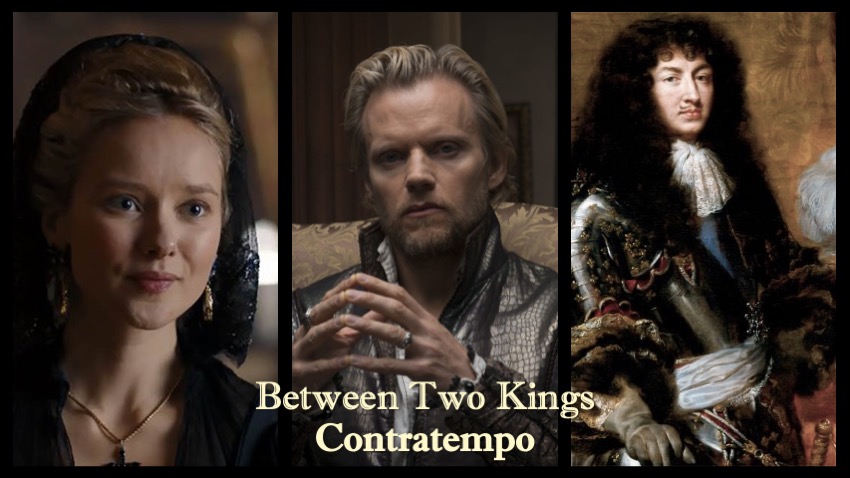
In 17th c. Italian fencing, contratempo meant an attack whereby the tempo for offensive action was the opponent’s own attack. It is a sophisticated technique of timing so that offensive action happens precisely when the opponent thinks they have an opening, thus turning their own tempo against them.
⚜️⚜️⚜️⚜️
“Halte!”
M. Beauchamps, the King’s young fencing master, raises his hand and ends the fencing match. “A fine bout, Your Majesty,” he adds, just as the King and his opponent, M. de Guiche, raise their foils in salute.
Louis turns his back, angrily whipping his foil in the air as he marches away. He seizes a towel from the hands of his valet, M. Bontemps and wipes his face.
M. de Guiche bows. “I was a poor adversary, Your Majesty.” The opposite is true. The King arrived for his fencing practice late and infuriated, after what, according to the early morning gossip, was an urgent meeting with the new Captain of his Musketeers, M. Mancini. The King sparred with anger and with little thought or strategy, and M. de Guiche had no choice but to show himself the lesser swordsman. Of course, the King would notice.
“We do not care to be flattered, M. de Guiche. We expect to be challenged!” The King throws the towel back into Bontemps’ hands and opens the door himself marching to his apartments, ignoring every bowing courtier along the way, with Bontemps following apace carrying the towels and the King’s fine doublet.
Once behind the closed doors of the King’s chamber, M. Bontemps masterfully directs a fast and silent choreography, conducting the small army of valets de garde-robe and servants with a simple raised brow or a slanted look so that everything is in place almost without a sound and at just the right moment: water for washing that is as warm as the King prefers, the repast he desires, a clean shirt just as he removes the one he wears, and his fine costume prepared for his Majesty’s afternoon visit with the Queen, who has been feeling better and is eager to receive her husband in her apartments.
“Have my mother here at once. She is at mass. Find the duc d’ Herblay and bring him here!” the King demands rejecting the costume. “Out! Everyone out!” He points to Bontemps. “You stay.”
The valet bows and stands silently by the closed door, keeping his eyes focused in some far off, distant point. Louis throws himself in a chair, still in his shirtsleeves, and after a few moments, springs to his feet and paces the room, only to throw himself back into the chair, tapping his foot on the floor impatiently. Finally, there is commotion outside the chamber.
“Her Majesty the Queen Mother!”
Louis springs to his feet again and signals Bontemps to open the door and leave.
“You are late!” Louis complains the moment M. Bontemps steps out, closing the door behind him.
Queen Anne raises a disapproving brow. She wears her black laced mantilla from mass, which she lets slip over her shoulders. “I came as quickly as I could.”
“I want him here too. The duc d’ Herblay! He should listen to this with you.”
She draws in a deep exasperated breath. “I know you ordered him to come, but he cannot be here.” Louis gasps appalled, but she raises her hand and speaks sternly, taking a step closer to her son. “He cannot be here, I will not permit it, even though I fear for his life as much as you should!”
“You intercepted my order!” He scoffs. “You fear for him!”
“And for you! There is pox across the river.” Louis looks puzzled. “At Saint-Severin. A small parish, mostly army widows and old soldiers. The parish priest was a Musketeer under M. de Treville. The duc d’ Herblay freely offers his assistance to his old comrades and their families and not just money and supplies, but his services. He has gone there himself. He is a man of God as much as he is a Musketeer. Others have joined him in this perilous undertaking compelled by the same sense of duty. The Baroness de Rohan-Rochefort and the Marquise de Normanville among them.”
Louis frowns. “The Baroness should not be taking such risks. As for the Marquise…How convenient!”
“Louis!” she admonishes. “This is beneath you. Not the King, the man.” She shakes her head, desponded. “I pray for the poor souls who suffer. I pray for the duc and all who defy disease and death to help those in need. So should you! They deserve our praise and our prayers.”
He feels the sting of her reproach just as he feels the despair and suffering. As a boy he was stricken by the pox. His mother defied everyone to remain near him, night and day, sleepless, nursing him to health. He understands the sacrifice his mother speaks about. Still, he will not budge. “No one thought to tell me? What about those at court? What about the Queen who is with child?”
“The disease has not spread beyond Saint Severin or across the river. There has not been rain or flooding for the foul air to fester. If the King leaves Paris prematurely there will be panic and panic is as bad as any plague. Besides, the court is preparing to leave Paris for the spring and will be moving soon.”
“You are right, we cannot risk another riot. But the Queen should leave at once. Discreetly. To Versailles.”
“Versailles? Louis, there is nothing at Versailles except marshes, mud, and rot from the winter. It is worse than remaining here. She should be somewhere safe… At the Château Neuf…”
“At Fontainebleau.” He will not be amenable to his mother’s suggestions even if he agrees. And he must send La Valliere from Fontainebleau to Versailles. He will not have her under the same roof as his wife. He turns his back and paces the room. “And you say that the duc d’ Herblay is at Saint Severin.”
“Offering his services to his old comrades and their families.”
Louis clicks his tongue, frustrated. He cannot find fault with this. “Well, then you alone will hear what I have to say. This is about Henri Bernard. He was moved to Vincennes but he is no longer there.”
“Good God! He has escaped!”
“Monsieur Mancini was here this morning, offering excuses.” Louis shakes his head. “I do not blame him, and before you say anything about M. Mancini, I remind you that you recommended him to me in the past. I stand by my Captain of the Musketeers. He barely had time to assume his new position and step into Vincennes. Those who took Henri Bernard from Vincennes took advantage of the fact, arriving with a signed release for the prisoner. Forged, of course. I say those who took the man, but I should rather name the culprits he names: Spain.”
She narrows her eyes, incredulous. “Spain?”
“I was as incredulous as you when I first heard it. Commander Marchal has launched a manhunt with his men and M. Mancini does the same with the Musketeers.” He returns to his chair and points to a chair across from him, for his mother to sit. “There is some logic in the move, on the part of Spain. M. le Tellier already alerted the council about two Spanish galleys sailing into the Bay of Biscay. The duc du Plessis took it upon himself to defend Us once more against them.”
“Spain… Vargas. A competent Spymaster who knows all.” She clenches her fists. “We will never be rid of this nightmare!”
“On the contrary. When I met Señor Vargas at Saint-Jean-de-Luz, he made it clear that it was in his best interest to support his King and my marriage against those inclined to prevent it. I believe that Señor Vargas has not changed his loyalties and his politics. According to Captain Mancini this did not come from Vargas. The name the Captain gave me, the name of the man he met–for a man showed up at Vincennes, unbelievable as it is–and the name on the forged papers that the Captain saw, was Beltran de Guevaro, Signor de Onate.”
“A familiar name.”
“Indeed. Last year, Don Guevaro replaced his brother for a few months as the Viceroy of Naples, because his brother was fighting against our armies in Tuscany.”
“Of course, I recall now. But how can he be connected to this? To Henri Bernard?”
“I have been thinking about it ever since Captain Mancini mentioned the name. Don Guevaro is a good friend of Don Juan José, who has been seeking a negotiation concerning M. le Prince.” Louis fixes his eyes on his mother. “A secret negotiation outside the regular, diplomatic channels.”
“Defying the King, his father? And you have agreed to such treachery.”
“They merely asked permission for an envoy to come to France,” Louis evades, but his mother’s demeanor compels him. “I gave it,” he adds quietly.
She frowns. “But Louis! The King is your uncle! Your father-in-law!”
“I will have Condé return to France, alive and penitent for all of Europe, for all the world to see. M. le Prince will return to France and kneel before me, declaring his loyalty to me and accepting defeat. That is all that is left, Mother. Once I have Condé, there is no longer any opposition. The Fronde will be no more.”
“You would negotiate with your uncle’s bastard?”
“That bastard wields power in the army and has friends at my uncle’s court. As you know, my uncle and father-in-law, the King, your brother, loves him. I wanted to hear what Don Juan José had to propose. I expected that a Frenchman as popular with the army and as competent in military affairs as M. le Prince would be unwelcome competition for Don Juan José.”
“What about Henri Bernard? Don Juan José and his allies, would they use him as leverage? If so, how do they know such a secret if it is not through Vargas as you say? Louis, how can you negotiate with those who play such devious games?”
Louis stands and walks behind his chair facing his mother. “That I would like to know. I would like to know how the secret of Henri Bernard could have reached that far. But perhaps it did not.” He fixes a meaningful look. “Spain is one explanation, the explanation that Captain Mancini offers me. I can think of a different explanation for Henri Bernard’s escape. After all, there are those in France who know him well.”
“Rochefort!”
“No, not the Comte de Rochefort. The Comte de Rochefort had no part in this,” he declares with certainty. “Henri Bernard has other friends in France. Not just my cousin in exile, but others. He even had a lover. I say ‘had’ because the lady has no scruples when it comes to her games of seduction, if the pamphlets are to be believed. That lady, the Marquise de Normanville, has family and friends, who knew about Henri Bernard and even protected him, since he was born.”
Queen Anne clicks her tongue disapprovingly. “Oh Louis, you absolve a fiend like Rochefort and turn against men who have loved and protected you all your life. Men like the duc d’ Herblay… And yet, the duc d’ Herblay has returned to Paris as soon as you permitted him, and since then he has been helping those poor people across the river. She too–his niece–the Marquise de Normanville. She is also risking her life. As for her father…”
“Her father has disappeared with the rest of their family. Are these the actions of an innocent man? Her father has abandoned his regiment and his post. Her father’s other friends have done the same. The man We raised from Musketeer to Governor of Paris, only to see him flee the city, as well as their fourth treasonous friend, the one who was once a Frondeur and then Ambassador of Venice. The one who dared to insult Us to our face and in Our own palace.”
“We know where they are, Louis, even if we pretend otherwise.” Queen Anne speaks calmly but sternly. “And that place is too far. Too far from Vincennes… Too far from Paris… Too far from everywhere that matters. You are eager to mistrust them.”
“And you, Madame, you are eager to defend them. I do not see you being equally appalled by the fact that one of them threatened me, your son and King, before my wife and the entire court and insulted the duc du Plessis, who is a member of our family. That he and his dissident friends continue to compromise the duc du Plessis and his mother. I do not see you defending your King and your family, Mother. I see you defending those four. I gave you d’ Herblay–I will not touch him, even if he continues to provoke–is this not enough?” Louis crosses his arms over his chest, ready to push against his mother further, but a faint knock on the door makes him stop.
“Your Majesty,” M. Bontemps whispers timidly behind the closed door. “Your Majesty, I beg your forgiveness. M. Falaize is here with an urgent message from Commander Marchal.”
Queen Anne motions to leave from the side door but Louis signals her to stay and return to her seat. “Enter!” he orders and M. Falaize walks in, hat in hand bowing deeply. “Speak!”
“We have the prisoner, Your Majesty, and Commander Marchal orders me to join them at Meudon as soon as I deliver this message.” He clicks his heels and salutes.
“Well, M. Falaize,” Louis says. “We need much more than this. We expect to hear a full report.”
“I will answer any questions to the best of my knowledge, Your Majesty.” M. Falaize is a soldier through and through.
Louis sits back in his chair, steepling his fingers on his chest. “We will hear what you know from the very beginning, M. Falaize.”
⚜️⚜️⚜️⚜️
“Commander Marchal confirms this?”
“Yes, Your Majesty. The prisoner Dauger was taken by Spanish agents. Six, or, by other accounts, eight men, with one Señor de Onate, as their leader. Their escape was well planned, but they used doubloons at Bloville where they were forced to get a carriage for their prisoner. It is how we found them on the road to Le Havre.”
“Their prisoner was taken ill?”
“I can only attest that the man we found was unconscious.”
“You saw the man yourself? You recognized him?” Queen Anne insists.
“The prisoner Dauger has always been hooded and masked in our presence, and he was thus covered when we found him, Your Majesty. Nevertheless, the man we found inside the carriage at Roumares and the prisoner I encountered at Vincennes appeared to me to be the same man: Dauger. Commander Marchal confirms it. He ordered that I convey this to His Majesty.”
“It makes no sense that they would leave him behind, in an empty carriage, a man they went to such great lengths to break out of Vincennes,” Queen Anne counters.
“It perplexed us at first, Your Majesty,” M. Falaize replies. “We heard pistols fired as we approached the carriage. There was evidence of an attack and the carriage was damaged. Our reasoning is that the prisoner was not as important to them as fleeing their attackers. Besides, the man was incapacitated, perhaps they thought him dead, just as we did.” He clears his throat.
“Yes, M. Falaize? There is more…” the King pushes.
“If I may, Your Majesty. This is by no means an inference. But we…my comrades and I have reported this to Commander Marchal just as I report it to you.”
“Go on.”
“We were ordered to visit this masked prisoner, Dauger, at Vincennes. We searched his room twice every day and made sure the orders for his imprisonment were followed to the letter.” The King nods. “The man had lost his mind, Your Majesty.” He turns to Queen Mother. “Forgive the distasteful description, Your Majesty. He would be silent one moment and howling the next, making no sense, ranting, calling himself all sorts of names: Alexander, Achilles, Brutus, Romeo, Henri, Thomas, Eustace, Philippe,” he hesitates, “he even…he even called out Your Majesty’s name at times. Louis. It is common with prisoners, Your Majesty. I have seen this often.” Queen Anne winces. The description is indeed distasteful.
“And, in your experience, this signifies what M. Falaize?” the King probes.
“They were attacked while fleeing with a demented, raging man. Under the circumstances, he could become a liability.”
“And you have no idea who may have attacked them?”
“No, Your Majesty. We found bullet holes all over the carriage which had fallen into a ditch at the side of the road, and the earth around it was dug by horse hooves.”
“Thank you, M. Falaize, your report has been enlightening.” The King waves his hand and M. Falaize retreats to the door bowing, just as M. Bontemps hurries into the room, whispering something to the King’s ear.
“Louis, I must ask…Don’t you find it strange that there was no one dead or injured, after an attack so fierce? No one besides…” his mother begins but the King raises his hand and she stops.
“There will be time to discuss this little matter later, Mother.”
“Little matter?”
He is on his feet. “Our time is invaluable.” He feigns an affable smile. “We will be visiting the Queen this afternoon. Join Us, Mother. At that time, We will be in a position to appease all your fears.”
Queen Anne realizes that she is being ushered hastily out of her son’s chamber on his orders. She never imagined this day would come. As the door closes behind her, she has the distinct impression that she can hear her son speaking to another man, whose voice sounds nothing like Bontemps’.
⚜️⚜️⚜️⚜️
The young Queen is disappointed. Not only can Queen Anne see it, but she can feel it. In her life, she too had been disappointed in this manner, and often. The young Queen expected a private afternoon with her husband–as private as such things can be–and she discovered that she would have to share him with his mother. It turned out even worse, because the King arrived at his wife’s apartments with the Cardinal and the Cardinal’s secretary, whose name Queen Anne did not recall until someone announced it: M. Colbert.
There is something unusual about this unexpected gathering. Queen Anne knows her son and this afternoon he is impervious to her, a man she does recognize. It alarms her that no one seems to notice the change. The King appears to be in great spirits nevertheless, excited, attentive, and tender with his wife, and announces the Queen’s early departure for Fontainebleau not as a necessity–he says nothing about Saint-Severin–but as a gift. A series of fêtes are planned so that it can be finally known that a Dauphin is expected, he tells the Queen, who is timid, but loves such diversions. “Besides,” the King adds, his excitement and gaiety as resonant and as they are feigned, “We must relinquish Our apartments at the Louvre to the vision of the talented Signor Romanelli who comes to Us highly recommended from Rome to decorate them. Our Mother’s apartments too.”
“Louis! What is the meaning of this?”
“A gift, Mother.” He slants a mischievous glance toward the Cardinal. “Monseigneur, alas, We are forced to make the revelation prematurely.” The Cardinal reciprocates the glance and bows deeply.
“Monseigneur is modesty incarnate,” the King extols, which of course, everyone, including the King, knows is a falsehood. Modesty is not one of the Cardinal’s virtues unless he is forced to feign it. “Cardinal Mazarin offers Us a marvelous gift, renovating Our apartments and yours, Mother,” the King proclaims.
“Your Majesty is too generous with your praises.” Mazarin bows to the King again and turns to Queen Anne: “I will be honored if Your Majesty accepts my small gift as a token of my devotion. Signor Romanelli is a renowned artist, whose work at my new residency attracted His Majesty’s attention.”
The afternoon is becoming more puzzling with every moment, Queen Anne thinks. Mazarin has been building a palace at the Rue de Richelieu, spending vast amounts of money that no one knew he had. This is the rumor. Now he offers to renovate part of the Louvre at his own expense. Not even Richelieu was this ambitious.
“Should your Majesties wish to inquire further, I have invited M. Colbert who knows all the details of the project and keeps a perfectly balanced accounting sheet.” The secretary bows deeply upon hearing his name.
“M. Colbert comes highly recommended too, Mother,” the King interjects, enthusiastically.
What happened to Louis since this morning, Queen Anne frets? What is this talk of fêtes and renovations, and gifts, and accountants or notaries or secretaries or whatever this Colbert is?
Finally, she manages a moment alone with her son, while they both walk from the Queen’s apartments to their own. “Louis, what is the matter today?”
He looks surprised but she knows he pretends. “Everything is as it should be, Mother.”
“And Henri Bernard? This morning…”
He presses her hands, reassuringly. “Henri Bernard no longer exists. Commander Marchal has his orders.”
“But Spain…”
He shrugs, his tone aloof. “A moot point. The time for games is over.” He eases his tone and smiles a reassuring smile which unnerves her. “I am sending our most competent envoy as ambassador to Spain. He will take care of the rest.”
“M. de Rohan. I have heard.”
“Indeed, but what you may not have heard, is that Spain has granted him all those titles which are rightfully his from birth. So, you see, Mother, it is the ducque de Lerma who will be speaking for France in Spain.”
“M. le Prince may finally recognize a peer, even though I doubt that Condé will acknowledge anyone as his peer.”
“Ah, you touch the very subject I had in mind.” Again, the King smiles that reassuring smile which unnerves Queen Anne. “You might as well hear the news first. M. de Rohan is a man of impeccable character as you yourself has declared on many occasions. Spain has claimed him, which is fair, for he is a son of Spain. But he is first and foremost a Frenchman.”
There is something alarming in this turn of the conversation. More alarming even than Louis’ reassuring smile and his imperviousness. “But he is already Baron de Rohan-Rochefort,” Queen Anne ventures.
“A poor substitute,” Louis sneers, and she feels the sting of his condescension. This was the title she had chosen. “It seems that M. de Rohan still carries his father’s sins for some who would not dare to raise him higher,” he adds and she is certain that the sting is meant for her.
“Louis!”
“M. le Prince will see it that way.”
This is not about Condé even though Condé is the pretext. Lous smiles that smile again which alarms the Queen, but she makes sure that she sounds firm and resolute: “Nothing will change the fact that the Comte de Rochefort is M. de Rohan’s father for M. le Prince or for anyone else in France and in Spain. M. de Rohan himself understands this well.”
“Which is why his father shall be reinstated immediately in France.” She gasps and he ignores her. “The Comte de Rochefort will also receive back his ancient family titles and estates. M. de Rohan is the scion of an ancient family of France.”
“Louis! Rochefort is a fiend! Pure evil! He has destroyed innocent lives. He almost killed his own son, M. de Rohan in Spain!”
The King levels her a cold, unforgiving look. “This was not a question, Mother, this is my decision.”

 Twelve Years After
Rochefort reinstated – a game changer and a contratempo indeed! And what an affront to Queen Mother, too. Louis must be desperate if he has conceded that.
I wonder if Rochefort wants to make a public comeback with his name cleared and his fortune & family estates returned to him in order to have a right to the Lerma fortune too – should something happen to Jean-Philippe. It seems like he preferred to operate from the shadows before. In any case, it hopefully means we will be seeing more of him and more about his endgame will be revealed in this part of the story. I guess he is “the second king” now that Henri seems to have exited the story?
So many characters will be affected by this. Can’t imagine the reactions, e.g. Aramis’ face when he meets Rochefort at court!
LikeLike
Hi Dinny,
Thank you for the great comment!
Louis is an opportunist, just like Rochefort. He needs a fleet, his economy is bad–he is still fighting the Fronde–and Rochefort hands him a fleet and money (a bank) and … even renovates his rooms at the Louvre.
I may write a note about all this, because it is all historically based even though it was not (obviously) Rochefort who did all this, but Mazarin and (later) Nicolas Fouquet . Mazarin did indeed renovate the Louvre (just as described here) and Fouquet set up a ponzi scheme not unlike Rochefort’s to be rivaled only by Colbert, who prevailed in the end. Dumas writes about the rivalry between Fouquet and Colbert but the historical rivalry is too good to be true and (perhaps we are too ambitious but…) we hope to get there too! One day!
Definitely this places a great deal of pressure on Rochefort now (and by extension on Raoul) who must keep providing for Louis… The implications for everyone are immense, you are right!
LikeLike