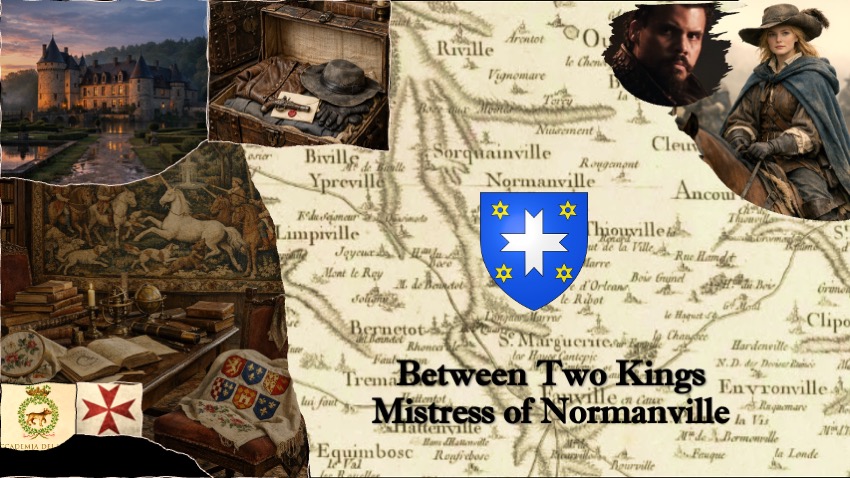
First, a little bit from the Canon, for inspiration.
Alexandre Dumas, The Man in the Iron Mask, chapter 83, ‘Porthos’s Will’:
“As to my personal or movable property, so called because it can be moved, as is so well explained by my learned friend, the Bishop of Vannes—” (d’ Artagnan shuddered at the dismal remembrance attached to that name) –the procurer continued imperturbably–”they consist:
[…]
6. My pictures and statues, which are said to be of great value, and which are sufficiently numerous to fatigue the sight.
7. My library, consisting of six thousand volumes, quite new, and have never been opened.”

⚜️⚜️⚜️⚜️
Marie Cessette was taught heraldry for the wrong reasons. Her old nurse Madame de Guesle was a good woman with little education. Whatever letters and numbers Marie Cessette learned early in her life she learned them from her mother. Soon, Marie Cessette discovered that she had questions about the world for which her nurse’s common sense and her mother’s modest schooling provided no answers. She asked her many questions with the ardor and innocence of a novice and came to learn that it was a grave mistake.
Madame de Guesle found Marie Cessette’s inquisitive disposition unseemly in a girl preparing for a good marriage. It was the same with Abbé Antoine de Béthisy, the curate at Pierrefonds and the family confessor, who warned against such dangerous proclivities, especially in women, for, as he argued fervently from the pulpit, the first sin was inflicted when a woman tasted the forbidden fruit from the tree of knowledge, and it brought about the damnation of man. Marie Cessette’s mother would never contest the decree of scriptures. But she also happens to be a practical woman. Burdened with the unfortunate circumstances of Marie Cessette’s birth, she saw a good marriage as ambition enough for her first-born. Any other fanciful notions would have to be tamed. Marie Cessette’s father, for his part, has approached the matter in a different manner, although, if pressured, he would claim that he agrees with his wife and with the scriptures. In that order.
With Porthos, it begins with the fact that he has the singular habit of buying books he never reads. In the early days of Marie Cessette’s life, her father’s books followed the household from one military camp to the next and when the family finally settled at Pierrefonds, he insisted on having a library. As far as Marie Cessette knows, her father has never availed himself of his library’s treasures, because he is always away, commanding some important mission somewhere. When he returns to Pierrefonds, he prefers to spend time with the family, to ride about his lands managing the affairs of his tenants, or to hunt, if the season permits. And yet he buys books. His library has expanded so much that to avoid hauling its contents to Blois whenever the family visits their other estate at Bracieux, he has invested in a second library there. It is a form of education, he insists adamantly. He has memorized every single title and author that he owns but has never read a single page, keeping his books pristine, which, to him, increases their value.
Marie Cessette’s life changed when Olivier was born. She was eight years old. It was a difficult birth, and her mother became very ill, and, for a long time afterward, was unable to attend the nursery and the house. So it happened that, Marie Cessette became mistress of the household in her mother’s stead, and likewise mother to two younger half-sisters aged four and two, and to her newborn half-brother. The burden was heavy and her father was away with his regiment often, but Marie Cessette bore it with courage and determination. This time Abbé de Béthisy not only approved but blessed the undertaking. Madame de Guesle, too, raised no objections. A girl is never too young to be schooled in the hidden machinery of running a household and a nursery, and eight years old is old enough. It was a hard apprenticeship that did not proceed exactly as the priest expected or the nurse hoped. It gave Marie Cessette good cause to enter her father’s library not merely to see it swept, dusted, and ordered, but to read the books herself.
As the world revealed itself page after page, Marie Cessette’s mind grew keener, and she learned to contrive small pretexts that granted her more time with her father’s precious books. Yet with that keenness came understanding. A girl whose ambition should be a good marriage is not meant to have questions let alone ask them freely as she once did. Was Eve’s transgression her curiosity or was it disobeying a command? Why is “knowing good and evil” a transgression and the same as learning and education? If it is a moral transgression, why is it permitted–nay encouraged–in men? And if the fault of woman is that her feeble mind makes her susceptible to sin, proven by how readily Eve was deceived by the devil, then what can be said about the frailty of man who was driven to sin not by the devil but by the feeble-minded Eve? Marie Cessette kept all these questions to herself, having learned a new and valuable lesson, that to preserve her curiosity and deepen her learning, as she intended, she would have to dim her intelligence, extinguish it even, as was expected.
By then, her mother had recuperated, and her father had risen at court and in the eyes of Queen Anne, who ruled as Regent. No longer another general with a noble name, and an old friend of the Duc d’ Herblay, the Prime Minister, but a man of consequence himself. It meant that expectations changed for his children, even for Marie Cessette who was not his by blood, and by every calculation of low birth, since her real father died a poor foot soldier before she was born. Nevertheless, like her half-sisters Renee, and Charlotte, and her half-brother Olivier, Marie Cessette too was meant for court, and marrying at court, is a different undertaking altogether.
There were tutors for her brother, as soon as he was breeched. Their father proclaimed that Olivier should start as early as possible. Tutors were engaged for the girls as well, affording the kinds of lessons that Marie Cessette craved for when she was the same age as her two younger half-sisters. For Marie Cessette these lessons came too late. She had read too many books and had already mastered the art of making herself appear and sound exactly as was expected. Still, she attended the same lessons as her half-sisters, with patience and good humor.
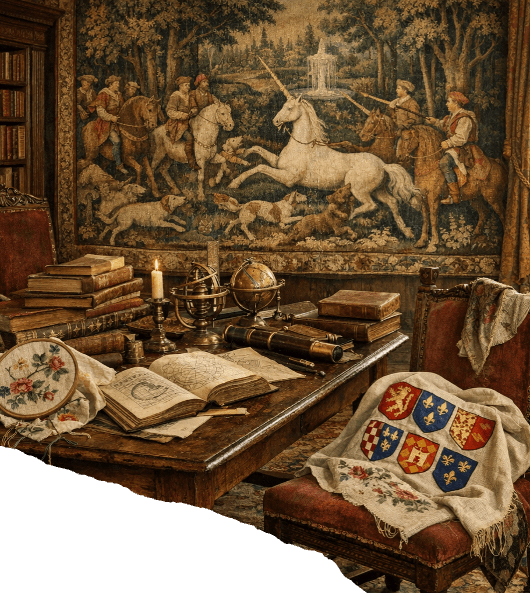
Their lessons about heraldry were still, markedly different from Olivier’s. Such lessons were imparted to the girls of the family along with the finer details of needlework and embroidery. For what other purpose would such knowledge serve young noblewomen besides preserving family ancestry, their own and that of their future husbands’?
⚜️⚜️⚜️⚜️
“…and I understand, Madame, that the arms of Normanville are blazoned.”
Pére Gazil who rides to Normanville in the carriage with Marie Cessette and her maid, Fleurie, is a lover of history among an array of other topics, and like all Jesuits well-read and well-travelled: from the South Seas, ‘Mar del Sur’ as the Spanish call it, to New France, the land of a thousand lakes and rivers as he calls it, and all in the service of the church and his patroness, the Duchess d’ Aiguillon. ‘Azure, a cross fourchée argent, between four mullets of six points voided Or,’ Marie Cessette thinks but lets him recite the description, just as she lets him explain the history of her husband’s estate which she knows. As with heraldry, so with history; it is thought a subject more fitting for men. And although in her Parisian salon such scruples have been dismissed with defiance, Marie Cessette must appear to comply with them now. It is what her exile is all about. “…Since the days of the Normans,” Pére Gazil is explaining eagerly while Fleurie is nodding wide-eyed, “and steeped in history! Some of it dark, I daresay, for Normanville has harbored both the Huguenots and the English and has been claimed by both. And indeed, many battles have been fought in its vicinity…” He pauses. “But I bore you, Mesdames. History is a dry and dull subject.”
“Not at all. My husband, the Marquis, is a great lover of history like yourself.”
“Ah, the Marquis is an exceptional man and worthy student of Signor Stelluti and the Academia dei Lincei. You may have heard that learned society spoken with suspicion, Madame, especially by those in the church, but some of us see it differently and aspire to join its ranks.” He leans closer. “In my travels, I was fortunate to have met Monsignor Salvatore Monteleone, the Secretary for Cardinal Barberini. He is a member of that learned society, and tells me, through Her Grace, the Duchess d’ Aiguillon, that he was honored to have met the Marquis in Rome.”
So much of Raoul’s life that Marie Cessette does not know about, but it does not bother her, for she has come to believe that a secret life is essential to happiness. What strikes her instead is how carefully her escort to this exile at Normanville has been selected by Raoul and his grandmother. It is not only Pére Gazil, who escorted Layla to Saint-Fargeau even though Marie Cessette does not remember him, for she was too ill. It is also Fra Raphael Clermont, who rides at one side of the carriage, armed to the teeth, the only sign of his religious affiliation to the Order of St. John, the Maltese cross on his leather pauldron. He rides silently, and if he overhears this conversation Marie Cessette cannot tell, but Pére Gazil does not seem to be concerned. It struck Marie Cessette when the two men first met at the courtyard of her house in Paris where her escort gathered, that they recognized each other. What she knows about Fra Clermont, the Knight of Malta, is that he has spent many years hunting conversos, those the Spanish call Marranos, in La Florida. The fact disturbed her greatly when she first heard it, but Raoul insisted. “He must join your escort. My grandmother thinks it a good idea also. We must anticipate any strike Spain may attempt”, he said cryptically, and Marie Cessette understood it to be a precaution against retaliation for faking Spanish identities to break Henri out of Vincennes. Raoul has a way of thinking many steps ahead of everyone else.
The other men in her escort have been chosen with equal discernment. The coachman, a towering man, is Fleurie’s father and used to be a Musketeer under M. de Treville. Marie Cessette’s father calls him Mousqueton, his nom de guerre, but his real name is M. Meynet. The rest come from Normandy and have been in Raoul’s service, just like Timothée. Marie Cessette has known all three by sight, if not by name. Their leader, Baptiste Caradas, is a lieutenant among Raoul’s men, like Timothée, but he is unlike Timothée in every way. A harsh man, who reminds Marie Cessette of Fabien Marchal at times, even though he looks nothing like him. In appearance he is more like the fearsome mercenary called Martin, who is loyal to the Duc du Plessis. The lieutenant’s father, still living, is seigneur of a small estate near Étretat and closer to the coast than Normanville. Baptiste is the youngest son in a family of seventeen children, eleven of them boys, so he joined the army when he was still very young, then chose the life of a mercenary, and later joined the ranks of the army once more, this time serving the Spymaster of France. “The rest of his story is hearsay”, Raoul confided, “but what matters is that Caradas–which is what everyone calls him–is fiercely loyal and brave.” Marie Cessette is certain that Raoul knows more about the man. It was plainly obvious to her, for example, the moment Caradas and Fra Clermont saw each other at the courtyard of her house in Paris, that they knew each other, and not a passing acquaintance, but a friendship, camaraderie even. She wondered with a shudder, if Caradas and Fra Clermont burned Marranos in La Florida together.
The other two men are also Normands. Romain de Seguzzo is a good friend of Timothée’s. Marie Cessette has heard his name mentioned in some of Timothée’s wilder stories about gambling and dueling, often serving as Timothée’s second. Quick to take offense but cool-headed with dice and steel alike, Timothée calls him. He is a dark, handsome man, the way Timothée would consider a man handsome. For her part, it was impossible not to notice the glimmer in the man’s eye the moment he laid eyes on Fleurie, her maid. As for the third man in her escort, Simon Patris, Marie Cessette has met him before, and this time because of her uncles and her father. His father was a Musketeer in M. de Treville’s regiment. Simon, the son, studied with the Jesuits, and was a protege of the Duc d’ Herblay, as far as Marie Cessette can put together, who, for some reason, chose to serve the Duc, and later Raoul, rather than follow his father’s footsteps with the Musketeers or a life in the church. Something in the way of his introduction, when he was presented to her at the courtyard, and the fact that his family comes from Dieppe, a Huguenot stronghold still, makes her wonder if he is a convert of a different kind.
Caradas has reined in his horse to the opposite side of the carriage: “We will stop at Épinay, once we cross the river, to cool and water the horses, Madame. It should take about an hour. The inn, ‘La Vache Noire’, is safe and very decent for your ladyship.”
Marie Cessette knows the inn, because it was the inn they did not choose, on the night they were smuggling Henri out of Paris dressed as Spaniards. M. de Rohan thought it too visible and on a busy road, so they paced their horses to reach Sannois and there they turned off the main road and stopped at a hovel of a tavern at St. Gratien. Marie Cessette knows not to give any hint, however. Instead, she smiles: “Of course, M. Caradas. Please do whatever you think is necessary.”
“We are still being followed,” the officer reports. They have been followed since they left Paris by Lieutenant Marchal’s men, which was to be expected.
“Will they follow us all the way to Normanville?” Pére Gazil wonders aloud.
“I doubt it, Monsieur,” Caradas replies. “Marchal wants to ascertain that Normanville is where we are headed, and the moment we are on the road to Barentin his men will abort. In fact, I suspect they will abort before we reach the ‘Crowned Bull’ at Saint Paul. It is a small village outside Rouen, and the inn is where Musketeers, guards, and messengers with dispatches change horses on the road between Le Havre, Rouen, and Paris. Anything beyond Barentin is more than a day’s ride back to Paris and Marchal will not waste his men thus. His spies in Normandy can do the rest.”
Pére Gazil sighs, shaking his head. “They are not the only ones following us,” Fra Clermont says from the other side of the carriage, and his voice, which Marie Cessette hears for the first time, is strikingly deep and resonant.
“We agreed not to alarm, Madame, until we are certain these men follow us and not Marchal’s men,” Caradas observes. “You must not worry, Madame. We noticed them as soon as we left Saint Denis. They seem to be keeping their distance.”
“My apologies, Madame,” Fra Clermont says with a faint bow even though his tone signals that he does not mean it. She has read it somewhere, that men like him, have the divine gift to intuit heretics, conversos, and witches with a simple glance and a whiff. She is not any of these things, and yet, she feels that she must guard herself. The men in her escort follow her husband’s orders, but it does not mean that they are ignorant of her circumstances. After all, her circumstances were sung on the streets of Paris. It disturbs her that she is beginning to see herself through their eyes. Marie Cessette returns Fra Clermont’s bow with a grateful smile that she hopes looks sincere.

⚜️⚜️⚜️⚜️
They find the road between Épinay and Pontoise busy and crossing the river takes longer, the barge having almost overturned earlier, which forces them to wait for hours until the barge is safely unloaded at the other side and new ropes secured to the pulleys so that it can be returned. The delay means that they must spend the night at Pontoise. This journey takes too long already. Compared to the last time Marie Cessette was on this same road, it feels like eternity. But this has been the plan that she agreed to follow. It is not just the exile but the road to it, she is beginning to realize. Restoring her reputation is not only the destination but also the journey and she must travel in the expected manner and pace.
Yet, Marie Cessette would rather they spent fewer nights on the road. It is neither fatigue nor impatience that compels her but deep sorrow. During the day, while they travel, she can be distracted, reading, or listening to Pére Gazil’s stories. But at night, alone, how can she stop her heart from returning to those she loves and has left behind: Raoul, her family, and Layla, her beloved Layla, whom she may not see for years? This journey is a painful trial, and her exile is likely to last much longer than Raoul hopes or pretends, because the resolution depends on the changing winds of court politics and on the will of a King who has come to despise her. This journey is a strange penance, Marie Cessette realizes, forced on one who is not willing to be penitent. But she will make a good show of it, and convincing too, even for the likes of Fra Clermont.
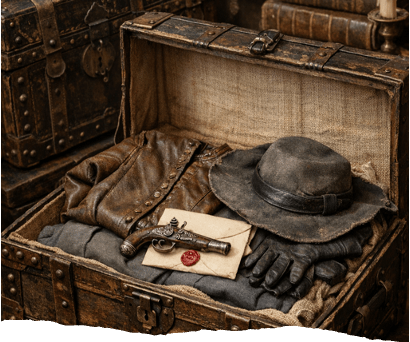
“I will take these with me,” she tells M. Patris pointing to the two small chests she keeps with her in the carriage. They are excessive, for a few hours of rest at a roadside inn, but it is to be expected of a lady who will not sacrifice her comfort, and M. Patris obliges. One chest holds letters from her brother and sisters, her prayer book, gifted by her mother, a pair of beautiful leather gloves and a translation of Thomas More’s ‘Utopia’–of all books!– gifted by her father, and her copy of Fortunio. She has not read that fairy tale for a long time but it reminds her of Layla and their friendship. Her jewelry is in the chest as well, including Raoul’s wedding gift, the ancient Roman necklace with the carnelian stones.
The other chest is an unexpected gift. It arrived the morning of her departure. Ciaran brought it with one of Layla’s footmen. “Madame asks that you open it, before you leave Paris. There’s a letter in it,” he said. But Marie Cessette did not open the chest, nor did she read Layla’s letter lest her courage abandoned her before she stepped into the carriage, and that would never do. Seated at the side of the bed, in the small room of the inn, unable to sleep unlike her maid Fleurie who is sleeping soundly, Marie Cessette wonders if Pontoise places enough distance between herself and her beloved friend or if she should wait until they arrive at Normanville. She relents in the early hours before dawn. Perhaps the scriptures are right, and women are frail creatures unable to withstand temptation, she thinks, opening Layla’s gift.
What she finds, on second thought, surprises her not at all. Folded inside the small chest is one of those split skirts that Madame de La Fére wears and Layla has adopted with great enthusiasm for they give a woman the freedom to ride astride. But there is more inside the chest: Layla’s old, battered leather doublet from the days when she was a Musketeer, two linen shirts cut in man’s fashion, and the pair of breeches that Marie Cessette borrowed from Layla when she disguised herself as a Spaniard the night they broke out Henri from Vincennes. There is a cavalier hat too, and adequately battered, to complete the disguise, but most importantly, there is a smaller beautifully carved case that includes an elegant pistol, not unlike the pistol the Comte de la Fére gave Layla as a wedding gift. It comes with a fully equipped leather bandolier. A small chuckle escapes Marie Cessette’s lips but the moment she reads Layla’s letter her eyes are flooded with tears.
“My dearest, most beloved Sister,
I cannot, in good conscience, suffer you to set out upon this journey without those provisions which seem to me the plainest necessities. Let Raoul say what he will and let his scheme be as ingenious as he thinks it. Common sense must prevail.
Keep your practice with the pistol, even at your stopping-places, if you can contrive it. And once you are at Normanville, make it your daily discipline. Twice, even thrice a day, if it may be done. Normandy is not Paris and you are no longer bound to its rules even though it is those rules that have inflicted this journey and this exile upon you. But Paris is too far and Normandy uncertain, especially now. Remember that to shoot for one’s life is not the same art as to hunt. Would that we had time! I should have made you perfectly adept in very little. Yet M. Patris, who goes with you, is an excellent marksman. I know him from my days with the regiment. He served the duc d’Herblay then, and once or twice I tried my skill against his. Naturally, I won.
(Marie Cessette laughs softly between her tears: “Naturally she did!”)
I send you all that is required, save the boots, because you are already well provided in that respect. Indeed, it is to you that I owe the little stratagem by which I can wear my men’s riding-boots beneath a lady’s habit, even when propriety forces me to ride side-saddle.
My beloved Sister, never permit any person to doubt you, nor to force you into becoming some other creature than your brilliant self. You tell me we are different, and I understand well how birth and family have set their seal upon our lives. Yet, what I know comes from the life I lived, as a nameless orphan. This, my love, is the lesson I have learned: it is better to intimidate than to be intimidated. At Normanville it is not the lady of the estate who arrives to be sheltered and shaped, but the mistress who will shape her domain as she chooses.
I shall not say farewell, my precious heart, only au revoir.
Layla—”
⚜️⚜️⚜️⚜️
Despite the sleepless night her mind is clear at daybreak and when Marie Cessette steps once more into the carriage she has the odd sensation of being roused from sleepwalking.
“Richard the Fearless, who ruled over the lands of Normanville, was grandson of the infamous Rollo. The fierce Norseman, who besieged Paris,” Pere Gazil resumes his history lesson, as the carriage moves slowly along the road from Pontoise toward Rouen.
“A most diverting history, Monsieur, Marie Cessette observes with courtesy. “But what of the estate as it stands today?”
“Madame, you speak wisely. We must return from chronicling to the real and practical concerns before us, and I confess that save for the curé of Saint-Marguerite, Pére Bartélémy d’Athenous, once my pupil at the seminary, and what he writes to me, I know little else,” Pére Gazil admits with an embarrassed smile.
“Perhaps we can each furnish what we know,” says Marie Cessette. “My husband keeps regular correspondence with the house steward, M. Bonshoms and with M. Dufay who administers the estate, and who, I believe, is married to Madame Bonshoms’s sister.”
Pére Gazil is listening with great interest. “You have the advantage, Madame. For my part, I know only that M. Bonshoms and his wife, the housekeeper, have two sons and are pious and charitable, as are M. Dufay and his wife, although that family was struck by death recently.”
“I may know a little more about this,” Marie Cessette says, “for when I learned from Madame Bonshoms, who writes to me as regularly as her husband reports to the Marquis, that her nephew was gravely injured at Stenay, I immediately wrote to my father who fought that same battle, as you may know.” She will say nothing about her uncle Charles, who was almost killed at Stenay but continues: “My father learned that the boy, barely thirteen, was a drummer with the infantry.” She will say nothing about her real father, who was killed, an infantryman. “My father made inquiries and found the boy, but he was too gravely injured to be moved. He saw that the boy was well tended and when he died, he was not cast into the common grave but laid at the churchyard of Stenay with his name cut into the stone so that he will be remembered. Jehan Dufay. That was his name.”
“Poor little soul. No other children?”
Marie Cessette shakes her head. “None that I have heard.” Besides her, Fleurie is wiping her eyes, and Marie Cessette at once changes the subject. Fleurie’s youngest brother, M. Meynet’s youngest son, was also injured at Stenay. He survived, but it cost him his leg. “There is also the family of M. Papon, the stablemaster and his wife, who is cook, and to whom, on occasion, my cook in Paris has sent receipts enclosed in my letters to Madame Bonshoms. I am eager to meet her, I confess, for it surprises me that a cook at so provincial an estate and so far from Paris should inquire after the newest fashions in good taste.”
Pére Gazil chuckles. “I understand her cooking is renowned, and she is prideful upon that point, but otherwise they are a good and God-fearing family.”
“A daughter and two sons. The youngest I think is near my brother’s age.”
“There is another child in that family, younger, and born deaf, is it not so?”
“You speak, I think, of Madame Papon’s nephew, the son of M. Mustel the groundskeeper.”
“Is he not a widower? And that poor boy, quick of mind and eager for learning, is an orphan.”
“Madame Bonshoms writes that his poor mother was the cook’s sister and died at childbirth and very young.” The carriage’s pace slackens, and Marie Cessette pauses realizing that the conversation affords her the opportunity she needs. “This brings me to another matter,” she says. “Education.”
Pére Gazil is not the least surprised. “You are a great proponent for education, Madame. Her Grace, the Duchess d’ Aiguillon impressed it upon me that I must advise and assist you in all things.”
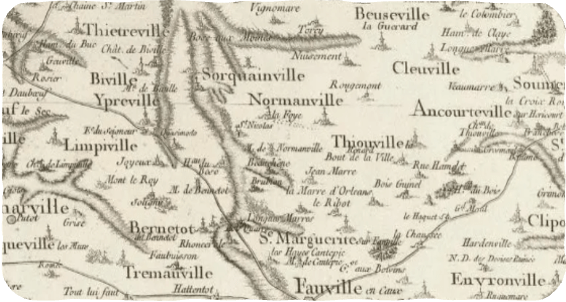
“The Duchess is as generous as she is discerning. And I am determined, on this matter. What do we know of schools? Madame Bonshoms tells me nothing, and neither does her husband in his monthly reports to my husband. I must conclude from this that the families living in the estate, and it is five and thirty villages not counting Fauville, which I am told, might pass for a small town, afford their children little education beside the schooling received at home. What says your former student Pére d’Athenous? Has he begun a little school for his parishioners?”
“He tells me the people of his parish and those he meets in the fields and on the road are honest and hardworking. Good Christians too, for this is no longer the land of Huguenots. But they are farmers, Madame, sowing their wheat, tending their cattle, and pressing their wine. I fear that you and I, accustomed as we are to a society of learned and cultivated friends may…”
“I am not so simple,” Marie Cessette interrupts him but at once softens her voice. “Pray understand, that I have lived much of my life in the countryside, at Pierrefonds, at Bracieux, and elsewhere, following my father to war. I do not dream of keeping a salon at Normanville, nor do I fancy myself founding a printing press and a society of poets and artists. I am not the Grande Mademoiselle and Normanville is not Saint-Fargeau. I expect to find honest, pious, and hard-working folk. Yet, I would have their children taught, to secure them a better future and improve their lives, even if they are to remain farmers. I see this not only as my duty but as a calling.”
Pére Gazil shakes his head. “In this Madame, you will find me of the same mind. But work so worthy is seldom easy. We must seek allies and advocates, among curés, among the elders, among all who hold credit.”
“Men and women? Would some women not be invaluable?”
“Assuredly both.” He nods. “Once at Normanville, we must determine those with influence starting with those in the Marquis’ service. From what you tell me, M. and Madame Bonshoms may be two such persons so we must make them allies.”
“And Pére d’Athenous?”
“Consider him already an advocate. He will lead us to others. We are fortunate, too, to have the Benedictine Brothers of Saint‑Wandrille, and the Sisters of the Abbaye de la Sainte‑Trinité at Caen, well disposed toward such a noble and worthy mission. Yet, I must caution you: we may also find men of the Church, men of weight, who will oppose us.”
“I never supposed it would be easy.” Marie Cessette sighs. “Before we speak of this as a mission, we might begin modestly, with a little school at Normanville.”
“A prudent beginning. A school for boys, such as M. Mustel’s clever son, to learn their letters, their catechism, and their numbers.” He smiles. “Perhaps a little history too. The history of their ancestors.”
“And the girls?”
Pére Gazil gasps. “Girls? What has this to do with girls?”
Marie Cessette is grateful for the sudden jolt that brings the carriage to a complete halt. It grants Pére Gazil a moment to muse upon her true purpose. She slips aside the curtain and peers out. “What is the matter, M. Caradas?” The road ahead of the carriage is congested as far as the eye can see, not only with carriages, carts, and riders but with a crowd of people on foot, as if in flight. Many look stricken. Others terrified.
“It makes no sense, Madame,” the officer replies. “Fra Clermont rides ahead, and as far as one can under the circumstances, to learn the truth of it.”
Pére Gazil has drawn back the curtain at the opposite window and leans out calling to those nearest in the crowd.
“These people are terrified, M. Caradas,” Marie Cessette observes.
“They are, indeed, Madame,” Pére Gazil confirms, returning to his seat. “They swear that the Grand Inquisitor has set foot upon these shores. They say he sails on the river, inland from the coast. That he arrived aboard a ship bearing a cross so high that it shadows the sun.”
From his saddle M. Caradas throws up his hands. “It makes no sense, Madame. As I said.”
⚜️⚜️⚜️⚜️
Their progress is delayed yet again. At Saint Clair-sur-Epte they contrive to turn the carriage off the high road and stop at a tavern built almost entirely of pale limestone scavenged from a neighboring château. The plunder brings tears to Pére Gazil’s eyes. “What waste!” he laments upon seeing the ruins, “for this château was raised by the King of England and once marked the border between Normandy and France. But His Eminence, Cardinal Mazarin ordered it dismantled. Who could have imagined that it would turn into this dismal ruin so fast?”
“Anyone who knows how precious ready-cut stone is to the poor, Monsieur,” observes M. de Seguzzo and it strikes Marie Cessette that of the men in her escort, Timothée’s friend is the least inclined to be reverent. The tavern is cramped and meanly stocked, and they are made to sit together about one great table set in the open air by the host and his sons, to avoid the foul air inside.
“The tale about the Grand Inquisitor must hold some truth,” says Fra Clermont. “I rode as far as Vesly, and it is the same everywhere. Some of these people have been walking for days, even crawling on their knees, seeking penance, and others swear they come from the coast where they saw his great ship with their own eyes.”
It is the most Marie Cessette has heard him speak at once. With him she makes sure to measure her words. “The Grand Inquisitor in France? Can such a thing be?”
He lifts a brow, troubled. “Had you asked me this morning at Pontoise, Madame, I’d have said no. But now…Now I don’t know what to think.”
“But the Inquisition, in France!” Pére Gazil protests, shaking his head. “It is an affront to His Majesty and His Eminence!”
“Ah Julien!” Fra Clermont’s familiarity startles Marie Cessette because she did not think the man capable of it. “You know them as well as I. Would you say that the Grand Inquisitor troubles himself over whom he offends or what borders he crosses?” He tilts his head toward Caradas beside him at the table. “Caradas will tell you the same.” Caradas nods.
“If there is any good in this delay,” M. de Seguzzo observes, “it is that Marchal’s men are caught in it and left further behind. I do not see them following us further than this point.”
“And the others?” Marie Cessette presses.
“They have not been upon the road with us this morning, Madame,” Caradas replies and Marie Cessette cannot tell whether he means to reassure her or if he is not reassured himself.
“Perhaps we were mistaken about them,” says Fra Clermont but sounds as uncertain as Caradas.
They decide to quit the main road and travel on country roads to Rouen, so far as the carriage can suffer it. It is rough going, yet faster than the blocked highway, and they reach the Cistercian Abbaye Notre-Dame de Fontaine-Guérard before sundown, before the gates are closed. The Abbess, Élisabeth Le Cordier de Bigards, scarcely older than Marie Cessette’s mother, is a great admirer of the Duchess d’ Aiguillon, and willingly grants them shelter for the night, even the men. Reports about the Grand Inquisitor have reached her too, and she is as perplexed as everyone else. The ways of God are obscure, she cautions.
From the Abbey to Rouen, their pace at last improves, not because the crowds have dwindled, but because they have dispersed along the many roads leading into the city. They reach Rouen by midday and choose not to lodge there as they first intended, pausing only long enough for supper and for the horses to be watered and cooled.
They find the city rife with rumors, and not just about the Grand Inquisitor descending upon it. One tale speaks about a pirate ship sighted not far from the Inquisitor’s great vessel. Men from that ship, it is said, made it ashore and maybe sailing inland upon the river. Is the Inquisitor meaning to hold a tribunal at Rouen some fret? Others stock their warehouses and board their homes and shops fearing a pirate attack from the river. Who will defend the city against such calamity? The King’s guard left at Rouen is small and the city’s militia is smaller. And since the duc d’ Herblay ceased to be Prime Minister the fortress has passed into the hands of Cardinal Mazarin and has fallen into disrepair, even though the Cardinal still uses it as a prison.
Another tale revolves around smugglers using the entire coast from Le Havre to Calais. Some say they are English and others say they are Dutch, and although they would not be the first smugglers in these waters, their contraband makes everyone uneasy: hundreds of muskets and pistols, enough for an army they say, barrels of powder, and even a cannon or two.
Pére Gazil crosses himself at the sound of it, and Fra Clermont, well-versed in the politics of Paris as he seems to be, observes: “It is true. The Longuevilles are preparing for another war, then.” But their innkeeper, a man also keen in politics, shakes his head.
“Either the Longuevilles or the Prince of Sedan, Monsieur. There is more than one taker for this sort of contraband in Normandy. If Normandy rises against King and Cardinal under the banner of Condé and with the backing of Spain, the Prince of Sedan may very well launch his own war.”
“He has been clamoring for the independence of his principality to be returned to him, since the days of our King’s father,” Pére Gazil remarks. “The Prince of Sedan, M. d’ Auvergne, has always been rebellious, following His Majesty’s uncle, the Duc d’ Orleans, in his earlier revolt and with the same purpose, to gain independence for his lands. And on many other instances he has conspired against the late King and Cardinal de Richelieu.” He crosses himself again. “God help us!”
“The Condés and the Longuevilles will not tether themselves to Huguenots,” M. Patris counters. “The Prince of Sedan, M. d’ Auvergne, is Catholic in name only.”
“They all hate our Cardinal at equal measure, M. Patris,” Marie Cessette says. “And they all are unrepentant Frondeurs. M. d’ Auvergne, is a leader among them alongside his brother Turenne, his influence exceeding that of M. de Beaufort and Cardinal de Retz. I believe that under such circumstances, Catholic in name only is Catholic enough.”
M. Caradas swears carefully, under his breath. “And we must ride straight into it with a carriage and women.”
“It is worse, I fear, Monsieur,” says the innkeeper. “My warning is no hearsay because I have met the fiends myself and barely escaped with my life. You travel to Normanville, you say, which means that once you ride past Mont-Saint Aignan and on route to Barentin, the road nears the forest of Roumare. You should consider yourselves fortunate that you do not have to cross it, and that your route only skirts the edge of it, but I caution you to keep your guard all the same. You travel with a lady, a young maid, and a priest, in a carriage that is most conspicuous for the lady’s coat-of-arms on its doors is as well known in our parts, as is the name of the lady’s husband.” He makes a deep bow to Marie Cessette. “Forgive me, Madame, but the King’s favorite is well known in this city and all over Normandy, especially since the battle fought but a year ago, here at the old fortress of Rouen.”
“Roumare is favored by highwaymen,” says M. de Seguzzo.
“These are not highwaymen, Monsieur,” the innkeeper objects. He points to the open seat next to the officer. “May I?” It is another tale he means to lay before them, and a long one. Marie Cessette signals to M. de Seguzzo and he moves aside for the innkeeper to sit at their table.
“Bohémiens have always been a scourge in our parts, but until now it has been no more than trespassing, maybe a few chickens and eggs pinched from farmhouses, a lamb or two sometimes, poaching, fishing where it is forbidden, petty thievery, and the like. They never accosted travelers. They never attacked villagers. They carried no arms, besides sticks and daggers. Their leader is a man they call Voivode and for years, he’d bring his troupe into the villages, and into the city on carnival days. He played the violin masterfully, like the very devil, and they danced and did all sorts of stunts, tumbling, walking on stilts and ropes, card tricks, telling fortunes, and the like.”
“But this has changed?” Caradas is eager to get to the point.
The innkeeper sighs. “Aye, Monsieur, and for the worse, since the rumors started about the Great Inquisitor’s ship off our coast. You see, Voivode and his troupe are not the only Bohémiens hereabouts and, it is well known, that in Spain his people are hunted along with the infidels and the witches and the heretics. Voivode no longer commands a troupe, Monsieur, but an army. They gather more to their ranks as they tramp the countryside, fleeing, so it seems, the Inquisitor’s track. Now it is not only Bohémiens who join them. Now it is no more a matter of poaching and petty theft. Now they attack to ravish and to plunder and to kill, like rabid dogs with no mercy. Two days past, they sacked and burned the manor at Déville. They did unspeakable things to the women. They carried off two little boys.”
“They are armed!” Marie Cessette pushes.
“It seems so, Madame. As I said. Too many weapons in Normandy these days and too many takers for them.”
“Who arms them?” Fra Clermont insists.
“That I cannot say, Monsieur. All I know is that they are armed. I saw them with my very eyes on the road from Canteleau. Not just daggers, Monsieur, but pistols. And they know how to use them. My sons and I escaped by God’s mercy. We left our cart behind. Ten wine casks, Monsieur, all gone.”
“We must travel by day only. It slows us significantly, but we have no choice,” says Caradas. “Under the circumstances, the carriage is an invitation and a death trap!”
“Perhaps for the best, M. Caradas,” Marie Cessette says and to the men’s puzzled looks she returns a small, steadying smile. She rises and signals her maid who stands at once. “M. Patris,” she tells the officer, “Fleurie will show you which chest I need from the carriage. Bring it to me, if you please.” Then to the innkeeper. “Monsieur, I must use one of your private rooms for a short while, and I shall pay you a full day’s rent.” She signals Fleurie again to see it done. “Messieurs, I shall return presently,” she says.
Whether they took it for a lady’s whim or the sort of extravagance ladies insist upon on the road, the men seated around the table were not prepared for what followed. At least this is what Marie Cessette thinks she reads in their stunned faces when she returns.
They spring to their feet the moment she approaches their table, followed by Fleurie, carrying Layla’s gift, only now the chest contains Marie Cessette’s traveling gown, while Marie Cessette herself is dressed in the cavalier outfit that Layla provided. “Messieurs, sit, I beg you. If you are to act thus, what is the point of this masquerade?” she cautions them sternly and the men comply at once. “This is better.” She swings over the bench, as a man would, and sits between Caradas and M. de Seguzzo. “Now, let us have wine and consider how to make that carriage work to our advantage.”
From across the table M. Meynet lets out a loud chuckle. “You are truly your father’s daughter, Madame!”
⚜️⚜️⚜️⚜️
Caradas slaps a hand on his forehead. “Parbleu, of course!” he exclaims upon hearing Marie Cessette’s words. “I cannot believe I did not see it!” The rest of the men lean back, shaking their heads, equally frustrated by their lack of imagination.
“Sang Dieu! The flight from Spain, the battle at Fuentarrabia, the sea battle at the Bidasoa! I did not think it either, and I have heard it in detail and from M. Bennart who was there!” M. Patris gasps. It occurs to Marie Cessette that none of the men feel the remotest inclination to refrain from swearing for her sake, which, an hour past, would have been unthinkable. Is this the side of men Layla sees, she wonders? She will keep to herself such observations, and share them with Layla when they meet, which will happen, and sooner than later. Somehow, now she is certain.
Only Pére Gazil looks from face to face, baffled. “Pardon me, Messieurs, but I do not understand.”
Fra Clermont lays a friendly hand on Pére Gazil’s shoulder. It is not the familiarity and the informality that strikes Marie Cessette this time, but how the man she thought impervious has softened, and so quickly. “Ah, Julien,” he chuckles. “I will have to explain this to you, as we ride together in the carriage.” He fixes his eyes on Marie Cessette as if seeking confirmation.
“Yes,” she replies. “I must have your horse, Monsieur.”
“The carriage of the Baroness de Rohan-Rochefort, however, was well fitted for a sharpshooter,” says M. de Seguzzo. “Being the only sharpshooter, might I suggest that I ride in the carriage instead of Fra Clermont? Will we be spending time here, at Rouen, making alterations to the carriage? Perhaps delaying our departure averts the danger.”
“Or increases it,” Marie Cessette counters. “Messieurs, even if half the rumors we have heard are true, then the situation will grow worse, and whether this means that Rouen sees an Auto-da-fé, an attack by pirates, a raid by brigands, war against the King and the Cardinal, or all of these things, I submit to you that it is wiser to hold our ground where we can defend ourselves and where we have leverage. That is not on the road, and I am neither mercenary nor soldier. I would be at my husband’s estate, where we can defend those whose livelihood and prosperity depend on that land. I would be where I am mistress.” She chooses the word with intent, and because she liked the sound of it, unusual though it was, in Layla’s letter.
Next to her Caradas clears his throat as if to speak but remains silent. The rest of the men fall silent also. In the end, M. de Seguzzo returns to it. “Madame, perhaps I should be the one inside the carriage instead of Fra Clermont.”
“No, Romain,” says Caradas. “This is not the same as the battle of the Baroness de Rohan-Rochefort in Spain. Our carriage is not fitted for a sharpshooter and Mademoiselle Maynet and Pére Gazil riding in the carriage are no fighters. We need a man inside the carriage who will fight with his hands if necessary. I will have my sharpshooter outside.” He clears his throat again. “Madame, I…” he hesitates. “…if I may…”
“Whether I can shoot, is this your concern, Monsieur?” Marie Cessette anticipates his question. “I hunt. It is not my favorite pastime, but I am tolerably good at it. And I know well enough that shooting for one’s life is not the same, but it is what I can do. She turns to M. de Seguzzo. “However, I expect to be instructed at every opportunity on the way to Normanville, Monsieur. And when, God-willing, we reach the estate, I expect daily training. Three times every day.” She rises. “It is already midday, and we must not linger another minute if we are to travel only in daytime.”

⚜️⚜️⚜️⚜️
They lodge at Barentin for the night, a tolerable inn, where they hear the same rumors as in Rouen. At Barentin, however, people are more worried about Voivode’s ragtag army, two farmsteads and a manor house at Pavilly having been attacked within a week. At dawn, they ride out again, hoping to reach Normanville, or at least, Fauville before nightfall.
“We are followed,” M. Patris signals from where he rides, behind the carriage.
“Not Marchal?” Fra Clermont replies from within, where he sits with Pére Gazil and Fleurie. The maid has been taking this journey with courage, but as the road brings them closer to the forest, she is shaken, losing her nerve. Having Pére Gazil and Fra Clermont in the carriage with her has steadied her, until this moment. From her horse ahead of the carriage with Caradas, Marie Cessette hears Fleurie’s thin whimpering, and Pére Gazil assuring her that all will be well.
“Not Marchal. The others. They keep their distance,” M. de Seguzzo calls from the carriage’s flank, nearer the fore, where he rides by design, close enough to vault onto the box and take his shot from a higher perch, or lay hold of the reins, if needed.
“We must move,” Marie Cessette tells Caradas who nods.
“We move!” Caradas orders. “We will not be distracted nor driven from the road.” He leans from his saddle to Marie Cessette. “Perhaps that is the purpose of those horsemen, whoever they are.”
They make good pace through Bouville and Croix-Mare halting barely an hour to water and cool their horses. By midday they have reached Yvetot, but between Vallinquierville and Fauville, the weather turns, a heavy storm approaching, and just as the light of day begins to wane.
“We must make it to Fauville!” Caradas pushes. “We cannot turn back. He orders the coachman M. Meynet to press the team. If the storm catches them, the carriage may bog in the mud and silt of the rough country road. But Voivode’s army catches them first.
⚜️⚜️⚜️⚜️
It is all open farmland, save for a dense coppice where the road narrows and drops, following a steep-sided gully, part wash, part ravine. They fall upon the carriage from all sides, some of the fiends clawing at the panels, others striving to scramble onto the roof, a few attempting to jump onto it from higher branches. M. de Seguzzo barely gains the carriage box as planned, musket in hand beside M. Meynet, who wrestles the reins to keep the coach from sliding into the ravine, the very thing the attackers seem to be seeking. In a cascade of bullets and a cacophony of clashing steel Marie Cessette hears Fleurie scream. Dear God they are inside the carriage, is all she has time to think. There is no more time, because two of Voivode’s wretches spring upon her horse.
One looks like an old man, toothless, in rags, his hands reaching for her reins like claws. The other, younger, tries to wrench her feet from the stirrups so that he drags her down. Later, what Marie Cessette will remember of him are his hollowed eyes. Later still, she will think of his face as the haunting portrait of hunger and rage. At the moment, however, she knows only this: she has one shot for she is not skilled enough to reload quickly, but she can handle a horse as well as any man.
Swiftly she swerves her horse so that for a moment the younger brute finds himself staring at the hind legs. It is enough. A hard squeeze, and the horse, already maddened by the attack, kicks fiercely, striking the man full in the chest. No matter how many years will pass, and how many deaths will follow, Marie Cessette will never forget the first man she killed. His body strikes the gravel and tumbles down the ravine, just as the old man makes another desperate clutch at her saddle, to pull her after him. A bullet finds him through the back, and he falls, his eyes emptied, his toothless mouth agape, to be trampled like a rag doll beneath the horses of M. Caradas and M. Patris who have drawn their swords, hacking through flesh in blind fury.
The fiends are no great fighters, but they have numbers on their side, and despair, the thickening darkness and fierce gusts of the storm making confusion their ally. They swarm like mad devils, leaping and howling in the lightning’s white rents across a blackened sky, thunder rolling, rain beginning in fat, hard drops. Marie Cessette turns her horse away from one attacker, then another, and in the next flash of lighting she catches, at the corner of her eye, M. Meynet on the box, straining to hold the team steady. Beside him M. de Seguzzo fights with sword and dagger against three, four, perhaps. On the side where M. Meynet sits, the carriage door is torn loose, for she can see the back of Fra Clermont, who holds the rear against those forcing their way in.
Another bolt of lightning, and it is as if a fiend is conjured next to M. Meynet, who must be injured, for he falters as the brute fights to grip for the reins from his hand. This one is tall, broad and strong, nothing of the gaunt carrion look of the others. Marie Cessette draws her pistol and steadies herself in the saddle. Make it count, she tells herself. The bullet pierces the man’s eye and he reels back with a howl, clutching his blood-smeared face. It buys Fra Clermont the heartbeat he needs. He turns from the ruined door, lunges, and with one brutal shove drags the brute down from the box and flings him to the ground.
Still, they come, as unrelenting as the storm that descends, thunder mixing with the clamor of battle. Only it is not thunder. It is another roaring altogether, pounding hooves and a crackling volley from behind, on the road from Vallinquierville, whence they have come.
“Sang Dieu!” Caradas spits, breathless in the saddle. “And who are these devils now?”
Ten cavaliers, every one masked, ride like phantoms through the gusting wind. The foremost, plainly their leader, raises a gloved hand and his men halt at a clean distance for shooting, lining up their horses to block the road. From the way they sit their horses, to the way they draw their pistols as one body, it is obvious, even to Marie Cessette, that these are trained soldiers. “Let the carriage go, or we execute every single one of you, filthy wretches,” their leader barks from his horse, his voice deep and sonorous, with a faint foreign tilt, and Voivode’s fiends check themselves. Pistols and daggers drop back, and the fiends retreat sliding back into the thicket and down the ravine like shadows.
Caradas and M. Patris rein in on either side of Marie Cessette, ready to protect her from a second attack. But the strange troop does not advance. Their masked leader merely lifts his hand again, touches the brim of his hat, and Marie Cessette is certain the salute is meant for her. Then he gives a short wave, and his men turn their horses and vanish back toward Rouen at the very moment the storm truly breaks.
“Well, I’ll be damned,” M. Patris chuckles. He sounds relieved despite the pouring rain.
“Romain!” Caradas calls M. de Seguzzo. “Fra Clermont! Are any injured? M. Maynet, how goes your arm?”
“I am well, lieutenant!” M. Meynet answers. “Only a scratch, nothing to speak of! But my poor Fleurie…”
“She is unhurt, M. Maynet!” Fra Clermont calls from inside the carriage. “Only frightened. And Pére Gazil proved himself a fighting man!”
“We move! We move immediately!” Caradas orders. “Before what remains of this carriage is stuck in the mud.”
⚜️⚜️⚜️⚜️
It is evening by the time they arrive at Normanville, storm upon storm having turned the road into a silty mire that nearly sinks the wheels more than once. As they draw closer, M. Patris rides ahead to warn the steward and the housekeeper, so that when the company at last arrives—first M. Caradas, the battered coach behind him, and M. Patris with Marie Cessette bringing up the rear—they find, despite thunder and streaming rain, the whole household ranged and waiting at the manor’s front door.
The state of the carriage, shattered, one door gone, the other barely holding to its hinges, is obviously not what the household expects. They stare aghast at the wreck and exchange baffled looks. Marie Cessette dismounts with the men just as the oldest of the servants, M. Bonshoms, she judges, by his dress and dignified bearing, hurries down the steps to the coach. Two young footmen follow, and a woman after them, composed and somber, who can only be his wife: Madame Bonshoms, the housekeeper. Pére Gazil and Fra Clermont help themselves out of the carriage, and to the astonishment and dismay of M. and Madame Bonshoms, the only woman to arrive in it is plainly a lady’s maid.
“You must be Madame Bonshoms?” asks Marie Cessette, intercepting the housekeeper halfway up the front steps. The woman gapes at her from head to foot as though her eyes refuse to make sense of what they behold. And who would blame her, Marie Cessette thinks. She is drenched through, caked with mud, and dressed like a man. “I am the Marquise,” Marie Cessette says to her housekeeper’s speechless astonishment. “I am the mistress of Normanville.”