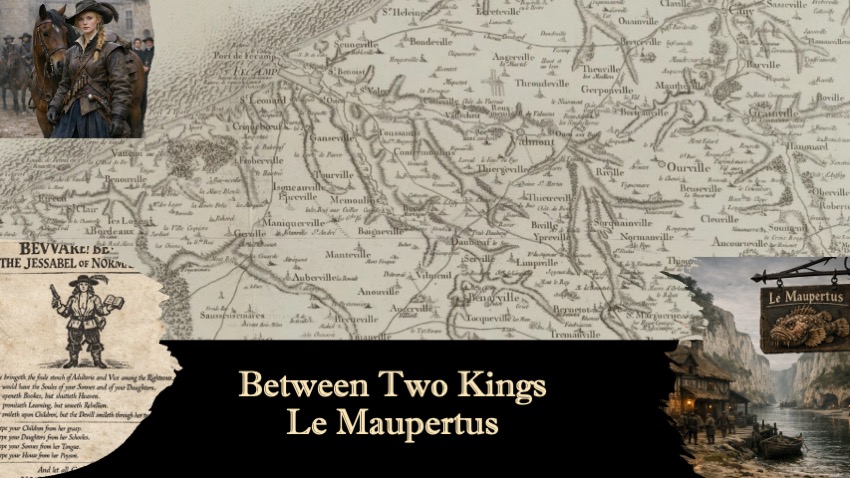
“Beauty provoketh thieves sooner than gold.”
W. Shakespeare, As You Like It. Act 1. Scene 3.
The only sign of the night’s violent storm is the sheen of rain on the flagstones of the inner courtyard, glistening beneath the early morning sun. Marie Cessette stands at the window of her bedchamber, transfixed by the immensity of the sky, washed crisp blue by the storm, and so near that the few white clouds drifting across it appear almost close enough to touch. She cannot recall when she last paused to look at the sky. Perhaps it was at Bracieux or at Pierrefonds before she was married, but she is certain she has never seen a sky as vast as the one over Normanville.
“Madame you are awake already!”
The rosy-cheeked girl who has walked in timidly, carrying a tray covered with a fine linen towel looks very young. Marie Cessette soon learns that she is fourteen, daughter of Madame Papon the cook and Monsieur Papon the stable master, and the middle of three children, her two brothers, fifteen-year-old Danyel and nine-year-old Artus, both working with their father at the stables. She is named Lucque after her grandmother and like her aunt, wife of the groundskeeper M. Mustel, who died at childbirth, and whose six-year-old son, Pomponne, was born deaf. Lucque wants to be a lady’s maid. She wants to learn everything about being a lady’s maid, for she is certain that she will meet clever and refined people who know about the world and maybe she will travel to places far from Normandy! She says all this almost in one breath, blushing to her ears by the end of it, but she says it, nevertheless. “Madame Bonshoms says that your Grace has a maid already. Mademoiselle Meynet,” she concludes wistfully, spying at Marie Cessette under lowered eyelids.
Marie Cessette smiles, and takes the tray from the girl’s hands, for in her eagerness to make her case, Lucque has forgotten to set it down. “I must suppose then that this handsome repast you bring me was not sent by your mother nor Madame Bonshoms?” Lucque shakes her head, crestfallen. But Marie Cessette will not crush such aspirations on her first day at Normanville and will never discourage one so young and so determined. “Well, I thank you for I find myself famished this morning,” she says and the girl’s face lights up. Marie Cessette carries the tray herself to a small table, Lucque following close behind.
“Madame will consider it, then?”
In the girl’s voice Marie Cessette hears an excitement she knows well, youthful, eager, and perilous in its confidence. Determined and persistent, she thinks. Already she likes Lucque. On the other hand, she knows that Fleurie will not welcome the prospect of another maid. But perhaps, there is a different way of arranging the matter.
“To become a lady’s maid, one must learn, and to learn one must become an apprentice.”
“I can bake and cook. I help my mother in the kitchen every day, and I can sew very well,” the girl ventures puzzled.
Marie Cessette sits next to the little table, unveiling the silver tray the girl has brought. It is rather fancifully decorated with flowers, but the food is chosen with discernment and good taste: newly baked white rolls, soft cheese, well-salted and seasoned butter, elegant little dishes of quince paste and cherry preserves, soft eggs, and a fine glass of the cider made in these parts, not the rustic swill served at inns and taverns, but the noble kind, long favored, so the Normans like to say, by the seigneurs of the provinces since the days of Charlemagne. “I baked the rolls myself, Madame!” Lucque says.
“And a very fine tray this is,” Marie Cessette declares. “But a lady’s maid need only order and present the repast, not prepare it, unless she is explicitly asked to do so.” She notices that the girl colors again, mortified this time. “This is one of the many things a lady’s maid must learn.” She pauses wondering whether she should probe about the one thing that matters to her, but the clever girl anticipates the question.
“I can read and write, Madame! And I know my numbers.” She smiles eagerly. “Madame Bonshoms tells us that your Grace is a lady of great learning. She says that you arrived with chests full of books rather than dresses. And then, of course, you arrived dressed as a cavalier, having faced those fearsome bandits, and drenched by the storm!”
“Not the best introduction I fear,” Marie Cessette muses. This was not the introduction Raoul would have wished, given the purpose of this exile.
“Oh no Madame!” the girl protests with fervor. “Since last night, my mother has been saying that this blessed place has finally found a deserving mistress. Madame Bonshoms says the same, and so does everyone in the household. We knew a Parisian lady from court was arriving and feared that we would displease you, our ways being so different, and Normanville being so far from Paris. My poor mother has labored for months to learn dishes that might please a lady who has served in the household of the Grande Mademoiselle and the Queen.” Marie Cessette had not imagined this, or rather, she was mistaken in whatever she imagined. “So, you see, Madame,” the girl returns to her purpose at once, “having met your Grace, I would give anything, anything, to…”
In Marie Cessette’s eyes, the girl need say no more, for she has already recommended herself and in more than one way. “And your mother and father consent? Before we venture upon anything, I must know that they do.” The girl opens her mouth to answer, but Marie Cessette raises her hand. “I shall speak with your mother and your father myself,” and easing her tone she adds, “I will be certain to answer all their concerns.” The girl smiles and draws in a deep breath of relief.
As for Fleurie, Marie Cessette’s maid chooses that very instant to enter the bedchamber, carrying another tray and linen towels. She is followed by one of the footmen, the younger of the two who stood at the door the night before. He must be Gallien Bonshoms, Marie Cessette surmises, the younger son of the steward and the housekeeper. He bears a heavy copper basin filled with hot water, sets it down near the fireplace, bows and withdraws. Fleurie, however, stops short at the sight of her mistress served by another. Her dismay does not go unnoticed, as intended, but Marie Cessette will have none of it.
“Fleurie,” she says affably, “after I have consulted with her parents, I have in mind to make Mademoiselle Papon your apprentice.” Fleurie opens her eyes wide with astonishment. “I trust you to provide Mademoiselle Papon with the finest education a lady’s maid could hope to receive.” She turns to Lucque, “For it is true, my dear Lucque, that Mademoiselle Meynet is one of the most—nay, I shall say the most—accomplished lady’s maid in Paris and very much sought after, so you will be an apprentice next to the best there is.” She watches Fleurie’s dismay-turned-to-astonishment replaced by a gratified smile, flattered by the compliment, which raises her significantly in the eyes of this new household where she is a stranger.
Perhaps it is Marie Cessette’s own, early education—inadequate though she has always thought it—her own early apprenticeship in the workings of a household, or perhaps it is the arduous hours—nay years—preparing to become a lady-in-waiting, the strenuous lessons not only in manners and ceremony, but in perception, prudence, and the art of discerning the unstated, which, at court is most important. Whatever the cause, Marie Cessette has long been alert to tacit rules, subtle balances, and hidden rivalries. She has never much considered it, for this comes to her as naturally as breathing. But as she walks through Normanville with Madame Bonshoms meeting the household it occurs to her that she can see much more than new faces and names. She can see at once the intricate web of rank, birth, custom, and old obligation, that holds together the small world into which she has stepped, an outsider, almost an intruder.
She sees, for instance, the authority that M. Bonshoms and his wife exercise over the estate, a combination of seniority, office, family standing, and name. M. Bonshoms’ father was a distant cousin of M. Robert Bonshoms, Seigneur de Couronne, who has recently retired as lay councilor from the Parlement of Rouen, an ennobled merchant who bought the estate and title of Couronne with letters of patent like many in Normandy, and who, as far as Marie-Cessette knows, continues to be a firm supporter of M. le Prince de Condé and an unrepentant Frondeur. Although not ennobled like his distant cousin at Rouen, M. Bonshom’s father was a wealthy herring merchant and elected échevin at Fécamp.
On the other hand, Madame Bonshoms’ father, M. Osmont the elder, a prosperous marchand de sel, was elected maire of Fécamp and was leader of the guild throughout his life. His second cousin, the Seigneur du Bossenel, also an unrepentant Frondeur, has been treasurer of the Parlement at Rouen for some time. In a sense, M. Bonshoms made an advantageous marriage given the position of his father-in-law at Fécamp.
The same is true for M. Dufay, the régisseur of Normanville, son of a sailcloth merchant from Fécamp, who married Madame Bonshom’s younger sister, Louise. Thus, at Normanville, power is split equally between the Bonshoms and the Dufays, a perfectly calibrated balance between the manor house and the land, and all of it because of the two Osmont sisters.
The thought pleases Marie Cessette exceedingly. It occurs to her that in this house, the first allies she must seek for her own cause are these two sisters, Madame Bonshoms and Madame Dufay. As far as Marie Cessette can surmise too, the Bonshoms and the Dufays draw on their family connections but only as far as they do not touch on politics. When it comes to politics, they keep themselves aloof, especially in her presence, and as they must, for Raoul is known to be the King’s favorite and a powerful man alongside the Cardinal, and she, his wife, is known to have dallied with friends of M. le Prince, the Cardinal’s political enemy. Marie Cessette has no doubt that rumors surrounding her must have reached even this remote part of Normandy, and the manner of her arrival did little to assuage them.
The second tier, so to speak, of the household at Normanville is another extended family, likewise connected through women. Lucque’s parents, the stablemaster, M. Papon, and his wife, Madame Papon, the cook, possess local standing of a different kind. Their families are not descendants of master tradesmen or distant relatives of ennobled merchants but have served the seigneurs of Normanville since the first Normans held this land, or so nearly, that memory and legend have long since become one in family lore. Then there is M. Mustel, the groundskeeper. He married the cook’s younger sister who died an untimely death leaving him a widower with a little son. M. Mustel’s younger brother is the estate baili and lately married to a farmer’s daughter from Saint-Marguerite, Florymonde Baro, who has given him an infant daughter Hélène, called Lenette.
But Marie Cessette sees more. She sees Lucque’s aspirations pressing against the narrow limits of her birth and family, just as she sees the first timid stirrings of love in the eyes of Gallien Bonshoms, the housekeeper’s younger son, who knows perfectly well that his love for Lucque is hopeless, for she is far beneath him and he is meant for a merchant’s daughter from Fécamp. Marie Cessette has noticed too the spark of desire in the smitten eyes of Gallien’s older brother, Herculles, the moment he gazed upon Fleurie, whom he too can never have for she is far above him: Parisian, refined, daughter of a Musketeer, a woman of the world, praised for her accomplishments in good society and at court, and he, a mere provincial. Marie Cessette can see Fleurie’s side too, how the attention flatters her, while her eyes stray toward Monsieur de Seguzzo and just as his rakish gaze lingers on her, and all under her father’s nose!
Marie Cessette is no prude, and under any other circumstances she would consider herself the last woman in France to lecture another on propriety. But propriety, or rather, the ruin of it, is precisely what has brought her here. She resolves, therefore, to settle the matter with Fleurie at once, and before their Parisian ways disturb this finely balanced world in which they are both intruders. And yet, however often she tells herself this last thing, the same insight which reveals to her the hidden subtleties of Normanville, tells her that what she believes for herself is not wholly true.
Each day, with every step deeper into this land imposed upon her as punishment and exile, Marie Cessette feels herself drawn and more firmly rooted in it, as though it was Normanville–not court, not Paris, not the refined life for which she was trained–but Normanville that she had been preparing all along.

⚜️⚜️⚜️⚜️
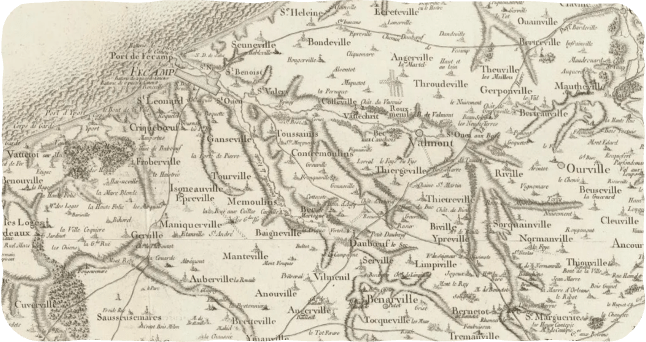
Père Barthélemy d’Athénous, curé of Saint-Marguerite, friend of Père Gazil and once his pupil at Saint-Omer, proves to be far younger than Marie Cessette imagined: scarcely six-and-twenty. He is well liked at Normanville, at Saint-Marguerite, and in all the neighboring villages and hamlets. Indeed, his good name travels farther still, along the whole coast of the Pays de Caux. He visits Normanville often, sometimes remaining several days with his old tutor and friend. More importantly, he escorts Marie Cessette whenever she ventures into the countryside, which he knows intimately, guiding her among the villages, farms, and scattered hamlets that belong to Normanville. She soon comes to think of Père d’Athénous as both her guide and her best ambassador, which is what Père Gazil promised. Very quickly he has become the man able to open doors, soften suspicions, and plead her cause before she needs to speak it. She finds him, besides, a charming companion, and one with whom she shares many common causes, not least, and to her relief, the education of children, even the poorest children, and not boys only, but girls as well.
He is also a mystery.
His name is French. He looks French, speaks French, and bears himself like a Frenchman. According to Madame Bonshoms, ‘L’Athénous’ was once a small coastal estate near Fécamp, now long abandoned. Perhaps the family fell upon hard times. Marie Cessette surmises, however, that if he was educated at the Jesuit college of Saint-Omer, then there must be English blood somewhere in his history, for that college, situated in the Spanish Netherlands, was founded expressly for the instruction of English Catholic boys.
Yet, and as far as Marie Cessette is concerned, the real mystery runs deeper. What is such a man doing as the curé of Saint-Marguerite? A man so young, elegant, and refined, undoubtedly a nobleman, a man who, in the course of a single dinner, can quote Virgil, dispute Saint Augustine, and speak of Montaigne with the same ease and turn of phrase with which he comments upon the disappointment that was M. Corneille’s ‘Pertharite’? Such a man would shine in the salons of Rouen and Paris, perhaps even at court. What, then, is he doing among the farmers and fishermen of Saint-Marguerite?
Marie Cessette wonders whether she alone is so perplexed by the charming young priest. If others speculate, their speculations do not appear in the gossip that increasingly reaches her as she spends more time among the wives and daughters of the seigneurs from neighboring estates. When the subject of Père d’Athénous is raised, most agree that he is a modest man, devoted to his flock. In their eyes there is nothing questionable in his decision to return to the land of his ancestors. Everyone loves and respects him, the prosperous and the poor, the pious and the sinners alike. Is this not a rare gift? Why cast doubt upon so evident a blessing from God? But Marie Cessette is not satisfied. She knows too well what it is to diminish one’s intelligence for she has done it all her life. The same instinct that reveals to her the intricate web by which Normanville is held together tells her that there is more to Père d’Athénous than he permits the world to see, and that it matters.
Once, very carefully, Marie Cessette broached the subject with Père Gazil. After all, Père Gazil was Père d’Athénous’s teacher at Saint-Omer and is now his friend. “His ambition is to serve,” Père Gazil said. “It has been so since he was a student.” He revealed nothing more. Yet Père Gazil is a man of remarkable subtlety, and one evening after dinner, during a compelling discussion in Marie Cessette’s salon at Normanville, he contrived to raise the matter indirectly. It occurred to Marie Cessette, therefore, that Père Gazil might be as puzzled by the mystery of Père d’Athénous as she has been.
The conversation that evening had turned upon the controversial arguments Cornelius Jansen advances in his ‘Augustinus’. “Jansen argues,” Père Gazil observed, “that salons are snares. That eloquence, beauty, wit, and noble company are dangerous instruments. That it is better to serve one poor parish honestly than to flatter a hundred noble souls into devotion.”
Marie Cessette was grateful to Père Gazil for his subtlety. She is well versed in the controversy surrounding Jansen’s position and his reproaches against the Jesuits. She has also heard the Jesuit counterpoint argued at length in her own salon in Paris and at Saint-Fargeau, where, as it happens, among the friends of the Grande Mademoiselle, Jansen’s views are not so overwhelmingly rejected as they are in Paris. That evening, prompted by Père Gazil’s artful cue, she pressed the matter: “But what if one word spoken in Paris — at a salon, or at court — may save ten thousand poor souls in Normandy? God does not give eloquence to be buried in silence.”
“I am no theologian,” Fra Clermont interjected, “and the finer points of this fierce debate elude me. Yet it seems to me that God gives a man talents not for his private ornament, but for good use. Such use, in my view, must be governed by charity, obedience, and prudence, lest the servant seek his own glory under the guise of serving God.”
“A Jesuit such as Père Gazil, and one such as myself, educated as I have been by Jesuits, will contend that we should not ask where a man is praised, but where he may serve most,” Père d’Athénous observed keenly. “Sometimes that place is a pulpit in Rouen, or a salon in Paris. Sometimes it is at the bedside of a dying fisherman. One might ask, for instance — and I have been asked this question, even by members of my own family — why I should choose to serve here, as a simple curé at Saint-Marguerite among farmers and fishermen, rather than seek a post at Fécamp, or Rouen, or even in Paris. To which I answer this: all those fine and exalted places have many voices speaking for God. But who is there to speak for Him at Saint-Marguerite? I also maintain that the poor are no less worthy of instruction because they live in a hut, or at the edge of the sea.” He smiled affably upon his interlocutors. “And it is not a failure of courage either, no pusillanimity, that pernicious vice against which Aquinas warns us. No!” He extended his arms, indicating the three of them in the salon. “Look at the common cause we have discovered. Is this not truly the hand of Providence, a confirmation from God that our work in this humble corner of France is worthy of our talents?”
Marie Cessette knew she was defeated. It was the perfect answer, magnificently delivered, and meant to put an end to speculation, which he clearly understood to be directed at himself. Still, he was evasive, and that speaks to Marie Cessette more than his erudition or his position in any theological argument.
She likes Père d’Athénous very well despite the mystery that surrounds him. At times he reminds her of Raoul, and that makes her like him better still. He has a keen mind, and, like Raoul, he can be equally fascinated by the fossils he excavates meticulously from the chalk cliffs, by the broken remnants of an ancient Roman road, or by an old abbey charter.
The presbytery at Saint-Marguerite, which Marie Cessette has visited with Père Gazil and Fra Clermont, looks more like a cabinet of curiosities than the modest house of a country curé. Its walls are lined with his collections: the fossils, the ancient seals, and the coins that he has unearthed from cliff, field, and ruined foundation. He assures them that such pursuits are not singular, and he can speak for hours about the exciting work of William Harvey, Gilbert North, and Inigo Jones, whom he calls ‘antiquarians’, around a place in England called Stonehenge. It is difficult for Marie Cessette not to take this as another clue to the mystery of Père d’Athénous. For what these learned men he admires have in common, besides the fact that they all are English, is that they all are royalists, and still suffer for it.
⚜️⚜️⚜️⚜️
“A noble and worthy cause, the education of poor children, of girls as well.” Madame le Marinier, remarks at the end of Père d’Athénous’s eloquent presentation of their cause, at the soirée she has arranged at the château de Cany. “I agree with you that for families beholden to the sea, it is the women who must bear the burden of rearing children and contriving to make a living while their husbands are absent for months, or years, or never return at all. You will find many advocates among us. Not everyone in Normandy is a savage, and abject poverty is, as Père d’Athénous reminded us this evening, an ungodly state. Yet, there are also those who will oppose your plan fervently, I fear, those blinded by religious zeal, and those who choose to remain enchained in their ignorance.”
The lady’s husband is the Baron de Cany, whose estate borders Normanville. He is a member of the Parlement of Rouen, and when he purchased the estate and the title from the former owner, the sire de Bréauté, the château was in a dismal state. But the baron will do anything to please his wife and has spared no expense, almost rebuilding the decrepit château from its foundations. He even engaged M. Mansart for the task. Unlike Madame le Marinier, Marie Cessette sees such extravagance not as the act of an indulgent and devoted husband, but as the act of an ambitious politician. M. Mansart has stood conspicuously with Queen Anne and is now closely connected to His Eminence, Cardinal Mazarin, so much so that the Cardinal’s enemies, friends of M. le Prince de Condé, have published the ‘Mansarade’, a pamphlet against the Cardinal’s architect as vicious as the ‘Mazarinades’ that M. Scarron and others publish against the Cardinal himself. The Baron and Baroness de Cany, in other words, are unrepentant Cardinalists, an irony, given that Cany belonged to the Condé family scarcely a generation earlier.
Madame le Marinier, the baroness, has been eager to welcome Marie Cessette to her splendid new house and to introduce her to her circle of friends. “We aspire to form a little salon where those of us with refined sensibilities–and we are a select few in Normandy–may delight in intelligent discourse,” she confided when first she met Marie Cessette, “but, of course, it cannot compare with what you are accustomed to in Paris, certainly not your salon which is renowned.” She smiled an embarrassed smile, “yes, even here, those of us who make an effort to keep ourselves cultivated and refined know about all the elegant diversions Paris has to offer.”
They all know who she has been, no point to pretend otherwise, Marie Cessette realizes quickly, and what they really think about her reputation she will not examine closely because she also realizes that in circles such as Madame le Marinier’s it is not only Raoul’s name and connections that protect her, but those of his grandmother, the Duchess d’ Aiguillon. Whether supporting the Condés and the Longuevilles or the Cardinal; whether Catholic or even secret Huguenot; nobles de robe, or petty nobility, everyone in Normandy respects that great lady, the Duchess d’ Aiguillon, at equal measure. It is a gift and an advantage that Marie Cessette had not fully considered.
As she is quick to take the measure of her surroundings, not a fortnight passes before Marie Cessette has formed a complete plan: whom to visit, in what order, who must accompany her, even what she must wear, for sartorial diplomacy is of the utmost importance. There is a place for her Parisian gowns, which, even though not her finest, here they are considered too fine, a place for Madame de la Fére’s split skirts, and a place for Layla’s military doublet and breeches. Every day and as she practices her shooting with M. de Seguzzo, Marie Cessette grows more grateful to Layla for having thought more practically than anyone, even Raoul.
So, at Madame le Marinier’s soiree at Cany, where Père d’Athénous introduces their cause to likeminded people, Marie Cessette knows to present herself as the relative of the Duchess d’ Aiguillon that everyone hopes to meet. And it works. She receives significant encouragement and further introductions. Together with the pledge already obtained by Père Gazil and Père d’Athenous from Dom François Pommeraye, prior claustral of the Abbey of the Holy Trinity of Fécamp to write a strong letter of recommendation to the King of Poland, the abbé commendataire, Marie Cessette’s cause seems to be well on its way.
But not everything is as it appears. Even in these gatherings, where enthusiasm for the education of the poor abides, there is an undercurrent of anxiety. Some threats are plain enough: the amassing of Spanish forces across the border and the strengthening of the factions that are loyal to M. le Prince de Condé within Normandy. No one wants another war. Other threats are not so clearly defined and thus more alarming: the appearance of the monstrous and mysterious Spanish ship off the coast, the pirate vessel that sails with it, and the band of armed Bohémiens whose attacks have turned deadly. What happened to Marie Cessette on the road to Normanville is proof that fears are well founded. And although smugglers have roamed this coast for as long as anyone remembers, this time, they tell Marie Cessette, feels different, more ominous, for these smugglers do not seem to be trading in salt or wine but in weapons. Heavy weapons too. There is talk of cannon. And if the murderous Bohémiens are any indication, who is to say–God forbid–that such arms will not be turned against the law-abiding citizens and nobles of this land?
From those closer to the ground, however, from the villagers’ wives and children whom she makes a point of meeting as she rides about the estate, Marie Cessette begins to hear about specific names and places. The more she is trusted, the more she learns. One name, above all, is repeated: Le Maupertus. It seems to mean both a place and a man. Or rather, a gang.

⚜️⚜️⚜️⚜️
Unlike her husband, Madame Papon, the cook, is not easily persuaded by her daughter’s aspiration to become a lady’s maid. Marie Cessette can hear the cook’s sonorous voice enumerating the many reasons why Lucque must marry and marry quickly, as she walks toward the kitchen, where she is not expected. It is to Madame Bonshoms that the cook speaks, for Marie Cessette hears her say: “I know that you and Madame Dufay see things differently, and I understand that our mistress knows the world as none of us country folk could–M. Papon never ceases to remind me of that–but in God’s name, my Lucque is as ripe as a cherry and we have two good marriage offers! Ah, remember me at her age? I was ready to run away with that vagabond, the faux-saunier from Saint Pierre-en-Port!”
“Oh God, do I remember!” Madame Bonshoms chuckles. “But Lucque is a sensible girl, Perrine. Think how much more advantageous her prospects will be with the Marquise’s patronage. And the Marquise can place her with her friends in Rouen or even in Paris!”
“M. Papon tells me the same, but what do I know of Rouen or Paris? I’ve been to neither place, and God help me, I hope to live and die and be buried right here at Normanville where I was born. What about the dangers? Look at that girl…Fleurie. She is so forward and puts on such airs! And, God forgive me, how she flirts! Oh yes, with your Herculles too. Even in her father’s presence!”
“Ah, Perrine! My poor Herculles! I warned him the moment I saw her. That’s a Parisian girl, I told him, and she’ll break your heart because that is how they are raised. But what son ever listens to his mother? Let him be burned a little, I say, and his father agrees with me. Then he’ll know what a good match Augustine is for him. But your Lucque was raised differently. She is a good girl and a good girl she will remain. Can you imagine your Lucque putting on airs like that? I cannot! But think about her chances…” Madame Bonshoms notices Marie Cessette in the doorway and springs to her feet. “Madame!”
The cook gasps, then quickly gathers herself, extending an awkward smile as she rises from the bench. The two women were seated at the kitchen table sharing cider during the brief lull between midday supper and dinner, Marie Cessette realizes.
“Be at ease, please,” she tells them, approaching the table. “I am intruding.”
“No…no…” both women protest. “We were just…”
Marie Cessette smiles. “Of course! And one day, perhaps I might share a glass with you?”
The cook’s eyes widen with surprise, but Madame Bonshoms replies to Marie Cessette with a small impish shrug: “Why not now?”
“Why not now indeed!” Marie Cessette says, and, turning to the cook she adds: “if Madame Papon has no objection?”
“Ah, Your Grace! You think of me better than I deserve!” the cook says with a laugh. She brings another glass to the table and pours cider for all three of them, while Madame Bonshoms pushes a plate of cheese and fresh fruit between them. The three women sit down together once more.
“Lucque tells me that you have labored for days over those receipts my cook was sending from Paris,” Marie Cessette begins.
“Oh, that girl!”
“No, no,” Marie Cessette laughs. “She is honest and she loves her mother. It is I who failed to understand.”
“But if Madame must entertain friends!” the cook objects.
“Indeed,” Madame Bonshoms chimes in. “The Baron and Baroness de Cany and their friends.”
“Oh, we shall entertain them!” Marie Cessette says. “We must, and very soon. But I have in mind to serve them the best that Normanville has to offer and nothing more. Here at Normanville we put no airs, Madame Papon. Let Paris stay in Paris, and that includes all those Parisian receipts I sent you.”
The cook sits back and claps her hands, with delight. “I knew it, your Grace! I told M. Papon and Madame Bonshoms,” she points to the housekeeper, “she will attest it herself because I told her the moment you stepped into this house drenched from that storm. That’s the lady of Normanville I said!”
Marie Cessette leans forward across the table. “As for Lucque…”
“Oh Madame, forgive me…” the cook begins.
“Perrine was only…” Madame Bonshoms is eager to shield her old friend.
“No, no!” Marie Cessette says, reaching for the cook’s hand across the table. “I heard nothing that was not meant for me to hear. I merely ask you to consider that this is still an apprenticeship not a post. Lucque will be here at Normanville.”
“That’s what I’ve been telling you, Perrine,” Madame Bonshoms says.
The cook nods. “I will think about it,” she concedes.
“Good,” Marie Cessette says warmly. “I fear I intruded for another reason. I shall need another basket tomorrow and earlier than before, for my plan is to leave before dawn.”
“How far is your Grace going this time?” Madame Bonshoms asks.
“I have in mind to go as far as Saint-Léonard.”
Both women gasp. “No! No! Madame.”
“That is what everyone says, and no one tells me why,” Marie Cessette replies piqued.
“Your Grace, I am from those parts as you know,” Madame Bonshoms begins. “I was born and raised at Fécamp, and when I was little, Saint-Leonard was a decent enough place, a few faux sauniers perhaps, but no different from any other village on that coast.”
“Until Le Maupertus?” Marie Cessette pushes. She notices that the cook crosses herself. “Oh come now, it cannot be as bad as this?
“Some folk will not even speak that cursed name. They say it brings bad luck,” the cook mutters.
“But the man is an échevin at Saint-Léonard and his brother is a priest, curé of Saint-Léonard,” Marie Cessette points out. Across the table the two women exchange a look. There is more to this story, of course there is, but Marie Cessette begins to wonder whether some part of it concerns her.
“How that fiend came to be a priest I never understood,” Madame Papon evades.
“Père d’Athenous says that Messire Anselme Le Chabot is a powerful orator,” Marie Cessette presses. In fact, Père d’Athenous called the priest a fiendish brute, who draws large crowds wherever he preaches his hateful sermons, most often at Saint-Léonard, where he is the curé, and where his brother, indeed, their entire family seems to have taken hold.
“I remember him from my childhood,” Madame Bonshoms says at last. “He was younger than my Gallien. Anselme the Mad they used to call him all the way from Fécamp to Contentin. People would lock themselves inside when he came through their villages, so fearful were they of his visions and his prophecies. Many believed that God spoke through him. Others, including the Brothers from Saint Trinity, thought him the devil’s work. He was not a priest in those days and claimed that he could tell the witches and the heretics with just a look or a whiff.” Marie Cessette has heard such claims before and is not impressed by superstition. Fra Clermont hunted conversos in the New World for years, claiming a similar gift, if such a gift truly exists, which she doubts. It is fear that these men are good at discerning, and in her mind, there is nothing Christian or godly about that.
“And Le Maupertus?” she insists.
Madame Bonshoms sighs. She sounds reluctant. “I shall tell the story as I know it. In those days he was only Jehan Le Chabot, Anselme’s older brother. The two traveled from village to village making money from the prophecies and the visions and from ferreting out heretics and witches. I remember Jehan in those days. He looked exactly like his name, a bullhead, with a face covered in boils and carbuncles, so that folk began calling him ‘le chabot de pierre’ like the fish that masks itself to look like the rocks.”
“Aye,” the cook adds, “and a fitting name that was, because like that scorpion fish, he hides a deadly sting.”
“Jehan was always the smooth one,” Madame Bonshoms says. “His younger brother was a raving fiend threatening fire and brimstone, while Jehan could charm the last sol out of your purse in a heartbeat. Then Jehan married Barbe Quesnel.”
“That one I know well,” the cook says, her voice dripping with contempt. “She comes from our parts. Not Normanville, thank God, but Barville.”
“That is part of the Baron de Cany’s estate,” Marie Cessette makes the connection.
“It is Madame, and Barbe Quesnel still has kin there, all of them scum from the womb. No decent folk want anything to do with that lot. The Baron and Baroness who seem to me good Christian people, ought to be warned of the snakes they shelter. It would not surprise me if the Quesnels have something to do with the Bohémiens who attacked your Grace on the road here.”
“Now they call Barbe Quesnel ‘La Mere Chabot’,” Madame Bonshoms continues, “and they say that she has a head for business.”
“Aye, and for money too,” the cook says, “and for making it in every ungodly way imaginable. I’ve heard it said that Messire Anselme owes her his priesthood, for it was her idea to twist an arm or two to buy it for him. And her husband owes her the fact that today, in Saint-Léonard, no one dreams of doing anything without his approval. They say that as soon as she married him, she struck a deal with the fiercest pirates sailing those waters,” she leans across the table, “the likes of Benito de Soto,” she whispers conspiratorially, crossing herself once more as she utters the name.
It is not a name Marie Cessette expected to hear, although on second thought, isn’t the cove of the Wrecks close by and was that cove not one of de Soto’s hideouts, according to Raoul? “And what of Le Maupertus?” she asks, making sure she shows no sign that she recognizes de Soto’s name.
“Le Maupertus is the name of the inn that La Mère Chabot opened,” Madame Bonshoms explains, “although now they are all called that, their entire family. They have three sons, each one of them a piece of work, I hear. The name suits them. Maupertus is a water passage between Saint-Léonardand Criqueboef, treacherous because from the sea it looks safe. But it is not a true passage, only a dead end, and the sandy shoals will mire any vessel whose pilot does not know how to pass in and out. It makes a perfect trap, and many unfortunate souls have fallen prey there to the pirates and vagabonds hiding in the nearby caves and woods. When we were children in Fécamp, long before that inn was built, we thought that finding oneself at Maupertus was the worst punishment.” She chuckles, sipping her cider. “Not that I knew anyone who was ever punished in this manner, but all my poor mother had to do with my brothers was to threaten with it. That is where La MèreChabot opened her inn while her husband set himself up at Saint-Léonard, easing his way among the townsfolk with his smooth manners, as if he were a respectable man, and all the while he was making them depend on his vile connections with smugglers and pirates and extracted money from them offering protection. And then, there was his brother, now a priest. ‘Le Frère Noir de Maupertus’,they started calling Messire Anselme Le Chabot. Who would dare speak against that gang of criminals, for that is what they are, and risk vengeance from their accomplices or being dragged to the town square as a heretic or a witch and lynched or worse? Monsieur Bonshoms’ cousin who is a councilman at Rouen told us that once or twice they tried to send a bailiff to restore order, but those men never made it past Criqueboef.”
“What does this Jehan, or Le Maupertus, or whatever name he goes by, have against educating children?” Marie Cessette asks. “I have been warned of him and of a priest preaching between Yport and Fécamp, fiery sermons against schools and education, warning villagers to keep their children away because the end of days is upon them, offering the Spanish ship as proof.” The women exchange another look, and Marie Cessette is convinced that they have known of this for some time, and that whatever Le Frère Noir de Maupertus is preaching concerns her. “That’s not all that he preaches, is it?” she insists.
The cook sits back raising her hands in the air. “Ah, your Grace, keep away from their lot!”
“Indeed,” Madame Bonshoms coaxes, “why not turn your efforts to the new school here, at Saint-Marguerite? Saint-Léonard is too far from Normanville, and coming from Fécamp, I assure you that Saint-Léonard is considered too far from Fécamp as well, and it is the same for any town and village fit for decent folk.”
Marie Cessette folds her arms over her chest. “What does this fiend preach?” The two women open their mouths to protest again, but she lifts a warning brow. “I must know.”
Madame Bonshoms shakes her head and with her eyes she signals to the cook. Madame Papon rises from the bench and goes to the large copper basin near the fireplace where she keeps the kindling. As she shifts through twigs and scraps of paper, Madame Bonshoms explains: “Herculles returned from Fécamp two days ago. He is to marry a girl there, Augustine, and lately he has been distracted…” She clears her throat, embarrassed. Marie Cessette knows what has been distracting Herculles, or rather who, and has already cautioned Fleurie. “His father and I thought that sending him to Fécamp on an errand would take his mind off…”
“Be easy on that account,” Marie Cessette interjects. “I have taken measures.”
Madame Bonshoms returns a grateful smile. “Thank you, Your Grace,” she says just as the cook places a piece of paper before Marie Cessette. “Herculles saw these, and others like them, all the way from Fécamp. But this one was put into his hand at Torcy.”
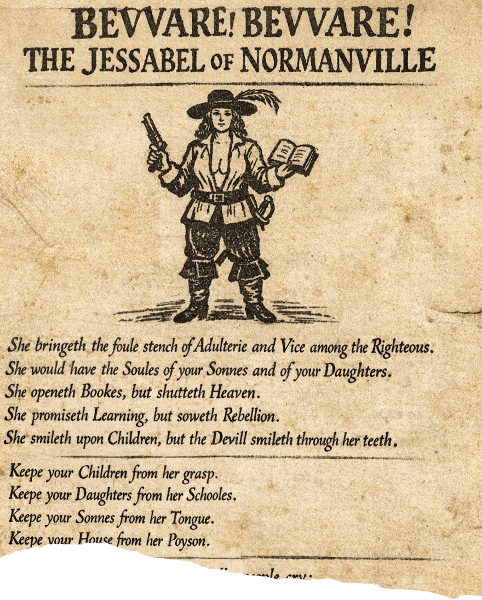
“Torcy? That is in Normanville,” Marie Cessette says as she picks it up from the table. It is a poorly printed and torn pamphlet, its message as crude as the paper upon which it is printed. It depicts a woman dressed as a cavalier but in the image the woman’s shirt hangs open exposing her breasts. She carries a pistol on one hand and a book on the other. Above the vile image, in large, crooked letters, it reads:
“BEVVARE! BEVVARE! THE JESSABEL OF NORMANVILLE”
Below in smaller script it says:
“She bringeth the foule stench of Adulterie and Vice among the Righteous.
She would have the Soules of your Sonnes and of your Daughters.
She openeth Bookes, but shutteth Heaven.
She promiseth Learning, but soweth Rebellion.
She smileth upon Children, but the Devill smileth through her teeth.
Keepe your Children from her grasp.
Keepe your Daughters from her Schooles.
Keepe your Sonnes from her Tongue.
Keepe your House from her Poyson.
And let all Godly people cry:
NO SCHOOLES FOR JESSABEL!
Printed for the warning of the simple, in the Yeare of Our Lord 1652, and to be read at doores, markets, wells, church-wayes, and all places where idle tongues doe gather.”
Marie Cessette sets the pamphlet on the table. “They have a printing press,” she observes and she knows that to the two women, who seem shaken by the crude warning and perhaps even somewhat swayed, her remark must sound trivial. But it is not trivial at all. This is a clandestine printing operation, and although such things are not uncommon in Paris, to find one in this remote part of Normandy ought to be impossible. It denotes that the gang called ‘Le Maupertus’ is more than it appears.
Their connection with Benito de Soto strengthens her suspicions. Benito de Soto’s men abducted and nearly killed her and the aftermath of that abduction changed the course of her life. So, this concerns her as much as it concerns Raoul, and she wonders whether, once again, the purpose is to attack Raoul through his wife. The Comte de Wardes, whose family, the Crespines, comes from Normandy, and whose ancestral estate at Bec is not far from Normanville, was using Benito de Soto to enrich himself just as Rochefort did. And it was de Wardes’ cabal, all seemingly Frondeurs but also much more, who had been behind her abduction, the assaults against the Comte de la Fèreand his wife, and, of course, upon Layla who lost a child and was almost killed. This cannot be a coincidence, Marie Cessette reckons and now she is more determined than ever.
⚜️⚜️⚜️⚜️
Marie Cessette has sat in war councils before, most recently when they planned Henri’s escape from Vincennes, but she has never before presided over one. Now, in the library of Normanville, she stands with the two priests, Père Gazil and Père d’Athenous, and with the men Raoul and her father have sent to protect her–M. Maynet, Caradas, Fra Clermont, M. de Seguzzo, and M. Patris–as well as with M. Bonshoms the house steward, M. Dufay the estate manager, Mustel, the groundskeeper, and his younger brother Jérôme, the bailiff.
All have seen the pamphlet. Marie Cessette does not shy from its vulgar image and its threats because what concerns her lies elsewhere, and she finds that all the men around her agree. Not only is the gang of Le Maupertus launching an attack farther inland from their territory, but somehow, they have reached into the lands of Normanville already. This last thing is the gravest matter of all.
“This has nothing to do with schooling poor children nor with teaching girls to read and write,” Père Gazil voices what they are all thinking.
“Le Maupertus is the worst kind of smuggler gang but since when do smugglers operate a clandestine press?” Père d’Athenous voices Marie Cessette’s thoughts.
“They are taking great pains to draw your attention, Madame,” Fra Clermont says.
“They have succeeded,” Marie Cessette replies. “I suspect they expect me to defend myself against such libel. But they underestimate us.” The men around her appear perplexed, she notices, so she continues. “First we must secure the estate and the house.” She turns to the groundskeeper and the bailiff. “Messieurs?”
“I have ten men guarding the estate with me against poachers,” says M. Mustel, the groundskeeper. “They are no soldiers but can fight if need be.”
“And I have six men ready to fight,” adds Jérôme Mustel, the bailiff.
“And the armory?” Marie Cessette insists?
“The Marquis de Normanville keeps a well-stocked armory,” the bailiff reports. “We can provide arms and powder to as many as thirty men for a week. Besides swords and daggers, we have a minion, and two swivel guns which may be mounted on the ramparts surrounding the house.”
“Let us make sure that we have enough able men, M. Mustel,” Caradas tells the bailiff. “We can train a few more, even farmers, in the rudiments.”
“Some women and children can also be trained to load pistols and carry ammunition,” Marie Cessette says. “As I have discovered, thanks to M. de Seguzzo’s daily lessons, such skills also require practice. And I saw it work well at Glénay, under the supervision of my father, my uncles, and the duc du Plessis.”
“And for yourself, Madame?” Père Gazil asks. “This is a direct attack against your Grace and against your cause.”
“We can have curés decry this vile, slanderous assault throughout Normanville, as well as at Cany, Valmont, and, of course, at Fécamp,” Père d’Athenous suggests.
“We may do all these things in due course,” Marie Cessette says. “But to do so now would only spread the slander and, in some minds, confirm it. No, Messieurs. I do not intend to defend myself against such filthy accusations, as I am sure is the expectation, perhaps even the plan. I mean to confront them.”
The men exchange uneasy glances. In the end it is Père Gazil, with his customary subtlety who takes it upon himself to voice their objection. “Madame, is this wise? The danger to your person is…”
“I daresay we are past that, Monsieur. The danger has found me already and has even crossed into Normanville so much so that soon we may have schools but no pupils,” she replies. “I know something of slander as I know that the measures against it expected of a woman such as myself are, in the end, ineffective. It is a bitter lesson, but I am a fast learner, I hope.” She looks around the room. “Tomorrow, Messieurs, we depart before dawn. Before I knew of this slanderous attack, I was already resolved to go to Saint-Léonard. This is where we shall go. It is time to speak to this vile Le Maupertus, myself.”


 Twelve Years After