Messages and letters have been piling on Raoul’s desk throughout the night and continue as dawn breaks over the Faubourg Saint-Germain. He is used to being thus inundated despite the fact that to sort his office’s regular vast correspondence he employs a few competent and trusted secretaries. But this morning he is neither at his office at the Palais Royal nor at the Louvre, and certainly not at the offices of the Company of the Orient at Saint Antoine. He is at home and the correspondence arriving is private and sensitive. Most of it comes from Normandy. There are two letters from Marie Cessette and one from Fra Clermont as well as a report from Caradas, interspersed with a few dozen pigeon posts that add significant details to how the journey to Normanville unfolded and what has happened in the fortnight since Marie Cessette has been at Normanville.
Being astute and clear-sighted Marie Cessette has, in just two letters, traced for Raoul an intricate web of connections in Normanville and the neighboring estates that lead to Rouen and, more importantly, to the Cardinal, to Condé, and to the Fronde. Her observations are invaluable, for, like Louis, Raoul is not fooled that the Fronde no longer poses a threat. They are waiting for the right opportunity just as Condé waits for his, although neither party trusts the other. Unbeknownst to all but Raoul, of course, is the fact that the Cardinal, an opportunist to rival the rest, plays both his own game and Rochefort’s as it serves him best. With Henri Bernard seemingly buried in whatever dungeon Louis and Marchal chose for Thomas de Renard who has been imprisoned instead–and Raoul knows that de Renard is secretly held at the Île Saint-Marguerite–the balance has shifted but only slightly. Henri Bernard after all was never a card in the hands of the Fronde, only a move Rochefort played against Louis that drew a tie. But Henri was never Rochefort’s true game. That true game Raoul has yet to uncover, and it seems to him that a few crucial rounds are to be played in Normandy once more. The moment, therefore, is a lull before a violent storm. What Raoul reads, persuades him that when the storm breaks, it will break in Normandy first. Marie Cessette seems to be of the same mind and Raoul trusts her judgment. She is determined to make sure that their estate at Normanville is well fortified and defended. ‘Mistress of Normanville’ they call her, she jests with her usual wit, but Raoul has read that title in other reports from his agents and realizes what he had not considered: that even he, who believes himself a fair husband, has underestimated his wife.
“Two more pigeon posts.They have been uncommonly busy this morning,” the Chevalier de Beaumont says, stepping into Raoul’s study.
“From Normanville?”
“One from Normanville. The other from…” He unrolls the slip and reads, “Fécamp.” He gives both notes to Raoul. “You will find them of particular interest. The Fécamp note most of all.”
Raoul reads swiftly the news his agents are sending, and it strikes him at once, just as Beaumont said it would. One name in particular. “Le Maupertus,” he murmurs.
“You know the name?”
He does. From somewhere. An old report in the archives. Something concerning Richelieu and Benito de Soto. “I shall discover it,” he says, then reads the note again.
Marie Cessette ought not to have gone there, he thinks. Yet, he understands why she did. Not for the result itself, which remains uncertain at best, but to establish Normanville as an estate of consequence, one with authority, for they have pushed already, defying even estate boundaries. It must be understood that henceforth Normanville is to be reckoned with in local affairs. And in Normandy, local affairs are never merely local. They are the affairs of France.
“I should have gone with her to Normandy,” the chevalier says, as though he has read the thought on Raoul’s face.
Raoul gestures toward the chairs by the fireplace. The two friends sit opposite one another. “This is a matter of appearances as much as of men willing to take up arms.”
“You mean I would not have improved her cause among those savages and zealots,” Beaumont says.
“I mean,” Raoul replies, “there are pamphlets. Marie Cessette is sending whatever she could obtain with her next letter.” He holds the chevalier’s gaze, and after a moment, Timothée snaps his fingers in the air, as if the point has at last struck him.
“Sang Dieu. A printing press!”
“Precisely. These savages are not so savage after all, are they?”
“Who pays for it, do you think? The Longuevilles?”
“I shall draw no conclusions yet. But I must have the answer.”
“It is you they are attacking.”
Raoul leans back in his chair. “Here is the only inference I am willing to make, because to my mind it is plain enough. The wife of the Marquis de Normanville arrives at Normanville with an armed escort and appears prepared to remain there for an indefinite period of time. Such a thing has made many people uneasy.”
“And all manner of men are taking shelter in that country,” Beaumont adds, “not only Condé’s family and allies. I hear that the Prince of Sedan is preparing another bid for independence, raising an army of his own. And who is this fine curé d’Athenous of Saint-Marguerite? His name appears in several notes.”
“Ah yes, Monsieur Barthélemy-Antoine d’Athénous or, rather, Bartholomew Anthony Atherton. A fine man by all accounts, educated at the Jesuit college of Saint-Omer, and, later, at Douai, with a sojourn at the Collège de Clermont before accepting the, admittedly humble, position at Saint-Marguerite. His father, Sir Edmund, ruined himself in the royalist cause, escaped England, and brokers the movement of arms and men between the Hague, Antwerp, Jersey, and Rouen. His eldest son, the curé’s older brother Thomas, also known as Monsieur d’ Holme, fought at Worcester, was nearly executed, but escaped through the royalist channels, and reached Antwerp. Now he is trying to buy weapons and hire veterans for the royalist cause. The curé’s two younger brothers are loyal as well. The youngest of the two, I have learned, is in the household of the Duke of York.”
“Sang Dieu. I had forgotten about the English. They say Charles, having escaped after Worcester, is making his way to Rouen.”
“He is. And hopes to join his mother and sister in Paris.”
“You must warn Marie Cessette, Raoul. She must know this. Marie Cessette’s fine curé is an English spy.”
“Or a priest faithful to his king. I will, of course, inform her immediately, but if I know my wife, she will think it a noble cause.”
“Do you?”
“Do you not? Charles reclaiming his father’s throne in England. Yes, I do. And Louis thinks the same. So does Condé, for that matter, and every Frondeur in France. Charles’s cause unites us all, you see. Therefore, whatever this fine curé d’Athenous is doing in Normandy is noble in everyone’s eyes.” Raoul pauses. “Other matters trouble me more.”
“The masked horsemen who intervened to protect Marie Cessette and her escort and the Bohémiens who attacked them?”
“They are more than a gang of Bohémiens, of this I am certain, for they are armed. A group of armed brigands is convenient to every one of the parties in Normandy, from the Fronde, to Condé and the Longuevilles, to Spain amassing troops at the border, to the Prince of Sedan, to the English, and to the smugglers who always used the coves and inland routes. I have men looking into their leader, whose name is Voyvode,” Raoul evades. He has an idea as to who the masked horsemen could be. It occurred to him upon reading Marie Cessette’s letter and Caradas’ report that they may have been sent by Rochefort, who has been particularly protective of Marie Cessette. Rochefort has shown no such appreciation for any other woman, as far as Raoul knows, not even Layla despite the fact that she is his daughter-in-law. But he demonstrates a preference for Marie Cessette which has always struck Raoul. He begins to wonder if this is a clue to Rochefort’s real purpose. “The ship troubles me too,” he adds, eager to turn the subject completely.
“The Inquisitor’s monstrosity? You believe it?”
“She is sailing north of Le Havre. They are preaching along the coast, and crowds are following them.”
“It is impossible to believe.”
“It is. Yet when one sets aside all that seems impossible in this extraordinary tale, whatever remains, however unlikely to reason, must be the truth, would you not agree?” Beaumont narrows his eyes, perplexed. “In short, Timothée, it seems to me that the monstrosity sailing along France’s northern coast is self-inflicted. I seem to have invited Spain.” Raoul draws a slow breath. “Yes. That haphazard plan of mine, to use the unexpected appearance of three Spanish ships off the coast of Brittany, and to pretend that Spain was responsible for breaking Eustache Dauger out of Vincennes.”
“Beltrán de Guevara, Seigneur de Oñate, to be more specific,” Timothée says. “That alias was my little embellishment, drawing into France one of Don Juan José’s close political allies.”
“No, no. I take full responsibility for it, and for whatever blame is due,” Raoul says. “I thought it was a useful name and still do. Not too famous, connected to many, yet less prominent than others. And before you ask, no, I do not believe Don Juan José has the power to rouse the Inquisition, still less to have them commission a ship to France in his name. No. I think our little contrivance made someone else in Spain very nervous, someone who can design such a bold plan, and I believe I know who that is. I explained as much to Jean the other day. He guessed the man at once.”
“Vargas?”
Raoul chuckles. “I have chosen the right men for my confidants, as I also told Jean the other day! Yes. I think this monstrosity is Vargas’s doing. I have been asking myself what I would do in his place. Consider Vargas’ impossible position. He finds himself obliged to serve Haro, who is not Olivares’s equal, and who detests Vargas, seeing in him only an upstart. Vargas’s sole protection is the King. And Philip is ailing and depressed and moved by the advice of Sor Maria who is a zealot and despises France. He has no heir, only a fragile infant daughter and an illegitimate son, Don Juan José, who is a prodigy with much of the army and navy at his back. A man who, as you and I know, tried and failed to prevent the Infanta’s marriage to Louis. Why was he determined to stop that marriage? Because an alliance with France strengthens Spain, and Don Juan José would rather see Spain weakened. Where else can he shine, perhaps all the way to his father’s throne?”
“As ambitious as Beaufort,” the Chevalier de Beaumont says, “and with the army and the fleet behind him.”
“So you see my reasoning. By invoking a close ally of Don Juan José, we frightened Vargas. What business would Don Juan José’s allies have, entering France in secret and in disguise, and breaking out an unnamed prisoner?” An unnamed prisoner who is the legitimate King of France, Raoul thinks, but does not say it.
“Would Vargas dare attempt something so bold?” Beaumont marvels.
“I know I would,” Raoul replies. “And what strengthens my suspicion is that the pirate ship the Inquisitor’s monstrosity has apparently captured, for no clear reason, is none other than the Belladonna.”
“Sang Dieu. They are looking for the prisoner. Vargas is looking for him. Is that man still aboard? His mother had escaped with him too.”
“I do not know, and it is one more thing I must discover. If we are to protect Jean and Layla in Spain, we must understand as much of Vargas’s design as possible. We must know what makes him uneasy, and what truly frightens him.” He fixes his gaze on the chevalier. “And for your sake as well, Timothée. You are going with them to Spain. They will need your sword and your political acumen.”
“I can offer more than that, dearest boy,” Beaumont says with a wink. “After all, Madame Zola has always had a tenderness for Spanish patrons. She passes herself off as a Spanish widow after all.”
“Is she as occupied with her Spanish patrons in Normandy these days as she was in the time of Stenay?”
“If Vargas has set foot on French soil, as you suspect, and if the Longuevilles and the Condés are arming themselves once more, then it is only a matter of time before she is. And if Valentine de Faye should decide to follow… a wealthy lover from the Spanish court into Spain for a few months, as she now must, then before Valentine departs, she ought to make certain that she leaves you, my darling boy, a few trusted little birds in Zola’s gilded cage, so that you do not feel too lonely in Paris while she is away.”
“I am always in Mademoiselle de Faye’s debt,” Raoul replies with a small bow. The Chevalier de Beaumont answers him with a gracious, accepting smile.
Raoul rises and crosses to his desk. “In the meantime, this pigeon post must be sent to Normanville at once. And have someone deliver this letter to Marie Cessette.” He hands both to the chevalier. “Do not look for me at the Palais-Royal today. I shall spend the day at my father’s house.”
“How does the duc de Richelieu enjoy living in the most desirable address in Paris?”
“He endures it with his usual equanimity. My father is immune to that sort of notoriety,” Raoul says with a chuckle. “And my mother as well.”
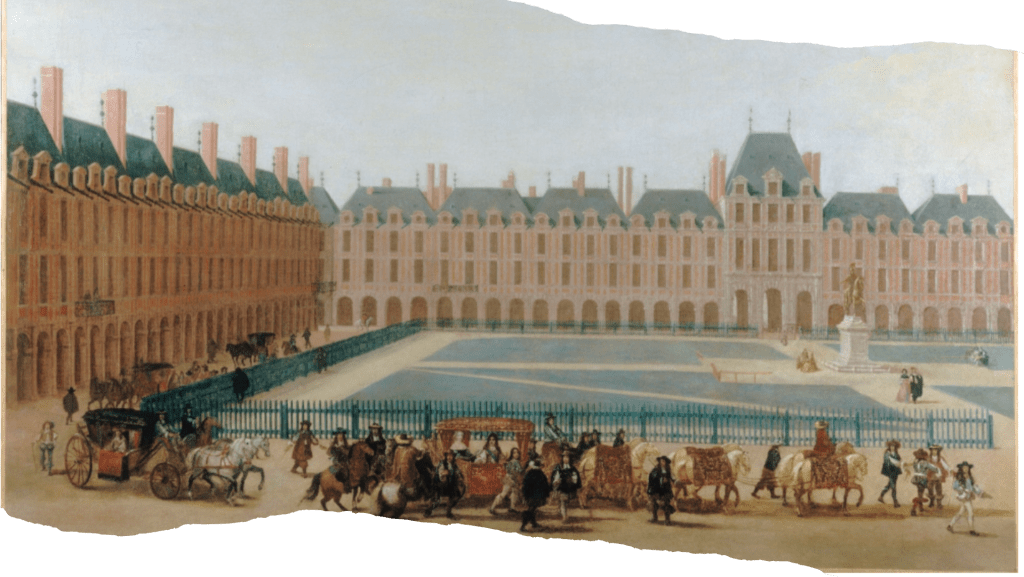
It is not entirely true. Raoul is certain he saw a wry smile pass over his father’s lips, when Athos sprang from the saddle before the great corner pavilion on the Place Royale. He is just as certain the wry smile was reciprocated by Lucien who stood waiting for his brother at the door with the key in his hand. Raoul had known, of course, what everyone knew: that Cardinal Richelieu had owned a pavilion in that most coveted quarter of Paris. But the pavilion Lucien and Raoul bought was not Richelieu’s old house. The pavilion that now belongs to the duc de Richelieu on the Place Royale, one of the largest and with a private garden, had passed through many hands, most recently Honoré d’Albert, the duc de Chaulnes and a Marshal of France, whose widow was eager to retire to her late husband’s country estate after his death. Stepping down from her carriage, Raoul’s mother, cast the same amused glance toward his father and his uncle. Raoul understood then that this house must have belonged to that part of their past lives into which he has decided he will never pry.
⚜️⚜️⚜️⚜️
Raoul kisses his mother’s hand as he enters the salon. She sits at a beautiful settee, while his father stands behind her smiling with contentment. “You look better each day, Mother.”
It is true. He was surprised to find her so restored even upon her arrival, after her ordeal and the long journey from Glénay. Looking at her now, save for her short hair, which she arranges with elegance, no one would guess what she endured and how near she came to death. There is something altered, however, between his mother and father. Something he has never perceived before, not even at Glénay, where he last left them. He wonders whether he might have understood it more clearly had he been raised with them both. The only word that comes to him is ‘bliss’, and bliss is not a word he has ever associated with either of his parents. So perhaps he is mistaken.
“I scarcely fit into my dresses,” his mother says. “I am being thoroughly indulged, and your father has been conspiring with the cook.” With her eyes, she indicates the beautifully laid little table before her.
“As I have already said, you may have new dresses. Besides, it is important,” Athos says, feigning an air of grave knowledge, “that the duchess of Richelieu commands admiration by her very presence. In fact, I am reconsidering the size of my own girth for the same reason. ‘Girth maketh the man’, as Porthos is fond of saying.” He leans forward as though to take a candied fruit from one of the plates, but she gives his hand a light slap.
“Your girth is perfect as it is,” she warns him, playful and severe at once, and Athos sighs, apparently defeated.
This is precisely what confounds Raoul. To call it ‘bliss’ does not quite describe it. But before he can puzzle further over the riddle of his parents, set, as it is, against his own aphorism concerning the impossible, the improbable, and the truth, the salon door flies open and the wild little whirlwind Bianca has become rushes into his arms, singing, “Raoul, Raoul, you are here!”
He lifts her up and kisses her, and his sister’s laughter and delight prove impossible to resist. She has been followed into the salon by Giulia, whom Raoul has always thought affable and affectionate, although she has worn a particularly stern expression since the family’s arrival from Glénay. Célestine, Bianca’s little companion, is with her as well. She is timid, as is only natural, the poor child having been carried from a small fishing village to the Place Royale in less than a month, but his mother says she is quick to learn and very clever. There is something about Célestine that reminds Raoul of Marie Cessette, and for the first time since his wife’s departure, he feels her absence keenly. Or perhaps it is the bewildering happiness between his parents that makes him feel it. He sets his sister down and greets the little girl with a smile. “Mademoiselle Rapin.” She smiles back. “How do you find this new house?”
“A very large house, Monsieur,” she replies, “but I contrive not to get lost.”
“She will meet Alexandre tomorrow!” Bianca bursts out eagerly. “We are all to go riding with Papa and Uncle Charles. Each of us with our own horse.”
His father gives a faint shrug. “D’Artagnan and I promised.”
“I was overruled,” his mother says, and immediately adds, “Ah, there he is.”
A nurse has entered the salon with his baby brother in her arms. “Fed and rested, Madame,” she tells Alessandra.
“Would you like to hold your brother?” his mother asks.
Raoul takes the baby gladly into his arms. Mon briquet, mon petit Léon. Tu as des cheveux comme un lion! He has heard Bianca’s little song for their brother, and it suits the baby perfectly.
Léon opens his large blue eyes with great curiosity and studies Raoul’s face for a moment. Then, all at once, he breaks into a broad smile. “He smiled yesterday for the first time,” his mother says. She has come to stand beside him. “He has been enchanting everyone with his smiles ever since.”
“But he has no teeth!” Bianca points out.
“Neither had you at his age,” Athos replies, sweeping his giggling daughter into his arms.
“A baby suits you,” his mother observes, with pointed innocence.
“Mother!”
She gives a small shrug. “It is merely an observation. I do not intend to be one of those mothers who pester their sons in this manner.”
His father’s expression shifts, even though his voice remains gentle. “How is she, Raoul? These past few days I have heard enough of Normandy, from Lucien too, to wonder whether…”
Raoul glances toward Bianca, who appears to be listening with great attention.
“Let us speak of all this by and by,” he cautions.
⚜️⚜️⚜️⚜️
A silence settles over Athos’s library after he has finished explaining what Raoul has warned him about. Porthos springs to his feet. “I am going to Normandy to bring my daughter home.”
“Porthos, wait.” D’Artagnan places himself between his raging friend and the door. “Ask yourself what is safest for Marie Cessette: to defy the King again, or to wait in Normandy, where he wishes her to be, while we work here to hasten her return.” He casts a helpless glance toward Athos, Aramis, and Lucien. “With my apologies, Aramis,” he adds.
“None are needed,” Aramis says quietly.
“Do not look at me,” Lucien tells him. “I would already be on the road to Normandy. In fact, I am considering it. The more I hear of this entire sordid affair, the less I like it. Say the word, Porthos and we leave. Normandy first. Then I go to Spain with Layla.”
“I would be on my way to Normandy as well,” Athos says to everyone’s astonishment. “We have defied the King before. What I have learned from it is that one must act with purpose—yes—but also with cunning. This time, we possess an advantage we have never had before. This is the House of Richelieu, and the irony can escape none of us. Furthermore, all four of us are expected to serve in the royal council.”
“How, then, can we leave Paris?” Porthos despairs, anger still ringing in his voice.
“I can,” Aramis says. “I am joining Monsieur de Rohan and Layla in Spain.” He inclines his head slightly to Lucien, who answers with a smile. “But I may be the only member of the King’s council whom Louis would rather not have in Paris.”
“Ah,” Athos says, “and here is where Raoul proves invaluable. You see, the Duc de Gramont, Monsieur de Guiche’s father, having been obliged to relinquish his post as Marshal of France and serve as Minister of State, is to be sent as ambassador to the Reichstag, a position which, according to Raoul, he has coveted ever since it became vacant.” Athos pauses. “There is more. Raoul has seen the documents prepared, so this is no mere rumor. Louis is creating two new marshal’s batons. Spain is gathering troops near the border with the Spanish Netherlands, and whether Condé chooses to fight against France or to return repentant, war in Normandy is imminent. In the east, meanwhile, the Turk is a threat not only at sea but on land. It seems Louis did not secure the terms he expected, and the Turk will not rest until they march upon Vienna and farther west. A messenger from the Sultan has arrived at Fontainebleau, and, apparently, the terms offered by the Porte were, shall we say, underwhelming. Louis is enraged.” Athos clasps his hands behind his back. “Now, if my arithmetic is sound, and knowing Raoul who would not reveal such matters without certainty, I see three Marshals of France in this room. And one of them,” he gestures toward Porthos, “is the man most experienced in fighting in Normandy.” He turns to Lucien with a smile. “Ah, and before you imagine yourself spared all this pomp and ceremony, brother, there is to be a new post in the navy, and it is already signed by the King, with the blessing of the Cardinal and the approval of the Admiral, the Duc de Vendôme: ‘Lieutenant Général des Armées Navales’.”
“Parbleu!” Lucien springs to his feet, his face caught between horror and disbelief. “No.”
“Yes. It occurred to me you’d say this the moment Raoul mentioned it,” Athos says. “From Alessandra’s uncle I have inherited an island in the Mediterranean, which I place at your disposal, along with the protection of Venice, should you decide to flee. But then Raoul also observed that the first order of this new Lieutenant Général des Armées Navales will be to establish a second headquarters for the Admiralty in…”
“Rouen?” Lucien says.
“Rouen, indeed!”
“It all falls very neatly into place, does it not?” D’Artagnan observes, with evident suspicion.
“I must wait to bring my daughter home until Louis decides to hand me a marshal’s baton and send me to Normandy?” Porthos thunders.
“Louis will wait until the Queen is delivered,” Aramis says. “That will be in no less than two months. It is what I would advise Louis, and I am certain it is his calculation. If there is a Dauphin, his position is one of strength, and he will act at once, and aggressively. If not, he may be inclined to negotiate, defer, and delay. You must decide, my friend, whether a delay of two months is a stratagem you can endure. Consider, too, that if there is to be war in Normandy, it will not begin before then.”
“I see Rochefort’s hand in all this,” d’ Artagnan growls.
Athos only shakes his head and Lucien notices: “What else is there?”
“I am not sure,” Athos hesitates. “I made the same observation about Rochefort when I spoke with Raoul…” He hesitates again. “He is not telling me everything.”
“He is spymaster,” D’Artagnan says, perplexed.
“Raoul is not a man to speak without certainty and proof,” Aramis adds. “Nor should he be, Athos.”
“That is not what I mean.” Athos sounds frustrated. “I do not know what I mean.”
“A father’s instinct?” Porthos says.
“A mother’s too. Alessandra agrees with me,” Athos replies.
Lucien rests a hand on Athos’s shoulder. “Then let us be practical. The more I consider it, the more I am inclined to agree with Aramis. Not that I do not understand your desire to intervene, Porthos. But two months give us time to prepare. This whole design reeks of Rochefort, and yet he appears to wish to protect your daughter. That is how I would explain the masked horsemen in Raoul’s account. We must ask why Rochefort sent those men, not who they are. We must ask why he is disposed to protect Marie Cessette, because it seems to me that this is the true game he is playing with us. Otherwise, Rochefort hires his mercenaries from the same places I hire mine.” He gives Athos a sidelong, wry look. “Only you are mad enough to hire Sicilians, brother. As for the Bohémiens, I shall get you the answer you need. Le Maupertus, I know. He runs one of the smuggling rings on the English Channel. Not the worst of them, but no jesting matter either. It was a mistake for Marie Cessette to step into their territory, even though part of me understands why she felt compelled to do it. They had better keep that estate at Normanville fortified. Between Athos and I, we must send more men. As for that Spanish ship…” Lucien’s expression darkens. “That ship troubles me most of all. It is not what it seems.”
“My daughter is trapped in the midst of this,” Porthos insists.
“She has already proved herself equal to the circumstances,” D’Artagnan says.
“So has Layla and more times than I can count,” Porthos counters. “But ask Lucien whether he would leave it at that.”
“Absolutely not,” Lucien says. “We are not leaving it at that. But we shall no longer play the defensive game Rochefort desires. This time, we attack. In two months, and whether there is a Dauphine or a Dauphin.”
“You have a plan, then?” Athos asks.
“Do I not always, Messieurs?” Lucien says. “The difference this time, as my brother reminded us, is that we are, whether we like it or not, the House of Richelieu.”