“They have puppy dogs and Alya also brought a bird, but the poor thing died on the trip. Her betrothed gave her a beautiful, gilded cage with a new bird. Alya goes everywhere with Belkis and Fatima, and she has dark hair like me. Did you know we are same age, we are both to be married and she loves to ride horses. Is that not wonderful? Charlotte will be thrilled and Yusuf promises to arrange a morning ride for us. Oh!” Rayya stops her chatter abruptly and frowns, “Uncle Francois brought that horrid man Macias with him.”
“Rayya,” Sophia speaks quickly into her daughter’s pause, “you did not go over to the house unannounced. There are formalities to follow, Yusuf did tell us about this.”
“I was with Yusuf,” Rayya flushes defensively. “He told me everything.”
“A ride would be marvelous,” Layla says turning to Suzanne. “You will come with us. There will be a kind hearted mare in the stable for you.” Suzanne laughs, “and elderly as well. It has been some time since I went on a spirited ride.”
“Where were you with Yusuf?” Sophia inquires sharply, “and where did you see M Roberval?”
“They are with Father in his library.”
“M Macias is there too?” Sophia is astounded.
“Yes, odious man.”
Marie and Sophia exchange a look of disbelief. “Rayya,” Marie says gently to her overly excited granddaughter, “time for you to change and check on Rosie. You are all to greet Yamina Hatun and Alya Hatun when they arrive. There will be several carriages as they travel everywhere with many attendants. Bring them directly to the orangery. Remember what we talked about?”
“Yes, yes,” Rayya rolls her eyes impatiently reciting, “just as Yusuf explained to us. Rosie has the packet ready and we wait until we are in the orangery.”
Marie stands up, “I will make sure they remember to stay in the library.” Layla stands with her grandmother, “I will go with you.”
“Surely Yusuf …”
“Yes, but I remember Rayya’s account of M Macias and his mischief. I am going with you.”
Sunlight transforms the glass orangery into a magical place of reflected light, a lush variety of greenery and colorful flowers. Sophia and her daughters walk with Alya. They are a lively group and Alya seems delighted at the constant chatter of places they want to take her, friends to meet, music, books. Questions fly back and forth with ease. The air is perfumed with garden scents. Alya sniffs at an intensely rich sweet scent. Sophia points to large urns of closely packed roses. “These are grown by the Hollendais.” She turns to Rosie who hands Alya a rectangular box wrapped in silk and tied with silk ribbon.
“For me?” Alya looks pleased and unwraps the box, releasing a pleasant pine scent. The box is covered with a marquetry of brass, ivory, and shells in a lustrous decorative pattern. “Exquisite,” Alya tilts and turns the box, catching the light on the varied surfaces, the textured pattern appears to shift and move. “Extraordinary.”
“The artist has been refining his techniques and is gaining the favor of the King,” Sophia explains. Alya opens the box and takes out two fine soft linen handkerchiefs. One is embroidered with a trailing cascade of roses in deep red silk, the border trimmed in gold.
“My father told me you are talented with embroidery. These are beautiful mendils,” Alya exclaims, “a lady’s handkerchief. My family raises roses.”
Rosie nods, “my father uses the oils for the soap he makes in Marseille.”
Alya unfolds the second handkerchief. It is embroidered with shades of blue and violet silk, clusters of star shaped blue flowers intertwined with a different flower, a deep violet blue in a tubular shape. Like the first it is trimmed with a gold silk thread.
“Lovely,” Alya murmurs, examining the design. “This one,” she touches the star shaped flower, “a bluebell. It grows in the wild all around our home. We have some in pots.” She looks closely and touches the second flower. “This flower is similar but different. The detail in the needlework to vary the depth of color is exquisite.” She looks up at Rosie, “you are an artist.” Rosie blushes and hurries to explain.
“That flower grows wild in a bluebell wood at Royaumont, our family home. Your father brought back bluebells from your country and now in places, the two grow next to each other.”
Rosie is suddenly shy as Alya hugs her impulsively, “thank you for a beautiful, thoughtful gift.” Alya looks at the young women grouped around her, “how fortunate you are, to have a younger sister.”
Rayya raises her brow and Layla squeezes her hand lest her impetuous younger sister think to offer a witty remark. Suzanne is serene and diplomatic, “Rosie has more older sisters than one might wish for.” Rosie simply smiles and shakes her head.
Marie and Alya’s aunt, Yusuf’s older sister Yamina, draw closer and Yamina Hatun admires the box and Rosie’s artistry. “My brother was thoughtful to suggest you present your beautiful gift in this place.” Yamina Hatun is small, round and with a cheerful demeanor. Behind them trail several women attendants, one of whom serves as a translator to assist their communications. Alya is fluent in French, the others practice their Osmanlıca and there is a great deal of laughter with mispronunciations, corrections and the invention of double meanings. Rayya declares there is no need for the help of interpreters. Sophia wonders if the servants might be questioned by the men in their family. She doubts Yusuf would do this, but Alya’s brothers and her intended husband may guard his future wife’s privacy and virtue more closely.
“It is beautiful garden,” Yamina Hatun declares. “I am grateful you share it with us.”
“My husband built this orangery,” Sophia says, “You might notice it has an unusual shape.” Alya cranes her neck to look in all directions. “Yes, I see it now.” It resembles…” she paused for the right word.
“The deck of a ship,” Sophia supplies. “There are platforms at each end, quarterdeck and a foredeck.” They come to a tree with twisting trunks rising tall and topped with branches tipped with grey green leaves.
“A beautiful olive tree,” Alya notes the sculptured beauty of the tree. “The mast,” Sophia says, pointing as she says, “can you see the palms?” Alya gasps at the orientation of broad sweeps of the palm fronds. “Sails,” she gasps delighted, “one can imagine being on a ship.”
Sophia smiles at Alya’s look of wonder and thinks about the orangery’s beginnings. It had been many years ago and after months of secrecy Lucien had shown her his intentions for the orangery’s design. At first glance, she had not grasped it and saw Lucien’s turn away, “no matter,” he had said masking his disappointment. “The garden is barely started.”
“I could not imagine it immediately,” Sophia says, “but I had the habit of sitting here with my correspondence or reading and one day, I simply looked up and there it was all around me. It was unmistakable and indeed remarkable.” She does not talk of the letter she immediately wrote to Lucien, taking it to M de Vry insisting that his men get it to Lucien by whatever means necessary. Lucien had returned within a fortnight, their reunion memorable, encompassed within this verdant garden.
“I am delighted you see it so clearly” Sophia says, “let’s keep walking, we have refreshments waiting for us.” The pebbled path winds through the garden, shaded with leafy branches and bordered with fragrant citrus and cherry trees, lavender, sweet alyssum, hibiscus and jasmine. In the upper branches of the leafy trees, comes a repeated fluty melody. A songbird is singing. Alya stops abruptly.
“A nightingale,” she exclaims looking up to see the bird. Sophia smiles at Alya’s eager effort to find the bird in the high dense foliage. “Rayya told us you traveled with a bird that died, a nightingale I believe.”
“Yes,” Alya replies quietly still looking up for the bird. “How sad,” Sophia says, “I understand that your betrothed gave you a gift of a bird. Was it a nightingale?”
“No,” Alya replies tonelessly, still looking for the singing bird, “I love their song,” Alya’s expression is wistful. Sophia discreetly looks away, recognizing a private memory. Alya wishes for the song to be that of a nightingale and Sophia does not have the heart to tell the young woman that the bird she hears in not a nightingale, but a song thrush, found in Paris gardens and easily mistaken for a nightingale. Private memories should not be disturbed with the truth.
“We shall have refreshments here.” The group has arrived at the far side of the orangery where Sophia indicates a raised pavilion covered by an immense triangular shade sail of pearlescent silk. There is a large round table, surrounded by a low divan with many large colorful cushions for sitting or leaning against. When the candles in the standing candelabras are lit, it will create a soft glow. “We will have our dinner here too,” Marie says.
“It is very beautiful,” Yamina smiles, “we are looking forward to it.”
“Yamina Hatun, you must advise me of any deficiencies. I do hope to have chosen dishes that will be pleasing. My daughters and I have a list of attractions for you to consider. We want to show you the best of Paris.” Servants are arriving setting platters of sliced fruits, berries, crisp wafers to dip into fruit compotes, candied fruits, a variety of cheeses and tarts. There are flasks of spice wine and spring water.
“Your generosity is appreciated.” Yamina inclines her head, one hand touching her heart.
Sophia gestures to the open door that leads outside and turns to Alya, “let us have some refreshment and afterward, you may wish to explore the gardens beyond the orangery.” She sees uncertainty pass over Alya’s delicate features. “My husband, your father and M Roberval are confined to my husband’s study. No one will bother you.”
The western sun is slanting across the land. The five men ride over a broad plateau, toward the village of Criquebeuf. In the small tavern Renacer offers silver coins for salted fish and cider, asking the woman who wraps the food if she has seen any other strangers either from coastal boats or by horseback. She looks surprised at his question and shakes her head. From there, the land slopes gently into flat grassy headlands and they can smell the sea, the wind blowing cold. They dismount, crossing the headland trail to push through stubby coastal shrubs to the top of the cliffs and looking down from a dizzying height to the pebbled beach. A boat is coming into the small cove, the man at the tiller expertly lining up the bow to surge forward with the waves, two men leaping from the bow to drag it up onto the beach. They watch the men unload the boat and then sit together on the beach passing a leather bag between them. They finish the bag, collect their catch and gear and start up the path to the headlands.
“Were they biting today?” Renacer calls out in a friendly tone as the men ascend the trail and he can hear their voices. The three men are surprised, replying in a cautious yet friendly manner, “we had some luck.”
“I would ask you what manner of ships you saw today,” Renacer says politely, “my ship is coming north from close to Etretat.” There is no reason for him not to disclose it, and he hopes to disarm the natural disinclination of local people to reveal anything to strangers. If they assume he is a smuggler, he will at least be a friendly one.
“You are captain of that ship?” a tall, grizzled fisherman asks. “Grappled to the Inquisition ship?”
“I am.”
“She bears north.”
“Good,” Renacer is relieved. The Belladonna is no longer a captive, news of her is already spreading along the invisible lines of communication linking villages and people along the coast.
“Are the Spanish headed north?” Any fisherman would recognize the distinctive features and immense size of a Spanish galleon. The fishermen look at each other, shaking their heads
“Not that we have seen.”
Renacer purses his lips, wondering if there is a reason to not tell him of a sighting. He has an idea of the plan enacted by Captain Corzo, but if no one saw the Santa Margarita, then perhaps he is wrong.
“Too many Les Anglois,” the fisherman offers.
“Hmm,” Renacer nods in agreement. An increase in the English naval presence would affect people on both sides of the channel who depend on each other for trade – legal or illegal. No one would welcome England’s navy.
He offers the man his flask and they pass it among them and chat amiably about fish and weather. Renacer signals for them to keep the flask, and they ride away, continuing in a northwest direction. Renacer leads, Jabari next to him if the trail permits, or behind with Anriquez followed by Gervais. In agreement with Renacer, Ferreira brings up the rear to keep a watchful eye on Jabari and Anriquez, his musket loaded and his dagger in easy reach.
Stands of trees and low shrubs dot the landscape. The green plateau is broken by narrow, steep sided valleys, stretching inland. At the crest of one of these valleys, they dismount and lead their horses down the trail to a small fishing hamlet perched to the side of a well-trodden path. To their left is the beach and the thunder of surf, to the right a small hamlet of huts dotting the slope to the valley floor. “What is this place called?” Renacer asks the serving woman in a small tavern, a shed, with a few upended barrels under an old sail for shade stretched from the roof to a scrubby tree. It flaps noisily in the wind. A young boy appears with an armful of branches collected from deeper in the valley. He nods warily at the five men before dropping the load of wood into a box. He glances at the woman.
“Grainval,” she replies tersely. He asks his questions of ships, coastal boats and men and she shrugs, pointing to the beach and the few men who are working on their boats, or in small groups smoking pipes, their eyes on the strangers.
Renacer walks out to the beach, trudges across the sand to greet the men. They listen thoughtfully to his questions, puffing on pipes and offering a few remarks on the Inquisition ship and the crowds. One man describes a ship he saw far to the west. It is clear from his description that he saw the Belladonna and not the Santa Margarita. Odysseus is following his orders, and the Belladonna is tacking her way west and north in a wide sweeping search for any sight of the Spanish galleon. The English blockading ships will ignore the Belladonna, as long as the Belladonna ignores the fat merchant ships scurrying through the Channel. The English are clearly looking for something else or someone else. He looks up at the curving land enclosing the beach and cove. It rises on a gentle slope from the beach to the headland, with more small huts and a tiny steepled church. He considers going to the village but decides against it. It is the manner of local people to not volunteer information to strangers, and he has probably learned all he will from the woman and the fishermen. He purchases a quantity of salted fish, bread and cider, depositing a generous number of coins into the woman’s palm. He thanks her politely and they walk their horses up the steep sided valley wall and return to the headland trail.
They reach Fecamp port in the early evening, a good time to catch port workers and seamen eating and drinking in the taverns. They pass close to the shipyards, hearing the thwap of axes and adzes shaping wood, blacksmiths hammering out anchors and bolts, mallets driving oakum. A pungent scent of pitch hangs over the port. Tucked behind the heavy wooden booms are two and three masted luggers with sails furled, drifting to the limit of their anchor chains or thumping against the dock. Sailors are visible on decks and longboats loaded with men are rowing toward the quays where women and crooks with marked cards and loaded dice wait for a sailor with coin in his pocket. “No drinking, no gambling,” Renacer scowls at the men. “We get our business done and move on.
They leave their horses at a stable and separate to cover the port and surrounding streets with taverns and inns of all sizes and states of decrepitude. Renacer takes Anriquez and Jabari with him, Ferriera and Gervais walk to the streets beyond the port. They spend several fruitless hours in and out of taverns, inns and talking to men sharing flasks and tossing dice. They meet in a tavern facing the port that bears an enormous wooden shape of a cod fish attached to a weather-beaten sign, La Morue Volante. Renacer is tempted to find a bed and stay for the night but decides against it. Better if he keeps Anriquez and Jabari closely under his watch and away from the lure of drink, women and plotting against him.
“There better be more here than putain salted herring,” Anriquez grumbles drumming his fingers on the table. “The name would suggest it does,” Gervais says pleasantly, his smile fading as both Jabari and Anriquez turn their heads to look at Gervais, frowning as though seeing Gervais for the first time. Anriquez’ scarred expression is inscrutable, dark eyes soulless and impenetrable. Gervais shifts nervously. The captain is civil enough, but the other two are powerful brutish men with many scars, hair pulled tight into pigtails revealing tattoos on their necks. He knows men like these in Normandy, the same kind who work with his father. Gervais aspires to a different position in the family business and to gain his father’s favor to broker their goods in Rouen. His father insists he learns to handle himself as he puts it, so Gervais still wades into the surf to unload boats or crates and barrels floating to shore. In the dead of night, he leads the donkey trains on the tangle of sunken trails hidden behind thick hedges that criss cross Normandy. Gervais swallows and offers a small smile, “I hope the same.” Anriquez regards him steadily and Gervais flushes, feeling himself to a hapless rabbit under the merciless eyes of a wolf. The captain taps the table breaking the spell. Anriquez meets Renacer’s meaningful gaze, turns back to Gervais with a small humorless smile and looks away humming tunelessly.
They are soon back on their horses and leave Fecamp. Renacer glances at the last of the setting sun flattening against a vibrantly colored horizon. He estimates a couple hours ride to Életot, less to the Valleuse de Senneville. They will be riding in the dark.
“We can stop in Senneville, although we could push on to Életot,” he advises the others, “better accommodations.” The air is cooling, the ocean booms relentlessly against the rocks far below the headland, bird song fading with the sun. A faint sound, familiar but unexpected, catches Renacer’s attention, he turns his head toward the ocean. On the beach, far below the headlands, swords are clashing. Now he hears voices – angry, shouting, cries of the injured. Men are fighting. They turn off the road, tethering their horses in a copse of trees. Ahead is another break in the plateau where a small valley leads inland from the beach.
“Gervais, stay with the horses. Anriquez, you and Ferreria check the beach.” He signals Jabari to come with him. They walk slowly toward the break in the plateau where the trail begins its descent into a narrow valley. They drop to their knees and then lay flat. The valley is directly below, but already there are too many shadows. “At least two,” Jabari murmurs, “a carriage, I cannot see how many horses.” Renacer signals to retreat and move to the headland overlooking the beach. The height of the cliffs is dizzying. Anriquez is farthest back from the edge. Renacer gives him a scornful look.
“I ain’t no foretop man,” Anriquez snarls, defensive, but he does not move closer. They drop down and crawl to the edge ti oeer lay flat as they peer over the edge to the beach far below filled with small figures of man fighting.
“A lot of men on the beach.” Ferreira observes. Renacer studies the horizon cursing that he does not have his glass. A yellow light flashed briefly. “Did you see that?” Renacer asks excitedly. It must be a stern light. The sky is darkening, clouds moving in and there is no visible moon. He keeps watching the horizon willing the light to show itself again. “There’s a ship out there.”
“A ship?” Ferreira squints, “a galleon? Why are those men staying in the boat?” Renacer follows his pointing finger to the four men still in the longboat, one at the tiller, two holding oars and man sitting between. “The man in the middle is likely the captain,” Renacer suggests. “If his men prevail, the cargo comes to shore, but if the fight goes against them, they row back to the ship, find a different beach.”
“Leave his men?” Jabari frowns and Anriquez has a different opinion, “or they kidnap the captain, force him to his ship, ground it here and steal the gold.”
Anriquez has a good point. Regardless, the captain of the Santa Margarita might be in that longboat, and the Santa Margarita is offshore. Captain Corzo had hidden in the Orkneys, waiting for the right time to land his cargo on this remote beach. The carriage and wagon will bring the gold through the valley that stretches inland. There are caves in this valley and Renacer feels a flush of excitement. A flota ship loaded with gold is within his grasp.
“Get Gervais,” Renacer orders, “he might recognize someone down there.”
“Near fifty men on the beach.” Jabari watches the fight for a moment, “they know their business. Not fishermen.” He frowns and pokes Renacer. “Do you see them? Are they…?”
“Priests,” Renacer exclaims. “Collecting their tax no doubt,” he jokes wryly. He looks up and down the headlands, “no sharpshooters.”
“No point,” Jabari scoffs, “it must be over 300 hundred feet to the beach, and its dark. The shot can get there but it won’t hit anybody.”
“Maybe their shooters are on the beach.” Ferreira is flat on the ground looking up and down the length of the beach, but he cannot see the area closest to the cliffs.
“What are you ladies doing here?” A tough voice jerks Renacer out of his moment of victory. He looks over his shoulder. A man armed with a long barrel musket is standing over them. Renacer notices two things at the same time – the first being the musket has a doglock, half-cocked. The man’s accent makes him English but not military or he would not have make that mistake. The second is that he is closest to Anriquez and if he knew the man, he would move away, quickly.
“Watching the masque,” Renacer stays flat, answering in an easy tone, “are those priests friends of yours?”
More men are emerging from the valley to confront them. “I suppose these are your friends,” Renacer jokes conversationally, knowing his men are tensing for the fight ahead. Surprise will depend on Anriquez. Renacer quickly rolls over and up to a sitting position, his hand moving toward his boot and his dagger. “Hey, don’t move,” the man with the pistol shouts at him, one extra beat for his hand to sweep over the musket before he can squeeze the trigger, but it is his step forward that proves fatal.
Renacer rolls one way, Anriquez the other, the shot is buried into the ground. Anriquez grabs the barrel of the musket and yanks the shooter forward to fall over him, landing awkwardly at the edge of the cliff where he grabs hold of the grass, but Anriquez casually spins around and kicks him in the face. He yelps, flails and drops over the side, his scream fading as he falls to the beach far below and then abruptly cuts off. It is over in seconds, but Rencacer is already crouched, dagger in hand and driving his head into the gut of the nearest attacker. They go down with fists flailing, rolling and grappling each trying to pin the other. He hears the scraping sound of a sword leaving a scabbard, and then a cry as a dagger is driven home, the sword now in the hands of Jabari who has no grace with a sword but knows how to cleave a head and slice a belly. Ferreira is shouting, more pistols or muskets fire. Suddenly the fight is over, bodies strewn across the grass. Renacer staggers to his feet, groans at the pain in his shoulder, blood flowing down his arm from a wound he did not know he had. He looks around wildly for his men, relieved to see them standing – bleeding but standing. Ferreira is bent over, cursing angrily, ready to slit the throat of a dying man, Anriquez squeezing the life out of another.
“Do not kill them all!” Renacer gasps, Anriquez stands back so he can kneel down next to a groaning man bleeding copiously from a head wound, “who do you work for? What ship is that?”
“Go to hell,” the man mumbles in English.
“You could still live.”
“Bloody pirate.”
“Putain goddams” Renacer curses, “are they all English?” He watches the man’s life pump from his body as blood soaks the ground. “Dimly he is aware of a horse and rider galloping away in the direction of Fecamp.
“Captain,” Jabari has his foot on a dead man’s chest pulling out his dagger. He wipes it on the man’s doublet. “More coming.”
Renacer growls, his blood up from the fight. He wants that gold and ready to kill more men to get it. He jabs a finger toward the ocean. “That gold is ours,” he declares angrily, “we need the men in the longboat.” He glares at his men, “which of you has the cojones for this fight?”
Jabari brandishes the sword and Ferreira grabs a musket from a dead man’s belt. Anriquez grips a dagger in each hand. “We need Gervais. Secure the horses,” Renacer climbs to his feet, holding his damaged shoulder and shifts his dagger to his other hand. He walks to the crest of the trail leading down to the valley. “I go first,”
He descends quickly, stepping cautiously, at times slipping down the steep trail. In the dark, he strains to see anyone lying in wait for him but hears only the rattle of carriage traces and the chuff of horses. Ferreira is close behind him with the musket. They descend to the floor of the dark valley. Renacer can feel the ocean wind against his face. To their left a path opens onto the beach where the battle continues to rage. To the right, they can barely see the shape of a carriage and horses facing into the valley. A driver talking in a soothing voice to keep the horses settled. He does not hear the two men behind him.
A figure appears around the side of the carriage moving from the deep shadows with a determined stride. Ferreira mutters and levels the musket. The figure comes closer, face shrouded by a broad brimmed hat, a pistol leveled at Renacer. A sudden gust of wind catches the broad brimmed hat and whips it away blonde hair tumbling … Renacer leaps in front of Ferreira arms spread wide, shouting, “no! no! Do not shoot. Belay that attack.”
It is the noble woman from Maupertus’ tavern. Her hand is shaking and Renacer slowly reaches for the pistol. “Careful,” he murmurs, “you won’t miss at this distance.” She stares at him, gripping the pistol more firmly. “You,” she says, “from that place.”
“In Maupertus,” he replies. “I will not hurt you.” He looks at the pistol. “Please lower your pistol.”
“What are you doing here?” she asks keeping the pistol steady.
“We were on the trail going north,” Renacer considers overpowering her, but his mind is racing with confusion as to why she is here and the most probable answers make no sense to him or for stealing a cargo of gold.
“We heard the fight on the beach and were attacked.”
“You fought them off?” she sounds surprised and he bridles at the insult, “of course we did,” he snaps. She says nothing more, so Renacer asks, “are those your priests out there?” He jerks his head in the direction of the beach. “Are they winning new converts for schools?” He chuckles at his own joke.
“I do not know,” she stares at him, chewing her lip preoccupied and oblivious to his attempt at humor. “I am not sure…” her voice trails off.
“Who are your men fighting? Who is the man in the longboat?”
She seems relieved that he asks this question, and looks at him intently, weighing a decision. “Would you fight? There are men who cannot get from the boat to this carriage. Can you do it? I will pay whatever you ask.”
Renacer gapes at her, speechless. He glances at Ferreira who is waiting with Jabari, Anriqez and Gervais. The woman still holds a pistol on their captain. They do not lower their weapons.
“From the boat to the carriage. You will pay us for that.”
“Yes,” she is now decisive and giving instructions. “Circle around and take more weapons so the two men in the boat can fight too.”
“Good ideas,” Renacer replies wryly. He stares at her. He cannot believe he is considering doing what she asks. He turns to his men who regard him with blank expressions. “Well?” he asks. They look at each other, back to him, shrugging their shoulders and nodding.
“What’s his name?” he asks as he starts to walk toward the beach, dagger in his hand. Silently he curses himself for leaving his pistols in the bag attached to the saddle.
“Who?” He realizes she is right behind him, almost running into him as stops abruptly. “The man in the boat and where in l’enfer are you are going?”
“With you.” She has a stubborn glare and fixes him with hard eyes against his objections. “You will need me at the boat,” she declares, pausing, “he may be … fearful to go with you.”
Renacer stares at her, “who…” and stops. It does not matter who the man is or what his purpose or hers. He knows now he was wrong about the gold, whatever this confrontation is about, it is not the Santa Margarita, Captain Corzo and his gold. When they are paid, he will give his share to the men. He owes them that much for making this mistake and risking their lives. He looks down at her.
“What’s your name?” She hesitates and then says, “I am the…”
He leans into her face, close enough to see the double row of eyelashes, the hint of freckles scattered across her nose, the depth of clarity in her blue eyes – a man could fall into…
“What is your name?” Amon demands recovering himself. She lifts a defiant chin, “what is yours.”
‘Amon.”
“Marie Cessette.
“Stay behind me,” he growls and steps out onto the beach.
⚜️⚜️
In the darkness, she plunges into the shoving noisy chaos on the beach, men fighting close, fierce, bloody, savage…the metallic taste of blood and the tangy smell of sweat and fear alongside the soft swish of blades sinking and ripping into flesh, bone shattering, shouts, screams, roars to kill, cries of fury, fear, and death. She does not know how, but suddenly they are at the boat, the men sitting in it staring at her …go! go! go!… she shouts imploring or maybe she is only whispering… Amon grabs the men over the gunwales and onto the beach pushing them toward the valley…hurry hurry! The frightened men stagger after the others fighting furiously as the enemy discovers their escape. Men swarm, slashing swords and daggers, turning spent guns into hammers smashing the stocks into faces and crushing skulls. She dodges, ducks, cries out, slips on a soft pile of entrails, a slumped body curled around protectively. She can hear Amon cursing and shouting, but cannot see him, and then she stumbles over a headless body and a severed arm. A greasy face, smeared with blood and dirt looms, yellow teeth bared and broken. Icy fear grips, she fires the pistol wildly in his direction … missing and now he is snarling with fury and lunges with a fist, her head snaps back and she is falling, his weight holding her down, hands squeezing her neck, foul breath filling her mouth. A roar of fury, the weight suddenly lifted from her, she rolls over to crawl away, but she is hauled to her feet. A deep voice in her ear…get up…Marie Cessette…get up now! She is forced forward, then the soft trail into the valley is under her feet. He shouts for water. She cannot stop shaking and when he holds the pouch to her lips she gulps thirstily. He pulls the pouch away … not so fast … and then lets her drink more. He pours water over his hands, wiping her face, pushing her hair back, turning her one way and then the other talking to her … this is not your blood … you are not injured … but he keeps looking, lifting her arms, raking wet hands through her hair and over her face to wash away someone else’s blood. She leans her aching head against his chest, his heartbeat firm and steady. He stands very still and then his arms go around her, comforting bands of steel.
The carriage rattles away. He lifts her onto the horse, settling her sideways in the saddle, swinging up behind her. He tucks a heavy cloak around her and secures her against him with one arm. He is warm and smells like a man, a strong calloused hand gentle against her throbbing swelling cheek. She opens her eyes as he leans down, her lips parting as he brushes his lips over hers. He takes up the reins to follow the carriage. She sways with the rhythm of the horse and soon falls into the blessed darkness of sleep.
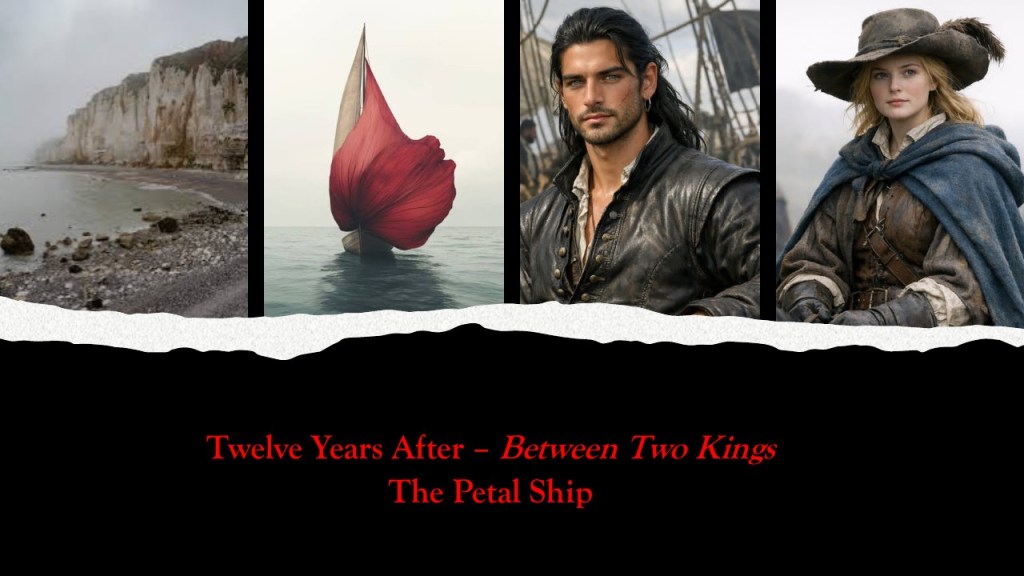
Notes on the concept of a ‘petal ship’
Lao Tzu- the Tao Te Ching, natural metaphors are used to explain why the flexible petal outlasts the rigid ship: A great, stiff oak tree stands defiant against the gale, only to be snapped at its trunk. A blade of grass or a fallen petal bends completely to the earth, letting the wind pass over it unharmed. Yielding is not weakness. By moving with the force of your obstacle (the water, time, or hardship), you preserve your energy and survive.
“Nothing in the world is softer or weaker than water. Yet for attacking things that are firm and strong, nothing can surpass it.”
The ‘petal ship’ is used to representsfragility, fleeting beauty, and the delicate journey of life. It has been used by writers to symbolize the values of bending to the currents of time and challenges of life. Petals drifting on water, symbolizes how life and love require us to navigate the currents of time on vessels as delicate as a flower.
Virginia Woolf – in The Waves, the character Rhoda— struggles with a fragile sense of identity and reality and literally drops petals into a basin of water and imagines them as a fleet of ships.
Isabel Allende – A Long Petal of the Sea, uses this metaphor to describe a rescue ship carrying refugees, blending the vulnerability of a flower with the geopolitical survival of displaced people.
Hans Christian Andersen – in his tale of Thumbelina, the tiny protagonist uses a floating tulip petal as a boat to row across a plate of water, a literal and whimsical vehicle representing childhood innocence navigating a vast, unpredictable world.


