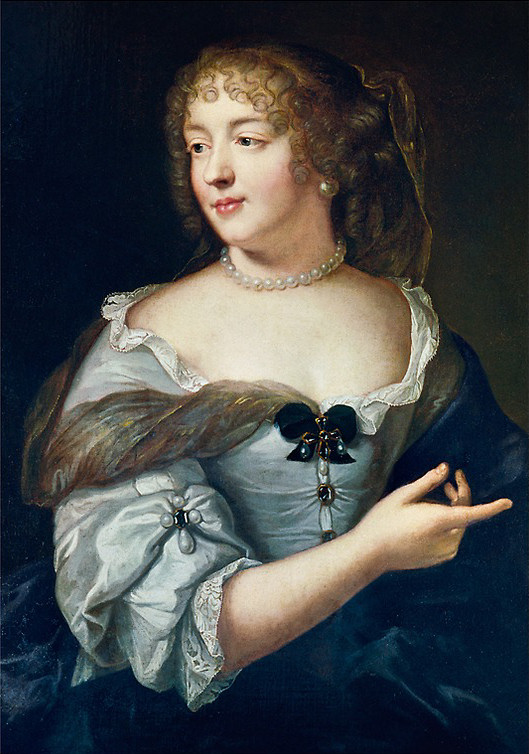
19th century copy after a lost 17th century original.
Marie de Rabutin-Chantal, marquise de Sévigné (5 February 1626 – 17 April 1696), known as Madame de Sévigné or Mme de Sévigné, was a French aristocrat, known for her letter-writing. Celebrated for their wit and vividness, her letters were addressed to her daughter, Françoise-Marguerite de Sévigné. She is considered one of the great icons of French 17th-century literature.
She was born in Paris in 1626, at the Hôtel de Coulanges, located at 1bis Place des Vosges, which at the time was called Place Royale (the name we use in the story), and 11bis Rue de Birague.
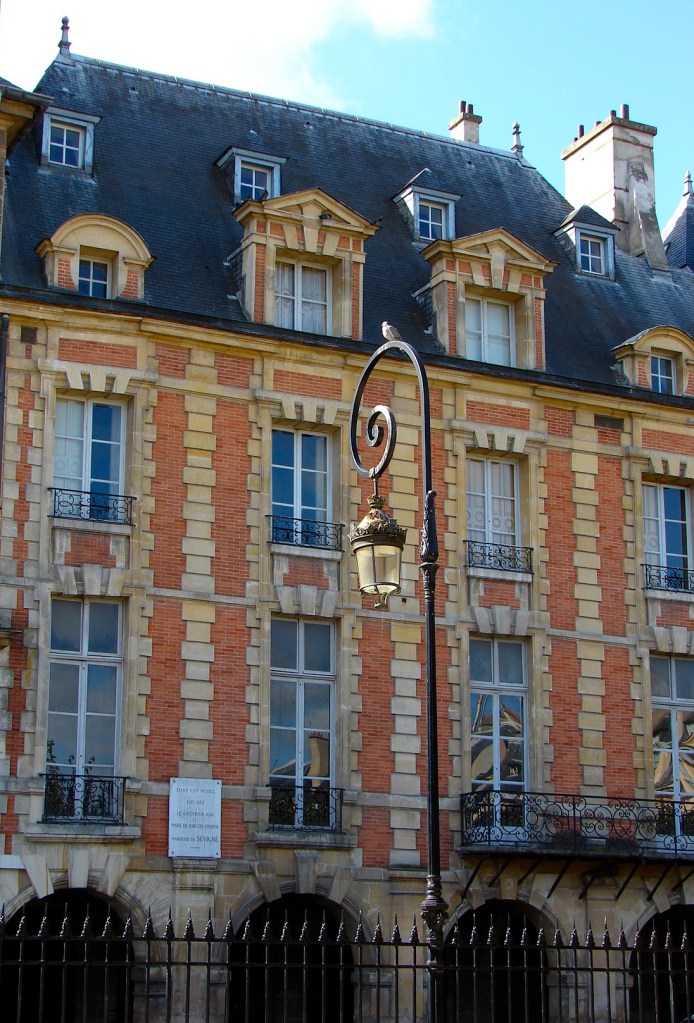
This was the home of her maternal grandparents, where her parents were also living. She was baptized the following day (Feb. 6) at the church of Saint Paul in Paris. Her baptismal record reveals that her godfather was Charles Le Normand, Seigneur de Beaumont, governor of La Fère, and first steward to the King. We use this fortunate little coincidence in the chapter. Her godmother was her maternal grandmother, Dame Marie de Bèze, wife of Messire Philippe de Coulanges, who was a member of the royal council. The child was given the name of her grandmother (and godmother): Marie.
Little Marie’s mother was Marie de Coulanges (1603-1633) and her father was Celse Bénigne de Rabutin, baron de Chantal (1596-1627). He was the son of Christophe de Rabutin de Chantal (died in a hunting accident in 1601) and Jeanne Françoise Frémyot, Baroness de Chantal, who founded the order of the Visitadines or Order of the Visitation of Holy Mary and was beatified in 1751 and canonized in 1767. She was a friend and disciple of Saint Francis de Sales.
Celse Bénigne de Rabutin, baron de Chantal was killed during the English attack on the Île de Ré in July 1627 under the orders of Marquis de Toiras. This was at the beginning of the Anglo-French War of 1627-1629. This is the war described in Dumas’ Three Musketeers (cf. siege of La Rochelle) but was not included in the BBC series where the main adversary is Spain. Little Marie was left an orphan at the age of one. Marie de Coulanges survived her husband only by six years.
Nevertheless, little Marie enjoyed a pampered childhood, first with her paternal grandmother Jeanne Françoise Frémyot, Baroness de Chantal from the age of eight to the age of ten (1634-6) and, after the death of her maternal grandfather Philippe de Coulanges, with her two maternal uncles, Christophe de Coulanges, abbé of Livry, whom she called “the very good” (“le bien bon”) in her letters, and Philippe II de la Tour de Coulanges, councilor to the King. The latter was the father of Philippe-Emmanuel de Coulanges (1633-1716), the future songwriter (“chansonnier”). The two young cousins became inseparable. In 1659, Philippe-Emmanuel de Coulanges, married Marie-Angélique du Gué de Bagnols (1641-1723), also known as a renowned letter-writer under her married name, Marie-Angélique de Coulanges.
At the age of eighteen Marie de Rabutin-Chantal married Henri, marquis de Sévigné (1623-1651), from a Breton family allied to the oldest houses of the province. However, the Sévigné family did not hold a title of nobility. The marriage took place on August 4,1644, at the church of Saint-Gervais in Paris and the couple went almost immediately to the Sévigné manor house of Les Rochers, near Vitré, which Marie later, immortalized in her letters. She gave birth to a daughter, Françoise, on October 10, 1646 (whether at Les Rochers or in Paris is not certain), and to a son, Charles, at Les Rochers on March 12, 1648.
Henri was a serial philanderer who spent money recklessly, but through her uncle’s careful financial oversight Marie was able to keep much of her fortune separate. On February 4, 1651, Henri de Sévigné was mortally wounded in a duel with François Amanieu, Seigneur d’ Ambleville, Chevalier d’Albret over his mistress, Mme de Gondran. He died two days later. Although she was only twenty-five when her husband died, Mme de Sévigné never married again. Instead, she devoted herself to her children. She spent most of 1651 in retirement at Les Rochers, but returned to Paris that November, which is why she makes an appearance in our story now. Thereafter, she divided her time between the city and the countryside. In Paris, she frequented salons, especially that of Nicolas Fouquet, superintendent of finances to King Louis XIV who was enamored with her and intended to marry her. This did not happen but they remained good friends. In fact, we read about his trial (1661-1664) in her (later) letters to her daughter.
Mme de Sévigné’s most amusing correspondence before her daughter’s marriage was with her cousin and friend Roger de Bussy-Rabutin. However, in 1658, she quarrelled with him.
On January 29, 1669, her daughter Françoise married François Adhémar de Monteil, comte de Grignan, a nobleman from Provence who had been married twice before. The couple intended to live in Paris, but Grignan was soon appointed lieutenant governor of Provence, necessitating that they live there. Mme de Sévigné was very close to her daughter, and sent her the first of her famous letters on February 6, 1671. Their correspondence lasted until Mme de Sévigné’s death.
By 1673, Mme de Sévigné’s letters were being copied and circulated. Therefore, she knew that her letters were semi-public texts and crafted them accordingly.
The year 1676 saw several important events in Mme de Sévigné’s life. For the first time she was seriously ill and did not thoroughly recover until she had visited Vichy. The letters depicting life at this 17th-century spa are among her best. The trial and execution of Madame de Brinvilliers, convicted for murdering her father and two of her brothers to inherit their estates and may have poisoned dozens of people and animals in the process of testing her poisons, took place that same year. The trial and execution figure in the letters.
The following year, in 1677, Mme de Sévigné moved into the Hôtel Carnavalet and welcomed the whole Grignan family to it. She returned to Provence in October 1678. On March 17, 1680, she lost La Rochefoucauld, one of her closest friends. The proportion of letters for the decade 1677–1687 is much smaller than that which represents the decade preceding it. In February 1684, her son Charles married Jeanne Marguerite de Mauron from Brittany. In the arrangements for this marriage, Mme de Sévigné divided all her fortune among her children and reserved for herself only part of the life interest.
In 1688, the whole family was greatly excited by the first campaign of the young marquis de Grignan, Mme de Grignan’s only son, who was sent to the siege of Philippsburg. In the same year, Mme de Sévigné attended the Saint-Cyr performance of Racine’s Esther, and some of her most amusing descriptions of court ceremonies and experiences date from this time. In 1689, she wrote positively of the preacher Antoine Anselme.
In 1693 she lost two of her oldest friends: her cousin Roger de Bussy-Rabutin and Mme de La Fayette. Another friend, Mme de Lavardin, followed in 1694. During an illness of her daughter in 1696, Mme de Sévigné caught a “fever” (possibly influenza or pneumonia), and died on April 17, at Grignan, and was buried there. Her daughter was not present during her illness.
Literary Salons
Mme de Sévigné spent a lot of time in the various Parisian literary salons, but she also frequently received her friends and acquaintances at her home. We have written elsewhere about these salons and the group of women called “Les Precieuses”. Her favorite circles were those of the Duke of La Rochefoucauld and Madame de La Fayette. Her letters marked “from the suburb” came from Madame de La Fayette’s home, while those marked “from the study” were written at the Duke of La Rochefoucauld’s. Mme de Sévigné was particularly pleased that her daughter was adored in the company of these two friends.
Mme de La Fayette, author of La Princesse de Clèves, was Mme de Sévigné’s closest friend, even though they were very different, both in personality and in their connections. La Fayette was a politically powerful woman, with access to the closed circles of the French monarchy. She also used this close relationship to benefit her friends. Around 1659, Mme de La Fayette wrote a very flattering portrait of her friend, which was published under a different name. Friendships between female authors at that time were very significant, as a certain female solidarity arose from encouraging one another in writing, even though Madame de Sévigné was a letter writer and not an author in the strict sense. There was a family connection between these two great writers as well. In 1650, Mme de La Fayette’s mother, then widowed, married Renaud de Sévigné, Marie’s uncle.
This year (2026), the 400th anniversary of her birth, between April 15 and August 23, 2026, the Musée Carnavalet presents an exhibition about her life and letters.
Sources:

 Twelve Years After
One thought on “A famous neighbor: Madame de Sévigné”