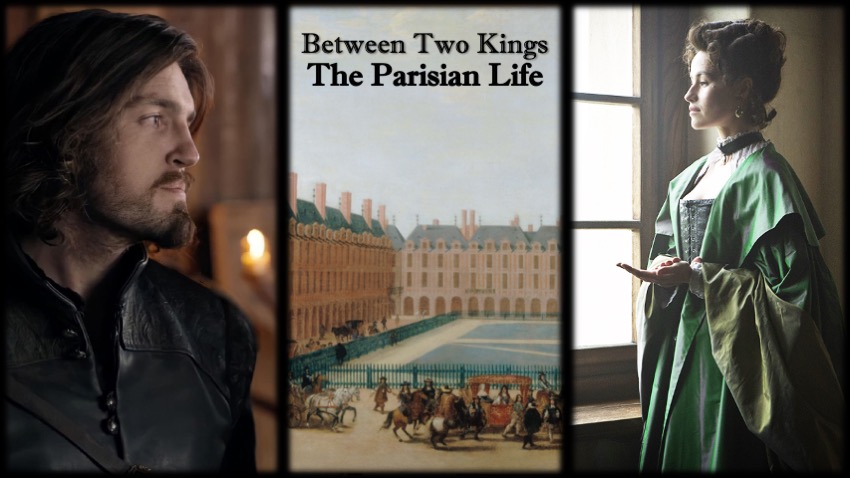
I have trod a measure. I have flattered
a lady. I have been politic with my friend,
smooth with mine enemy…
W. Shakespeare, As you like it, Act 5, scene 4, 46-48 (The Folger)
Athos enters Alessandra’s salon, carrying a sheaf of papers and drops into a chair, stretching out his legs and letting out a long exhausted sigh. Only then does Alessandra raise her eyes, from her writing desk, where she sits, half-buried behind stacks of papers, sealed letters, and letters waiting to be read. She is poring over a ledger assisted by her new secretary, Père Ambroise d’Orbec, who has come highly recommended by her mother-in-law to serve as the household confessor and advisor ‘in all matters spiritual and practical’, as the duchess d’Aiguillon indicated in her long letter to her son and daughter-in-law. After she first met Père Ambroise, Alessandra secretly joked to Athos that his mother seems to be surrounded by Jesuits who look like Père Massey.
“My mother works in mysterious ways,” Athos had observed. “Consider my new secretary M. de la Quintinie, whom she so ardently praised and so forcefully recommended. A Jesuit-trained lawyer, eager to be part of elegant society, and, as I have discovered, possessed of a particular passion for gardening. I suspect, however, that in my mother’s secret calculation, it was my excellent secretary’s understanding of fashionable salons that weighed most heavily.
“That is unfair both to your mother and to yourself,” Alessandra had countered. “She is an astute and wise woman and you are perfectly capable of moving in fashionable society.”
“No, no, hear me out,” Athos had insisted with a half-chuckle. “Apart from the undeniable fact that my most recent foray into the fashionable salons of Paris was disastrous–and I consider myself fortunate to recall little of it–Lucien is convinced that our mother thinks him an iconoclast–those were Lucien’s very words by the way–and I am convinced that she considers me hopelessly old-fashioned. In effect, she has recommended not a secretary but a tutor, so that her eldest son can be reformed from a relic to someone presentable.”
“It seems to me,” Alessandra had replied, amused, “that you and Lucien have decided you are both too good for fashionable society, styling yourselves, he, as some sort of untamed brute and you as a remote eremite. Ironically, that makes you both very well suited to it because in refined society no one is more fashionable than he who appears reluctant. As for your mother’s recommendations, and speaking for myself, there cannot be a man more helpful in practical matters than Père Ambroise. On the other hand,” she added half in jest and half in earnest, “it is daunting to think that in order to run this new household of ours, we require the assistance of a man who kept the finances of a small colony in the Americas for five years.”
There is truth in Alessandra’s jest. This is the largest household either she or Athos has ever been obliged to assemble and command.
“Bragelonne is not the size of Royaumont or Pierrefonds, but, truly, how large ought a household in Paris be?” Athos had bemoaned during dinner at Lucien’s house in the Marais, seated with his wife, his mother, Lucien, Sophia, Porthos, Elodie, Raoul, Layla, and M. de Rohan.
“This is no country estate, Athos. It is an entirely different undertaking,” Sophia observed carefully.
“But surely it cannot be this difficult to assemble a household in Paris!” Alessandra came to her husband’s defense. A faint smile crossed the lips of the duchess d’Aiguillon but it was Raoul who spoke, and he sounded smug enough to irritate Alessandra all the more.
“It is the household of the duc de Richelieu at the Place Royale, Mother,” Raoul said.
“One should hope that your father and I are aware of the former,” she replied tersely. “As for the latter…” She stopped. She had lived at the Place Royale in a house owned by Richelieu in the days when he ruled France, a fact that some of those around the table–her husband, Lucien, and, she suspected, her mother-in-law– already knew. What Raoul knew about those days Alessandra could not fathom, but she did not care to recall them in this or any other company. It was enough that she could still see part of that house from one of the nursery windows.
“Don’t look at me,” Lucien teased Alessandra, eager to ease the tension. “I thought the house an excellent bargain, and you’d be our neighbors.”
“Raoul is right,” Porthos said, eager to change the subject. “Athos, my friend, this is not a question of how many servants you require. It is a question of how many you are expected to have.”
“Not too few to be called miserly, or God-forbid-an eccentric, and not too many to be thought a vulgar upstart,” Lucien feigned a knowledgeable tone. “There is a golden mean, brother,” he chuckled, “and only fashionable society knows what that is. I am convinced it changes faster than the weather.”
“That is not funny Lucien.” Sophia frowned at her husband. “It is no trivial matter either. You will be scrutinized, Athos, not merely for the number of your servants, but for who they are, their reputation, and who has recommended them. It becomes a nightmare to find the right people. Everyone is always looking for servants, and the entire city, it seems, gossips about who manages to snatch whom from where.” She turned to Alessandra. “I have prepared a list of names for you to consider. As for Lucien,” she added, casting another stern glance toward her smirking husband, “yes, whatever clever thing he may say now, he has prepared a list as well. Athos, he will give it to you after dinner, as he promised me this morning.”
“I have never been the mistress of a country estate,” Layla interjected with a diplomatic equanimity that was becoming increasingly natural to her. “I was so unprepared that I considered my little household at my grandmother’s house large and overwhelming.” She smiled affectionately at her grandmother across the table, who reciprocated. “Then, came our household in the Marais…”
“It is still growing if you can believe it,” M. de Rohan sighed as he addressed the entire company. “We hired new footmen last week merely to keep pace with the preparations for Spain.”
Layla nodded. “I have become one of those women who complain that they cannot find a decent housemaid in Paris! Me! The very same Layla who used to clean the stables at the Musketeer garrison under Captain d’Artagnan. Is it not unbelievable?” She looked around the table laughing with the rest of them, the tension having dissipated. “And we shall have to do it all over again, in Spain,” Layla added, while M. de Rohan shook his head, with resignation.
Athos smiled at his niece and nephew. “It is the life of an ambassador. This, at least, Alessandra and I know well. Venice had specific demands regarding the household members required to travel with the family, and once in Paris, servants had been assigned to us, as a matter of security,” he explained. “I do not know how France manages these matters…”
“Not so differently,” Raoul said. “However, this is Madrid.”
“In other words,” Alessandra said, turning to her nephew, M. de Rohan, “you must have a household at least as large as the one you have in Paris, but considerably more ostentatious.”
“They expect a fine spectacle, daughter,” Lucien said. “What better example of their expectations than the monstrous ship Vargas has thrust before us?”
“How much of your Paris household do you intend to take with you?” Elodie asked.
Layla shrugged. “If it were left to us, we would travel only with Griet for me, and Ciaran to serve as JeanPhilippe’s valet.”
“Now that is an absurd notion,” her grandmother cautioned gently. “Your manner of travel and how you enter Madrid will be under scrutiny, not only your household after you are settled there.”
“Well, I do not intend to travel in a litter,” Layla said. “We have made that demand very clear.” She fixed a stern look on Raoul who confirmed with a nod. “Finally, we have settled for a carriage, and riding Yağız for part of the way. I entered Madrid riding Yağız last time. Apparently, that eccentricity is now expected of me.”
“And yet, we managed very well before traveling just with Griet and Ciaran.” M. de Rohan sounded vexed. Across from him Raoul shook his head, which indicated to everyone that, unlike Layla’s travel arrangements, this detail remained unresolved.
“Before you were not the Ambassador of France as well as the duque de Lerma,” Porthos said. “Just as Athos is no longer only the Comte de la Fère and Lucien is the duc du Plessis and many titles besides.”
“You see uncle,” Layla told Athos gently, “we find ourselves facing the same predicament.”
Lucien leaned toward his daughter and brother. “I see a definite family flaw in our preference for understated simplicity and I cannot imagine that it comes from our father,” he whispered, but it was loud enough for his mother and wife to overhear. The lady bit her lips to suppress a small smile, whereas Sophia slanted him an exasperated look.
“And how do you plan to manage in Spain?” Elodie asked. “An ostentatious household, as I imagine it, requires far more people than those who must come with you from France. As both the French Ambassador and the duque de Lerma, the expectations must be different indeed.”
“The logistics of the journey alone are overwhelming,” Layla contended with a small sigh. “But we are fortunate in our excellent advisors. Among them we count all of you around this table, and the duc d’Herblay, who will join us in Madrid. We have decided to seek members for the new household in Madrid from Lerma, where we have been once before. Some good people we met there.”
“You intend to restore the ducal palace then? That should be ostentatious enough,” Alessandra observed. “That palace rivals the Real Alcázar and the Buen Retiro.”
“No, not that,” M. de Rohan declared firmly, a faint wince signaling that the subject upset him. “We will, however, provide for the people of Lerma, who have suffered all these years and take many of them into our household in Madrid.”
“It solves one problem for you,” Athos remarked ruefully, “but raises another. From what I know of Madrid, a man must show nobility of heart and Christian charity toward his tenants and dependents, but never too much. It is a different kind of golden mean, and, I fear, it is equally unattainable.”
“I will tell you what is truly unattainable,” Sophia interjected. “All those rules the Ottomans impose upon their women, to ensure no man’s eye catches so much as a mere glimpse of them. It is worse than any cloister. We may have to rebuild our house.”
“So your guests have arrived,” Raoul remarked.
“In two days,” Sophia said. “And you will all receive invitations.” She smiled. “I mean the ladies around this table. For the men, I leave the invitations and the particulars to Lucien and Yusuf.”
⚜️⚜️⚜️⚜️
Athos drops the sheaf of papers he is carrying onto the chair beside him. “How far have you got?”
Père Ambroise smiles encouragingly but Alessandra shakes her head behind the stacks of papers on her writing desk. “Not far enough. We received several recommendations for steward and housekeeper, and finally settled with M. Vanier and his wife, whom Lucien and Sophia recommended. They served for years as steward and housekeeper in a house Lucien owned on the Île Notre-Dame, recently sold to Madame de Bretonvilliers so she might extend the gardens of her own house, where she prefers to spend time since her husband’s death. Père Ambroise and I have met M. and Madame Vanier twice. I found them knowledgeable and experienced. They can start as early as next week.”
“Good,” Athos says.
“Indeed, they are very efficient,” Père Ambroise confirms, “although your Grace may wish to interview them yourself before…”
“No, no,” Athos waves his hand. “I trust your good judgement.” Alessandra raises an amused brow at her husband’s eagerness to work as little as possible to bring together their household as fast as possible. It is a side of Athos she did not know. And he as much as admits it: “God knows,” Athos says, “we must have a steward and a housekeeper we can trust, so they may take over the hiring of this army of servants, and allow us to return to our lives and whatever we were doing before. I forget what that was.”
“Gardening perchance?” Alessandra teases. “For I have noticed that you have been spending time with Lucien and M. de la Quintinie in what may one day become the garden of this house.”
“Gardening is a noble pastime.” Athos declares. “It clears the mind to consider all kinds of other questions. Besides, La Quintinie assures me that we may even have strawberries in the spring.”
Alessandra mocks an admiring look. “Speaking of armies, and since we already possess a small army ourselves, currently housed at several inns throughout Paris…”
“Of course, Madame, back to business,” Athos says. “I bought the house on the Rue des Tournelles. It is scarcely five minutes from here, and has everything they require: a porte cochère opening onto a paved courtyard, stabling for horses, warehouses for supplies and an armory, and rooms above for the men to be lodged. Gasparo approves. They will move in by the end of the week with their lackeys and grooms. We are no longer in the country, no longer at Bragelonne or Glénay, which means that Agostino and Raffaele, who serve as quartermasters must hire new cooks, laundresses, and, of course, find new sutlers. D’Artagan and Porthos have provided them with a sufficient list, I am told, and Lucien knows some of the merchants.” Athos pauses. “Now, back to our servants here…”
“Yes. Speaking of our servants,” Alessandra says quietly, “I believe I have found myself a lady’s maid,” Immediately, Athos sits upright. Of the long roster of servants they must employ, Alessandra’s lady’s maid has proved the hardest position to fill. “I was determined to dislike everyone,” Alessandra admits.
“But you liked her?” Athos presses. As far as he knows, Alessandra has met and interviewed almost a dozen young women for the position, to no avail. It is not so much that they are not competent, Alessandra has confessed. It is that she finds it difficult to replace Esther, and even though Esther had never been trained as a lady’s maid.
“Her name is Mademoiselle Gabrielle Barbin,” Alessandra says. “She was raised at the Hospice des Enfants-Trouvés, where her mother still works as a cook. Madame de Marillac is her godmother and writes one of Mademoiselle Barbin’s stellar letters of recommendation. Your mother writes another, and then Sophia tells me that she knows of her because she is very much sought after. She has served as lady’s maid to Madame de Fleix’s eldest daughter, who has taken the veil with the Carmélites de l’Incarnation. That is how the girl finds herself in need of a new position. Madame de Sévigné who visited this morning did not conceal her disappointment that Mademoiselle Barbin is no longer available, for she had wished to employ her.”
“She is a young woman of impeccable moral character,” Père Ambroise adds, “pleasant, and competent.”
“But you liked her?” Athos insists and Alessandra returns a sorrowful smile. He understands. “She will never be Esther,” he says gently. He had liked Esther very well too and the details of her death, which he learned only later, were abhorrent and devastating.
Alessandra draws a deep, determined breath. “No, she will not, but we must move on.” She attempts a smile. “Your turn.”
“Well, we are fortunate in a friend like Porthos for he has singlehandedly supplied nearly everyone we need. Perchance you remember a time when you and I…sold savory meat pies?”
Père Ambroise narrows his eyes, perplexed. “Your Grace sold pies?”
A playful glimmer shines in Alessandra’s eyes. “Yes, but we did not bake them,” she tells the baffled priest.
“We did not. M. Ragois baked them,” Athos says. “So, now, that same M. Ragois comes to us from Bracieux as our head cook, with…” Athos selects a paper from the stack beside him and reads, “with his wife Hélène, an excellent cook herself; his two nephews, Jehan, who trains as his aid, and Colin, who works as the marmiton; and his niece Madelon, who is the kitchen maid. Porthos writes that M. Ragois and his wife adopted the three children after their mother and father died of smallpox. The youngest one, Colin, is fifteen. But there is something else Porthos writes that I must read to you.” Athos pauses, scanning the letter. “Ah, here it is,” he says. “ ‘M. Ragois’, Porthos writes, ‘is not the best cook in France. No, that would be a most undeserving description. M. Ragois is a true philosopher!’ ”
Alessandra clears her throat to mask a giggle.
“A philosopher!” Père Ambroise marvels. “Were those pies, so very good, Madame?”
“I could not bear to eat them, Père, and it was not the fault of the philosopher, M. Ragois. But his Grace, if I recall, found them irresistible. What I can tell you is that those savory pies proved excellent in other respects,” she adds with a playful smile.
“There is more,” Athos says, continuing to read from Porthos’ letter. “M. Ragois, our philosopher head cook destined, according to Porthos, to make our soirees and dinners the envy of Parisian fashionable society, comes to us with his brother-in-law, a certain M. Pichereau, who is a pastry cook.” He raises his eyes with a proud look. “Adding the Soret brothers, who arrive from Bragelonne tomorrow to take charge of the wine cellar and pantry, I would conclude, Madame, that I have made great progress.”
Alessandra fixes him with a disbelieving look. “I would conclude that you cheated.”
“Certainly not,” Athos protests. “That is eight positions, crucial ones, and filled in a few days!”
“Porthos supplied you with almost everyone. You said so yourself. And in a single letter!” Athos is about to object but Alessandra stops him. “No, let me hear of someone you, yourself, have selected besides the Soret brothers from Bragelonne, whom you know well already. Père Ambroise and I have been interviewing people and reading letters for two weeks!” She narrows her eyes as if considering the positions in their roster. “What about your valet?”
Athos sighs. He has always been averse to having a valet, even during his years at court. “You may not like it,” he begins sheepishly. “You know how I am about valets. I spoke to Lucien. He thought…”
“So Lucien was involved.”
“In a roundabout way. He happens to know the man. Or rather, he knows the man’s mother and her first husband. D’Artagnan knows the man’s stepfather and Aramis too, but in a roundabout way also. Strangely, so do you.” He pauses as if he hesitates. “It is not easy to explain.”
“Madame,” Père Ambroise interjects carefully. “Perhaps I should confer with M. de la Quintinie about the other matter concerning the young Mademoiselle?” He motions to the door.
Athos frowns. “What is this other matter that concerns Petite?”
“I will tell you presently,” Alessandra says. She nods indicating that Père Ambroise is free to leave. “A discreet and careful man,” she observes as the door closes and immediately adds. “Now. About this valet.”
“It is political.”
“I gathered. Is he a Frondeur?”
A loud chuckle escapes Athos’ lips. “You are unbelievable!”
“Ah. So he is.”
“In…a roundabout way.”
Alessandra smiles. “This all sounds far too complicated for a valet.”
Athos draws in a deep breath. “Where to begin? Bakers. And it seems to me there has already been too much talk of bakers. Well, this concerns another baker, this time, a baker at the Rue des Lombards…”
“Sang Dieu! Near Saint-Merri? Longueville’s house!”
“You see? I told you, you would recognize him.”
“Oh I recognize him well. I met Madame de Montbazon there. That was before we… before you pretended to be a baker, and I a baker’s wife selling the savory pies made by Porthos’ philosopher cook, M. Ragois, while trying to break that ingrate, Beaufort, out of Vincennes.” She shakes her head. “You are right, too much talk of bakers and I don’t like coincidences.”
“Well, this coincidence, I fear, is only that. A coincidence. The baker from the Rue des Lombards has a stepson.”
“First of all, he was no baker. If I recall, by night he was a militia commander and a close friend of Louvières.”
“And of Retz.”
Alessandra clicks her tongue disapprovingly. “As if matters could not grow worse.”
“Or better. Listen to the rest of this extraordinary story. The baker from the Rue des Lombards who was no baker, married his housekeeper, a Flemish widow. Trüchen, yes, that is what Lucien calls her. ”
“I think I remember her. Lucien knows her then?”
“He did business with her late husband in Dunkirk, where the man had some sort of shop,” Athos shrugs. “Spices, sugar…whatever that makes the husband.”
“A grocer?”
“I suppose. In any case, Lucien’s business made Trüchen’s late husband a very wealthy grocer but it has taken his widow some years to inherit the money and the business.”
“So now the baker from the Rue des Lombards, who is no baker but an unrepentant Frondeur in Retz’ party, is also a wealthy man,” Alessandra concludes.
“Indeed he is. He has bought the building from Longueville as well as two adjacent buildings with his wife’s money, Lucien tells me. And since her two brothers now run the old shop in Dunkirk, they all find themselves…”
“Working for Lucien. I see.” Alessandra does not sound satisfied. “What of politics? The man’s old bakery was a hive for Frondeurs from Retz’s party.”
“Lucien does not care about politics,” Athos evades.
“But we do. Neither you nor I have been immune to politics, Athos. In fact, looking back on this story of the valet, I would say we are sinking in it again.”
“You think I should not employ the stepson then?”
She sighs. “Do you like him?”
“I do not need a valet. I have never needed a valet. But I must have one. Even Lucien thinks it is ridiculous that I do not employ a valet. I appreciate the young man’s ambition. He wants to make something of himself, and cares little for politics. He is well trained.”
“So you met him.” Athos replies with a half-shrug. “What’s his name?”
“He uses his stepfather’s name, Planchet.” Athos says. “Claude-Francois Planchet.” He smiles impishly. “And do you know the other reason why I will hire him? So that you and I are even. I have found myself a valet just as you have found yourself a lady’s maid, Madame.”
Alessandra rises from her writing desk and walks to him. “And all accomplished, in a roundabout way, which, apparently, is our way, Monsieur,” she teases, with a small laugh. She reaches out and he takes her hand, kisses it, and draws her closer so that she is seated comfortably, nested in his arms. “Now,” he asks gently, “what is this matter which concerns Petite?”
“I am not certain there is any real cause of concern. On the other hand,…”
“Begin at the beginning.”
“This morning I received a visit from one of our neighbors, Madame de Sévigné. You must know her. Everyone in Paris does, especially after that sad affair between her husband and the Chevalier d’Albret over Madame de Gondran, which resulted in Marquis de Sévigné’s untimely death.”
“A sad affair indeed. Speaking of politics, her husband was another unrepentant Frondeur in Retz’ party as well as Retz’s relative.”
“But she is careful to distance herself from politics. She made that clear to me this morning.”
Athos smiles. “You see how you come to view things my way?”
Alessandra clicks her tongue playfully. “I suppose. I suppose we cannot escape politics. Not if we live at the Place Royale.”
“I know of her,” Athos says, rather reluctantly. “My father–my adopted father–stood as her godfather with her maternal grandmother, Madame de Bèze, and I knew one of her uncles, the Abbé de Coulanges for he was a good friend of M. de Treville. They dined together often. M. de Coulanges was a good and God-fearing man. Her paternal grandmother Jane Frances de Chantal was a true saint.”
“Madame de Sévigné lived here as a child, at the pavilion next to ours, she said.”
“What else did she say?”
Alessandra sighs. “This and that. That M. de Rohan is a most admirable man and that he and Layla are very much the center of attention at court and in society, which can be both fortunate and dangerous. How much she misses Marie Cessette’s salon, and how it was one of the most fashionable salons in Paris. That she believes Raoul to be a kind and generous husband. That Marie Cessette is the innocent victim of his enemies at court. That, like Raoul, she is a good friend of M. Fouquet. She spoke about her children. Her son, Charles, is a year older than Bianca, and her daughter, Françoise, is three years older. She suggested we bring the children together. She is a devoted mother. It was a social call, between good neighbors. I must reciprocate, naturally.”
“Naturally. But there is more, isn’t there?” Athos insists.
Alessandra sighs again. “It was how she spoke of her own education, I suppose. How she mentioned that her uncle, the Abbé de Coulanges, was adamant that she receive a thorough education, even though she was a girl. M. Ménage was her tutor, as was M. Chapelain, did you know?” Athos shakes his head. “She told me that she is determined to do the same for her daughter, not only her son, starting from a young age. It made me think…The entire conversation… She was telling me so much more, or perhaps, I comprehended much more.”
Athos has been listening attentively, nodding while Alessandra speaks, as if he understands the concern beneath her words. “Petite and Léon are the family of the duc de Richelieu,” he says. “They must enter the world that our spirited neighbor describes, just as Raoul and Marie Cessette, Layla, and Jean Philippe have done. But unlike them, our younger children must also be raised in this world and what is expected of them is different. They will be raised here, at the Place Royale with all that entails. Is this not it?”
“I could not summarize it better. On the other hand, Petite is only three,” Alessandra observes. “Is it not too early for tutors? She has Giulia, and M. Bonet, her music teacher, and, I suppose, we have agreed to the riding lessons with the pony. ” She pauses. “But listening to our neighbor this morning, how she was prepared, and how she prepares her children, it occurred to me that even if it is early for Petite, it is not early for us. Look how difficult it is merely to find servants. We will be scrutinized, Athos, as Sophia reminded us, and not only for our choice of servants. If I understood what Madame de Sévigné was truly telling me this morning, and if we wish our children to be spared some of the inevitable scrutiny they are bound to face…”
A small frown creases Athos’ brow. “This is a heavy burden and they are only children.”
“They are our children, and they will be raised in Paris. Raised to be at court. But the burden falls first and foremost on you and me. Who we’ve been. Who we are now…” she pauses for a moment as if hearing her own words. “Sang Dieu,” she gasps. “I am beginning to sound like you.”
“You are, Madame, and it is alarming,” he teases, kissing her cheek. “Is it too late, I wonder, to return to Tatie May’s house or escape to that island?”
“Now you sound like Lucien.”
“He has already remarked upon this surprising development.” Athos sobers. “You are right. We cannot escape and we shall not leave our children defenseless. I will speak to my mother. When it comes to finding the right tutors, my mother is the first person to consult.” He fixes his eyes on Alessandra as if another thought crosses his mind, one that he recognizes in her eyes as well. “As for…”
“Yes,” Alessandra agrees before Athos even begins his sentence. “He worries me. Alarms me rather. A little more everyday. At Lucien’s dinner he…”
“I noticed,” Athos says gravely. “And yes, he is a grown man and spymaster of France, but something has changed. I cannot tell what it is, only that it feels sinister.”
“Now you sound like me.”
“Aramis spoke to him. Not that it is enough…” Athos clicks his tongue impatiently just as someone knocks at the door. “Enter!” Athos calls and before Alessandra has time to rise from where she sat with her husband, a young footman opens the door and Raoul walks into the room. He smiles at the sight of his parents.
“My apologies,” Raoul says gently, “we are expected at Lucien’s, Father, and I thought to come earlier so that…”
“My love, there is no need to apologize or explain,” Alessandra says, kissing her son on both cheeks. “You can come whenever you like. This is your home. ”
“It will be a true home when your mother and I manage to hire enough people to run it,” Athos teases, rising from his chair to greet his son as well.
“But I see you have made progress,” Raoul says, pointing with smiling eyes toward the closed door of the salon from where the footman has retreated. “I see you hired Blaise.”
“An excellent recommendation,” Athos says. “And we all know his brother, Mathurin. He was my best gunsmith when I was Captain.”
“M. Mathurin Robineau is our new gatekeeper,” Alessandra tells Raoul. “And he is not the only retired Musketeer in our service.”
“D’Artagnan sent a long list,” Athos sighs, with an apologetic look. “I have yet to meet most of them…as your mother will surely tell you.”
“But your father has found himself a valet,” Alessandra announces.
“Then, times have changed!” Raoul replies with a chuckle. “I hope you refrain from making any such choice appear political,” he adds, no longer jesting.
Athos frowns but it is Alessandra who speaks. “Good God, Raoul! Do you know everything?”
“I do, I suppose,” Raoul says simply. “But I choose to concentrate only on what matters. The Fronde has recovered from their grave losses. They still have a leader in Condé, and the King’s cousin, the Grande Mademoiselle, has created her own court at Saint-Fargeau, where Frondeurs gather with alarming zeal. Beaufort flatters everyone biding his time, and Retz is pushing his allies to help him escape from Vincennes. M. Planchet of the Rue des Lombards is a rich grocer and staunch supporter of Cardinal de Retz’s party. So staunch, in fact, that he may be providing some of the money for the Cardinal’s attempt to escape. It is how I learned about his stepson entering your service, Father.”
“He is only a valet, Raoul,” Athos says, sternly.
“He is indeed. And it is true that the younger M. Planchet has no interest in politics unlike his stepfather. The choice may still raise eyebrows…”
“So be it,” Alessandra interjects tersely, rushing to Athos’ defense.
“Mother, perhaps you do not understand…”
“Oh, I do. We do. We understand you perfectly well.” Alessandra glares at her son. “Your father and I are neither naive simpletons nor antiquated relics.”
“Alessandra,” Athos intervenes quietly, and turning to Raoul he adds in the same tone: “You did not come early merely to visit us.”
Raoul draws a deep exasperated sigh. “In fact, I did. I wanted to see you. I want to see my sister and my brother. At the same time…”
He stops as another knock sounds at the door. At once the footman’s voice follows: “Madame! A royal messenger has arrived for Your Grace, from Fontainebleau.”
“Enter!” Alessandra says, looking perplexed. The footman, M. Blaise Robineau hurries inside with a sealed letter which he places in her hands. He bows and leaves just as Alessandra murmurs: “Well, this is curious,” and breaks the seal. She reads the letter once, then a second time, and hands it to Athos, who swears under his breath upon reading it.
“You knew about this,” Alessandra tells Raoul quietly. “That is why you came early.”
“Not the exact wording. The intention, certainly,” Raoul replies. “I am aware of recent changes in Queen Anne’s retinue, and I wished to ensure you knew of them, before this letter arrived. Before you made a response.”
Alessandra gasps, in exasperation. “I have a choice?”
“You always have a choice,” Athos says gravely, keeping Queen Anne’s letter inviting Alessandra to be her Dame d’honneur in his hands. “You are still recovering from an illness that nearly killed you. You have small children. You begin a new household in Paris.”
But Alessandra keeps her eyes fixed on her son’s. “I want to know what you know,” she demands of him. “I want to know how this is even possible. Chevreuse would never abandon her position.”
Raoul inclines his head. “You are right, she would not. It was a dismissal, and so cleverly done that Chevreuse found herself trapped in her own scheme.” It is Alessandra’s turn to swear under her breath, as she sinks into a chair. “Let me explain this from the beginning,” Raoul says, hurrying to sit beside his mother, and inviting his father to join them.
“Two days ago a similar invitation was sent from Fontainebleau, regarding the Queen Mother’s dame d’atour, a position vacant since the mysterious and sudden disappearance of…”
“Catherine,” Athos says grimly.
“Indeed. Chevreuse, who was never a friend of Catherine de Renard, had assumed her duties for a while, and eagerly. But the position had to be filled sooner or later. The letter was finally sent two days ago from Fontainebleau to Madame d’Artagnan in Paris.” A small amused chuckle escapes Alessandra’s lips while a frown creases Athos’ brow.
“Let me venture a guess,” Alessandra says. “Constance d’Artagnan accepted.” Raoul nods.
“Let me venture another guess,” Athos interjects. “Queen Anne announced it to Chevreuse expecting her to be scandalized by the choice. Expecting her, in fact, to threaten resignation. Chevreuse has always threatened to resign whenever events failed to please her, as far back as I remember. It is how she always managed to remain in power…or to return. Only this time, I suspect, no one begged her to stay.”
Raoul lets out a breath of surprise. “One might think you witnessed the exchange yourself!”
“This invitation is an honor and a significant gesture toward this family,” Athos says, handing the Queen’s letter back to Alessandra. “The manner with which it happened, however, raises concerns. Chevreuse and her allies will not take this dismissal lightly. She will retaliate.”
“She will,” Raoul agrees. “It places my mother, you, our entire family–I speak specifically about the children–within her sights. That is what I wanted you to know. And, of course, should you accept the position, Mother, Madame d’Artagnan will have to be there with you.” He casts a meaningful glance toward his father who is shaking his head, still frowning, displeased.
“I have a choice?” Alessandra repeats.
“You always have a choice,” Raoul says. “And you possess a considerable list of serious excuses. Still, you will be refusing, which carries its own risks. In my mind, it comes down to one question. Who would you prefer as our enemy? Chevreuse and her allies, or the House of Bourbon?”
“Chevreuse was always our enemy,” Alessandra remarks. She stands and begins pacing the room reading Queen Anne’s letter again and again. “Was the House of Bourbon ever our friend?”
“They are now, in many ways, our family,” Raoul remarks. “With Orléans having retreated at Blois, his daughter exiled at Saint-Fargeau, and Condé’s allies arming themselves again, perhaps they see their family and allies diminishing. Consider the power of the name Richelieu alone; consider all that Lucien, my grandmother, and you, Father, have to offer to the King.”
“I am known as a Frondeur of M. de Retz’ party,” Athos says. “ Was this not your concern in the first place?”
“So was Chevreuse, at least for a while. But her political affiliations are driven by her own private likes and dislikes more than anything else. My only concern was that your enemies might use your servants against you. You are the duc de Richelieu. You are also well connected in Venice. Louis sees much further than his war with his nobles.”
“Maybe you should offer Louis that island, Athos,” Alessandra scoffs. “Maybe then, we will have a true choice.”
Raoul stands. “Well,” he says in a pleasant tone. “I shall go see the children and leave you to consider the matter privately. Do not hurry your decision, but Mother, I cannot lie to you. It is a crucial one.” He walks to the door. “In a half hour I shall wait in the courtyard, Father. We are expected at Lucien’s.”
⚜️⚜️⚜️⚜️
Alessandra stands at the window with Queen Anne’s letter opened in her hands while Athos remains seated, his eyes fixed upon his wife. After several moments of silence, she sighs and returns to sit across from him.
“Alessandra, you can refuse,” he says gently. “This is perhaps one of those fortuitous moments when you have the right excuses.”
She looks down at the letter once more, and then folds it carefully along its original crease. “This is a summons dressed in silk and the vague promise of family allegiance, from a King and Queen Mother who exile their own cousin,” she says. “If I refuse I insult Queen Anne. Again. For it will not be the first time I have refused her services. As for Chevreuse, she is already an enemy whether I accept the position or not.”
“This time, unlike every other time, we can afford the consequences of your refusal,” Athos says.
A silence falls between them. Somewhere outside, perhaps in the street in front of the house, a horse is stamping against the flagged stones, and from the nursery comes a burst of childish laughter, and then Bianca begins to sing. Alessandra turns her head toward the sound, and for a moment, all the calculation leaves her face. Athos can see immediately what she is not saying, which is also what he is thinking.
“Bianca will be watched and judged before she understands what judging means,” Alessandra finally says. “Léon inherits enemies from the cradle.” She stops, pressing the folded letter beneath her palm. “We came to Paris thinking we must build a household but we must build a fortress.”
“A fortress made of servants, tutors, neighbors, royal favors, and enemies invited to dinner,” Athos says grimly.
“That is Paris.”
He studies her. “And you?”
She lifts her eyes to his and he sees neither his wife who nearly died, nor the duchess whom Paris is so eager to scrutinize especially if she agrees to become Queen Anne’s dame d’honneur. He sees a woman able to spy between kingdoms, seduce Kings and Cardinals, fight her own battles, and, when necessary, evade Musketeers. Alessandra notices his gaze and perhaps even reads his mind, because she smiles. Not brightly or lovingly, but with the old, dangerous glimmer that Athos finds irresistible.
“You and I are part of the House of Richelieu now,” she says. “The old red fox should be turning in his grave. I confess, I find consolation in the thought.” She unfolds the Queen’s letter: “Sensible of your merit, and desiring to attach to her person one whose name and qualities recommend her equally,” Alessandra reads. “Well, there you have it. The description of me Queen Anne prefers at the moment. Besides,” she adds, mischief coming fully into her green eyes, “are you not the least curious to see how the notorious Milady will manage Queen Anne’s household, now that she is clearly so much wiser, and alongside Constance d’Artangan of all people?”
Learn more about Athos’ and Alessandra’s famous neighbor Mme de Sévigné!


Dear Mordaunt and Corso,
thank you for another wonderful batch of chapters – I have been following the story diligently 🙂 It’s really interesting how this new round will turn out, with everyone back in Paris, and the Four + Lucien back in the royal favour, with sinister things brewing in Normandy. The story has taken such an interesting turn with Normandy, I must say. I did think that at some point the story will have to focus more on Marie-Cessette, the way The Florentine Conspiracy had a focus on Layla, for example, but this has so much more scale than I thought. I loved Vargas’ Grand Inquisitor operation (I think I am a friend of Vargas in general, as I always have a soft spot for spymasters), although it was a bit difficult to follow Amos Renacer’s subplot which I understand is gaining in weight. And of course, the introduction of F.G. Mordaunt is such a brilliant twist that I did not expect at all! Come to think of it, I believe you hinted at his potential appearance in a Facebook discussion, but it was impossible to predict it back at the time. I also learned a lot of Latin thanks to Corso’s chapter titles 👍
As an ardent Milathos fan, I certainly enjoyed reading about them reconciling and recommitting to each other. Interestingly, my favourite moment was probably when Athos manages to get through to Alessandra when she is crying in the night, and he finds the words to persuade her to trust him with her weakness and her tears. Very beautifully written! I feel very happy for them, but it is rather obvious their renewed commitment to each other will be put to test very soon, and while I don’t expect them to fall at the first fence, I feel a lot less certain about the second one. Anyway, I am looking forward to hearing Athos calling her Sandretta and, of course, to “the proposal”!
At the same time I can’t believe they (and Lucien!) keep postponing that conversation with the Duchess d’Aiguillon about what exactly happened that summer at the cove, when they were children. Rochefort won’t just go away, one would think they should have gathered it by now, they should be prepared. And they procrastinate with this conversation with Raoul that they both want to have. A bit of good old self-sabotage!
To be honest, I expected Rochefort to become more “visible” after Henry de Winter, Comminges and Thomas de Renard had left the stage, but apparently he will have to share the spotlight at least with Mordaunt. Who I presume believes that his father was poisoned by Alessandra or Alessandra and Athos? And he is in France not just to seize Charles II, but to avenge his father? It’s interesting that he never came up before in Alessandra’s memories/ journal – didn’t he live with them as a baby/toddler when she was married to his father?
Can I say how much I disapprove of Henri and his decision to stay on board The Belladonna as a surgeon? I mean, I was not a friend of Henri’s to begin with, but this?! He just keeps adding insult to injury. So many people made sacrifices and put their lives and positions on the line for him, so that he could escape to safety, but then he decides he “found purpose” on a ship of smugglers sailing along the French shores without a clear purpose, a ship that could be (and was in the end) captured and its crew could be detained in France. Sancta simplicitas indeed!
LikeLike
Dear Dinny
It is great to hear from you. What a fantastic comment.
We are so glad to hear you are enjoying the twists and turns of the story. First, the Marie Cessette, Normandy plotline. A Marie Cessette-centered plotline was long overdue. Not that she did not feature in other plotlines, including the Henri-Man-in-the-Iron-Mask (more or less) one, but this new plotline in Normandy is hers and hers alone and the scale is different, just as you note.
The same is true when it comes to Normanville. We have been in Normandy before on several occasions but never at Normanville. We wanted to save Raoul’s estate-as-center-of-action, for something special. The Normanville we picked (there are two Normanvilles in Normandy) is strategically located for what we have in mind. Maupertus was a real place and not too far (we love to explore historical maps!). De Wardes’ (remember him?) family estate is not too far either! Charles II landed at Fecamp in Oct. 1651 escaping from England. What better way to finally introduce England into our story?
We have avoided England so far, because we feel that it is Dumas’ domain. His Charles I plotline in ‘Twenty Years After’ is incomparable drama. But with this Normanville twist, we feel, we can still “play with it” without intruding into one of Dumas’ most memorable storylines.
Enter: G. F. Mordaunt. He is not exactly Dumas’ character. He is not Milady’s son and the timeline is different. We have kept some of his backstory (e.g., his Calvinist upbringing after he was abandoned as a child.) Alessandra is aware of him (as you will see) but he was her husband’s son from a different marriage and her interactions with that child were not direct (he was raised elsewhere.) Age-wise, because of this altered timeline, “our” Mordaunt is closer in age to e.g. Constance or Sophia (i.e. the younger characters of the Four+Lucien-Generation) than to e.g. to Raoul’s generation (as per Dumas).
So now in our story we finally have both a Mordaunt and a Corso (or Corzo)! 😉
Which brings us to Spain. Of course, there was never a real ship such as the one we describe in Normandy or anywhere in France, but we feel Vargas would make such a bold and to-your-face move and what he is looking is still not too clear but it is part of the major plotline that opens in Spain (with Layla, Rohan, Aramis, etc.) and connects to Normandy, to Paris, and elsewhere. As for Vargas: we love him!
We love Rochefort too—we know it sounds strange, but he is marvelously wicked—and his game remains a mystery even to Raoul. Along with Raoul, it seems as if we know what Rochefort is up to one moment, but then he perplexes us once more. He lies low for the moment. Or does he?
Now to Athos and Alessandra, our favorite topic! They have been “dancing” around each other for as far back as the opening of the BBC series and even further back—the backstory we added. When one of them is “there” the other has either moved on or is not “there” yet. Finally, they seem to have found their dancing step. This is all we can say without spoilers. They are in Paris and at the center of Parisian society. He is the duc de Richelieu, scion of a powerful family along with his brother the duc du Plessis. She is the duchesse de Richelieu and the Queen’s first lady-in-waiting. The circumstances are completely new for both.
Which bring us to the question re: the duchesse d’Aiguillon and why neither son is pushing for the truth. We feel that under the circumstances, it makes sense that even if Athos is more ‘open’ to the past neither son wants to know for the moment. It is healthy procrastination vis-à-vis the experiences of the two young boys, which were very different but still traumatic (as we’d describe them today). The story of course, will not go away.
We end with Henri. Henri is very angry. His entire life erased. He had to pick a new name in a warehouse. Would he think about others in that state? Remember to some extent he was raised to be a King. He made a choice in his state of mind and circumstances. It is no spoiler to write that we do not leave characters ‘muted’ for long or lingering for long.
It is also worth asking, since Henri is still around: who are the “two kings” of the story’s title? We hope that’s a good cliffhanger-ish answer! 😉
LikeLike
Hi Mordaunt, I really enjoyed reading your comment, thank you!
I have a couple of other questions about the chapters: one is about Lucien’s fleet. Lucien thinks Rochefort will be caught unawares by the fact that he does not actually own his ships and hence cannot gift them to the King, i.e. he gets to keep his main asset while Rochefort surrendered his. But can he seriously think Rochefort does not know it? He kept an eye on Lucien his entire life (as Lucien admits himself in the chapter The Riddle of Rochefort), how could he possibly miss that? Especially being more or less in “the same business”.
My other question is about Alessandra’s parents, or more exactly, about justice Athos promises she will have. Until this part of the story, we thought (and so did the characters, I believe) that her parents were killed randomly during the siege of Uzès by the royal forces. Now the way Alessandra recalls this during her captivity, it seems like the soldiers knew very well who they were attacking and had been ordered to do it and to confiscate her mother’s paintings. However, Alessandra never mentions it to Athos or anyone else and it is not quite clear if she even realises herself it was not a random war crime. However, in this case, how is justice possible? Unknown soldiers committing what would have been a rather ordinary act of violence during a war without second thoughts (the way the characters see it), how can they be brought to justice 30+ years later?
By the way, I certainly understand that revisiting that past is traumatic for all the three of them. But the thing is, it can’t get much worse if they ask (all things considered), but things will definitely get worse if Rochefort gets to use that past against them in some new imaginative way, just because they were not prepared. Oh well.
Yes, I am sorry, but yes, Henri could and should have thought about the others! (That is, of course, a reproach to him as a character, not to you as authors, as I am sure you understand! 🤗). I just think he is letting everyone down, and I sure hope someone gets to tell him that for once, instead of just having sympathy with his “circumstances”!
I actually thought Rochefort would step into the breach as “the second king” after Henri’s departure. He does believe (and Athos confirms this as true) to be of the royal bloodline, so I hoped he would. He at least doesn’t pretend to be a “good man”, so when he sabotages everyone else, it’s to be expected (I totally share Raoul’s grudging respect for Rochefort’s readiness to own up to all the unsavoury things he does).
By the way, I have recently come across an interesting book “Je voulais vivre” by a French author Adélaïde Clermont-Tonner. Have you heard about it? I haven’t read it yet, but I understand it is a spin-off of The Three Musketeers relating the story of that book and filling the gaps from Milady’s POV. Clermont-Tonner seems to be an established writer in France, with her books winning quite a few literary awards including Le Prix Renaudot for this one, so I am quite curious. My French is very basic still, so it will be a challenge, but I am really looking forward to it.
P.S. I hope you will make the readers happy by going back to the two chapters per week tradition! ❤️
LikeLike
Hi Dinny!
We know about the Adélaïde Clermont-Tonner book. It is not the only book that retells the story from her POV. There is also e.g. ‘Milady mon amour’ by Yak Rivais and I believe there is a film that is loosely based on that book. These are wonderful books and great inspiration!
We can answer some of the questions but not all because… spoilers. Lucien has business in many places and his hands in all sorts of “business” and a lot of it is not above board. Rochefort certainly knows this fact. The extent of Lucien’s business, how his fleet is entangled, how Lucien is or is not involved, etc, however, would be much more complicated information to retrieve. We must also assume that Lucien knows how to hide his tracks the same way Rochefort knows how to hide his tracks or neither would be such successful (sic) criminals. We also know that Lucien has a very small circle of people he trusts when it comes to “real business” and so far, we have not seen anyone betray him. There is a story (backstory; posted elsewhere) where a young man inadvertently betrayed him and the repercussions were horrific and affected the entire family of that young man. We must not forget who Lucien can be.
Re: Alessandra’s parents. Athos does not know what happened and she is not fully aware either. The point of that promise Athos made was not so much factual but it was about trust. Not about hearing the story and weighing where justice is needed, but assuring her that if she feels that she needs justice for them (for whatever reason) he is there on her side. We do not know the story- not yet. It is a plotline however, and I hope that is not too much of a spoiler.
Re: procrastination of the two brothers vis a vis their own story. We felt that in order to make the characters feel real, such reluctance is necessary because it tells us about them as people (fictional people but …people). People are inconsistent. They stumble. And those moments make for character building.
Henri… he has a journey ahead!
Rochefort probably thinks being ‘king’ is below him! I daresay he is that grandiose!
😉
LikeLike