“Madame!”
“What do you want?”
Sylvine knows not to disturb her mistress when she is in such a temper, which everyone in the household can hear even though Madame de Chevreuse keeps the door of her chamber locked. The crashing sounds of glass and porcelain, shattered in fury, leaves little room for doubt.
Two days have passed since their departure from Fontainebleau, a hurried departure, if ever there was one, but Sylvine had welcomed it at first. She has come to despise the proud, preening servants there—servants, aye, not ladies’ companions like herself—who smirk, whisper, lay wagers, and strain to see whether her belly has begun to show. By the time her mistress’s carriage had passed Les Innocents, however, Sylvine realized that this was no mere caprice, no ordinary fit of petulance over some quarrel in the Queen Mother’s household. This was something else. Alarming. From the direction of Les Halles, someone was singing:
“The Queen casts out Chevreuse and gives Richelieu her post,
Poor lady, gone from Court, undone by the one she hates most.”
“Close the curtains!” the duchess demanded, livid, lunging forward to pull one herself with such violence she nearly tore it from the carriage window.
Then, the duchess locked herself in her chamber for two days and no sooner had they coaxed a tray of food through the door, than a message arrived from Fontainebleau. The Queen Mother’s seal, the footman assured them; and, for one blessed moment, the entire house breathed again with relief. This was how such quarrels ended, even though this one had endured longer than most. But the relief was short-lived. In her chamber, the duchess read the Queen Mother’s message, and things got worse.
Is there anything left in that chamber for her to break, Sylvine wonders as she knocks again.“M. Marchal is here,” she ventures through the locked door.
On days such as this, Sylvine wishes she were her own mistress, serving no one, rich enough to smash every object in a chamber she called her own. For she too is enraged, and with very good reason. Thomas has disappeared, and Lieutenant Marchal does not deign even to look at her, while the child she carries may very well be his. To deepen the insult, Lieutenant Marchal shares her mistress’s bed. He waits to see the duchess now, and of his own accord, for no summons was sent. He looks sheepish too, a look Sylvine has never before seen in his eyes. He knows, as everyone knows, of the duchess’s discomfiture, and has come to console her. Sylvine would never have believed Lieutenant Marchal capable of offering consolation.
Behind the door there is first silence, then the small click of a key turning in the lock.
“Let him in,” Chevreuse says and before Sylvine knows it, she has been seized by the arm and dragged inside, through the half-open door.
“Do not dream of listening at my keyhole, little viper, or you and your bastard will find yourselves in the street,” Chevreuse hisses in her ear and thrusts Sylvine back into the gallery, slamming the door in her face, leaving it unlocked this time.
Sylvine steps back, startled to feel the stinging of tears. She tells herself it is the child that has made weeping so easy of late. She tells herself it is rage. She draws a long breath, gathers her wits, and smooths her skirts. By the time she has crossed the gallery and descended to the foot of the stairs, where Lieutenant Marchal waits, pretending not to see her, pretending not to know her, she is herself again.
“Her Grace will see…” she begins but Marchal shoves past her and runs up the stairs, calling out his lover’s name.
⚜️⚜️⚜️⚜️
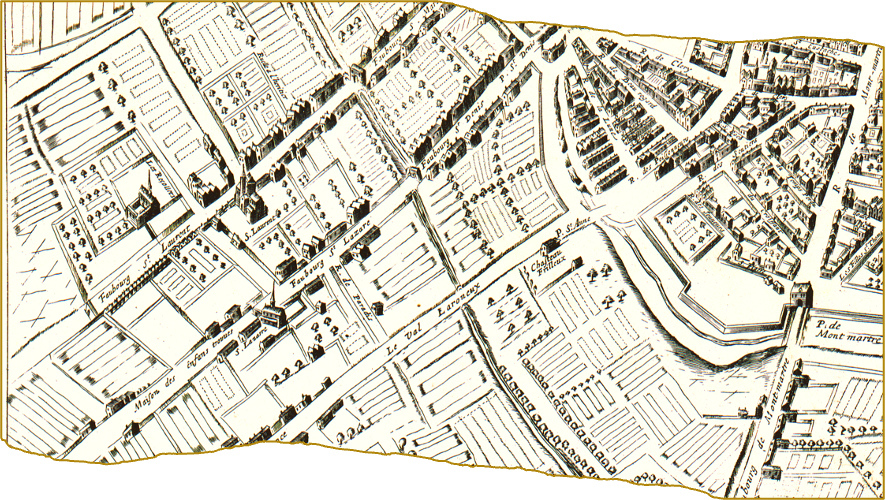
Madame d’Aiguillon journeys often to the faubourg Saint-Denis. There, she calls at Saint-Lazare, the house of Monsieur Vincent de Paul’s priests, where she receives reports of the mission she supports generously. She also visits the nearby foundling house of Les Enfants-Trouvés, which she and Mademoiselle Le Gras sustain with vigilant care.
There is another house at Saint-Denis, not far from Monsieur Vincent’s mission, newly established, where the duchess also visits, sometimes alone, sometimes with Layla, and sometimes in the company of one of her younger granddaughters. It is the house that Layla has bought where the orphans from Bicêtre have found a gentler, happier life under the care of Madeleine Martinez, now Madame Lesassier, for she has married Monsieur André Lesassier, the Jesuit-trained lawyer, whom Monsieur Diodati entrusted with overseeing the children’s removal from Bicêtre. Monsieur Lesassier is himself a widower, with two small children, the youngest still an infant, and Madeleine tends them with a mother’s devotion.
For both the duchess and Layla, a visit to the Lesassier house is a kind of pilgrimage, although different for each. Layla cares deeply for the orphans of Bicêtre, yet with Madame Madeleine she remains reserved. She is neither discourteous nor dismissive, but she keeps a measured distance from her father’s former lover, the mother of Gabriel Martinez, whose crimes have cost Layla grievously.
The Duchess d’Aiguillon understands her granddaughter’s chill restraint, just as she understands the secret wound her son carries. Lucien never speaks of his son, and Madeleine is silent too, but a mother knows what is left unsaid. The duchess prays that her son may find solace, and that her granddaughter may find forgiveness in her heart, just as she prays for the poor lost soul of her grandson. It is at Saint-Lazare, that she then finds consolation, in Monsieur Vincent’s counsel and wisdom, whether in confession or in their private conversations.
Long before dawn on the fourteenth of August, the Vigil of the Assumption, with Layla obliged to remain in Paris, the duchess sets out for Saint-Denis with Rosie. The child has been most eager to accompany her grandmother on this pilgrimage. Folded carefully in linen, Rosie carries a small veil of white silk for the image of the Blessed Virgin. She has worked it diligently, with blue and silver thread and a delicate hand, setting tiny lilies along the border and the name of MARIA at its center. It is an offering she has labored anxiously to finish in time, and one she is determined to deliver herself. Our Lady will wear Rosie’s veil upon the feast the next day, and prayers will be sung for the entire family. This will also be Rosie’s first presentation to Monsieur Vincent. Rosie is a gentle, quiet child, but as the carriage crosses the gate of Saint-Denis, she fidgets uneasily on her seat.
“It is a beautiful veil, my love. You must not worry,” her grandmother says, taking Rosie’s hand.
“Meeting Monsieur Vincent makes me nervous, Grand-mère,” Rosie admits. “He is a great man. Why, he is the most important man I have ever met. I am sure he will receive my little offering kindly, but…” She hesitates, as if the feeling resists explanation. “How am I to speak to him? What if I say the wrong thing in confession?”
“You cannot say the wrong thing in confession, my love,” her grandmother replies, gently. “It is your heart that speaks at confession, remember?”
“I know in my heart, but in my mind…” Rosie frets. “What if I forget my words altogether? What if once at the confessional I cannot speak at all?”
The duchess presses Rosie’s hand reassuringly. “In confession, my love, God opens our hearts to His mercy and compassion. Who better to guide you than Monsieur Vincent?”
Rosie nods with brave eagerness, although the lingering crease upon her fair brow and the chill of her hands tell the duchess that she remains afraid. It is understandable. Many people are awed by the thought of meeting Monsieur Vincent, only to find themselves humbled not by grandeur, but by his modesty and wisdom.
Grandmother and granddaughter arrive at Saint-Lazare in the cool of dawn, while the house is still ordered by silence and prayer. In the chapel, the priests are at their morning meditation. Marie and Rosie kneel quietly in the nave among a handful of penitents who have come early for confession and Mass on the Vigil of the Assumption.
“It is time,” the duchess murmurs after a while, inclining her head toward her granddaughter, and the two rise to meet the sacristan, who receives Rosie’s gift with a small bow and points to a side altar.
“Monsieur Vincent waits for you, Mademoiselle La Croix,” he says, indicating a little prie-dieu placed beside a screen, near enough for speech and in full view of the chapel. Rosie casts her grandmother a panicked look, for she had prepared herself for the stark severity of the confessional. Still, she follows the sacristan’s direction with visible trepidation. At once, the duchess perceives Monsieur Vincent’s great wisdom. He has anticipated the child’s fear, and knows how to disarm it.
“Madame la Duchesse,” the sacristan adds, “Monsieur Alméras will hear your confession today,” and the duchess, who knows her way about the chapel, turns toward the confessional. She knows Monsieur Alméras well too, for he is one of Monsieur Vincent’s most trusted priests. He must be a few years older than Athos, she reckons, and even though he looks nothing like her son, there is sometimes something in Monsieur Alméras’s disciplined, sober manner that reminds her of him. Monsieur Alméras is more inclined to listen than to console, but he is no less charitable for that.
She removes her gloves and kneels at the confessional, hands folded. On the other side of the carved lattice, Monsieur Alméras draws back the shutter with the dry hiss of wood.
“Bless me, Father, for I have sinned,” the duchess says.
“Oh, yes, you have, Marie. Indeed you have,” a voice sneers. Not the voice of Monsieur Alméras, but a voice the duchess recognizes even though she has not heard the man’s voice for decades.
Rochefort.

⚜️⚜️⚜️⚜️
Alessandra is not easily deceived. A conspiracy is brewing between Athos and Lucien, which Raoul knows about and it has nothing to do with household servants, gardens, or politics. She finds it vexing that, in the midst of everything, Athos should be distracted by it. Lucien too. Could it be Lucien’s idea, whatever this mischief is, she wonders?
A carriage, Alessandra suspects. One of those grand gilded carriages, too large for half the old streets of Paris, with the Richelieu coat of arms on the doors. She can almost see Lucien’s grin when it is delivered.“The Queen’s Dame d’honneur cannot go about Paris in a fiacre, Milady,” he will tease, while Athos will mock one of his aloof gazes. That is how these two are now, most of the time.
Alessandra sighs and clasps her hands behind her back as she walks to the window of her private salon. In truth, it is not the mischief between Athos and Lucien that vexes her. Nor is it the carriage. A grand carriage is necessary, after all. It is the position she has found herself that concerns her. She has never underestimated Queen Anne, although over the years she has sought, often at grave cost, to keep beyond the Queen’s reach. Queen Anne would catch up with me in the end, Alessandra admits to herself. She sighs again and turns to the Queen’s unsealed letter on her writing desk, where papers and ledgers still lie in ordered stacks, although, at last, the new steward, M. Vanier, and his wife have arrived, sparing Alessandra and Athos a considerable measure of household grief.
Dame d’honneur to the Queen Mother, Alessandra thinks.
Of course she has accepted the position. There has been an answer to her letter too, from the Louvre this time, and that also lies unsealed upon the desk. It includes a welcoming note from the Queen Mother’s valet de chambre, M. de La Porte, and a very long list of her duties: how often she may return home to visit her husband and see her children, every hour of her day arranged, how and where her own entourage is to be lodged, and what she is expected to bring with her: not merely a grand carriage, but a sedan chair, and horses trained for different outings.All this requires an entirely new household, Alessandra has realized, and the thought sinks heavily.
Even though her duties have not yet started, a day from now, on the Feast of the Assumption, she is expected at Val-de-Grâce for High Mass, seated not beside her husband and the rest of the Richelieu family, but with the Queen Mother, next to Constance d’ Artagnan, and, worse still, next to Chevreuse. It is of vital importance, M. de La Porte stresses in his instructions, that in this transition, which has already stirred gossip and reached the pamphleteers at the Pont-Neuf, all parties appear affable and in agreement. The thought of Chevreuse being forced to sit between herself and Constance d’ Artagnan, in full view of everyone, is Alessandra’s only consolation.
“Enter!” she replies to the knock on the door. She knows it is Mademoiselle Barbin, her new maid. The young woman has a particular way of knocking, different from any maid Alessandra has ever had: discreet, yet impossible to ignore.
“Madame, you have a visitor,” Mademoiselle Barbin announces.
“We expect no one at this hour,” Alessandra says. The time is unusual for an uninvited guest: too late for a morning call, too early for an afternoon one. Alessandra has no taste for visitors at this hour. Bianca’s music lesson ends soon, and Lèon will be waking from his nap. Alessandra is determined not to miss a single moment of her children’s lives. She has missed too much already, especially of Bianca’s, and this position at court, however indulgent the Queen Mother seems to be regarding Alessandra’s young children, will still draw her away from them.
“No, Madame, but the gentleman insists.”
“Gentleman? Does he not give a name?”
The maid shakes her head. “M. Robineau demanded it, Madame, but he refused and M. Vanier was then summoned. The gentleman—and he looks and sounds like a man accustomed to giving orders—insists that he is a childhood friend of Your Grace and of M. le Duc. He brings a gift for Your Grace, he says, which Your Grace will recognize.” She hands Alessandra a small jewelry box. It is made of an unusual reddish polished timber. Alessandra has seen such rare wood before, in Venice, among gifts her aunt received from the New World. In Venice, they call it by its Spanish name: caoba.
Aside from Moyse, all my childhood friends are family, and besides Lucien, no one I know has dealings with the New World, Alessandra thinks, already prepared to refuse the gift and order the man turned away. Then she notices the latch: small, delicate, carved in gold with a pearl at its center, shaped like a forget-me-not. She opens the box and is struck by the faint fragrance of lilac rising from the silk lining. Whoever has sent this knows her well. But when she unwraps what lies inside, she goes cold.
It has been a lifetime since she last saw this ring, its sapphire stone chipped, its back scratched to obscure its sordid history. She once thought it cursed. Athos too, for in the end, he sold it, or so he told her long ago.
“You never thought you would see it again! Admit it!”
He has pushed past the footman and steward, in vain blocking his way, and now he stands in the middle of her salon, grinning in triumph.
Rochefort.
⚜️⚜️⚜️⚜️
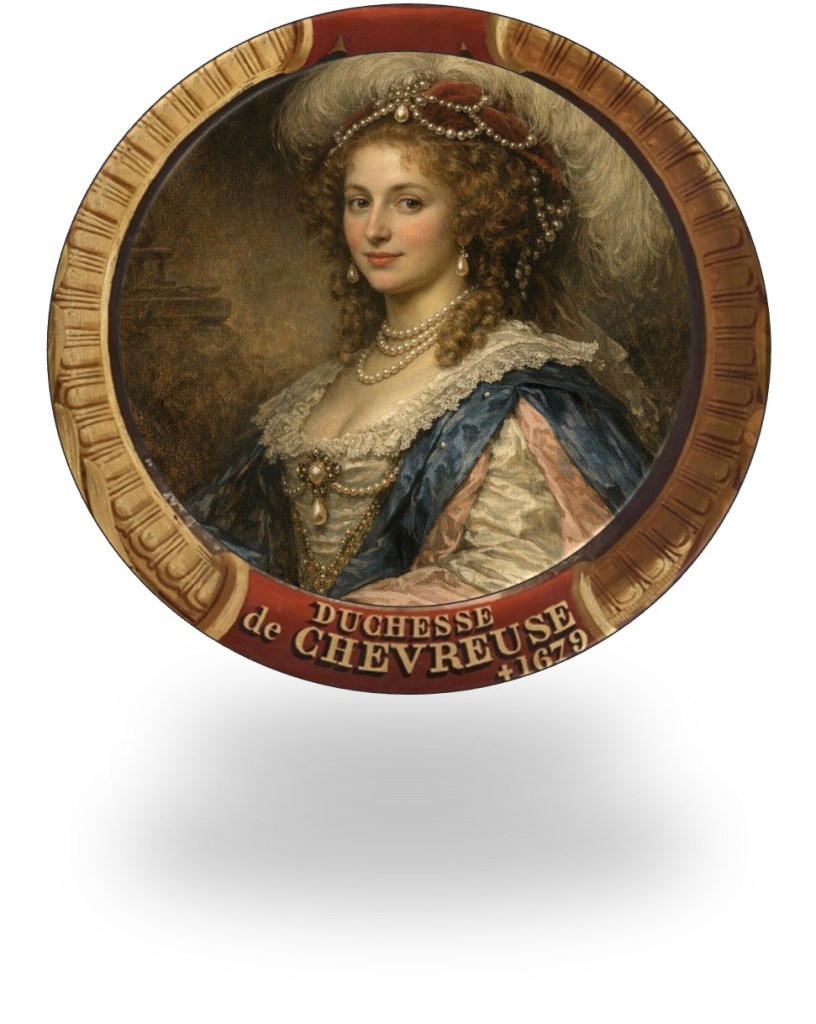
“I, a daughter of the House of Rohan, forced to stand in public view between a vulgar commoner and a murderous whore!” Chevreuse laments.
She sinks onto the edge of the bed, and Marchal sits beside her.
“Anne would never do this to me,” she says. “Not to me, her childhood friend.”
She looks at him with large, tearful eyes. She wants to be consoled. “Anne is easily swayed,” she continues, “and this is someone’s calculation.”
“It is not difficult to guess whose,” Marchal remarks pointedly. “He plays such games masterfully. Better than anyone at court. And lately, he has the King’s ear again. His friends too, Guiche and Fouquet. I say nothing of the Lieutenant of the Queen’s Guard, M. Rohan-Rochefort.”
“Of course!” Chevreuse gasps. “How did I not see it? The clever Spymaster protects them all: his murderous mother, his treasonous father, and his father’s equally treasonous friends. Even his vile uncle. The bastards of Richelieu!”
“I have a way to remove him for good,” Marchal says quietly. “And this shall not be redress. It shall be revenge.”
Chevreuse seizes his hand and kisses it with fervor.
At last, Marchal thinks. His first and most vital conquest is made.
⚜️⚜️⚜️⚜️
“Throw him out!” Alessandra commands.
“Is it the ring?” Rochefort sneers. “It must be. For it cannot possibly be the ring-bearer.”
The commotion which has already drawn M. Robineau and M. Vanier into the salon has brought M. d’Orbec too. The priest stands panting at the threshold after running up two flights of stairs from the library, where he had been working with M. La Quintinie.
Rochefort lifts both hands as if surrendering. “Messieurs,” he feigns a pleading tone, “is this how an old friend, bearing a gift, is received in the household of the Duc de Richelieu? With cruelty? Is this what the world should learn of this noble house?”
The footman and the steward wait for Alessandra to confirm her order, both looking bewildered. M. d’Orbec, having recovered his breath, steps firmly into the room. “Now, Monsieur,” he says sternly, “Madame and His Grace are anything but cruel. They are most generous. I daresay it is all a misunderstanding.”
This is what it means to live at the Place Royale, Alessandra reminds herself. This is what it means to be scrutinized. It means still more now, and the letters upon her desk from Queen Anne and M. de La Porte prove it.
She draws a steadying breath. “Not a misunderstanding,” she says. “But I shall receive the guest, despite the absence of an invitation or a letter of request.”
“I am most grateful, Madame!” Rochefort mocks an elaborate deep bow that deceives no one.
“Madame, perhaps I should remain,” M. d’Orbec suggests.
“Thank you,” Alessandra replies. “But Monsieur is indeed an old acquaintance. I would be remiss not to receive him as he deserves.” She signals to the footman, the steward, and her maid, and they withdraw, closing the door behind them. Still, at M. d’Orbec’s insistence, the footman, M. Robineau, declares before leaving: “M. Vanier and I shall be just outside the door, Madame.”
“How loyal they are,” Rochefort says with false admiration as soon as the door closes. He turns as if to survey the room. “You have made a small marvel here already.” Then, with mock concern, he adds: “And so soon after your terrible ordeal.”
“Do you expect to be thanked for your false courtesy?” Alessandra asks coldly.
“Oh, no. Not at all.” Rochefort throws himself into a chair and flashes a sneering grin. “I expect considerably more.”He crosses his legs with easy insolence. “What say you to the ring? Vile, is it not? What decent man gives his young wife, whom he professes to love, such a crude memento of his own debauchery? What did he tell the poor wench, I wonder? That it belonged to his mother? That it was a wedding gift from his father? Of course, she was not his mother, and he was not his father, and their story was as ignominious as the ring itself.” He tilts his head. “It was meant for him, you know; the ring. It is a man’s ring, after all. Anyone can see it. I am sure the wench saw it too. It comes from the days when we were both young and reckless. A wager became a quarrel, the quarrel became a brawl, and the brawl became a duel. I was a betting man then. He was my second. He was always my second. We won, of course. I took the money, and thought it only fair that he should have the sapphire, since it had been part of the wager. I have always been generous in that way.” He sighs theatrically.“It is a curse.” He shakes his head as if pitying himself, then fixes Alessandra with a cruelly amused stare. “Did he ever tell you what was inscribed on the back before he scraped it away and gave it to the foolish wench he married?”
The story of the ring, which she never cared about, disgusts Alessandra as much as the ring itself, but she is determined to show Rochefort nothing.
“No?” he presses. “Well, that would be typical of the man. But why linger over so sad a tale? After all, the man drank himself into oblivion, or was killed at a duel, or something of the sort. As for the wench, she murdered his younger brother, who was not truly his brother, and was as twisted as any bastard could be. Ah, you did not know he was a bastard? Well, yes. The mother had been careless at court, and the father was an old fool who could get no children of his own so he adopted the bastards no one wanted. If you ask me, the brother got what he deserved from the murderous wench, and not a moment too soon. The wench was executed, of course. Hanged from a tree, or something equally crude.”
“What do you want?”
Rochefort sits back and opens his arms wide. He grins. “Is it not obvious?”
“Not to me.”
He places both hands to his chest. “Your modesty touches me deeply, Madame. Here. In the heart.”
She raises a mocking brow and hopes he sees it.
“Ah, you think me heartless, dear Madame. But no. Not true at all. Indeed, I submit that it is you who have treated me cruelly, while I have come to place my poor heart in your hands.”
Despite herself, Alessandra gasps. “Your heart? In my hands?”
“Entirely, dear Madame. Entirely. And always devoted to your safety and happiness. For who has done more in that regard?”
“Do you expect me to be grateful?” Alessandra asks with scorn.
Rochefort looks appalled. “That would be vulgar.” He leans forward, smiling with cunning. “But I do expect my proposal to be considered, and accepted.”
“What proposal?”
“A marriage proposal, dear Madame. I have come to offer you my hand in marriage. For here you are, soon to be Her Majesty’s Dame d’honneur, and living with a man who is not your husband. It may be fashionably uncouth but eccentricities of this kind do not remain fashionable long.” Upstairs, in the music room, Bianca begins practicing her scales upon the harp. Rochefort clicks his tongue in feigned compassion. “Such a beautiful and gifted child, your daughter. Bianca is it not? And as talented in music as her namesake was in painting. If not for yourself and your good name, Madame, consider your precious children.”
“Get out,” Alessandra says. “Get out, or I shall have you thrown out.” Rochefort rises reluctantly, just as Alessandra thrusts the jewelry box with the sapphire ring back into his hands. “And take this abomination with you.”
Rochefort steps nearer. “This is no jest, Madame,” he hisses. “I advise you to consider it very carefully.”

⚜️⚜️⚜️⚜️
The arched gallery opens onto one of the Louvre’s inner courtyards. At this hour, early in the afternoon, the late-summer light begins to slant, imbuing the air with a golden hue. It is a pleasant afternoon, every now and then a cool breeze carrying the fragrance of jasmine and late summer roses. Five gentlemen walk briskly side by side, bantering as old friends or brothers do. They are both, in truth, although one of them was once believed to be a deadly enemy.
“But she expects me to send invitations!” Lucien bemoans his wife’s demanding list of household duties against that of Athos’s, which seems to have eased since the hiring of a steward and housekeeper. “Explain to me why I must waste valuable time. Are you not all here? Can I not simply say, Messieurs, the dinner to welcome Yusuf’s sons is on such-and-such a day, at such-and-such an hour?”
“Women see these matters differently,” Porthos says philosophically.
“Can you not merely say you sent them?” d’Artagnan suggests. “None of us will contradict you. How would she know?”
Lucien lets out a loud chuckle. “Oh, she would know. And I would rather do as she demands than be obliged to explain myself afterward.”
Athos drapes an arm around Lucien’s shoulder. “Brother, I believe you have answered your own question.”
Lucien sighs. “I still say it is valuable time wasted.”
“Speaking of dinners,” Aramis says quietly, “I dined with Philippe twice this week.”
The gentlemen stop at once, surrounding Aramis with words of encouragement. He receives them with a graceful smile. “Finally,” he says, “something good has come of all this grief.”
“Messieurs!”
They turn toward the affable voice behind them.
“M. de Rohan!”
The young lieutenant hurries to join them. “M. Morant told me he saw you arrive, and I thought to catch you before council.”
“We were early,” d’Artagnan says. “The council with M. Le Tellier is in half an hour.”
“We did not expect to see you so soon,” Aramis says. “Her Majesty Queen Anne has returned to Paris and was at Sexte at Notre-Dame, I understand.”
“Indeed,” M. de Rohan replies. “She has returned to the Louvre now and will attend Vespers here in the chapel.”
The group resumes their leisurely walk along the gallery.
“And she attends High Mass at Val-de-Grâce tomorrow,” Athos remarks.
“As we all must,” Lucien adds.
“His Majesty and the whole court arrive as well,” Porthos says. “I imagine that is one matter Le Tellier will raise in council.”
“But Her Majesty Marie-Thérèse,” Lucien observes, “she cannot be traveling in her condition.”
“I have received no such orders and think it unlikely,” M. de Rohan replies. “But I suppose we shall hear from M. Le Tellier if…” He stops.
From the far end of the gallery, a man is walking briskly toward them. Even at a distance, they all recognize him, even though some have not seen him for decades. M. de Rohan, the only one openly armed, closes his fist around the hilt of his sword. Lucien’s hand tightens around the pommel of his hidden dagger.
“Is this not a most fortunate encounter?” Rochefort says, smiling. “We seem to be going the same way.” His gaze passes over them, bright with malice. “Come, Messieurs. Let us walk together.” He smiles wider.
“We are family, after all.”